5 Sources
[1]
As AI content floods the internet, Pangram raises $9M to detect it
New York-based AI detection startup Pangram is on a mission to combat the AI slop infestation spreading across the internet, and it just raised $9 million on a bet that demand for tools that distinguish human-generated content from AI-generated text will only grow. Pangram's fundraise -- led by Menlo Ventures, with participation from Haystack, ScOp, Script Capital, and Cadenza -- comes as the startup also launches its next-generation AI text detection model, Pangram 4, and an AI image detection model, Pangram Image. Pangram says the new text detection model is over 99% accurate at finding AI-assisted writing and mixed human-AI content, plus it can more easily detect AI humanizer programs. The AI image detector is only available via research preview for now; Pangram plans to release it more widely in the coming weeks. Stanford AI and machine learning grads Max Spero and Bradley Emi launched Pangram about two years ago, after the launch of ChatGPT opened the floodgates for an internet full of bots, AI-generated SEO slop content, and what Spero calls "LLM-powered Russian disinformation campaigns and UAE-influenced campaigns on Twitter." "I think it's just incredibly valuable to know whether what you're looking at is something that's AI-generated or not," Spero told TechCrunch. "Especially text that you're reading, because it changes how people approach the text. Is this something that I'm going to have to look out for hallucinations and jump in skeptically, or is this something that I trust was well-researched from an actual journalist?" Pangram's AI detection system is essentially a large machine learning model that was trained on tens of millions of known human documents. The startup then created a "synthetic mirror" for each document, replicating the topic, length, and tone of voice, but written by a frontier LLM. "Our model is learning the stylistic differences and the choices that AI makes consistently and is able to use that to learn what makes something AI-generated with high confidence," Spero said, adding that the AI detector isn't relying on copy-paste metadata or hidden watermarks. For Pangram, AI detection isn't just about whether or not a piece of text was written entirely by AI. It's also about distinguishing between levels of AI assistance -- like in the case of someone who writes something themselves, but then asks AI to edit or clean it up. Spero believes AI assistance can be acceptable, just so long as the writer discloses their use of AI. Pangram's emergence comes at a time when AI usage is becoming more commonplace. In some cases, like the Canadian politician who read an AI prompt aloud in a speech to lawmakers, the mistakes result in ridicule. In other cases, as with certain lawyers making their case using fake citations created by ChatGPT, the consequences could be sanctions and fines. That backlash isn't just costing individuals embarrassment or sanctions -- it's starting to show up in institutional rules, too. The open-access archive arXiv introduced a new enforcement policy this year, stating that submissions containing evidence that authors failed to review LLM output (like hallucinated references or meta comments such as, "Would you like me to make any changes?") can trigger a one-year submission ban. Pangram isn't the only one betting that AI detection will become more sought after. Competitors like Winston AI, Originality.ai, Copyleaks, and GPTZero are are chasing the same demand, each building its own detector. Pangram's technology, while not perfect, could help fuel the resistance to accepting the AI-generated content flooding the internet, the courtroom, and academic papers. Users can access Pangram via a $20-per-month subscription on the web or download the Chrome extension, which automatically labels posts in real time on X, LinkedIn, Substack, Reddit, and Medium. It also provides a feed health score with a percentage breakdown of human versus AI content on your screen. Pangram also offers its technology via API. Notably, Substack recently integrated Pangram's technology into its platform to show readers which of their favorite authors write their newsletters using AI. Other API customers include Quora, schools and universities, publishers and agents, and recruiters, among others, per Spero. Does Pangram work? Spero said roughly one in 10,000 human documents are incorrectly labeled as AI with Pangram's model, so I decided to put it to the test. The text detection model was very impressive but not perfect. It easily flagged entirely AI-generated news articles written by both ChatGPT and Claude, and was rarely fooled by my attempts to edit the AI-generated text into sounding more human. At the same time, Pangram did flag sentences that I completely rewrote as being AI-written. Pangram also wasn't at all fooled by my attempts to prompt ChatGPT and Claude into evading AI detectors when generating content. I also gave ChatGPT and Claude one of my own articles and asked them to polish it up. Pangram gave it a 13% AI assisted score, which was probably close to accurate, but the model was able to detect subtle word-choice changes in some sentences and ignored them in others. It also flagged some sentences as AI-assisted when they were human written. That was notable because when I gave Pangram that same article in its entirety, as I had written it, it got a 100% human score. Maybe the problem was that news articles can be a bit dry and could easily sound like AI. So I tried a different tactic. I tested Pangram on my own more voicey, personal Substack newsletter content, pasting the first half of the text into Pangram and then asking ChatGPT and Claude to copy my style and write the second half. For the most part, Pangram easily detected human-written text versus AI-written text. My limited testing of Pangram's new image detection model turned out to be equally impressive. Pangram's AI image detection system promises to spot AI-generated images across AI models, unlike OpenAI's or Google DeepMind's watermark-based checks, which mostly detect their own output. It works on pixel-level distributions, learning subtle statistical differences between real photos and AI-generated images. Spero says the model can even detect an AI image that appears inside a real-world photo. In my testing, the model easily detected AI-generated imagery, whether it was photorealistic or cartoonish. I can also confirm the model could detect an AI image appearing in a real-world photo -- the heat map Pangram provides clearly lighting up over the image -- though in one instance it incorrectly labeled a photo of an AI-generated image as human content. Spero says he doesn't want his technology to fuel a witch hunt against people using AI for writing, but that there needs to be some sort of mechanism to push back against the slop. "The future that I see is that AI content just continues to proliferate," Spero said. "We're getting new GPUs faster than new people are being born. If we do not actively discriminate in favor of human content, then we're just gonna see more and more AI, and it's just gonna drown out any human signal that we have."
[2]
Sick of A.I.-Generated Content? The 'Slop Janitor' Is Here to Help.
Pangram, an A.I. detection start-up, promises near-perfect accuracy in sniffing out writing and imagery that wasn't made by humans. It's raising some big questions along the way. Max Spero calls himself the internet's slop janitor. He is the chief executive of Pangram, an artificial intelligence detection company that has become a leading tool for deciphering whether an article, a social media post or another piece of text was written by a human or a chatbot. In other words, is it A.I. slop or not? As generative A.I. continues to permeate more and more forms of communication, New York-based Pangram is one of a new group of start-ups vying to be the best at distinguishing A.I. from human-generated content. The company says its A.I. text-detection model can accurately identify 9,999 out of 10,000 times whether text was A.I.-generated. And it has recently signed up some high-profile online publishers as customers. A.I. writing and A.I.-detection tools raise a host of big, thorny questions: How should society treat A.I.-generated text? And how should A.I.-detection tools like Pangram be used given that they can -- even if rarely -- be wrong? Today, Pangram is announcing a $9 million fund-raising round led by Menlo Ventures with participation from ScOp Venture Capital, Haystack Ventures and others. The fast-growing company is also announcing the release of its latest A.I. detection model -- Pangram 4.0 -- and its first-ever A.I.-image detection model. Mr. Spero and his co-founder, Bradley Emi, both 30, met as undergraduates at Stanford, studying in the university's artificial intelligence lab and playing poker late into the night. Upon graduation, they followed well-trodden paths for Stanford computer science engineers: Mr. Spero went to Google and Mr. Emi to Tesla, where he worked under Andrej Karpathy, the prominent A.I. researcher and OpenAI co-founder. After the release of ChatGPT in 2022, the two friends felt called to build something "for the world that this technology will bring forth," Mr. Spero said. An inevitable feature of the A.I. future, they felt, would be scores of A.I.-generated content flooding the internet and other channels of communication.
[3]
Pangram Launches New World's Best AI Detector, Expands to Images Backed by $9M From Menlo Ventures
Pangram 4's text model is highly accurate on hard cases, including short passages and AI-assisted writing; image detection enters research preview. NEW YORK--(BUSINESS WIRE)--July 29, 2026-- Pangram, the AI research lab known for its industry-leading 1 in 10,000 false positive rate, is announcing two new products. Pangram 4, its latest text detection model, offers major improvements in distinguishing AI-assisted writing and mixed human-AI content, plus greater robustness against AI humanizer programs. The company also released a research preview of an AI image detection model which is 99.5% accurate in internal benchmarks. Pangram 4 is available to all customers today, and Pangram AI Image Detector Research Preview is open to the public. This press release features multimedia. View the full release here: https://www.businesswire.com/news/home/20260729222515/en/ The launches follow a $9M funding round led by Menlo Ventures, with participation from Haystack, ScOp Venture Capital, Script Capital, and Cadenza. Pangram is using this capital to push forward on two fronts: improving the accuracy of its core text detection, as well as expanding into new modalities, starting with images. "Fully AI-generated content is everywhere now, and much of it is undisclosed," said Max Spero, cofounder and CEO of Pangram. "Pangram exists to make authorship legible for publishers, teachers, journalists, and anyone who relies on the truthful and authentic communication of information." Yet, as familiarity with AI writing has grown, so has the demand for products that obfuscate the true origin of AI-generated writing. Pangram 4 is trained to counter these kinds of "humanizer" tools, accurately identifying AI-written text even after it has been passed through a tool that paraphrases, rewords, or otherwise modifies it in order to evade detection. The new model also delivers major accuracy gains on mixed human-AI writing, while still maintaining a 0.01% false positive rate. Menlo Ventures partner Deedy Das frames the problem in terms of trust. "With LLMs, the cost of producing language collapses to zero, and the cost of trusting language goes to infinity," he said. "Pangram has emerged a clear #1 in quality and is trusted across Substack, Quora, and other platforms to power detection across their website." Currently in research preview, Pangram's AI Image Detector represents a new frontier for the company. "AI image detection is challenging because real and AI content is often blended, like in a photo of an AI-generated ad on a billboard," said Bradley Emi, cofounder and CTO of Pangram. "That's why we tried to cast as wide a net as possible: whether you're browsing social media or assessing photographic evidence in a courtroom, everyone deserves to know what's real." Pangram 4 is live today for all customers, and the research preview for Pangram's AI Image Detector is open to the public for testing and feedback. As generative AI continues to proliferate across every format, Pangram plans to bring the same standard of reliability to detecting all modalities of AI-generated content. To try Pangram 4 or Pangram AI Image Detector Preview, visit www.pangram.com. About Pangram Pangram Labs is the technology leader in AI detection systems, surpassing other detection providers in accuracy and reliability. Pangram's detection systems are used today by thousands of businesses. Founded by classmates at Stanford University, Pangram has been adopted by academic institutions, content moderators, journalists, media, and consumers concerned with transparency. View source version on businesswire.com: https://www.businesswire.com/news/home/20260729222515/en/
[4]
Pangram Labs raises $9M to launch more accurate AI detection for text and images
Pangram Labs Inc., an artificial intelligence research lab that develops AI detection software, today announced it raised $9 million, led by Menlo Ventures, to improve the accuracy of its core text detection and expand into other media, starting with images. Haystack, ScOp Venture Capital, Script Capital and Cadenza also participated in the investment round. The funding brings the total raised by the company to almost $13 million after raising $2.7 million in June 2025. Pangram is best known for its AI detection platform that the company claims is capable of industry-leading 1 in 10,000 false positives. "Fully AI-generated content is everywhere now, and much of it is undisclosed," said cofounder and chief executive Max Spero. "Pangram exists to make authorship legible for publishers, teachers, journalists and anyone who relies on the truthful and authentic communication of information." The company uses what it calls a "classifier model," a type of neural network that can estimate whether a portion of text is AI-generated or human-written. According to Pangram's page on how the product works, says that the system functions by attempting to determine what a passage "sounds like" an LLM or a human. Training the classifier involved pulling known-human text drawn from before 2021 and pairing it with AI-generated text so that the classifier could readily distinguish the two. The company acknowledged that this works well now, but language style and use drift over time, and the training model will have to adjust with it. The company also announced Pangram 4, the company's most powerful AI detector to date, and introduced Pangram Image detection in research preview. The company said in internal benchmarks, Pangram 4 has a false positive rate of 0.0041%, or around once for every 24,000 documents. The company added that the new model also greatly reduces false negatives, when it fails to detect AI, and it is robust against humanizers, which attempt to make AI text look human-written. The company's Image model for detecting AI-generated images can catch images created by image providers including OpenAI Group PBC's GPT Image, Google LLC's Gemini Nano Banana, Midjourney Inc., FLUX, and Grok Imagine, and some AI video providers, including Kling AI Pte. Ltd., Seedance, Google's Veo and Wan. The company said that a new breed of AI image detectors is needed because deepfakes and AI-generated images passed as truth are becoming more prevalent. Although other companies have begun to embed invisible watermarks and other markers in their content, for example, Google's SynthID, these only work on frontier models that embed them. Even as AI images proliferate, humans are getting worse at detecting them. According to a report from Let's Enhance, a blog focused on AI creative tools, overall detection rates hover around 63.7%, but for high-capability image generators such as FLUX, rates drop to near 29%. Research showed that distinguishing AI from natural is falling to close to 50% on average, essentially a coin toss. AI detectors and the reliability gap Pangram's detection accuracy and false positive rate claims come from what appears to be primarily internal benchmarks, a technical white paper and a small number of favorable third-party studies. The company wants to set itself apart from other AI detectors because accuracy is meaningful. A key point to examine for AI detectors is that they are by and large unreliable. MIT Sloan Teaching and Learning Technologies pointed out that the technology is "far from foolproof" and often features high error rates that can lead to false accusations. The Mozilla Foundation found that detector tools are not as reliable as they claim and that AI detectors can be biased against non-native English speakers. Reliability itself is highly context-dependent, with false positives being the main concern. While some newer AI detection vendors, including Pangram, claim major improvements, the broader literature on the subject still builds on a foundation that AI detection is a probabilistic signal rather than reliable for actual writing. The result is that numerous educational facilities have either discontinued or banned the use of AI detectors or provided guidance to professors and teachers that it should be used as a data point and not a verdict. The University of Waterloo discontinued using Turnitin LLC, one of the leading detectors, in September; MIT's position is that AI detectors just don't work -- educators and professional work should be built on adaptive policies and expectations instead.
[5]
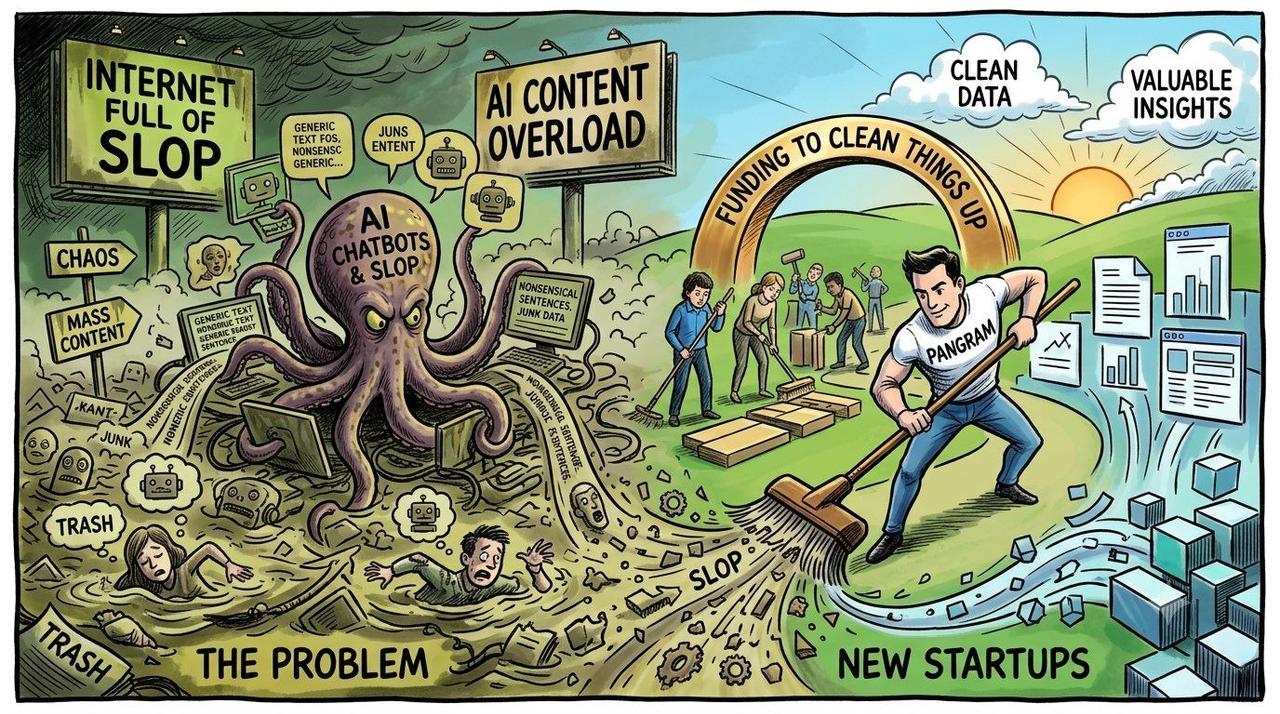
First Fund a Business to Create AI Slop, Then Fund Pangram to Clean It Up
The tool works on top of an LLM that is trained to learn the patterns of how AI chatbots rewrite or create content and then used to discover slop This should was ideally one for our weekly column "Funny Side Up". How else can we describe what we've seen over three years. First an industry creates rubbish as if it's very life depended on it (which it did) and then funds a new startup to clean it all up. That's precisely what NY-based startup Pangram plans to do with its latest $9 million fundraise. And, the one assumption the founders and investors are making is that AI generated slop will only grow in the years ahead, thus generating demand for tools that could distinguish machine-generated rubbish from human-generated content. Led by Menlo Ventures, with Haystack, ScOp, Script Capital and Cadenza joining in, the slop clearing is on with a vengeance. Pangram also launched its AI text detection model - Pangram 4 - and an AI image detection model called Pangram Image. Looks like the founders don't believe in christening a set of tools with something more creative. Not surprising, given that these tools are expected to sweep the Internet clean off AI slop. Of course, this isn't the first company (and probably won't be the last) to announce a "Swachh Internet" mission, but Pangram seems confident that their solutions are 99% accurate in finding AI authorship as well as mixed human AI content. You can try out Pangram for free! The only thing that can compete with the pace at which AI slop has grown is the spread of AI bots that now accounts for over half of the traffic on the Internet. The AI bot menace involves automated systems surpassing human web traffic, coordinating malicious disinformation swarms, and executing advanced cyberattacks. It is high time, someone cleaned it all up! The brains behind Pangram are machine learning grads from Stanford Max Spero and Brad Emi who came up with the idea two years ago, around the time ChatGPT arrived and delivered content for the AI bots to consume. In some ways, the operation aimed at removing humans from the Internet. Spero told TechCrunch that one cannot underscore the value to ascertain whether one is looking at something that's slop or not. This holds good for text because it changes how people would approach it. If a reader knows she's engaging with AI-generated content, it makes it easier to prepare for AI hallucinations. Of course, there's the caveat that one must deliver upfront. Pangram too is based on an LLM trained on millions of known human documents. There is a "synthetic mirror" for each document that replicates the topic, length, and tone of voice, but is written by the chatbot. So, the Pangram model learns the styles and choices that AI makes consistently and then uses this learning to catch something that's AI generated with a higher level of confidence. Spero says their AI detector has no need to reply on copy-paste metadata or hidden watermarks. And the key to achieving success on this front is that Pangram does not see AI detection as a binary outcome. It seeks to analyse the levels of AI usage such as when one writes something and seeks AI help to cross the Ts and dot the Is. The founders believe such assistance should be acceptable, but the author must disclose it upfront. Given that the situation has gone from bad to worse, we believe Pangram has work to do and so do possibly a few others who can follow their lead. Over the past six months several experts had targeted AI slop with some noting how it was hampering children and research suggesting that enterprise AI growth was stymied by AI content "lacking substance". However, the story that got us worried came from Barron's about how AI was changing the manner in which company boards and executives were talking to their shareholders. "There's a familiar ring these days across company conference calls, shareholder letters, news releases, and other corporate communications," the article, published in April 2026, said. As we said earlier, Pangram isn't the only one stepping into the slop with brooms in hand. Companies like Copy Leaks, Originality.AI, GPTZero and Winston.AI have been at it for some time and each is trying its own way to counter the rubbish that AI has generated with gusto over the past two to three years. While one may look askance at the technology that each of these companies use and wonder how the AI giants and its users may find workarounds, the fact remains that Pangram and their ilk would definitely grow the resistance to accepting AI-generated content on the Internet. Of course, there's a cost as does every clean-up known to humankind. Fork out $20 per month to get Pangram on the web or via a Chrome extension and have it label posts in real time across several social sharing platforms like Reddit, Medium, Substack, LinkedIn etc. In case publishers are interested, Pangram can also be used via an API as Substack recently did. Of course, where that leaves popular authors on the platform when some of their content gets flagged as AI generated, is anybody's guess. Spero says other publishers like Quora have also become corporate subscribers. Maybe, we need more of them to join the battle against AI slop that is rendering the Internet into a garbage can.
Share
Copy Link
New York-based AI detection startup Pangram secured $9 million in funding led by Menlo Ventures as it launches Pangram 4, claiming 99% accuracy in detecting AI-generated content. The company also unveiled an AI image detection model to address the growing challenge of AI slop flooding the internet.
New York-based AI detection startup Pangram raised $9 million in a funding round led by Menlo Ventures, with participation from Haystack, ScOp Venture Capital, Script Capital, and Cadenza
1
. The investment brings the company's total funding to nearly $13 million after raising $2.7 million in June 20254
. Founded by Stanford AI graduates Max Spero and Bradley Emi approximately two years ago, Pangram emerged after ChatGPT's launch opened the floodgates for AI-generated content across the internet1
.
Source: TechCrunch
Coinciding with the fundraise, Pangram launched its next-generation AI text detection model, Pangram 4, which the company claims achieves over 99% accuracy at identifying AI-assisted writing and mixed human-AI content
1
. The new model demonstrates major improvements in detecting AI-assisted writing and shows greater robustness against AI humanizer programs that attempt to disguise machine-generated text as human writing3
. According to internal benchmarks, Pangram 4 maintains an industry-leading false positive rate of 0.0041%, or approximately once for every 24,000 documents4
. Spero, who calls himself the internet's "slop janitor," told The New York Times that the company's AI text-detection model can accurately identify 9,999 out of 10,000 times whether text was AI-generated2
.Pangram's AI detection system functions as a large machine learning model trained on tens of millions of known human documents
1
. The company created synthetic mirrors for each document, replicating the topic, length, and tone of voice but written by frontier LLMs1
. This classifier model learns the stylistic differences and choices that AI makes consistently, enabling it to identify AI-generated content with high confidence without relying on copy-paste metadata or hidden watermarks5
. Menlo Ventures partner Deedy Das explained the problem: "With LLMs, the cost of producing language collapses to zero, and the cost of trusting language goes to infinity"3
.

Source: SiliconANGLE
Pangram also unveiled an AI image detection model, currently available via research preview, which the company plans to release more widely in coming weeks
1
. The AI image detection model achieves 99.5% accuracy in internal benchmarks and can identify images created by major generative AI platforms including OpenAI's GPT Image, Google's Gemini Nano Banana, Midjourney, FLUX, and Grok Imagine4
. Bradley Emi, Pangram's CTO, noted that AI image detection presents unique challenges because real and AI content is often blended, such as in photos of AI-generated ads on billboards3
.The funding comes as AI content floods the internet, with consequences ranging from embarrassment to serious legal sanctions. A Canadian politician recently read an AI prompt aloud during a speech to lawmakers, while lawyers have faced sanctions and fines for using fake citations created by ChatGPT
1
. Institutional pushback is mounting: the open-access archive arXiv introduced a new enforcement policy this year stating that submissions containing evidence of unreviewed LLM output can trigger a one-year submission ban1
. Research from Let's Enhance shows that human detection rates for AI images hover around 63.7%, dropping to near 29% for high-capability generators like FLUX4
.
Source: CXOToday
Related Stories
Users can access Pangram via a $20-per-month subscription on the web or through a Chrome extension that automatically labels posts in real time on platforms including X, LinkedIn, Substack, Reddit, and Medium
1
. The extension provides a feed health score with a percentage breakdown of human versus AI content on screen1
. Pangram also offers its technology via API, with Substack recently integrating Pangram's technology to show readers which authors write newsletters using AI1
. Other API customers include Quora, schools and universities, publishers, agents, and recruiters1
.Pangram faces competition from other AI detection tools including Winston AI, Originality.ai, Copyleaks, and GPTZero, each building its own detector to address growing demand
1
. However, broader concerns about AI detector reliability persist. MIT Sloan Teaching and Learning Technologies points out that the technology remains "far from foolproof" with high error rates that can lead to false accusations4
. The Mozilla Foundation found that detector tools can be biased against non-native English speakers4
. Despite these industry-wide challenges, Pangram positions itself as having emerged as "a clear #1 in quality" and is trusted across Substack, Quora, and other platforms, according to Menlo Ventures3
.Summarized by
Navi
[3]
25 Jun 2025•Startups

21 Jul 2026•Technology

10 Apr 2026•Entertainment and Society