People confess their AI secrets in a purple box in a San Francisco park


2 Sources
[1]
Is it OK to have AI text your boyfriend? When using a chatbot for personal messages crosses a line
A purple box set up on a folding table in San Francisco's Alamo Square could have been mistaken for a tissue box. Instead, it held dozens of secrets. Oliva Tai was nearby, watching as passersby puzzled over a sign that read, "Confession box: Everyone has an AI secret." Among confessions about
[2]
Is It OK to Have AI Text Your Boyfriend? When Using a Chatbot for Personal Messages Crosses a Line
As more people turn to chatbots to write emails or handle mundane tasks, it raises the question: Does using them for personal messages cross a line A purple box set up on a folding table in San Francisco's Alamo Square could have been mistaken for a tissue box. Instead, it held dozens of
Share
Copy Link
An artist's confession box in San Francisco collects anonymous admissions of AI use in personal messages. Research says the guilt crosses experience levels.
On a folding table in Alamo Square, San Francisco, sits a purple box labeled "Confession box: Everyone has an AI secret." Artist Oliva Tai set it up to collect anonymous written admissions about how people use AI, and what comes back is personal: a breakup text written by AI, a girlfriend's grandmother's 80th birthday letter, one confession reading "I had ChatGPT date my boyfriend. Every text."
2
1
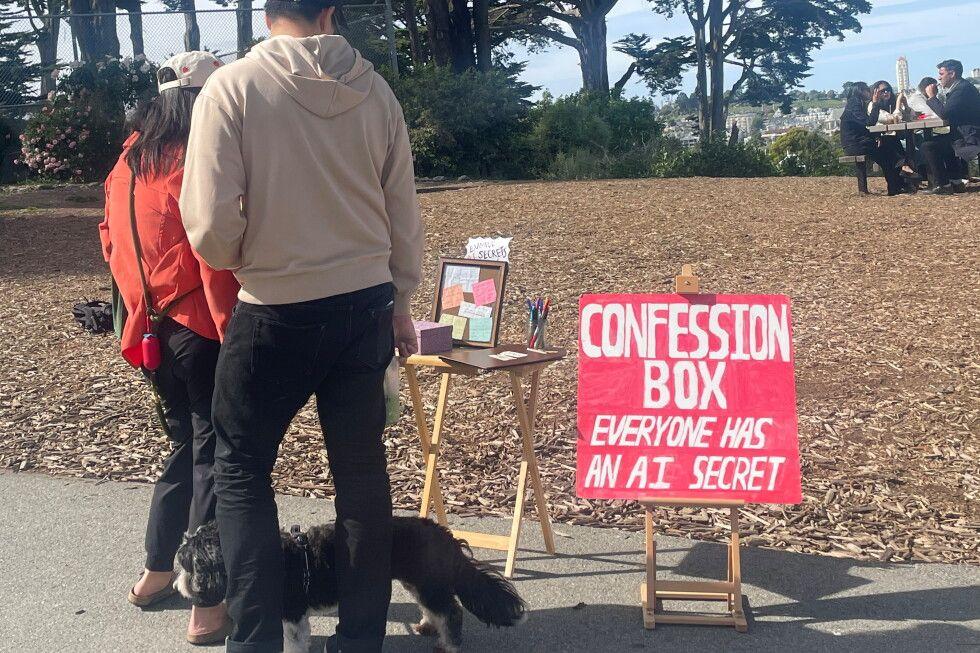
Source: AP
Tai has staged the project more than a dozen times across the Bay Area, New York and Denver. That is why she framed the box as confession: people admitted feeling somewhat guilty about using AI, she said, yet used it anyway.
2
1
The guilt is not a beginner's problem
Danielle Hass, a professor at Kennesaw State University in Georgia, studied exactly this for her Ph.D. in consumer behavior, using short scenarios that asked people to react to AI-written messages. In her vignette experiments, prior users of AI felt just as guilty about AI-written personal messages as those who had not. "Everyone felt guilty," she said. Hass traced the feeling to dishonesty: "The driver of this relationship was dishonesty, that people felt like they were manipulating."
2
1
The judgment lands even when you come clean. Scott Claessens, a senior researcher at Britain's University of Bristol, has looked at how AI users are judged. His research suggests people who use AI are seen as lazier, less competent and less trustworthy, even when they are honest about it.
2
1
Why AI feels different from a store-bought card
He said something about AI's effortlessness is what puts people off. "What we really want in our social relationships is for people to put effort in, because it shows that as a signal that you're invested in the relationship," he said.
2
1
Sarah Newman, who directs art and education at Harvard's metaLAB and collaborated with Tai on the project, predicts norms about appropriate use will likely emerge as AI adoption speeds up. Her test in the meantime: if you would not be comfortable telling your partner you used AI to write your wedding vows, don't do it. "Personal messages don't need to be perfect. Part of what makes these messages authentic and endearing is that they are imperfect," she said.
2
1
Tai and Claessens both said some situations could warrant AI, such as couples who don't share a native language or people with dyslexia.
2
1
Hass said she is glad the guilt shows up where it does. People accept AI's efficiency at work without a second thought, she said, but personal life is where "you're supposed to be human." "Guilt's purpose in this context is to show us our interpersonal wrongdoings," Hass said.
2
1
Related Stories

References
Summarized by

Navi
[1]
Related Stories
AI Companionship Raises Questions About Emotional Dependency and Corporate Responsibility
21 Jul 2026•Entertainment and Society
AI Companionship Is Making People Lonelier, New Research Reveals
29 Sept 2026•Entertainment and Society
Millions Form Emotional Bonds With AI Chatbots as Human-AI Relationships Reshape Intimacy
30 Dec 2025•Entertainment and Society

Recent Highlights


Recent Highlights
Today's Top Stories








Don’t drown in AI news. We cut through the noise - filtering, ranking and summarizing the most important AI news, breakthroughs and research daily. Follow topics that matter to you and stay ahead.


