PewDiePie Launches AJAX AI After OpenAI Bans Him Twice Over Knowledge Distillation


2 Sources
[1]
PewDiePie launches AJAX AI model after an alleged ban by OpenAI
YouTube creator Felix Kjellberg, better known as PewDiePie, has unveiled Ajax, a small language model designed to run locally as an always-on AI assistant. The announcement comes with an unusual backstory. Felix, who was the most-subscribed YouTuber for many years, says OpenAI suspended his account
[2]
OpenAI Banned PewDiePie Twice While He Built Ajax, an Uncensored AI That Will Run on Your PC
Ajax is reportedly a 9-billion-parameter model built on Alibaba's Qwen 3.5. A countdown on its download page ends at 08:25 Japan time on October 3. YouTuber PewDiePie says OpenAI banned his account twice while he built Ajax, a small AI model meant to run on your own computer and browse the web for
Share
Copy Link
YouTube creator PewDiePie unveiled AJAX, a small language model designed to run locally as an always-on AI assistant. The announcement came after OpenAI suspended his account twice during development, citing distillation violations. Built on Alibaba's Qwen 3.5, AJAX aims to handle everyday tasks privately on user hardware without cloud dependency.
PewDiePie Unveils AJAX AI After Double OpenAI Ban
YouTube creator Felix Kjellberg, better known as PewDiePie, has launched AJAX AI, a small language model designed to run locally on PC as an always-on assistant. The announcement carries an unusual backstory: OpenAI banned PewDiePie twice during development, with one suspension email explicitly citing "distillation" as the reason for deactivation
1
. The project represents a shift toward user-controlled AI that operates without sending data to cloud-based AI providers.
Source: Decrypt
AJAX Built on Alibaba's Qwen as Alternative to Cloud-Based AI
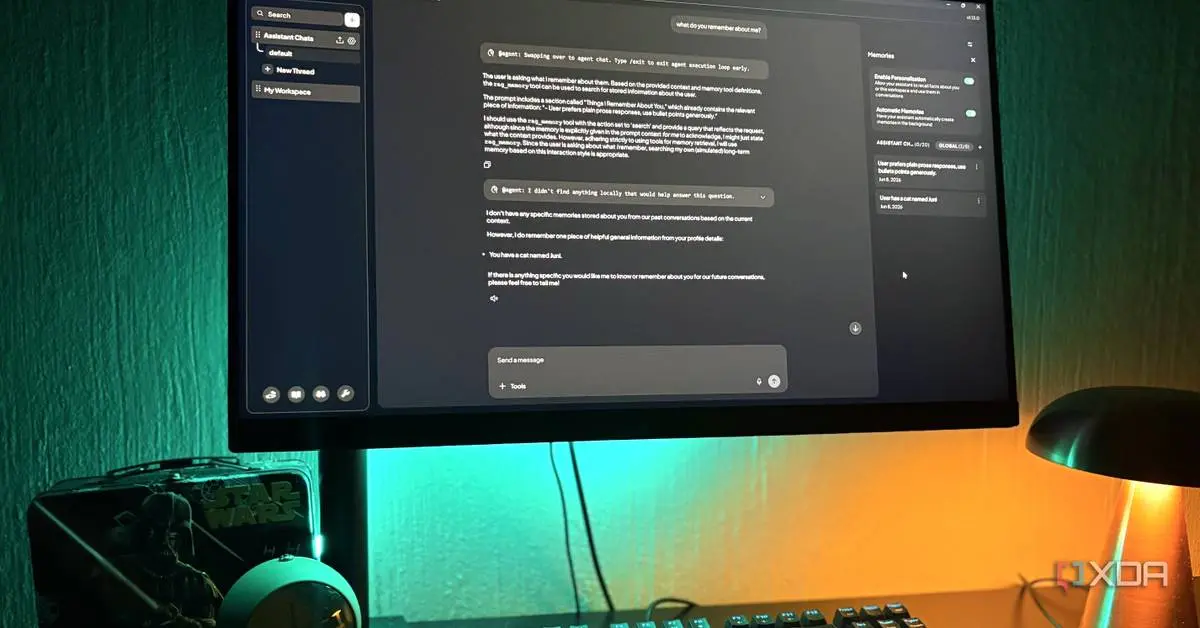
AJAX is a 9-billion-parameter model built on Alibaba's Qwen 3.5, designed specifically for Odysseus AI workspace, Kjellberg's self-hosted platform launched in June. The small language model aims to handle web searches, browsing, email management, calendars, and other daily activities while keeping processing private on user hardware
1
. This approach contrasts sharply with increasingly large frontier models powering commercial services. By Kjellberg's calculations, one copy of a rumored trillion-parameter frontier model would require approximately 27 computers and electricity equivalent to roughly 150 houses2
.OpenAI Banned PewDiePie Over Knowledge Distillation Violations
Kjellberg revealed he wanted to use knowledge distillation to train AJAX, specifically attempting to extract reasoning tokens from GPT-5.6 Sol, OpenAI's flagship model released on July 9. Knowledge distillation involves using outputs from a larger "teacher" model to train smaller models to reproduce capabilities. While OpenAI describes distillation as a legitimate technical method, its Terms of Use prohibit using output to develop models that compete with OpenAI or automatically extracting output from its services
1
. After his first ban, Kjellberg disputed the action and his account was restored. However, when he used Sol again to generate seed data for AJAX, OpenAI banned him a second time2
. This case highlights growing tensions around competitive model development and model extraction practices.
Source: Interesting Engineering
Creating Uncensored AI Through Ablation of Refusal Mechanisms
Kjellberg deliberately modified how AJAX handles refusals using Heretic, an open-source tool that performs automatic "abliteration" to remove refusal behaviors without extensively altering other capabilities. This technique compares how models react to harmful versus harmless prompts, identifies refusal patterns, and removes them
2
. The result is an uncensored AI that answers requests typical ChatGPT-style assistants refuse. Kjellberg acknowledged AJAX took "a little brain damage" from the procedure but claims it handles tasks like sorting inboxes and browsing successfully about nine times out of ten2
. He states he retained boundaries around causing harm to others or oneself and, on legal advice, designed AJAX not to provide dangerous actionable instructions1
.Related Stories
Ongoing Development Through Reinforcement Learning and GRPO
AJAX remains under active development using GRPO, a reinforcement learning method where the model attempts identical tasks 16 times and learns from successful attempts
2
. Kjellberg plans additional rounds of ablation, quantization to compress the model, and benchmarking before releasing subsequent versions. As of early October, the project website presented AJAX as "Coming soon" rather than offering public downloads, with no published hardware requirements or confirmed license for model weights1
. A countdown initially appeared on the download page for 08:25 Japan time on October 3, though that timer was later removed2
.What This Means for Local AI Development
The AJAX project signals growing interest in alternatives to cloud-dependent AI services, particularly among creators seeking privacy and control. Watch for how major AI companies respond to competitive model development using distillation techniques, especially as researchers demonstrated in August that encrypted reasoning blocks from OpenAI, Anthropic and Google could be decoded by replaying them to weaker models
2
. OpenAI already disrupted a campaign on September 30 by individuals associated with Moonshot AI attempting to extract hidden reasoning from its models2
. The tension between open local approaches and restrictions from companies developing the largest AI models will likely intensify as more creators explore self-hosted solutions that run locally on PC without subscription fees.References
Summarized by

Navi
[1]
Related Stories
PewDiePie Launches Odysseus AI Platform Promising Privacy Over Cloud-Based Rivals
02 Jun 2026•Technology

PewDiePie Builds AI Council That Turns Against Him in Ambitious Self-Hosting Experiment
03 Nov 2025•Entertainment and Society

OpenAI Announces Plans to Release First Open-Weight Language Model Since 2019
01 Apr 2025•Technology

Recent Highlights



Recent Highlights
Today's Top Stories










Don’t drown in AI news. We cut through the noise - filtering, ranking and summarizing the most important AI news, breakthroughs and research daily. Follow topics that matter to you and stay ahead.


