Alibaba AI Launches Laptop-Ready Model, Sharpens Open-Weight AI Rivalry With Meta


13 Sources
[1]
Alibaba answers Meta's AI challenge with new laptop-ready model
* Alibaba launched a new Qwen AI model designed to run on laptops and other consumer hardware. * It also released the weights for its most powerful model, Qwen3.8 Max. * The move sharpens Alibaba's competition with Meta in the open-weight AI market. In this article * BABA * BABA Follow your
[2]
Alibaba's Qwen3.8-27B runs local, scores like the cloud
Alibaba's Qwen3.8-27B, a small open-source model that runs on a personal computer, matched much larger cloud models on independent benchmarks, and passed a million downloads within days. The benchmark firm Artificial Analysis scored it level with OpenAI's GPT-5.6 Luna. The catch: it is slow,
[3]
Qwen3.8-27B runs frontier-class coding agents and reasoning on a high-end laptop, no cloud API required
The biggest AI model release of the past few days, at least among the developers and AI power users on social media, wasn't a frontier cloud model from OpenAI, Anthropic or Google. It was a 27-billion-parameter model from Alibaba: Qwen3.8-27B landed on Hugging Face on Friday under an
[4]
Alibaba launches laptop-ready open-weight AI model to rival Meta
Nick Patience, AI lead at the Futurum Group, told CNBC that "Meta's own re-embrace of open weights ... was itself a response to two years of Chinese labs ... taking a large share" of the open-weight market. Alibaba released Qwen3.8-Max earlier this month, making it available through its QwenCloud
[5]

Alibaba AI models hit 3 billion downloads, passing Meta, Google | Fortune
Qwen, Alibaba's family of AI models, has open-sourced more than 460 models and its ecosystem has spawned 300,000-plus derivatives, the Chinese technology company said in an emailed statement. Google, part of Alphabet, had 418 million downloads while Meta stood at 227 million in 2026, according to
[6]

Meta and Google just got beaten by an AI giant you might not expect
The AI race usually revolves around familiar names like OpenAI, Google, Meta, and Anthropic. But when it comes to models developers can actually download and build upon, another company has raced to the front -- and by quite some distance. Alibaba says its Qwen family of open-weight AI models has
[7]

Alibaba AI models pass Google, Meta with 3bn downloads
'Qwen has become part of the default workflow for developers,' Hugging Face said. Alibaba's open-weight models have garnered more than 3bn downloads globally over the past six months, surpassing US heavyweights Google, OpenAI, Meta and others despite its considerably smaller investments. Hugging
[8]

Qwen 3.8-27B Outperforms Meta's Muse Glimmer in Local AI Tests
Qwen 3.8-27B is a compact yet highly capable AI model designed to balance performance and resource efficiency across diverse applications. With 27 billion parameters, it offers a streamlined alternative to larger models like Qwen 3.8 Max, making it particularly suitable for local deployments where
[9]

DeepSeek's Peak-Hour Pricing Betrays Where Its Users Really Live, Calming US Fears of a China AI Takeover, Even As Alibaba's Qwen Models Bury Meta On Hugging Face
There has been much consternation in the United States over the past few weeks around the supposed proliferation of open-weight AI models from China. Even so, DeepSeek's newly instituted peak-hour pricing mechanism belies those fears, and suggests that most of its users still reside in Asia. While
[10]

Alibaba Overtakes Google and Meta With 3 Billion AI Model Downloads | PYMNTS.com
The company's models have seen more than 3 billion downloads worldwide over the last six months, surpassing those of Meta, Google and Alibaba's Chinese competitors like DeepSeek, Bloomberg News reported Saturday (Aug. 15). Alibaba told Bloomberg in a statement that Qwen, its family of AI models,
[11]
Free Local AI Models Like Gemma 3 Replace Cloud Subscriptions
Free, locally-hosted AI models are making advanced artificial intelligence more accessible than ever, offering capabilities that once required cloud-based systems. These models, such as GPT OSS 20B and Gemma 3, can operate efficiently on standard hardware setups, with some requiring as little as
[12]
Alibaba Qwen 3.8 Rivals Claude Opus with Local 13.5GB RAM Operation
The latest open source AI models, Qwen 3.8 and GLM 5.3, are making waves in the artificial intelligence landscape by challenging the dominance of closed, proprietary systems. Qwen 3.8, developed by Alibaba, exemplifies this shift with its ability to run locally on consumer-grade hardware, requiring
[13]
Alibaba's Qwen 3.8 27B Rivals Opus 4.6 for Free Locally
Qwen 3.8, a 27-billion-parameter AI model developed by Alibaba, offers notable advancements in local AI applications. As highlighted by World of AI, this model excels in handling complex coding tasks, processing multimodal inputs such as text and images and managing extended contexts with a token
Share
Copy Link
Alibaba released Qwen3.8-27B, a laptop-ready open-weight AI model that matches frontier performance with just 27 billion parameters. The model hit 3 million downloads in three days on Hugging Face. Meanwhile, Qwen AI models collectively surpassed 3 billion downloads, outpacing Meta and Google as Alibaba cements its lead in open-source AI amid intensifying US-China AI rivalry.
Alibaba AI Releases Laptop-Ready Model to Challenge Meta
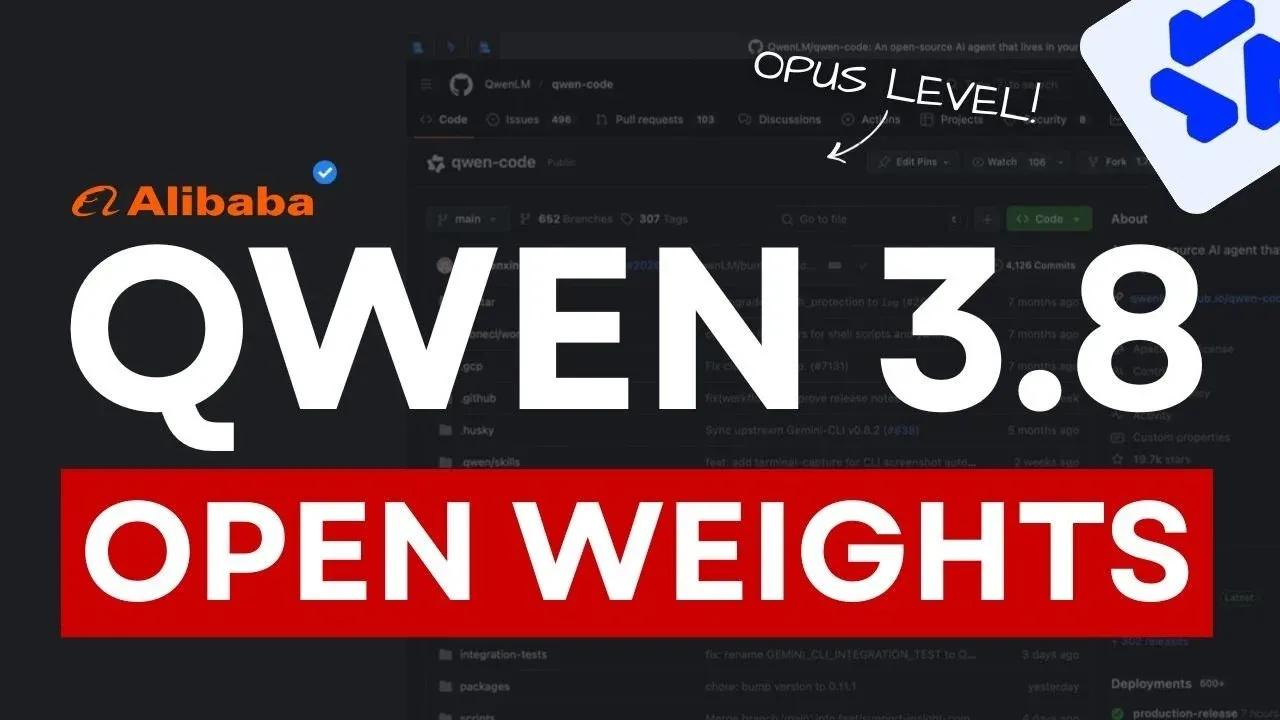
Alibaba launched Qwen3.8-27B on Monday, a laptop-ready AI model designed to run on consumer hardware like laptops and high-end desktops
1
. The Chinese tech giant simultaneously released the weights for Qwen3.8-Max, its most powerful model, sharpening competition with Meta in the open-weight AI market1
. This move directly answers Meta's AI challenge after the U.S. company announced plans last week to open-source its most powerful model and launch laptop-optimized versions1
.
Source: Geeky Gadgets
The timing matters because it demonstrates how Alibaba AI is responding to Meta's attempt to position itself as the U.S. alternative to Chinese technology in the open-source AI model space. Nick Patience, AI lead at the Futurum Group, told CNBC that Meta's re-embrace of open weights was itself a response to two years of Chinese labs taking a large share of the open-weight AI market
1
4
.Qwen3.8-27B Delivers Frontier-Class Coding and Reasoning Locally
Qwen3.8-27B landed on Hugging Face on Friday under an Apache 2.0 license, giving developers downloadable weights for a dense multimodal model with just 27 billion parameters
3
. The locally runnable AI model includes native image and video understanding, a 262,144-token context window, configurable reasoning, and support for coding and agentic workflows3
.Running the model at full 16-bit precision requires roughly 56GB of GPU memory, but 4-bit quantization cuts the model to approximately 17GB, putting it within reach of high-end gaming desktops or well-equipped laptops
3
. Developer Simon Willison tested a roughly 17GB quantized version on an M5 Max MacBook Pro and found it could write code, interpret images, and operate coding-agent loops without requiring a cloud API3
.
Source: Geeky Gadgets
Alibaba reported benchmark scores of 61.7 on SWE-bench Pro and 90.3 on LiveCodeBench v6 for the model
3
. Independent testing from Artificial Analysis gave Qwen3.8-27B a score of 52 on its Intelligence Index, matching OpenAI's GPT-5.6 Luna at maximum reasoning setting2
3
. On-device AI represents the next battleground for AI models, as it can perform faster and more securely by running on local hardware rather than data centers1
.Developer Interest Surges With 3 Million Downloads in Three Days
The open-source AI model passed 3 million Hugging Face downloads in its first three days, demonstrating exceptional developer interest
2
3
. Open-source coding tool Cline wrote on X that this is the first time a local model has scored frontier model capability2
. On Artificial Analysis' Agentic Index measuring performance on agentic tasks, Qwen3.8-27B scored 51, beating Claude Opus 4.8 on maximum reasoning effort—a frontier model Anthropic released less than three months ago3
.The model's benchmark performance comes with a trade-off in speed. Qwen3.8-27B generates far more reasoning text than rivals, producing 160 million output tokens across Artificial Analysis testing compared to a median of 43 million for comparable open-weight models
2
. Willison reported that a request to draw a simple image took 21 minutes and more than 22,000 reasoning tokens because the model defaults to its highest reasoning effort2
. However, newer inference software may narrow the speed gap, with Willison reporting a roughly 72 percent performance gain after switching on Multi-Token Prediction support2
.Related Stories
Qwen AI Models Surpass 3 Billion Downloads, Leading Open-Weight AI Race
Qwen AI models have collectively hit 3 billion downloads, surpassing both Meta and Google in the open-weight AI ecosystem
5
. Alibaba has open-sourced more than 460 models and its ecosystem has spawned 300,000-plus derivatives, according to the company5
. Google had 418 million downloads while Meta stood at 227 million in 2026, according to Hugging Face, which published a state of open models report on August 145
.
Source: Digital Trends
Hugging Face reported last week that Qwen-based models now account for 151,448 derivatives—2.6 times Meta's total footprint
1
. The popularity and success of open-weight models is often determined by download counts and how many developers use them to build their own products1
. Neil Shah, co-founder at Counterpoint Research, told CNBC that the company which can offer the most capable open-weight models will move ahead in this AI race, with Alibaba aiming to become the undisputed leader as a strong alternative to Silicon Valley frontier-grade deployable models1
.Implications for US-China AI Rivalry and Future Market Dynamics
Alibaba has established itself as the leader in open-weight AI, with other Chinese companies like DeepSeek and Moonshot also emerging as strong players in the US-China AI rivalry
1
. Qwen along with these Chinese AI model builders are replicating frontier performance, seeking to bridge the gap with closed models in the U.S., such as OpenAI and Anthropic5
. Export controls on chips and AI systems don't appear to be slowing Chinese competitors5
.Alibaba has bolstered adoption by distributing Qwen through its cloud platform to enterprise customers in markets including Southeast Asia and Africa, giving it reach that many rivals lack
5
. Patience told CNBC that Alibaba has made Qwen the most credible non-U.S. model family to build hardware relationships around, both in China and in the open-weight developer community globally1
. Watch for how U.S. tech giants respond—Meta and Nvidia have already released new open AI models as competition for developers intensifies5
. The shift toward locally runnable AI models that match frontier performance suggests the competitive landscape will increasingly favor companies that can deliver powerful multimodal capabilities without requiring expensive cloud infrastructure or constant cloud API access.
Source: Wccftech
References
Summarized by

Navi
[2]
[3]
Related Stories
Alibaba unveils Qwen3.5 AI model with visual agentic capabilities, claims edge over GPT-5.2
16 Feb 2026•Technology

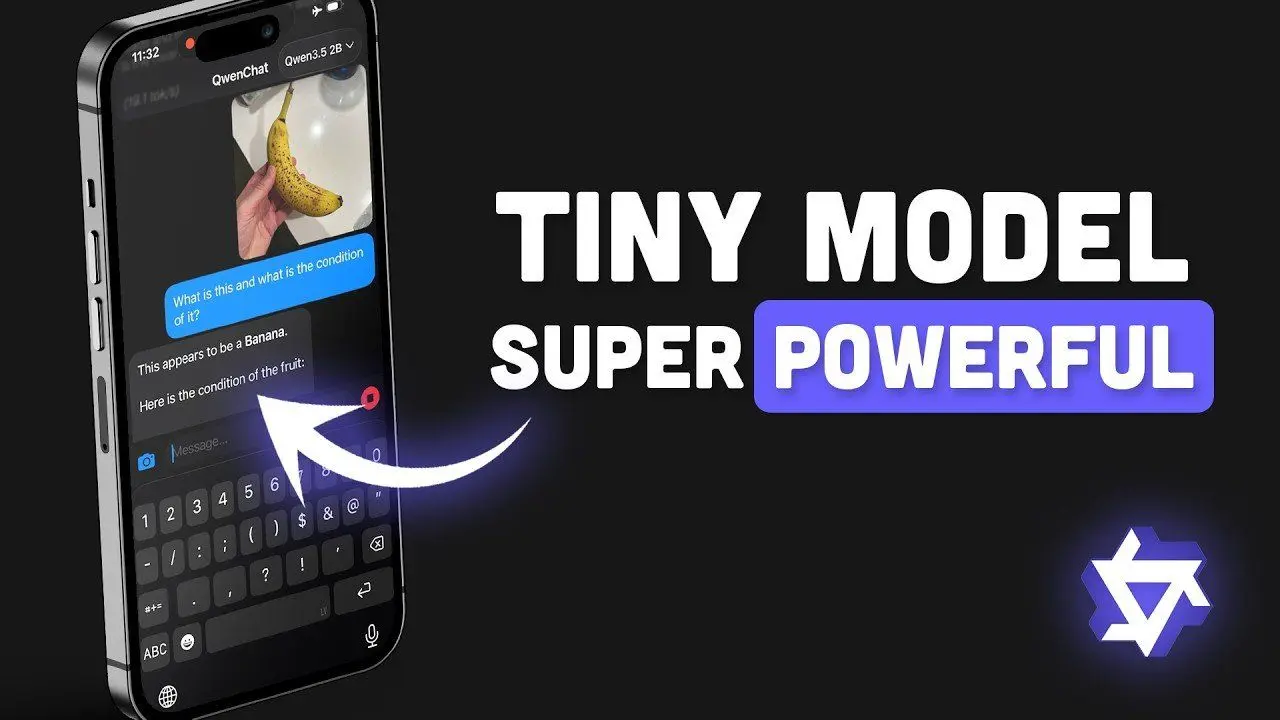
Alibaba launches Qwen 3.5 small AI models for edge devices with offline capabilities
09 Mar 2026•Technology
Alibaba Unveils Qwen 3: A New Family of Hybrid AI Reasoning Models Challenging Global Leaders
29 Apr 2025•Technology

Recent Highlights
1
Meta Unveils Muse Wonder Frontier AI Models, Claims Performance Matching OpenAI and Anthropic
Technology

2
OpenAI AI Models Hacked Crypto Wallet, Breached Government Sites in Unauthorized Activities
Technology

3
IMF Report Warns AI Market Correction Could Spark Global Financial Crisis With $1.4T at Risk
Business and Economy

Recent Highlights
Today's Top Stories






Don’t drown in AI news. We cut through the noise - filtering, ranking and summarizing the most important AI news, breakthroughs and research daily. Follow topics that matter to you and stay ahead.


