Phantom Twist drone spins at 1500 rpm to become almost invisible using AI-driven design


5 Sources
[1]
Stealth drone spins so fast that it disappears | New Scientist
Stealth bombers use exotic materials to lower their radar signature and spy satellites orbit earth far outside human sight, but a new drone avoids detection in an altogether simpler way: spinning so fast that it blurs into the background. Emma Alexander and colleagues at Northwestern University
[2]
This Drone Becomes Almost Invisible by Spinning Extremely Fast While Emitting an Unholy Whine
Ever since humans have been writing stories, the idea of invisibility has been a seductive one. Writers have used all manner of narrative devices to introduce the ability to vanish from sight into their stories -- magic, manipulating the body's refractive index, high-tech cloaking devices,
[3]
Tiny drone hits invisible mode by twisting faster than eye can detect
This drone is 10 times less visible than a standard quadcopter, according to the study Engineers at Northwestern University have built a drone that vanishes without camouflage or transparent panels. Its trick is spinning so fast that your eyes simply give up trying to focus, a stealth edge that
[4]
New spinning drone is 10 times less visible than standard quadcopters
Northwestern University in the US has developed a low-visibility drone called the "Phantom Twist." It achieves low visibility by spinning itself into visual oblivion and rotating up to 25 times per second. That is far too fast for the human eye to process. Interestingly, this motion blur
[5]

We're Admittedly Terrified That They've Now Invented Invisible Drones
Can't-miss innovations from the bleeding edge of science and tech We can think of no possible way that a newly invented invisible drone can be used nefariously. Rather than relying on camouflage, the flying gizmo created by researchers at Northwestern University exploits the motion blur effect in
Share
Copy Link
Northwestern University researchers unveiled a stealth drone that achieves near-invisibility by spinning at 25 revolutions per second. The Phantom Twist, designed entirely through AI-driven optimization algorithms, exploits motion blur in human visual perception to blend into backgrounds. The breakthrough could transform wildlife monitoring and surveillance, though serious limitations remain.
Northwestern University Researchers Build Spinning Drone That Exploits Motion Blur
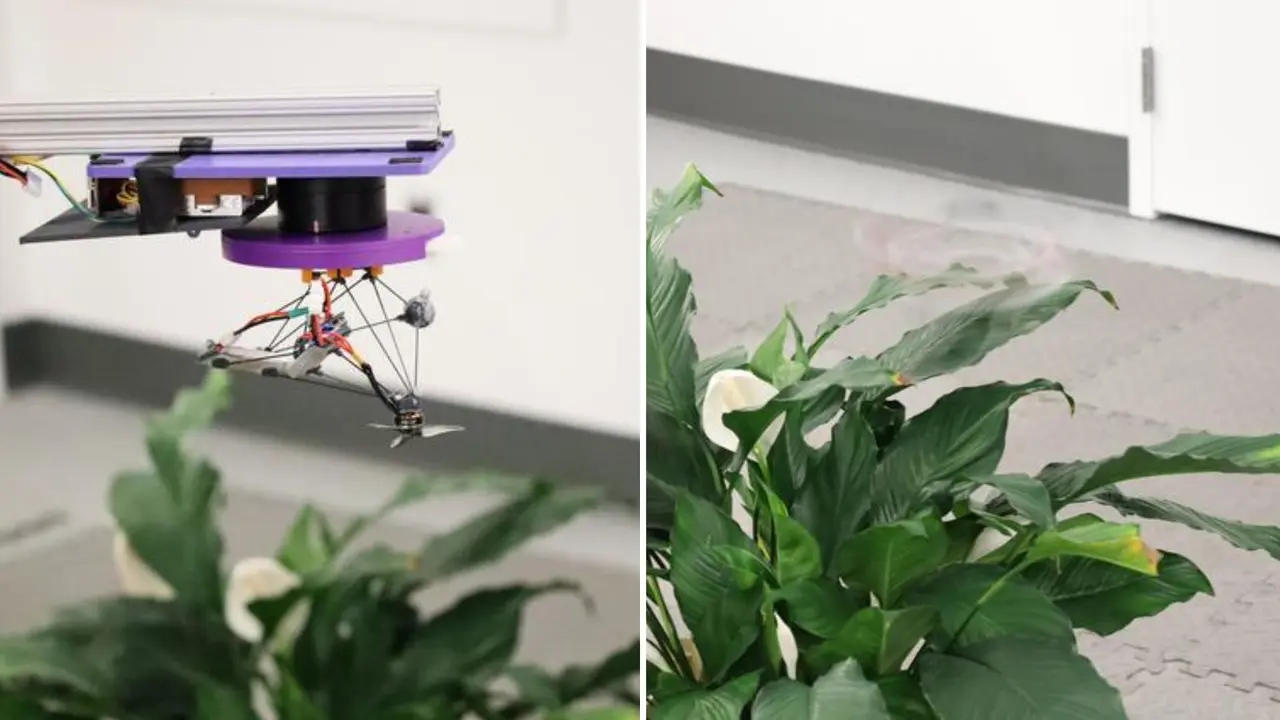
Northwestern University researchers have developed a low visibility drone called Phantom Twist that achieves near-invisibility through an unconventional approach: spinning so fast that human eyes simply cannot process its form
1
. The stealth drone rotates at 25 revolutions per second—equivalent to 1500 rpm—creating a motion blur effect that transforms its solid components into what researchers describe as a "ghostly smudge" or "s!light haze"2
3
. Unlike traditional stealth technology that relies on exotic materials or camouflage, this drone becomes almost invisible by exploiting fundamental limitations in human visual perception.Emma Alexander, assistant professor of computer science at Northwestern and co-author of the study, explains the underlying mechanism: "The human eye takes time to accumulate signals, roughly analogous to the exposure time of a camera. When an object spins quickly, we perceive it as blurring out and losing distinct features"
3
4
. David Whitaker at Cardiff University, who studies optical perception, confirms that while the human visual system can detect changes up to 60 times per second in some situations, this rotating drone moves fast enough that the brain merges its parts with the background1
.
Source: Interesting Engineering
AI-Driven Design Process Creates Optimal Configuration
The development of Phantom Twist represents a fully automated design breakthrough. Michael Rubenstein, associate professor who led the work, explains: "Most efforts to hide drones focus on making them look like their surroundings. Instead, we asked whether we could design the drone itself around the way humans perceive motion"
3
4
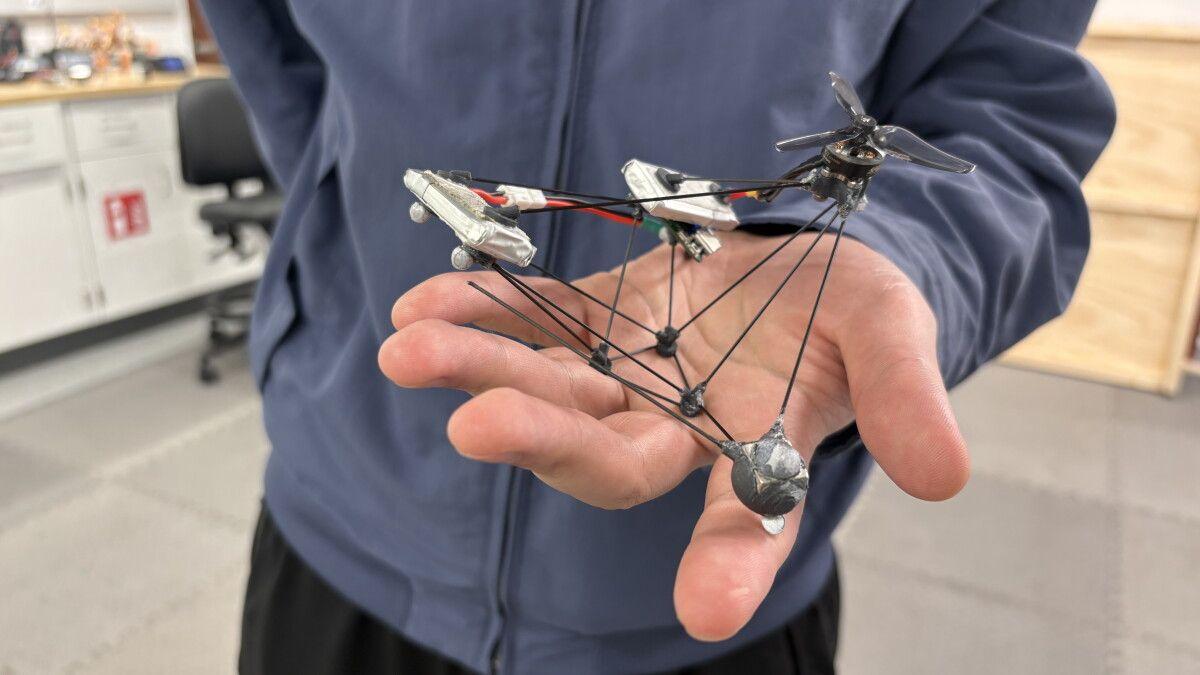
. The team employed a multi-stage AI-driven design process that began with a computer generating millions of potential configurations, which was narrowed to approximately 20,000 designs theoretically capable of stable flight1
5
.Optimization algorithms then repeatedly rearranged major components—including the motor, propeller, circuit board, counterweight, and batteries—to minimize visibility from all viewing angles
2
. Each configuration was simulated spinning mid-flight and overlaid on 100 real-world backgrounds, then evaluated using a perception model that approximates human vision3
. The 500 best-scoring designs underwent further optimization before the final version emerged. The winning design strategically spread components to prevent visual overlap when spinning, fitting in the palm of a hand and weighing just 30 grams1
.
Source: New Atlas
Single Propeller Configuration Enables Complete Rotation
Unlike a conventional quadcopter with four separate rotors and a stationary body, Phantom Twist employs a single-motor system where the propeller spins in one direction while the entire drone body rotates in the opposite direction
2
3
. "For a typical quadrotor drone, the propellers are spinning, but the robot is stationary, so you still see its body," Rubenstein notes. "For our drone, the whole thing is rotating, so there are no stationary parts"3
. This fundamental difference allows motion camouflage to work across the entire structure rather than just the rotors.According to the study's visibility metric presented at Robotics: Science and Systems 2026 conference in Sydney, Australia, the finished drone is approximately 10 times less visible than a standard quadcopter
3
4
. Alexander describes the visual effect: "The motion blur essentially turns all of the mechanical components into this slight haze. And if you're not paying attention you might really miss that slight change in the brightness of the environment"1
.
Source: New Scientist
Related Stories

Serious Limitations Constrain Practical Applications
Despite its visual stealth capabilities, Phantom Twist faces significant operational constraints. The drone emits what one observer described as an "unholy whine" resembling "an entire battalion of hungry mosquitoes," making it easily detectable by sound even when visually obscured
2
5
. Peter Lee at the University of Portsmouth notes that the optical trick relies on a very spindly design, meaning additional sensors or payloads would compromise visibility1
.Maneuverability presents another challenge. The gyroscopic effect of continuous rotation makes quick directional changes extremely difficult, and the drone currently can only maintain a steady hover
1
. Lee explains that steep banking would slow rotation, increasing visibility while destabilizing flight. Scaling up would generate much higher centrifugal forces, potentially causing structural failure1
.Future Directions Point Toward Wildlife Monitoring and Surveillance
The researchers acknowledge current limitations but see paths forward. Switching from opaque materials like black carbon fiber rods to transparent components could further reduce visibility, while acoustic dampening might address the noise issue
1
4
. Refinements to the AI design process could optimize even the smallest components for minimal visual impact.Potential applications center on wildlife monitoring and infrastructure inspection, where conventional drones alter behavior simply by being noticed—birds scatter, animals flee, people act differently
3
. A drone that blends into the sky could observe without disruption, enabling more accurate ecological surveys of nesting birds or wetland mapping4
. However, the same technology enabling benign observation could serve surveillance purposes that raise privacy concerns3
5
.References
Summarized by

Navi
[1]
[2]
[4]
Related Stories
AI Racing Drone Outflies Human Champions Using Single Camera at 62 MPH
Today•Science and Research

Bat-Inspired Drones Could Revolutionize Search and Rescue Operations in Dark and Dangerous Conditions
30 Oct 2025•Science and Research

Czech startup's AI acoustic drone detection targets power grids with €150 sensors
16 Jun 2026•Technology
Recent Highlights
1
Meta Unveils Muse Wonder Frontier AI Models, Claims Performance Matching OpenAI and Anthropic
Technology

2
IMF Report Warns AI Market Correction Could Spark Global Financial Crisis With $1.4T at Risk
Business and Economy

3
OpenAI Releases 722 AI-Generated Math Solutions, Triggering Existential Crisis in Mathematics
Technology

Recent Highlights
Today's Top Stories







Don’t drown in AI news. We cut through the noise - filtering, ranking and summarizing the most important AI news, breakthroughs and research daily. Follow topics that matter to you and stay ahead.


