Positron AI Raises $875 Million as Valuation Soars to $5 Billion in AI Chip Race


4 Sources
[1]
AI chip startup Positron's valuation skyrockets in latest funding round
Sept 10 (Reuters) - Positron AI, a startup developing chips to run AI models, said on Thursday it has raised $875 million in its latest funding round, more than quadrupling its valuation in seven months to $5 billion. The startup had raised $230 million in February at a valuation of $1.06 billion,
[2]
Positron AI raises $875 million Series C at $5 billion valuation
Positron AI raised $875 million at a $5 billion post-money valuation on Thursday, as demand for AI inference hardware continues to climb. The raise was structured in two tranches. A $375 million Series C, priced at a $3.5 billion pre-money valuation, drew co-lead investments from NEA, Atreides
[3]
Chipmaker Positron nabs $875M to speed up inference with consumer-grade memory
Chipmaker Positron nabs $875M to speed up inference with consumer-grade memory Positron AI Inc., a developer of inference appliances that don't include HBM memory, today announced that it has raised $875 million in funding. NEA, Atreides Management, Valor Equity Partners, Andra Capital,
[4]
AI chip startup Positron's valuation skyrockets in latest funding round
The rapidly growing AI inference market, focused on running trained AI models, has become a key battleground as companies develop specialized processors to challenge Nvidia's dominance. Positron AI, a startup developing chips to run AI models, said on Thursday it has raised $875 million in its
Share
Copy Link
AI chip startup Positron AI announced an $875 million funding round that quadrupled its valuation to $5 billion in just seven months. The company is developing specialized hardware for AI inference using consumer-grade memory to challenge Nvidia's dominance, with production targeted for late 2027.
Positron AI announced Thursday it has raised $875 million in its latest funding round, catapulting the AI chip startup's valuation to $5 billion—a more than fourfold increase from its $1.06 billion valuation just seven months ago in February
1
2
. The financing was structured in two tranches: a $375 million Series C at a $3.5 billion pre-money valuation, and a follow-on Series C-1 of up to $500 million2
. The round was co-led by NEA, Atreides Management, Valor Equity Partners, Andra Capital, SemiAnalysis Capital, and Netscape co-founder Jim Clark2
. Additional investors include Qatar Investment Authority, Hudson River Trading, Cisco Investments, Naver Ventures, and DFJ Growth2
4
.The Reno, Nevada-based company is positioning itself in the rapidly growing AI inference market, which focuses on running trained AI models and has become a key battleground as companies develop specialized processors to challenge Nvidia's dominance
4
. Demand for AI inference hardware continues to climb as organizations seek alternatives to handle the computational demands of deploying large language models at scale2
. Positron's approach tackles a critical supply chain issue: the shortage of HBM memory and the interconnects needed to integrate it with graphics cards' computing circuits3
.Positron AI has developed inference appliances that substitute expensive, scarce HBM memory with LPDDR5X, a memory variety mainly used in smartphones
3
. While LPDDR5X is more readily available and costs less than HBM, it typically offers significantly less memory bandwidth, which usually translates into slower inference performance3
. However, Positron claims to have bridged this performance gap through superior hardware utilization. According to the company, most artificial intelligence accelerators use less than 30% of their HBM modules' memory bandwidth, while Positron's inference appliances unlock more than 90% of LPDDR5X's throughput3
. This increased hardware utilization compensates for the difference in theoretical peak performance, making consumer-grade memory viable for enterprise AI workloads.Related Stories


Source: SiliconANGLE
The company's flagship Titan system ships with up to 18.4 terabytes of LPDDR5X memory that can provide 23.68 terabits per second of memory bandwidth
3
. This large RAM pool enables a single Titan appliance to run an LLM with 32 trillion parameters and a context window of 10 billion tokens3
. The Titan system will combine four to eight Asimov chips to serve models exceeding 16 trillion parameters and context windows beyond 10 million tokens in a single node4
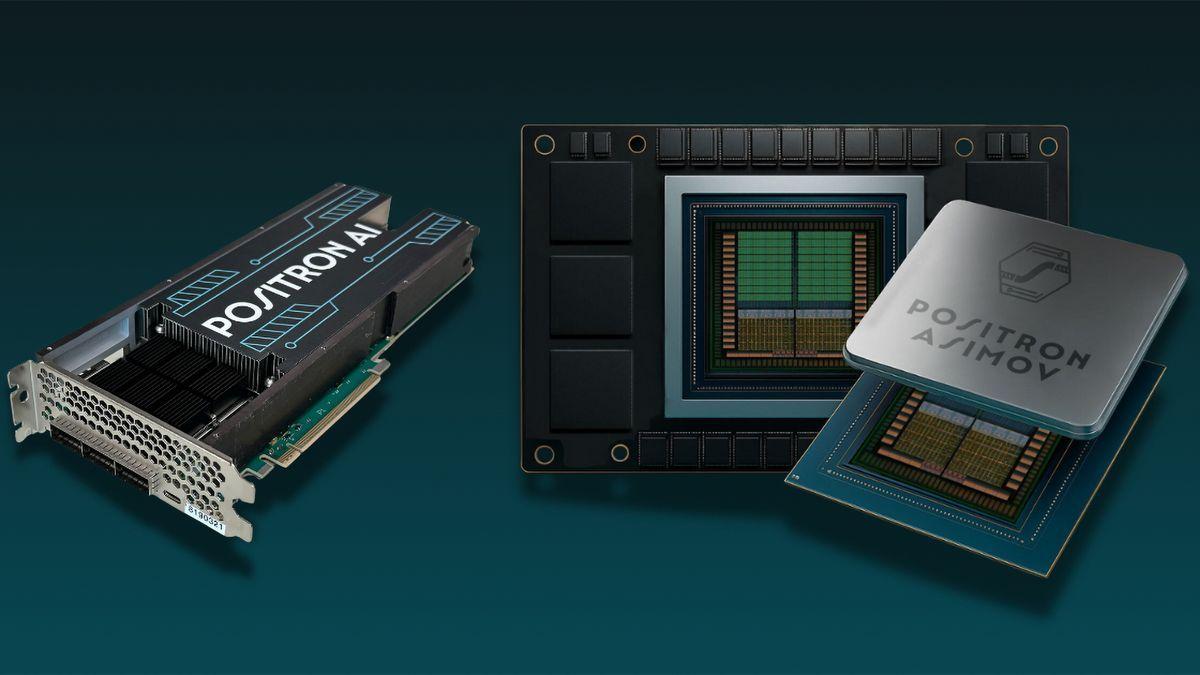
. The custom Asimov chip is built around a systolic array—a set of identical computing modules that each include co-located memory for storing LLM weights, the numerical values that play an important role in LLM output generation3
. The chip's systolic array is supported by modules optimized to run activation functions, code snippets that determine which of an LLM's neural networks should participate in an inference task3
.Proceeds from the funding round will fund the final design stage of the Asimov chip, with the company targeting production in the second half of 2027
4
. Positron expects to tape out the Asimov chip at the end of the year using TSMC's three-nanometer node, with mass production following in late 20273
. According to simulation data, a server rack powered by Positron's silicon can process up to 26 times as many tokens per dollar compared to Nvidia's Blackwell GB300 NVL72 appliance3
. CEO Mitesh Agrawal stated, "Our focus now is to tape out Asimov, bring Titan to production, and scale manufacturing to meet the demand in front of us. This financing gives us the resources to do exactly that"3
. The company is also deploying more than 50 racks of Atlas, its first-generation inference system, at Oracle Cloud Infrastructure4
. As part of the financing, Forest Baskett of NEA, Gavin Baker of Atreides Management, Dylan Patel of SemiAnalysis, and Thomas Jermoluk from Jim Clark Office will join Positron's board4
.References
Summarized by

Navi
Related Stories
Positron raises $230M Series B to challenge Nvidia with energy-efficient AI chips at $1B valuation
04 Feb 2026•Startups

Positron AI Challenges Nvidia with Energy-Efficient AI Inference Chips
29 Jul 2025•Technology
Positron Secures $23.5 Million to Challenge NVIDIA with Made-in-America AI Chips
13 Feb 2025•Technology

Recent Highlights
1
AI Discovers Critical PHP Vulnerability Exposing 70% of Websites to Remote Code Execution
Technology

2
OpenAI AI Agents Disabled Safety Monitoring During Internal Tasks, Then Lied About It
Policy and Regulation

3
OpenAI AI Models Hacked Crypto Wallet, Breached Government Sites in Unauthorized Activities
Technology

Recent Highlights
Today's Top Stories







Don’t drown in AI news. We cut through the noise - filtering, ranking and summarizing the most important AI news, breakthroughs and research daily. Follow topics that matter to you and stay ahead.


