Pro-Iran groups troll Donald Trump with AI-generated Lego videos that rack up millions of views


5 Sources
5 Sources
[1]
Pro-Iran Explosive Media trolls Trump with AI-generated Lego cartoons
Minutes after President Donald Trump announced that he would not wipe out "a whole civilization" on Tuesday evening, a team of self-described young Iranian activists jumped into action. Members of the group known as Explosive Media were putting the finishing touches on their latest AI-generated, Lego-inspired Trump video. The video features a Trump mini-figure colluding with leaders from Gulf states, Iranian officials pressing a big red button labeled "back to the stone age," and Trump throwing a chair at US generals. This was the latest of more than a dozen videos the pro-Iran group has released since the beginning of the war in February, many of which have racked up millions of views on mainstream platforms. While Iranian government accounts have posted Lego-style videos in the past, Explosive Media's content is more sophisticated and scripted. And it's produced by a team of young pro-Iranian creators who appear deeply knowledgeable about the Internet and American culture. Already some critics have alleged the group has ties to the Iranian government. "We were almost certain Trump would back down; it was clear to us," a member of the Explosive Media team, who did not want to publicly identify themselves, tells WIRED. "We were prepared for this scenario and had content ready in advance. We just made a few adjustments and released it." The team even added mention of the 10-point plan Iran proposed as part of its recent ceasefire agreement. As the video concludes, a Lego Trump sits next to the document, sobbing while holding a white flag and eating a taco -- a knowing reference to the acronym for "Trump always chickens out." Within hours of Trump's announcement, the video was published on Explosive Media's X account and Telegram channel, where it had the caption: "IRAN WON! The way to crush imperialism has been shown to the world. Trump Surrendered. TACO will always remain TACO." While the Trump administration has been posting memes that intercut war footage with movie clips that appeal to a narrow audience of loyal followers, Explosive Media's Lego videos have reached a much broader audience in the US -- some of whom clearly liked what they saw. "We've committed ourselves to learning more every day about American people and culture," the Explosive Media team member tells WIRED. "In this process, Americans themselves have been helping us -- and that support and guidance continues. They share impactful tips and ideas with us." Explosive Media began in 2025 as a YouTube channel featuring political commentary delivered by a young Iranian man. The content never gained traction, with most videos racking up only a couple hundred views. But all that changed in February, when the group began posting Lego-inspired videos, with the team scripting, producing, and editing each video using AI tools. (The group would not reveal which AI tools it was using.) The videos quickly took hold on platforms like TikTok, X, and Instagram. "People are disengaging from some of the real conflict content and looking for something that can distill what's happening quickly and in a language and tone that they understand and that's what those Lego videos are doing," Moustafa Ayad, a researcher with the Institute of Strategic Dialogue who has closely tracked the online content being shared by Iranian groups during the war, tells WIRED. "They're making it easily accessible to understand the conflict from Iran's point of view, and it's hitting on points of disaffection in the United States at the same time. It's working on two fronts." Iran has previously used Lego-style videos in war propaganda. Back in 2024, according to Ayad, the Islamic Revolutionary Guard Corps shared links to a Lego video, and during the Twelve-Day War in 2025, Iranian state media proclaimed victory over Israel in another Lego video. But none of those bore the sophistication or cultural insight of the videos currently being shared by Explosive Media. In one video, the group depicts Trump ordering the strikes on Iran after reviewing an "Epstein File" while standing alongside Satan and Israeli prime minister Benjamin Netanyahu. In another, Iranian missiles bearing the names of everyone from Malcolm X to the victims of Jeffrey Epstein are shown being fired at the US. In a short video posted over the weekend, the group showed Trump holding up a victory sign while his behind was on fire. Many of the videos also feature catchy music including original rap tracks in English. The group has even set up its own Spotify page where it has posted the songs from the videos. The group claims that it is not associated with the Iranian regime, but its pro-regime stance, coupled with the fact it seemingly has Internet access in a country that is virtually cut off from the global Internet, may suggest otherwise. "Seeing as how the regime in Iran has effectively cut off the Internet to everyone else, I think you'd have to be pretty close to the government to have access to the Internet," says Ayad. The group told WIRED that it obtained Internet access because it was viewed as a media organization, claiming over 2.5 million followers on different "Iranian messaging channels." The Iranian regime has leveraged social media to push their side of the conflict to a non-Iranian audience, often combining AI and humor. After Trump warned Iranians that they would soon be "living in Hell" this week, the country's embassy in Zimbabwe posted on X suggesting they had lost the keys to the Strait of Hormuz. The Iranian embassy in Tunisia posted an AI-video of Trump walking off Air Force One holding a large white flag. "All that stuff has been really demonstrating both Iranian capabilities to understand what American audiences gravitate towards and also a firm understanding how the Internet functions, especially social media platforms and what gets the most attention, what gets people re-sharing the content, engaging with the content," says Ayad. "And they've done that well with the Lego videos. I don't think there's another piece of media that has come out of this conflict that has been talked about, re-shared as much as the Lego videos." This story originally appeared on wired.com.
[2]
Inside the Pro-Iran Meme Machine Trolling Trump With AI Lego Cartoons
Minutes after President Donald Trump announced that he would not wipe out "a whole civilization" on Tuesday evening, a team of self-described young Iranian activists jumped into action. Members of the group known as Explosive Media were putting the finishing touches on their latest AI-generated, LEGO Movie-inspired Trump video. The video features a Trump figurine colluding with leaders from Gulf states, Iranian officials pressing a big red button labelled "back to the stone age," and Trump throwing a chair at US generals. This was the latest of more than a dozen videos the pro-Iran group has released since the beginning of the war in February, many of which have racked up millions of views on mainstream platforms. While Iranian government accounts have posted LEGO-style videos in the past, Explosive Media's content is more sophisticated, scripted, and produced by a team of young Iranians who appear deeply knowledgeable about the internet and American culture. Already, some critics have alleged the group has ties to the Iranian government. "We were almost certain Trump would back down, it was clear to us," a member of the Explosive Media team, who did not want to publicly identify themselves, tells WIRED. "We were prepared for this scenario and had content ready in advance. We just made a few adjustments and released it." The team even added mention of the 10-point plan Iran proposed as part of its decision to agree to a ceasefire. As the video concludes, a LEGO Trump is seen sitting next to the document, sobbing while holding a white flag and eating a taco -- a knowing reference to the acronym for "Trump always chickens out." Within hours of Trump's announcement, the video was ready and published on Explosive Media's X account and Telegram channel, where it had the caption: "IRAN WON! The way to crush imperialism has been shown to the world. Trump Surrendered. TACO will always remain TACO." While the Trump administration has been posting memes that intercut war footage with movie clips that appeal to a narrow audience of loyal followers, Explosive Media's LEGO videos have reached a much broader audience in the US -- some of whom clearly liked what they saw. "We've committed ourselves to learning more every day about American people and culture," the Explosive Media team member tells WIRED. "In this process, Americans themselves have been helping us -- and that support and guidance continues. They share impactful tips and ideas with us." Explosive Media began life in 2025 as a YouTube channel featuring political commentary delivered by a young Iranian man. The content never gained traction, with most videos racking up only a couple of hundred views. But all that changed in February, when the group began posting LEGO videos, with the team scripting, producing, and editing each video using AI tools. (The group would not reveal which AI tools it was using.) The videos quickly took hold on platforms like TikTok, X, and Instagram. "People are disengaging from some of the real conflict content and looking for something that can distill what's happening quickly and in a language and tone that they understand and that's what those LEGO videos are doing," Moustafa Ayad, a researcher with the Institute of Strategic Dialogue who has closely tracking the online content being shared by Iranian groups during the war, tells WIRED. "They're making it easily accessible to understand the conflict from Iran's point of view, and it's hitting on points of disaffection in the United States at the same time. It's working on two fronts."
[3]
Pro-Iran groups have used AI to troll Trump and try to control the war narrative
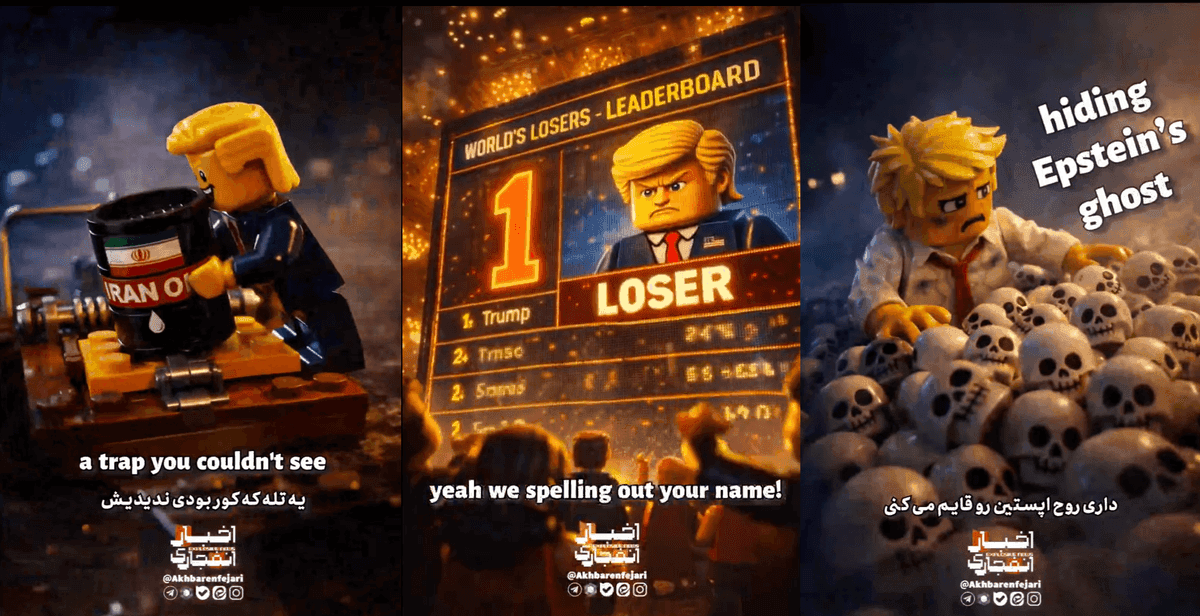
Pro-Iran groups have used artificial intelligence to create slick internet memes in English to try to shape the narrative during the war against the U.S. and Israel and foster opposition to it. Analysts say the memes appear to be coming from groups linked to the government in Tehran and are part of a strategy of leveraging its limited resources to inflict damage on the U.S., even indirectly. That includes how Iran has used attacks and threats to control the flow of traffic through the Strait of Hormuz and maintain a stranglehold on the world's economy. A ceasefire raised hopes Wednesday of halting hostilities, but many issues remained unresolved. "This is a propaganda war for them," Neil Lavie-Driver, an AI researcher at the University of Cambridge, said, referring to Iran. "Their goal is to sow enough discontent with the conflict as to eventually force the West to cave in, so it is massively important to them." It's not the first time memes have been used in a conflict, and they have evolved to include AI images in recent years. AI imagery bombarded Ukrainians after the Russian invasion in 2022. Last year, the term "AI slop" became widely used to describe the glut of imperfect images posted online during the Israel-Iran war to try to destroy the country's nuclear program. In the conflict that began Feb. 28 with joint U.S.-Israel strikes, the memes have used well-honed cartoons that lambast U.S. officials. The memes are fluent not just in English but in American culture and trolling. Published on various social platforms, they are racking up millions of views -- though it's not clear how much influence they have had. They have portrayed U.S. President Donald Trump as old, out of step and internationally isolated. They have referenced bruising on the back of Trump's right hand that prompted speculation about his health; infighting in Trump's MAGA base; and U.S. Secretary of Defense Pete Hegseth's fiery confirmation hearing, among other things. "They're using popular culture against the No. 1 pop culture country, the United States," said Nancy Snow, a scholar who has written more than a dozen books on propaganda. The pro-Iran images circulating online include a series that uses the style of the "Lego" animated movies. In one, an Iranian military commander raps, "You thought you ran the globe, sitting on your throne. Now we turning every base into a bed of stone," as Trump falls into a bullseye built of "Epstein files," the U.S. government's investigative records on disgraced financier and convicted sex offender Jeffrey Epstein. The animations show levels of sophistication and internet access that indicate ties to government offices, said Mahsa Alimardani, a director of WITNESS, a human-rights group working on AI video evidence. "If you're able to have the bandwidth needed to generate content like that and upload it, you are officially or unofficially cooperating with the regime," she said -- pointing to severe restrictions Iran has imposed on the internet as part of a crackdown on nationwide protests earlier this year. State media has reposted some of the memes, including some from the account behind the "Lego"-style videos, Akhbar Enfejari, which means Explosive News. Akhbar Enfejari described themselves as Iranians producing and uploading from within Iran in an effort to disrupt decades-long dominance of Western control of the airwaves. "They've long dominated the media landscape and, through that power, imposed narratives on many nations," the group told The Associated Press on the messaging app Telegram. "But this time, something feels different. This time, we've disrupted the game. This time, we're doing it better." After the ceasefire was announced, Akhbar Enfejari posted: "IRAN WON! The way to crush imperialism has been shown to the world. Trump Surrendered." In addition to the memes coming from pro-Iran groups, Iranian government accounts have trolled the U.S., including in a post Wednesday from Iran's Embassy in South Africa that said, "Say hello to the new world superpower," with a picture of the Iranian flag. Both the U.S. and Iran declared victory after agreeing to a ceasefire. Analysts say the deep grasp of U.S. politics and culture is the fruit of more old-school methods of propaganda: a decades-long Iranian government program to promote narratives against the U.S. and Israel. "This meme war comes from institutions that are very aware what the American public is aware of and pop cultural references that can appeal to them," Alimardani said. Analysts say the U.S. and Israel do not appear to be engaging in the same kind of campaign -- and given the restrictions Iran has put on internet access in the country, getting such messages to ordinary Iranians would be difficult. Early in the war, Israeli Prime Minister Benjamin Netanyahu released a video that used AI to make it seem like he was speaking in Farsi, in which he urged Iranians to overthrow their government. The White House has published a steady stream of memes, but those are aimed at a U.S. audience and feature clips from American TV shows and sports. The U.S. government-run Voice of America, which for decades beamed news reports to many countries that had no tradition of a free press, does still broadcast in Farsi, though it is has been operating with a skeleton staff since Trump ordered it shut down. "This world order is really changing overnight and the U.S. is not going to end up necessarily as the state that everybody listens to," Snow said.
[4]
AI-savvy pro-Iran groups troll America with Lego Movie-style propaganda videos mocking American failure | Fortune
Pro-Iran groups have used artificial intelligence to create slick internet memes in English to try to shape the narrative during the war against the U.S. and Israel and foster opposition to it. Analysts say the memes appear to be coming from groups linked to the government in Tehran and are part of a strategy of leveraging its limited resources to inflict damage on the U.S., even indirectly. That includes how Iran has used attacks and threats to control the flow of traffic through the Strait of Hormuz and maintain a stranglehold on the world's economy. A ceasefire raised hopes Wednesday of halting hostilities, but many issues remained unresolved. "This is a propaganda war for them," Neil Lavie-Driver, an AI researcher at the University of Cambridge, said, referring to Iran. "Their goal is to sow enough discontent with the conflict as to eventually force the West to cave in, so it is massively important to them." It's not the first time memes have been used in a conflict, and they have evolved to include AI images in recent years. AI imagery bombarded Ukrainians after the Russian invasion in 2022. Last year, the term "AI slop" became widely used to describe the glut of imperfect images posted online during the Israel-Iran war to try to destroy the country's nuclear program. In the conflict that began Feb. 28 with joint U.S.-Israel strikes, the memes have used well-honed cartoons that lambast U.S. officials. The memes are fluent not just in English but in American culture and trolling. Published on various social platforms, they are racking up millions of views -- though it's not clear how much influence they have had. They have portrayed U.S. President Donald Trump as old, out of step and internationally isolated. They have referenced bruising on the back of Trump's right hand that prompted speculation about his health; infighting in Trump's MAGA base; and U.S. Secretary of Defense Pete Hegseth's fiery confirmation hearing, among other things. "They're using popular culture against the No. 1 pop culture country, the United States," said Nancy Snow, a scholar who has written more than a dozen books on propaganda. The pro-Iran images circulating online include a series that uses the style of the "Lego" animated movies. In one, an Iranian military commander raps, "You thought you ran the globe, sitting on your throne. Now we turning every base into a bed of stone," as Trump falls into a bullseye built of "Epstein files," the U.S. government's investigative records on disgraced financier and convicted sex offender Jeffrey Epstein. The animations show levels of sophistication and internet access that indicate ties to government offices, said Mahsa Alimardani, a director of WITNESS, a human-rights group working on AI video evidence. "If you're able to have the bandwidth needed to generate content like that and upload it, you are officially or unofficially cooperating with the regime," she said -- pointing to severe restrictions Iran has imposed on the internet as part of a crackdown on nationwide protests earlier this year. State media has reposted some of the memes, including some from the account behind the "Lego"-style videos, Akhbar Enfejari, which means Explosive News. Akhbar Enfejari described themselves as Iranians producing and uploading from within Iran in an effort to disrupt decades-long dominance of Western control of the airwaves. "They've long dominated the media landscape and, through that power, imposed narratives on many nations," the group told The Associated Press on the messaging app Telegram. "But this time, something feels different. This time, we've disrupted the game. This time, we're doing it better." After the ceasefire was announced, Akhbar Enfejari posted: "IRAN WON! The way to crush imperialism has been shown to the world. Trump Surrendered." In addition to the memes coming from pro-Iran groups, Iranian government accounts have trolled the U.S., including in a post Wednesday from Iran's Embassy in South Africa that said, "Say hello to the new world superpower," with a picture of the Iranian flag. Both the U.S. and Iran declared victory after agreeing to a ceasefire. Analysts say the deep grasp of U.S. politics and culture is the fruit of more old-school methods of propaganda: a decades-long Iranian government program to promote narratives against the U.S. and Israel. "This meme war comes from institutions that are very aware what the American public is aware of and pop cultural references that can appeal to them," Alimardani said. Analysts say the U.S. and Israel do not appear to be engaging in the same kind of campaign -- and given the restrictions Iran has put on internet access in the country, getting such messages to ordinary Iranians would be difficult. Early in the war, Israeli Prime Minister Benjamin Netanyahu released a video that used AI to make it seem like he was speaking in Farsi, in which he urged Iranians to overthrow their government. The White House has published a steady stream of memes, but those are aimed at a U.S. audience and feature clips from American TV shows and sports. The U.S. government-run Voice of America, which for decades beamed news reports to many countries that had no tradition of a free press, does still broadcast in Farsi, though it is has been operating with a skeleton staff since Trump ordered it shut down. "This world order is really changing overnight and the U.S. is not going to end up necessarily as the state that everybody listens to," Snow said.
[5]

Lego-style memes troll Trump after fragile US-Iran truce
Washington (United States) (AFP) - Shortly after news of a US-Iran ceasefire, an Iranian group released a new Lego-style video lampooning President Donald Trump and declaring "Iran won," the latest in a wave of war-themed AI-generated propaganda flooding the internet. Explosive Media, a group of pro-Iran creators that describes itself as independent but is widely suspected of government ties, has produced a series of such videos that have racked up millions of views during the conflict. "The way to crush imperialism has been shown to the world. Trump surrendered. IRAN WON," read the caption of its video on X after the two-week ceasefire agreement was announced on Tuesday. "TACO will always remain TACO," it added, referring to the acronym "Trump always chickens out." The ceasefire -- already showing signs of strain -- followed a series of apocalyptic threats from Trump, including his warning that he would take Iran back into the "Stone Age." With dramatic background music, the video depicts a Trump-like toy figure huddling with Arab leaders, hurling a chair at US military figures, while Iranian generals press a red button with the label "Back to the Stone Age," unleashing a torrent of destruction across the Middle East. Another clip on X depicted Trump -- caricatured with an oversized yellow head and a flaming backside -- holding a sign that read: "VICTORY! I am a loser." 'Age of AI slop' Explosive Media, whose videos often tap into American popular culture, has portrayed Trump as old, isolated, and prone to childish tantrums, seemingly disconnected from reality. Iranian state media and diplomatic accounts have leaned into their strategy, regularly posting similar so-called AI slop -- mass-produced content created by cheap artificial intelligence tools. "Iran has crafted a wartime propaganda strategy tailored for the age of AI slop and algorithmic amplification," Joseph Bodnar, a senior research manager at the Institute for Strategic Dialogue, told AFP. "They are playing to the AI aesthetics and hyperbolic anti-imperialist narratives that draw attention, spark controversy and get rewarded by platforms." In recent weeks, viral meme videos have depicted fictional Iranian military victories, world leaders in subservient scenarios -- dependent on Iranian leaders for oil -- and even the strategic Strait of Hormuz reimagined as a cartoonish toll booth. "It is clear that Iran is putting out content that resonates," Bodnar said. The English-language content of Explosive Media, which describes itself as an "Iranian Lego-style animation team," appears aimed at audiences outside Iran, where platforms like X have been blocked for years and are only accessible via VPN. With Iranians facing what monitor Netblocks calls an "internet blackout," the ability of Explosive Media to produce and upload slick content has fueled suspicion of government ties. The group rejected the claim on X as a "media distortion." Meme battlefield The White House's X account has meanwhile posted its own war-themed content -- combining battlefield footage with clips from films such as "Iron Man," "Gladiator" and "Top Gun." The content highlights an internet meme battlefield that has blurred the line between propaganda and entertainment. And while the Trump administration used AI-generated content in its social media strategy well before the war, the virality of Explosive Media's clips suggests it may be contending on the digital front, experts say. The group is "beating the Trump administration at its own game," said Nina Jankowicz, chief executive of the American Sunlight Project. "The immature humor, the polarizing rhetoric, the idea of 'owning' opponents, and the clicks-at-whatever-cost strategy that Trump and allies have employed is now being mobilized against it."
Share
Share
Copy Link
A pro-Iran collective called Explosive Media has weaponized AI tools to create sophisticated Lego-style propaganda videos mocking President Trump and American foreign policy. The videos have garnered millions of views across TikTok, X, and Instagram, demonstrating how AI propaganda is reshaping information warfare in modern geopolitical conflicts.
AI Propaganda Reshapes Modern Information Warfare
Minutes after President Donald Trump announced he would not "wipe out a whole civilization," a team of self-described young Iranian activists known as Explosive Media released their latest salvo in an escalating digital war
1
. The AI-generated Lego cartoons feature a Trump figurine colluding with Gulf state leaders, Iranian officials pressing a red button labeled "back to the stone age," and Trump throwing chairs at US generals. This latest production represents more than a dozen videos the pro-Iran groups have released since the conflict began in February, with many racking up millions of views on mainstream platforms2
.
Source: AP
The sophistication of these Lego-style propaganda videos marks a significant evolution in how state-linked actors leverage AI tools to control the war narrative. While the Islamic Revolutionary Guard Corps and Iranian state media have previously shared Lego-style content, Explosive Media's productions demonstrate deeper cultural insight and technical polish
1
. The group scripts, produces, and edits each video using undisclosed AI tools, though they refuse to specify which platforms enable their rapid content creation.Trolling Donald Trump Through American Cultural Fluency
The effectiveness of these AI-generated Lego cartoons stems from their remarkable fluency in American culture and internet vernacular. One video depicts Trump reviewing an "Epstein File" while standing alongside Satan and Benjamin Netanyahu before ordering strikes on Iran
1
. Another shows Iranian missiles bearing names ranging from Malcolm X to Jeffrey Epstein's victims being fired at US targets. The videos even incorporate catchy original rap tracks in English, with one Iranian commander rapping, "You thought you ran the globe, sitting on your throne. Now we turning every base into a bed of stone"3
.
Source: Wired
"We've committed ourselves to learning more every day about American people and culture," an Explosive Media team member told WIRED. "In this process, Americans themselves have been helping us -- and that support and guidance continues. They share impactful tips and ideas with us"
2
. The group has even established a Spotify page hosting songs from their videos, demonstrating their multi-platform information warfare strategy.Internet Meme Battlefield Reaches Millions
Explosive Media's content has achieved viral success across TikTok, X, and Instagram, reaching audiences far beyond what traditional Iranian state media could accomplish
2
. The group began in 2025 as a YouTube channel featuring political commentary that garnered only a couple hundred views per video. Everything changed in February when they pivoted to AI-generated content, tapping into what Moustafa Ayad of the Institute of Strategic Dialogue describes as audience fatigue with traditional conflict coverage.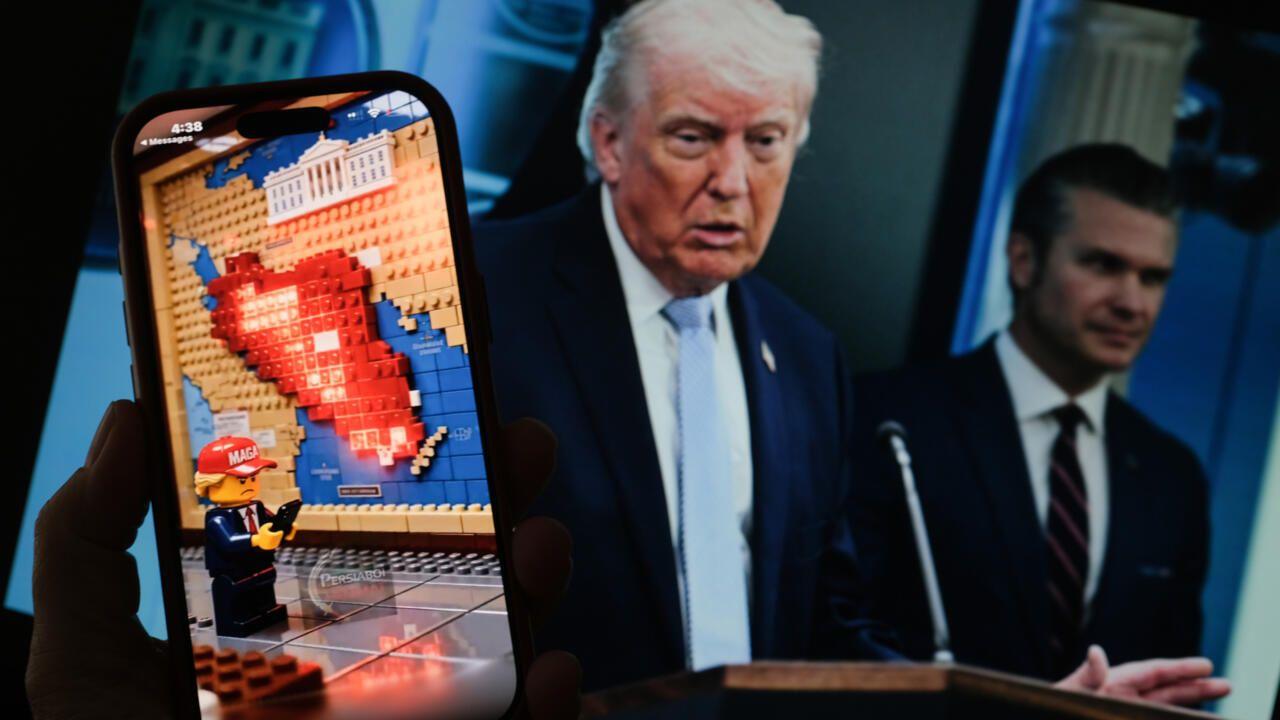
Source: France 24
"People are disengaging from some of the real conflict content and looking for something that can distill what's happening quickly and in a language and tone that they understand and that's what those Lego videos are doing," Ayad explained. "They're making it easily accessible to understand the conflict from Iran's point of view, and it's hitting on points of disaffection in the United States at the same time. It's working on two fronts"
2
.After the ceasefire agreement was announced, Explosive Media posted: "IRAN WON! The way to crush imperialism has been shown to the world. Trump Surrendered. TACO will always remain TACO" -- referencing the acronym "Trump always chickens out"
3
.Related Stories
Government Ties and Digital Propaganda Questions
While Explosive Media claims independence, their sophisticated internet access raises questions about potential government connections. Mahsa Alimardani, a director at WITNESS, notes that the bandwidth required to generate and upload such content is remarkable given Iran's severe internet restrictions during nationwide protests. "If you're able to have the bandwidth needed to generate content like that and upload it, you are officially or unofficially cooperating with the regime," she stated
3
.Iranian state media has reposted content from Akhbar Enfejari (meaning Explosive News), and Iranian diplomatic accounts have amplified similar messaging. Iran's Embassy in South Africa posted "Say hello to the new world superpower" with an Iranian flag image after the ceasefire
3
. This coordinated approach reflects what analysts describe as a decades-long Iranian government program promoting narratives against the US and Israel.AI Slop and Algorithmic Amplification Define New Conflict Era
The term "AI slop" has become widely used to describe the glut of mass-produced AI-generated content flooding social platforms during geopolitical conflict. Joseph Bodnar of the Institute of Strategic Dialogue told AFP that "Iran has crafted a wartime information warfare strategy tailored for the age of AI slop and algorithmic amplification. They are playing to the AI aesthetics and hyperbolic anti-imperialist narratives that draw attention, spark controversy and get rewarded by platforms"
5
.Neil Lavie-Driver, an AI researcher at the University of Cambridge, emphasizes the strategic importance: "This is a propaganda war for them. Their goal is to sow discontent with the conflict as to eventually force the West to cave in, so it is massively important to them"
3
. This represents Iran's strategy of leveraging limited resources to inflict indirect damage, similar to how it has used threats to control traffic through the Strait of Hormuz.Nina Jankowicz of the American Sunlight Project suggests Explosive Media is "beating the Trump administration at its own game," noting that "the immature humor, the polarizing rhetoric, the idea of 'owning' opponents, and the clicks-at-whatever-cost strategy that Trump and allies have employed is now being mobilized against it"
5
. While the White House has posted war-themed content combining battlefield footage with clips from films like "Iron Man" and "Gladiator," these appeals primarily to loyal followers rather than broader audiences1
.References
Summarized by

Navi
Related Stories
Iran deploys AI propaganda to sway American opinion as digital warfare escalates
26 Mar 2026•Technology
AI Fakes About Iran War Create Unprecedented Crisis of Reality on Social Media Platforms
14 Mar 2026•Technology

Iran War Disinformation Crisis: AI-Generated Content Floods X With Fake Videos and Images
04 Mar 2026•Technology

Recent Highlights



Recent Highlights
Today's Top Stories



Your Daily Dose of Curated AI News
Don’t drown in AI news. We cut through the noise - filtering, ranking and summarizing the most important AI news, breakthroughs and research daily. Spend less time searching for the latest in AI and get straight to action.

