4 Sources
4 Sources
[1]
Iran Is Winning the AI Slop Propaganda War
"White House videos -- AI or otherwise -- are like group-chat in-jokes aimed at keeping cohesion." An AI-generated LEGO movie out of Iran depicting Trump as a war hungry pedophile has gone viral online. The video is the work of Iran-based propagandists called the "Explosive News Team" and is just the latest in a long line of AI-generated LEGO videos aimed at mocking Trump and Benjamin Netanyahu. LEGO-themed propaganda isn't new and the Iranian video plays on familiar wartime propaganda themes. What's different in 2026 is speed and scale. During World War II, the Korean War, and the Vietnam War, America's enemies littered the battlefield with pamphlets, cartoons, and radio broadcasts aimed at shaking the morale of American troops, but that stuff rarely got back home. Now, Iran can use AI tools to produce lavishly animated cartoons at scale for dissemination across social media all aimed at the US homefront. The latest "Explosive News Team" video is set to a catchy rap song about how Trump is a LOSER and millions of people are watching it across multiple platforms. At the same time Iran is releasing AI-generated videos of Trump drowning in a river of blood, the US Department of Homeland Security is sharing fashwave filtered pictures of Gen Z ICE agents milling around airports. Iran's use of LEGO set rap music tells me it's been studying us. These are videos meant for the American people crafted in a language Iran knows we'll understand. Meanwhile, the White House is dropping Grand Theft Auto and Call of Duty memes that were out of fashion 10 years ago on Reddit and vague-posting pixelated images of Trump like it's running an ARG. Iran is attempting to speak to the broader American public. Trump is confident he only has to impress the online freaks he thinks still love him. In other words, there's a AI slopaganda proxy war playing out, and Trump is speaking only to people whose brains are rotting out of their skull, while Iranian propaganda is currently doing a better job of speaking to the concerns of the broad American population than the American president. Trump continues to narrowcast to his base while losing support for his wildly unpopular war as Americans worry about skyrocketing gas prices, a tanking economy and stock market, insane lines at airports, and a war that has little rationale and apparently no real goal. A recent Pew poll found 61 percent of Americans disapprove of Trump's handling of the conflict. To be clear, it speaks to how bad things are online that we need to analyze whose AI disinformation and propaganda is "better," and, in general, the slopification of the internet has been a disaster. And yet, the stuff Iran is making is resonating and spreading online in a way that Trump's slop is not. We do not know who, specifically, is making the Iranian AI slop or which tools they are using to make it. But the fact that Iranian AI slop is resonating with Americans while American slop is not should perhaps not be surprising; for the last several years, the most successful purveyors of AI slop have largely been based in foreign countries, where they have been incentivized to make content that specifically targets American audiences because of the way that social media ad rates work. Because of that, an entire economy has emerged in which people who would otherwise have little interest in reaching American audiences have been incentivized to study what resonates with Americans on the internet and have created entire businesses focused on teaching other people what Americans care about and how to target them with AI slop. Propaganda, especially war-time propaganda, is about causing a quick emotional reaction in the viewer. Iran has proved remarkably capable of that and hits similar themes in most of its videos: Epstein, Netanyahu, and blood. "The really striking throughline is the 1) connecting victims from Minab to Epstein, 2) a cartoonish antisemitism that attributes the bog-standard reactionary hawkishness of Trump and Netanyahu to a sinister and supernatural evil, 3) heavy emphasis on missiles and revenge-weapons," Kelsey Atherton, Chief Editor at Center for International Policy, told 404 Media. "There's a grand tradition of wartime propaganda aimed at convincing the other side to quit and I think Iran's best falls into that camp, like North Korea and especially North Vietnam sending pamphlets aimed at getting black soldiers to defect by highlighting inequity at home," Atherton said. "Iran's online propaganda is trying to activate this by (charitably) appealing to class war and (uncharitably) leaning on antisemitism to get US soldiers to quit and to erode support among Americans watching short-form vertical video." In one AI-generated video shared by Russian state controlled news organization RT depicts victims of American military campaigns staring at the sky. It begins with an American Indian then cuts to a boy in Hiroshima, a schoolgirl in Minab, a little girl in front of the bizarre temple on Epstein's Island, and ends with US-assassinated Quds Forces leader Qasem Soleimani. US Under Secretary of State Sarah B Rogers attempted to critique the video in a post on X. "You do see common propaganda threads here and elsewhere: the ideology is resentment-driven, civilization-skeptical, and obsessed with upending, cathartic violence enacted by the 'historically downtrodden' (ie 'wretched of the earth')," she said. The post felt like projection and was especially strange given the Trump administration's own resentment driven ideology, destruction of institutions, and obsession with revenge-driven violence on behalf of the "forgotten man." Iran did not start America's war with it. And it did not start the AI-generated propaganda war, it's just doing it better than the United States. There are other echoes of the past. An AI-generated Iranian riff on Pixar's Inside Out shared on X by Iran's embassy in the Hague showed a Disneyesque version of the inside of Trump's brain. It showed frothing demons demanding the President lie to the press. A poster from World War II depicts an X-Ray photo of Hitler's Brain filled with skeletons and snakes. It's the same theme in different eras using different tools. LEGO bricks, too, are a far older propaganda tool than the current war. The Danish bricks are one of the most recognizable toys on the planet. Last year, Russian propagandists circulated images of fake LEGO sets depicting soldier's funerals ahead of an election in Moldova. In 2020, the Chinese released "Once Upon a Virus," a LEGO short film that mocked America's response to the Covid pandemic. The Trump administration's new fascist aesthetic is defined by AI slop. From Studio Ghibli-inspired grotesques to AI-generated Sora videos of ICE raids that never happened going viral on Facebook, Trump and his supporters are also using the tools of the moment to churn out crappy propaganda. The difference is that Trump's videos aren't about winning hearts and minds, they're about activating a rapidly diminishing base of supporters. "I think Trump's stuff is aimed at the same audience, except to convince them that what they're doing is righteous and good," Atherton said. "Obviously we're seeing the stuff put out in English to English video-watching audiences but White House videos -- AI or otherwise -- are like group-chat in-jokes aimed at keeping cohesion. It's not an AI video but the Wii Sports/snuff film one is so skin-crawling that it requires the audience to be cooked in the feverswamps." The Trump administration has bet big on video game memes as the vehicle for its propaganda efforts. Last October DHS depicted Halo's Master Chief as an anti-immigrant killer and compared immigrants to a ravening horde of mindless monsters. Two weeks ago it published a now-deleted video that mixed footage from Call of Duty with missile strikes in Iran. White House Communications Director Steven Cheung posted the infinite ammo cheatcode for Grand Theft Auto: San Andreas above footage of airstrikes. Video games are incredibly popular in the United States, but many of these memes require a level of familiarity with specific games and the culture around them. LEGO, by contrast, is instantly recognizable to most of the world. On March 5, the White House's X account posted a video mixing American pop culture figures like Walter White, Optimus Prime, Super Man, and Tony Stark with footage from the war. Watching it, I was reminded of a moment from six years ago after America assassinated Soleimani during the first Trump administration. On an Iranian television show, Cleric Shahab Moradi called in to share his thoughts on how Iran could strike back. Who might Iran attack that has the same cultural purchase as Soleimani did in Iran? Who were America's heroes? "Think about it. Are we supposed to take out Spider-Man and SpongeBob? They don't have any heroes," Moradi said. "We have a country in front of us with a large population and a large landmass, but it doesn't have any heroes. All of their heroes are cartoon characters -- they're all fictional." And so Iran has chosen to speak to Americans in a language it thinks we'll understand: with cartoons and LEGOs.
[2]
Iran targets US public opinion with online information war
When President Donald Trump announced in a social media video on February 28 that the United States and Israel had launched strikes on Iran, he kickstarted a war that has engulfed the Middle East. But he also sparked an online information war that analysts say has been dominated by the use of AI-generated content to spread fake news about the conflict One study from Clemson University in South Carolina found that, within 24 hours of the US and Israel launching attacks on Iran, dozens of social media accounts affiliated with the Islamic Revolutionary Guard Corps had begun posting Iranian propaganda about the war, some of which reached an audience of millions. Among the most widely viewed content are AI-generated videos mocking Trump - styled to reference Western media including the LEGO movies and the Teletubbies - and AI videos and photographs claiming to show the devastation Iranian strikes have wrought on Israel and the Gulf states. "The propaganda includes memes and cartoons that aren't meant to be perceived as real but are very good at spreading political messaging," said Darren Linvill, author of the study and co-director of Clemson's Media Forensics Hub. "The deepfakes portray a version of reality that [seems] genuine and often paint Iran as more successful in the conflict. Both are being shared widely among communities that are critical of the war and hungry for this messaging." 'Politically divisive' The accounts analysed in the Clemson study had been used previously for Iranian influence operations "designed to exploit regional fault lines to advance Iranian regime interests" in the West by posting "politically divisive" content such as critiques of the recent US immigration crackdown. The switch to posting war propaganda on platforms including X, Instagram and Bluesky suggests that Iran quickly overhauled its social media strategy when the war with the US and Israel began. As the conflict has spiralled over the past month, Iran has relied on both state media outlets and proxies to push its online message as a form of asymmetrical warfare with a view to targeting a US audience. Read moreMiddle East war live: Iran rejects US ceasefire plan and offers counterproposal, state TV says "The Iranian regime wants to make the conflict as painful as possible for the US and Israel, and if they can target what support Trump and [Prime Minister Benjamin] Netanyahu have, it may ultimately shorten the war," Linvill said. There is fertile ground in the United States for messages critiquing military involvement in the Middle East. Ipsos polling from mid-March found that US public opinion was "overwhelmingly" against the war in Iran, with 58 percent opposing US military strikes and 78 percent against the idea of US boots on the ground. In some cases, the Iranian regime does not need to create original or fake content to spread its message. Clips of the former head of the US National Counterterrorism Center, Joe Kent, being interviewed about his resignation in opposition to the war were widely shared online by Iranian state media. 'A ton of lies in a grain of truth' AI videos in particular "travel fast and plug into emotions that people already have", said Tine Munk, senior lecturer in criminology at Nottingham Trent University and a specialist in digital warfare. "They create a lot of noise, even when they are so obviously fake because it is easy to communicate complex ideas through visual storytelling using these shared cultural references," he said. But many of the photos and videos gaining traction online purport to show events on the ground that are harder to identify as fake. Information warfare analyst Tal Hagin has been tracking these on X - a platform where disinformation about the war is rife. Among them are hundreds of examples of videos and images showing Iranian attacks on Israel that are either years old, of attacks on different countries or are AI-generated. "There was a strike in Tel Aviv on February 28th, and the videos and photos of those strikes have been used every single day to allegedly depict new strikes," Hagin said. The strategy is effective, he added, because the initial attack really did happen. "Then they put a ton of lies into that grain of truth, so people don't know what the truth is anymore." In addition, "social media platforms are not fulfilling their commitments on labelling content and removing it if it is provably false", said Melanie Smith, expert in information operations at the Institute for Strategic Dialogue. "We're seeing content get millions of views before it's proven to be AI and labelled as such." 'Information battlefield' The current conflict in the Middle East is not the first time viral videos and memes have been used as a weapon of war - they are an established form of Ukrainian resistance against Russian misinformation. But the use of AI to generate wartime propaganda is a new development. "This conflict is the first time we've really seen AI-generated content be used very intentionally to sow chaos and confusion around what's actually happening on the ground," Smith said. Adding to the confusion are censorship rules restricting the flow of information out of both Israel and Iran. In Israel, wartime censors have prohibited the sharing of information deemed sensitive, such as the location of interceptor missiles. Meanwhile, Iran has imposed a full internet blackout, now in its fourth week, making it extremely difficult for outsiders to know what is happening on the ground. The result is "a big information void that can be filled very quickly with synthetic content, propaganda narratives and generally chaotic information", Smith said. Iran is surging forward on this "information battlefield", said Munk. "It's a broader war strategy where Iran cannot always dominate militarily, so it's focused on shaping perceptions to create doubt and uncertainty." Trump has accused Iran of using AI-generated "fake news" as a "disinformation weapon" -although the White House shared its own heavily critiqued AI video combining real footage of strikes in Iran with clips from action movies and video games. "Iran has been fairly successful, certainly more successful than the US and Israel, in reaching a broad audience and gaining more support than they might otherwise have," Linvill said.
[3]
The Memo: Pro-Iran memes go viral, striking back at Trump in propaganda war
The war on Iran is the first major conflict where the propaganda battle might be won or lost in memes. Pro-Iran accounts have unleashed viral videos in recent days mocking President Trump, casting him as a dupe of Israeli Prime Minister Benjamin Netanyahu and suggesting U.S. forces could suffer major losses if the conflict continues. The videos make use of AI technology and sophisticated animation, holding Trump and his allies up to ridicule and sometimes presenting the protagonists in the war as Lego-style characters. (The official Lego brand obviously has no connection with the videos in question.) The videos are plainly designed not only to show Iranian defiance but to foment dissent against Trump's war among Americans. They function almost entirely on a visual level, removing any real language barrier, and the spare text is more often in English than in Farsi. Some videos also make reference to potent topics in American political culture, such as the Jeffrey Epstein scandal. The pro-Iranian messages are a counterweight, of a kind, to the videos the Trump administration has released to underscore its military successes in the conflict that began on Feb. 28. The U.S. videos have been accompanied by loud music and spliced with clips from franchises including "Call of Duty" and "Top Gun." In one instance, cartoon character SpongeBob SquarePants even popped up saying, "You want to see me do it again?" amid footage of U.S. strikes on Iran. The American videos have been controversial, with critics complaining about a trivialization or gamification of war and bloodshed. The administration has defended the approach. In one quote that itself went semi-viral on social media, an unnamed senior White House official proudly told Politico, "We're over here just grinding away on banger memes, dude." Experts on propaganda and the use of social media in the modern age say that the new developments are hugely significant -- even as they are careful not to equate the so-called meme war with an actual war that has killed almost 2,000 people in Iran, roiled the global economy and cost the lives of at least 13 American service members. Roger Stahl, a professor of communication studies at the University of Georgia, said he didn't want to "diminish the fact that there is a real, kinetic war" taking place. But he acknowledged that the nature of social media can make it easier for a side that is militarily outgunned to get its message out at near-parity with its larger adversaries. "The platform itself and the viral nature of things favors asymmetric, low-power actors because they can produce something that will go viral if it's clever enough," Stahl said. Contrasting the current, often chaotic, information environment with the old model where American media was defined by a handful of newspapers and three broadcast networks, Stahl added that now "it's not about having monopoly power over a few channels, but about open season on an open field. Just as Iran has thousands of tiny drones, it can play the social game in a similar way." The provenance of every single pro-Iranian video is not clear. Two of the major AI animations appear to come from an account known as Explosive Media on social platform X and Akhbarenfejari on Instagram. The X account described the people behind it as an "independent Iranian AI production team" in a March 18 post. But the Iranian leadership itself has also made use of social media -- and its puckish sensibility. The Speaker of the Iranian Parliament, Mohammad Bagher Ghalibaf, trolled U.S. Defense Secretary Pete Hegseth with a Thursday post implying Hegseth was being a crybaby for complaining that Iran had "lied" about its missile capabilities. The Iranian Embassy in South Africa shared its own AI-generated video early Friday celebrating missile attacks against Tel Aviv. And, earlier in the week, a spokesperson for the Islamic Revolutionary Guard Corps made a video statement in which he switched from Farsi to English to mock Trump with the trademark phrases "You're fired" and "Thank you for your attention to this matter." To be sure, the Iranian regime is equally open to the charge of trivializing the conflict, and the enthusiasm expressed online for the videos by Trump-critical Americans sits uneasily with the Islamic Republic's grim human rights record. A regime crackdown on domestic protesters earlier this year is estimated to have killed more than 7,000 people. But it's possible to acknowledge those facts and still see why people are fascinated by the very modern way in which the propaganda battle is playing out. The sheer speed of communication in the social media age can mean that "traditional newspapers are sometimes covering what the rest of the world understands is already going on in social media," said Renee Hobbs, a communications studies professor at the University of Rhode Island. Hobbs, an expert on modern media literacy, also noted that the Iranian efforts to make Trump a figure of ridicule have a particular potency given the president's fixation with being viewed as a strong leader. "I think now, in his second term, people around the world are understanding how to get under his skin, and what are the triggers," Hobbs said. She added that Trump's adversaries, including the Iranians, "make the decision to fight fire with fire. 'If Trump is going to use internet memes to show how strong he is, we are going to use the same strategies to show how weak he is.'" Similarly, Stahl noted that one reason that the pro-Iranian animated videos have such traction is because they have an actual narrative structure as opposed to the "highlight reel" sensibility of the Trump administration's videos of missile strikes. The U.S. videos "don't tell a story. They aren't designed to make a case. The ones coming out of Iran, like the AI 'Lego' one, ascribe a motive to the Trump administration -- distraction from the Epstein files -- and describe the overreach of the campaign," he said. Ultimately the propaganda battle will never be quite so important as the military and diplomatic ones. But it is being waged with ferocity all the same. "It's the TikTok age, and governments are driving their propaganda and their messages in that type of format," said Tobe Berkovitz, a Boston University professor emeritus who specializes in political communication. The Memo is a reported column by Niall Stanage.
[4]
Memetic warfare: US, Iran, and Israel battle for meme dominance and social media virality
Illustrative image of an Instagram logo appearing on a smartphone screen. In 2026, the psychological front of warfare is fought in memes and videos shared on social media. As the war between the US, Israel, and Iran unfolds on the battlefield, it is also playing out across digital platforms. Now, beyond individual creators, governments are capitalizing on how audiences, particularly younger ones, consume information. This month, the Reuters Institute for the Study of Journalism at the University of Oxford published a study highlighting a growing trend in which younger audiences, more than through traditional outlets, are getting their news from social media and short-form video. In the wake of this trend, the front of memetic warfare continues to expand. Iran's meme and AI campaign Iran's campaign on social media has been particularly prominent, and a number of the Islamic Republic's memes and videos have gone viral. Earlier this month, Islamic Revolutionary Guard Corps-affiliated Tasnim News Agency shared a Lego-style video showing Israeli Prime Minister Benjamin Netanyahu and Satan showing US President Donald Trump a photo album titled "Jeffrey Epstein File." In response, the Lego Trump launches a missile that destroys the Iranian girls' school in Minab, where over 175 people were killed earlier in the war. In response, Lego Iranians launch missile and drone attacks that wreak havoc on Israel, US Gulf allies, and American and British troops. In another example, following Trump's announcement that the US and Iran may share control of the Strait of Hormuz, the Iranian embassy in South Africa shared a picture of the interior of a car with a fake, pink steering wheel attached to the dashboard in front of the passenger's seat. In another video, also directed at the US president, Iranian military spokesperson Ebrahim Zolfaghari mocks Trump's signature line from The Apprentice, "You are fired," by repeating the phrase, adding "thank you for your attention to this matter," referencing the line the president often uses to sign off on announcements posted to his Truth Social account. Meanwhile, accounts affiliated with the Islamic Republic have been posting increasing amounts of AI-generated content. While accusing Israel of using AI to fake videos proving Netanyahu was not killed in an Iranian missile attack, an Iranian-linked account uses the emergent technology to create propaganda videos and fake news. Iran's use of AI to create fake images to boost its perceived military prowess came into the spotlight in June of last year, when accounts associated with the country spread a fake image purporting to show a downed US B-2 bomber. The IDF and the social media battle Israel, for its part, has also openly engaged in social media warfare. Over the course of the war, the IDF has published videos to its Instagram account to capitalize on social media trends. Last week, joining a nostalgic trend where people post images and videos of themselves in the 1990's, the IDF posted a video featuring IDF aircraft, tanks, naval vessels, and personnel from the decade, with the audio playing "Iris" by the Goo Goo Dolls. In another video, the IDF posted a video of a group text chat. In the video, former Iranian supreme leader Ayatollah Ali Khamenei writes, "Death to Israel, death to America, who's in?" A series of successive notifications pop up where Hamas, Hezbollah, and Iranian leaders, including Mohammed Deif, Ismail Haniyeh, Hassan Nasrallah, Yahya Sinwar, Mohammed Sinwar, Hossein Salami, and ultimately Khamenei himself, are shown having "left the chat." The notifications in the video appear with the dates the figures were killed by the IDF. The White House and meme warfare The US too has escalated its use of social media warfare since the start of Operation Epic Fury, with such content being published by accounts associated with Trump. The White House's X/Twitter account has posted several videos designed to go viral. In one, footage from the Wii Sports video game is stitched together with declassified videos of US Central Command (CENTCOM) strikes on Iranian targets. Another video, titled "Justice the American Way," stitches together CENTCOM footage with clips from popular movies and television shows, along with music from the Mortal Kombat video game. Another video posted by the White House switches between footage of CENTCOM strikes and a clip from SpongeBob, in which SpongeBob, dressed as a superhero, asks, "Want to see me do it again?"
Share
Share
Copy Link
Iran has launched a sophisticated AI propaganda campaign targeting American audiences with viral memes and videos that mock Trump and Netanyahu. The Islamic Revolutionary Guard Corps-affiliated accounts reached millions within 24 hours of conflict onset, outperforming White House messaging in resonance and reach across social media platforms.
Iran has emerged as a formidable player in the propaganda war, deploying AI-generated content at unprecedented speed and scale to influence US public opinion. Within 24 hours of the United States and Israel launching strikes on Iran on February 28, dozens of social media accounts affiliated with the Islamic Revolutionary Guard Corps began posting Iranian propaganda about the conflict, some reaching audiences of millions, according to a Clemson University study
2
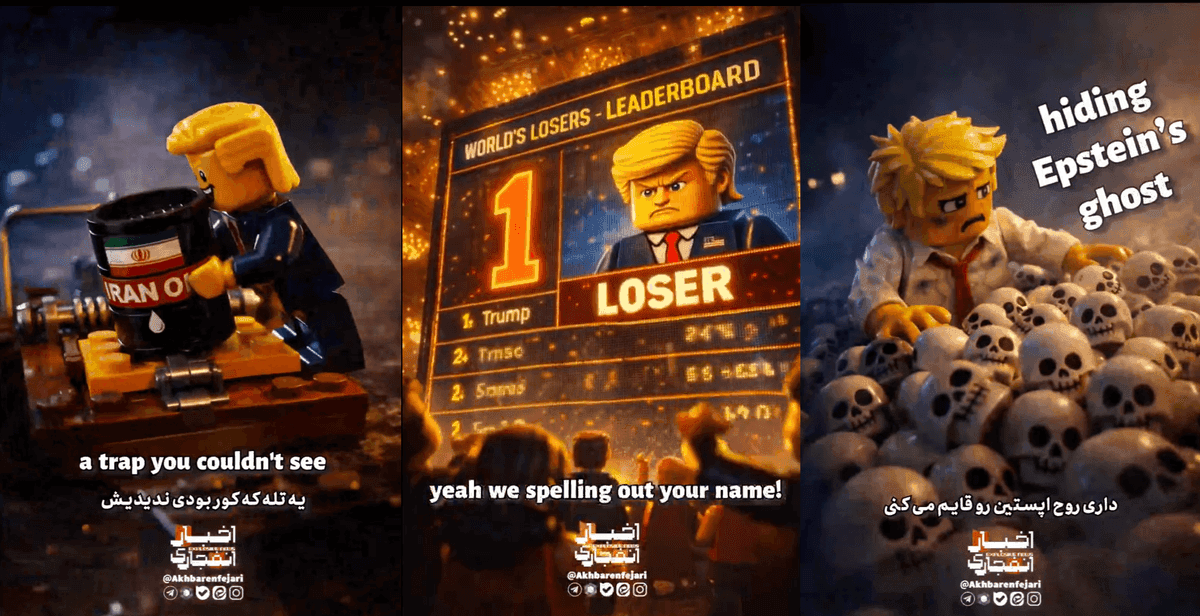
. The Iranian regime's "Explosive News Team" has produced AI-generated LEGO videos depicting Donald Trump as a war-hungry figure, with one viral video set to a catchy rap song about Trump being a "LOSER" spreading across multiple platforms1
.
Source: 404 Media
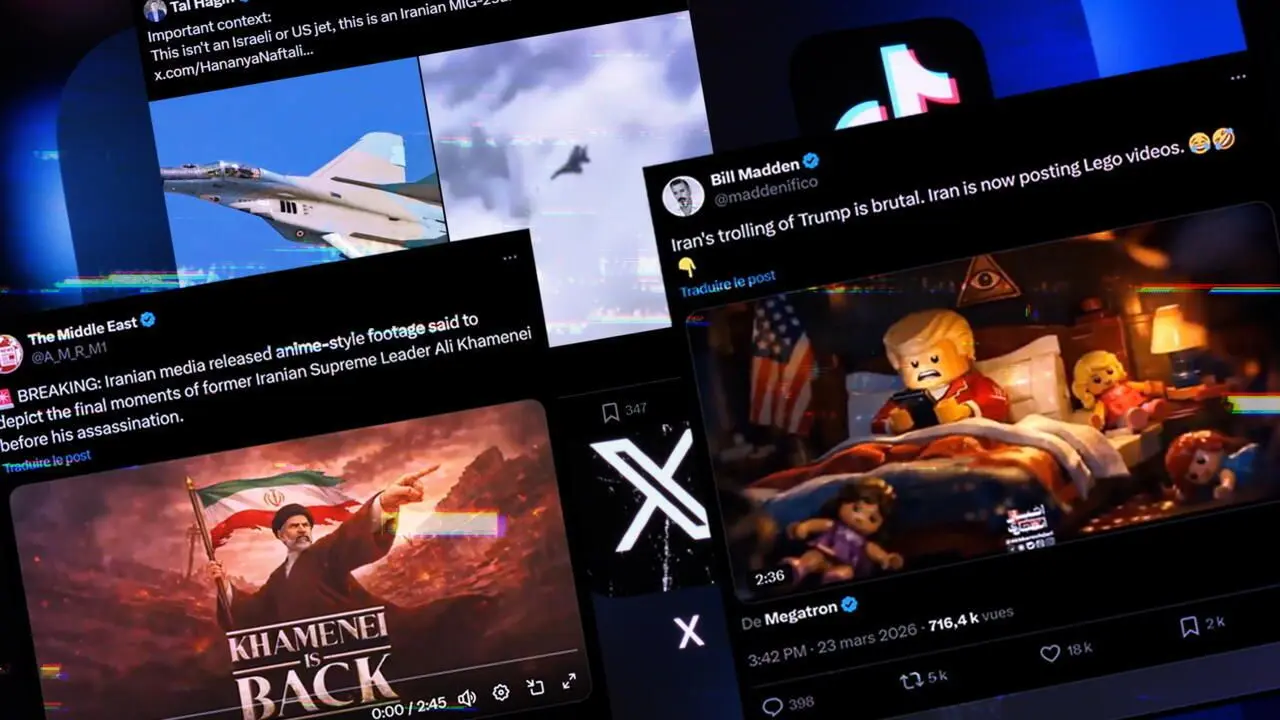
The sophistication of Iran's approach reveals a deep understanding of American digital culture. These AI-generated videos use familiar Western media references including LEGO movies and Teletubbies to craft messages that resonate with American audiences
2
. The pro-Iran memes make use of AI technology and sophisticated animation, holding Trump and Benjamin Netanyahu up to ridicule while presenting protagonists as LEGO-style characters3
. "Iran's use of LEGO set rap music tells me it's been studying us. These are videos meant for the American people crafted in a language Iran knows we'll understand," notes the analysis1
.The online information war demonstrates how memetic warfare favors asymmetric actors who can produce viral content without monopolizing traditional media channels. Roger Stahl, a professor of communication studies at the University of Georgia, explains that "the platform itself and the viral nature of things favors asymmetric, low-power actors because they can produce something that will go viral if it's clever enough"
3
.
Source: France 24
The accounts analyzed in the Clemson study had previously been used for Iranian influence operations designed to exploit regional fault lines by posting politically divisive content such as critiques of the US immigration crackdown
2
.Iran's strategy extends beyond entertainment-style memes to include disinformation designed to paint the regime as more successful in the conflict. AI videos and photographs claiming to show devastation Iranian strikes have wrought on Israel and the Gulf states spread widely, with information warfare analyst Tal Hagin tracking hundreds of examples of videos and images showing Iranian attacks that are either years old, of attacks on different countries, or AI-generated
2
. "There was a strike in Tel Aviv on February 28th, and the videos and photos of those strikes have been used every single day to allegedly depict new strikes," Hagin said, adding that the strategy works because "they put a ton of lies into that grain of truth, so people don't know what the truth is anymore"2
.While Iran targets the broader American public with culturally relevant content, the White House has released videos featuring Grand Theft Auto and Call of Duty memes that critics say were out of fashion a decade ago
1
. The administration's approach includes videos stitching together declassified US Central Command footage with clips from Wii Sports, popular movies, television shows, and SpongeBob cartoons4
. An unnamed senior White House official defended the strategy to Politico, stating: "We're over here just grinding away on banger memes, dude"3
.
Source: The Hill
The contrast in effectiveness is striking. A Pew poll found 61 percent of Americans disapprove of Trump's handling of the conflict, while Ipsos polling from mid-March found US public opinion "overwhelmingly" against the war in Iran, with 58 percent opposing US military strikes and 78 percent against US boots on the ground
1
2
. "Trump continues to narrowcast to his base while losing support for his wildly unpopular war as Americans worry about skyrocketing gas prices, a tanking economy and stock market, insane lines at airports, and a war that has little rationale and apparently no real goal," the analysis states1
.Related Stories

The current conflict marks the first major war where AI-generated propaganda plays a central role in shaping public perception. "This conflict is the first time we've really seen" AI used to generate wartime propaganda at this scale, according to experts
2
. The viral videos function almost entirely on a visual level, removing language barriers, with spare text more often in English than in Farsi and references to potent topics in American political culture such as the Jeffrey Epstein scandal3
.Darren Linvill, co-director of Clemson's Media Forensics Hub and author of the study, notes that "the propaganda includes memes and cartoons that aren't meant to be perceived as real but are very good at spreading political messaging. The deepfakes portray a version of reality that [seems] genuine and often paint Iran as more successful in the conflict"
2
. Kelsey Atherton, Chief Editor at Center for International Policy, identifies striking themes connecting victims from Minab to Epstein, cartoonish antisemitism attributing hawkishness to sinister evil, and heavy emphasis on missiles and revenge-weapons1
.The success of Iranian AI propaganda reveals systemic failures in content moderation. "Social media platforms are not fulfilling their commitments on labelling content and removing it if it is provably false," said Melanie Smith, expert in information operations at the Institute for Strategic Dialogue, adding that "we're seeing content get millions of views before it's proven to be AI and labelled as such"
2
. The Iranian regime leverages both state media outlets and proxies to push its online message across platforms including X, Instagram, and Bluesky as a form of asymmetrical warfare targeting US audiences2
.Tine Munk, senior lecturer in criminology at Nottingham Trent University and specialist in digital warfare, explains that AI videos "travel fast and plug into emotions that people already have. They create a lot of noise, even when they are so obviously fake because it is easy to communicate complex ideas through visual storytelling using these shared cultural references"
2
. This development builds on an established economy where foreign actors have been incentivized to study what resonates with Americans and create businesses teaching others how to target them with AI-generated content1
.Summarized by
Navi
[1]
09 Apr 2026•Entertainment and Society

14 Mar 2026•Technology

21 Jun 2025•Technology

1
Policy and Regulation

2
Policy and Regulation

3
Technology