14 Sources
[1]
Amazon Is Considering Selling Its AI Chips to Other Companies
Amazon.com Inc. is considering selling its chips to other companies, Chief Executive Officer Andy Jassy said Thursday, adding that the cloud-computing giant's in-house silicon unit is on pace to bring in more than $20 billion over the course of a year. The disclosure offers a rare glimpse into the scale of Amazon's in-house chip operation, which produces general-purpose computing and AI accelerators, as well as chips that make the company's servers run more efficiently. Today, Amazon rents that hardware to customers of Amazon Web Services, the cloud-computing unit. But demand for processors capable of building artificial intelligence models has strained supply and sent companies looking for alternatives to Nvidia Corp.'s market-leading graphics processing units. "There's so much demand for our chips that it's quite possible we'll sell racks of them to third parties in the future," Jassy said in his annual letter to shareholders. The Amazon chief, who took the reins almost five years ago, said the chip business would have a $50 billion annual run rate if it were an independent business selling semiconductors to AWS customers and other third parties. Jassy also touted Amazon's $4 billion effort to bring speedy delivery to shoppers in rural America.
[2]
Amazon cloud unit's AI revenue run rate exceeds $15 billion in first quarter, CEO says
April 9 (Reuters) - Amazon.com (AMZN.O), opens new tab said on Thursday its cloud business's AI revenue run rate was more than $15 billion in the first quarter of 2026, the company's first disclosure of direct financial returns from its artificial intelligence efforts. The numbers are also "ascending rapidly", Amazon CEO Andy Jassy said in a letter to shareholders, adding that its cloud business as a whole would be growing even faster without the capacity constraints that the tech industry is currently facing. Jassy also said the annual revenue run rate for Amazon's chips business, which produces its Graviton and Trainium processors, is now over $20 billion, doubling from the $10 billion milestone the company reported earlier this year. "There's so much demand for our chips that it's quite possible we'll sell racks of them to third parties in the future," Jassy added. Reporting by Deborah Sophia in Bengaluru; Editing by Jonathan Ananda and Devika Syamnath Our Standards: The Thomson Reuters Trust Principles., opens new tab
[3]
Amazon CEO Jassy defends $200 billion AI spend: "We're not going to be conservative"
"We're not going to be conservative in how we play this -- we're investing to be the meaningful leader, and our future business, operating income, and [free cash flow] will be much larger because of it," Jassy wrote. The company disclosed in February that it expects to spend roughly $200 billion this year on capital expenditures, with the lion's share going toward AI infrastructure, including data centers, chips and networking equipment. That's more than any of its tech peers, and a nearly 60% increase from last year. Amazon shares have struggled so far this year as investors question the company's aggressive AI spending plans and grow increasingly impatient about when the investments will pay off. The stock has slid more than 4% year to date.
[4]
Amazon's chip business could be worth $50 billion, Jassy says, and he hints it may sell them externally
In short: Andy Jassy's annual letter to shareholders, published on 9 April 2026, reveals that Amazon's custom chip business, covering Graviton, Trainium, and Nitro, generates more than $20 billion in annualised revenue growing at triple-digit rates year-on-year. If sold on the open market like Nvidia, Jassy says, the business would be worth roughly $50 billion a year. He also signals that Amazon may begin selling those chips directly to third parties, and defends the company's $200 billion capital expenditure plan for 2026 as grounded in committed customer demand rather than speculation. Jassy opened the letter's financial argument with a direct rebuttal of the scepticism that has surrounded Amazon's capital commitments. "We're not investing approximately $200 billion in capex in 2026 on a hunch," he wrote. "We're not going to be conservative in how we play this. We're investing to be the meaningful leader, and our future business, operating income, and free cash flow will be much larger because of it." The context for that claim is a company that saw its free cash flow fall from $38 billion to $11 billion last year, driven by a $50.7 billion increase in capital spending, the bulk of it committed to AI infrastructure. The defence rests on customer commitments already in place. Of the CapEx expected to be deployed in 2026, Jassy said a substantial portion already has customer backing, citing as one example OpenAI's commitment of more than $100 billion to AWS. That commitment, which expanded an existing $38 billion seven-year partnership struck in November 2025, also includes OpenAI consuming approximately two gigawatts of Trainium capacity through AWS infrastructure. SoftBank, which holds a majority stake in OpenAI and has been financing its infrastructure build through mechanisms including a $40 billion bridge loan, is in effect underwriting part of the demand that Jassy is now pointing to as validation for his CapEx stance. Amazon's custom silicon programme spans three product lines. Graviton is a custom CPU that Jassy says delivers more than 40% better price-performance than comparable x86 processors, the market that Intel and AMD dominate. It is now used by 98% of the top 1,000 EC2 customers, a figure that reflects a shift in the economics of cloud compute that has been underway for several years. Demand is sufficiently intense that two large AWS customers asked whether they could purchase all available Graviton capacity for 2026. Amazon declined. Trainium is the AI training and inference accelerator that represents Amazon's most direct response to Nvidia. Trainium2, which Jassy says offers roughly 30% better price-performance than comparable GPU alternatives, has largely sold out. Trainium3, which began shipping in early 2026 and offers a further 30 to 40% improvement in price-performance over Trainium2, is nearly fully subscribed, with Uber among the companies that have moved workloads onto it. Trainium4, still approximately 18 months from broad availability and featuring interoperability with Nvidia's NVLink Fusion interconnect technology, has already been significantly reserved. Nitro, the custom network and security chip that underpins AWS's virtualisation layer, completes the three-chip portfolio. Together, Jassy says the three lines produce more than $20 billion in annualised revenue, growing at triple-digit percentage rates year-on-year. "If we were a standalone chip company," he writes, "our chips would be generating over $50 billion in annual revenue." The business currently exists entirely within AWS; customers access Trainium and Graviton through EC2 instances rather than buying chips directly. At scale, Jassy argues, Trainium will "save us tens of billions of capex dollars per year, and provide several hundred basis points of operating margin advantage versus relying on others' chips for inference." That claim is central to the investment thesis underpinning the $200 billion CapEx programme: custom silicon is not only a competitive differentiator but a structural cost advantage that compounds over time as the ratio of inference to training in AI workloads continues to rise. Jassy is careful in how he frames the competitive dynamic with Nvidia. "We have a strong partnership with NVIDIA, will always have customers who choose to run NVIDIA," he writes, while also asserting that "virtually all AI thus far has been done on NVIDIA chips, but a new shift has started." Customers, he says, "want better price-performance." Nvidia, which reported revenue of $68.1 billion in the fourth quarter of 2025, a 73% year-on-year increase, entered 2026 from a position of market dominance that Amazon's custom silicon is chipping away at from within the AWS customer base rather than in any broader merchant market. Trainium4's incorporation of NVLink Fusion means Amazon is also building in a bridge rather than a wall: customers can combine Trainium accelerators with Nvidia GPUs within the same system, preserving optionality for enterprises that have invested heavily in Nvidia's software stack. The letter's most consequential signal on chips, however, may be a single sentence about the future: "There's so much demand for our chips that it's quite possible we'll sell racks of them to third parties in the future." Amazon currently monetises its custom silicon exclusively through EC2 compute services. Selling chips directly would represent a structural shift in its competitive posture, placing it in the merchant silicon market alongside Nvidia and AMD, and allowing the economics of the chip business to be assessed independently of the cloud revenue it currently underpins. The shareholder letter situates the chip business within a wider AI infrastructure thesis. Amazon Bedrock, the managed service through which AWS customers access foundation models including Amazon's own Nova family, processed more tokens in Q1 2026 than in all prior periods combined, with inference volumes "nearly doubling month-over-month" in March. AWS's AI revenue run rate crossed $15 billion in Q1 2026, a figure Jassy contextualises by noting it represents growth roughly 260 times faster than AWS experienced at a comparable stage of its development. Jassy also uses the letter to frame Amazon's satellite internet service, Amazon Leo, as a competitive counterpart to SpaceX's Starlink, having already secured contracts with Delta Air Lines, JetBlue, AT&T, Vodafone, and NASA. The satellite and chip disclosures share an underlying argument: that Amazon is building infrastructure at a scale and across categories that most observers have not fully priced in. The legal scrutiny that has begun to attach itself to Amazon's AI products, including a proposed class action over the training data used for Nova Reel, represents one category of risk that the letter does not address. The year 2025 established AI infrastructure as the central capital allocation question for the technology industry, and Jassy's letter is, in part, an argument that Amazon arrived at the right answer earlier and more decisively than the market has yet recognised.
[5]
'Not on a hunch': Andy Jassy defends Amazon's $200B spending spree
Andy Jassy's new letter to Amazon shareholders is a data-heavy defense of the tech giant's biggest bets -- from AI and custom chips to satellite internet and 20-minute delivery. In the process, the Amazon CEO discloses that AI revenue for AWS has hit a $15 billion annual run rate, that Amazon's internal chips business is generating over $20 billion a year, and that two large customers asked to buy all of Amazon's available Graviton chip capacity for 2026. Amazon said no, but Jassy says it gives a sense for the demand. "We're not investing approximately $200 billion in capex in 2026 on a hunch," he writes. That is basically the thesis statement for this year's letter, released Thursday morning. It continues a tradition that stretches back nearly three decades, to Amazon founder Jeff Bezos's first shareholder letter in 1997, which introduced the world to the "Day 1" mindset and is appended to the latest letter every year in an attempt to show its enduring relevance. The evolution: This is Jassy's fifth installment since succeeding Bezos as CEO in 2021. His letters have gone from establishing his management philosophy and navigating a post-pandemic cost hangover to laying out the frameworks Amazon uses to invent and build. This year he touches on progress in businesses including grocery (where Amazon says it's now the second-largest U.S. grocer), satellite broadband (Amazon Leo is set to launch commercially in mid-2026), Amazon Now delivery (expanding from India to the U.S. and Europe), Alexa+, and Zoox, its autonomous ride-hailing service now starting commercial service. His overarching message: progress won't be a straight line (here, Jassy's letter riffs on the title of an album by the New Zealand indie rock band The Beths) but Amazon is placing big bets on many fronts simultaneously, as it has throughout its history, and the results will come. The unstated plea: have patience, folks, we've been here before, and look how it turned out. The AI bet: Nowhere is this appeal more important than in AI, given investor concerns about the massive investments being made across the industry. Throughout the letter, Jassy makes the case that the company's huge capital outlays are backed by real demand and realistic economics. Jassy readily acknowledges that Amazon's free cash flow (FCF) dropped from $38 billion to $11 billion last year, driven by a $50.7 billion increase in capital spending, primarily on AI infrastructure. That was despite revenue overall growing 12% from $638 billion to $717 billion last year. "AI is a once-in-a-lifetime opportunity where the current growth is unprecedented and the future growth even bigger," he writes, adding later, "We're not going to be conservative in how we play this -- we're investing to be the meaningful leader, and our future business, operating income, and FCF will be much larger because of it." AWS AI revenue: The disclosure about the annual revenue run rate for AI in AWS ($15 billion as of Q1 2026) is a preview of sorts of Amazon's upcoming quarterly earnings, which won't be reported for a few weeks. Amazon hasn't previously reported this type of AI revenue figure. To put the figure in context, AWS overall had a $142 billion dollar revenue run rate as of Q4 25. "We have never seen a technology more quickly adopted than AI," he writes, adding later, "Amazon is smack in the middle of this land rush, and companies are choosing AWS for AI." Jassy compares the current AI wave to the early days of AWS, noting that three years after AWS launched commercially the cloud division had a $58 million revenue run rate. Three years after generative AI took off, the company's AI business is nearly 260 times greater than that. Future external businesses: Jassy points to two areas where Amazon may open up internal capabilities to outside customers. * It's "quite possible" Amazon will sell racks of its internally developed chips to third parties in the future, he writes. * In addition, he says, Amazon will explore building and selling its robotics solutions to other industrial and consumer customers. Both follow the Amazon playbook of building something internally, then offering it as an external service -- the same pattern behind businesses such as AWS and Fulfillment by Amazon, the company's logistics services for third-party sellers. Chips economics: Jassy says Amazon currently only monetizes its custom chips through its own EC2 cloud service, but if the chips business were standalone and sold externally like Nvidia, the annual run rate would be roughly $50 billion. He projects that at scale, Trainium will save "tens of billions of capex dollars per year" and provide "several hundred basis points of operating margin advantage" versus relying on third-party chips for inference. Trainium2 has largely sold out. Trainium3, which started shipping in early 2026, is nearly fully subscribed. Trainium4, still about 18 months from broad availability, has already been significantly reserved. "Our chips business is on fire," Jassy writes, noting that the business "changes the economics for AWS, and will be much larger than most think." Across Amazon's business, he writes, "It's hard to overstate my optimism for what's ahead." Read the full letter here.
[6]
Amazon may sell Trainium AI chips to third parties in shot at Nvidia
Amazon $AMZN CEO Andy Jassy is floating the prospect of selling the company's Trainium AI chips directly to external buyers, putting a dollar figure on the company's chip operation for the first time and placing its annualized revenue above $20 billion. "There's so much demand for our chips that it's quite possible we'll sell racks of them to third parties in the future," Jassy wrote in his annual shareholder letter Thursday. Access to Amazon's chips is currently limited to Amazon Web Services, with customers paying for cloud-based usage rather than owning any physical hardware. Selling to AWS and external customers alike, as standalone chipmakers do, would put annual revenue at around $50 billion, up from the $20 billion the company estimates for the year, Jassy said. The $20 billion figure spans three product lines: Trainium, the AI accelerator chip; Graviton, a general-purpose processor; and Nitro, a chip that helps run Amazon's EC2 server instances. All three are growing at triple-digit rates year over year, Jassy claimed in his letter. Jassy said demand for Trainium has outpaced supply at each generation. Trainium2 is essentially unavailable, with its entire allocated capacity spoken for. Trainium3 started reaching customers in early 2026, and reservations have filled nearly all available supply. Even Trainium4 -- which is not expected to reach wide release for another year and a half -- has substantial pre-orders committed. Jassy argued that a full-scale Trainium rollout could shave tens of billions off annual capital costs while meaningfully widening profit margin. The chip disclosure comes as Jassy defended Amazon's plan to spend roughly $200 billion on capital expenditures in 2026 -- most of it on AWS data centers. Heavy AI-related property and equipment purchases, which surged $50.7 billion year over year, compressed free cash flow to $11 billion in 2025 from $38 billion. AWS's AI business is running at more than $15 billion in annualized revenue as of the first quarter of 2026, up from essentially nothing three years ago, Jassy said. The company's overall AWS revenue run rate stood at $142 billion in the fourth quarter of 2025, representing 24% year-over-year growth. Supply of AI-grade chips has been unable to keep pace with demand across the industry, a squeeze that has motivated buyers to explore processor options outside Nvidia $NVDA's product line. "Virtually all AI thus far has been done on NVIDIA chips," Jassy added, "but a new shift has started."
[7]
Andy Jassy Bets $200B on A.I. to Cement Amazon's Tech Dominance
Andy Jassy commits $200 billion to A.I., betting Amazon's growth will come from chips, data and AWS innovation. Amazon is going all in on A.I. and betting more money on it than anyone else in Silicon Valley. Under CEO Andy Jassy, the tech giant plans to pour a staggering $200 billion into A.I. infrastructure this year, the biggest corporate investment of its kind, as it races to seize what Jassy calls a "once-in-a-lifetime opportunity." His next task? Convincing investors that the gamble will pay off. Sign Up For Our Daily Newsletter Sign Up Thank you for signing up! By clicking submit, you agree to our <a href="http://observermedia.com/terms">terms of service</a> and acknowledge we may use your information to send you emails, product samples, and promotions on this website and other properties. You can opt out anytime. See all of our newsletters Amazon's skyrocketing capital expenditures weren't made "on a hunch," said Jassy in his annual shareholder letter published today (April 9). "A.I. is a once-in-a-lifetime opportunity where the current growth is unprecedented and the future growth even bigger." Already, those investments are beginning to pay dividends. A.I. services provided by AWS, Amazon's cloud computing business, have helped push its quarterly revenue run rate past $15 billion in early 2026, Jassy revealed. "Amazon is smack in the middle of this land rush, and companies are choosing AWS," he said. Jassy, who succeeded Jeff Bezos as CEO in 2021, spent 24 years building AWS before taking the helm. His own path wasn't linear. He once pursued sports broadcasting, coached high school soccer, and tried launching startups before joining Amazon. AWS's rise has been far from straightforward, too. Launched in 2002, the platform's early forays into payments and databases fell flat. But persistence paid off. Its success didn't follow "a straight line," Jassy noted. Adaptability, he said, is essential in a world of shifting technology and business models. "One of these seminal shifts is A.I." Beyond software, AWS is also booming in hardware. Demand for its Trainium chips, Graviton processors, and Nitro platform has lifted its chip division to an annual revenue run rate above $20 billion, growing at a triple-digit clip. Interest is so intense that AWS faces "capacity constraints that yield unserved demand," Jassy said, adding that two customers even asked to buy all of Amazon's Graviton capacity for 2026. "We can't agree to these requests given other customers' needs, but it gives you an idea of the demand." That demand is driving even greater investment. "We're not going to be conservative in how we play this -- we're investing to be the meaningful leader, and our future business, operating income and [free cash flow] will be much larger because of it," said Jassy. Amazon has already lined up major customers for its massive outlay, including a recent $100 billion multi-year deal with OpenAI to run workloads on AWS. Additional agreements are underway, Jassy said, suggesting that much of its 2026 spend will be recouped in the next few years. Despite partnering with rivals -- Amazon has also invested heavily in Anthropic, a key OpenAI competitor -- the company isn't worried about conflicts of interest. Matt Garman, CEO of AWS, said Amazon's collaborative approach has long been its strength. "The world is big -- I don't think any of these places are a winner-take-all market," he told an audience at the HumanX conference in San Francisco this week. "We think there's space for many of these companies to be successful."
[8]
Amazon CEO reveals AI revenue, dismisses spending doubts in annual letter
Amazon's cloud division has reached a remarkable milestone, raking in more than $15 billion each year from its AI offerings. This impressive figure highlights the success of Amazon's heavy investments in technology. Additionally, the company's custom chip sector is thriving, boasting annual revenues exceeding $20 billion. With plans to market these chips externally, Amazon is poised for further expansion. Amazon's AI services at its cloud-computing unit are generating annualized revenue of more than $15 billion, CEO Andy Jassy said, the first time the company has reported numbers on a business it has backed with billions of dollars in investment. The figure, based on first-quarter performance, represents roughly 10% of Amazon Web Services' $142 billion revenue run-rate and follows years of wait from investors and analysts. The disclosure was one of several Jassy made on Thursday in his annual shareholder letter that sketched an increasingly confident portrait of the technology giant's AI ambitions. Amazon shares rose 4.5%. Like rivals, Amazon is under pressure to prove its spending on AI would pay off. The company projected $200 billion in capital expenditure this year, mainly focused on AI, a figure that spooked investors and fanned worries about an industry bubble. "We're not investing ... on a hunch," Jassy said. "Of the AWS capex we expect to spend in 2026, much of which will be monetized in 2027-2028, we already have customer commitments for a substantial portion of it." Investors cheered Amazon's update. "The AI run-rate is a strong validation that AWS is successfully turning the AI boom into real, high-growth revenue," said Brian Mulberry, chief market strategist at Zacks Investment Management, which holds Amazon shares. "It's still 'early days' per Jassy, but the momentum positions AWS as a leader in AI infrastructure." Meanwhile, smaller cloud rival Microsoft said in January its AI business had crossed an annual revenue run-rate of $13 billion in late 2024. While the disclosures from Amazon and Microsoft offer more clarity on Big Tech's AI investment returns, they still do not compare directly, as the revenue run-rate metric projects annual performance by extrapolating current sales and relies heavily on the period it is calculated in. CUSTOM CHIP BOOM Jassy also pointed to rapid growth in Amazon's custom chip business, as large tech companies develop their own processors to cut dependence on Nvidia's costly AI chips. That business, which includes Graviton processors, Trainium AI chips and Nitro networking cards, now has an annualized revenue run-rate of over $20 billion, doubling from the $10 billion disclosed alongside fourth-quarter results. Jassy suggested Amazon could eventually sell its chips to outside customers. Rival Google has found success with a similar strategy, striking a deal last October to supply Claude-creator Anthropic with one million of its custom AI chips, worth tens of billions of dollars. "There's so much demand for our chips that it's quite possible we'll sell racks of them to third parties in the future," Jassy said.
[9]
Amazon CEO Says Chip Business Is 'On Fire,' Graviton & Trainium Now Competing At Intel, AMD, And NVIDIA Scale
Amazon's CEO, Andy Jassy, issued a letter to shareholders about the company's custom chip business, and his words showed strong optimism about the in-house infrastructure stack. Amazon's Andy Jassy Hints Towards Selling Their Custom Silicon To External Customers, Given Their Internal Success There's no doubt that hyperscalers are experiencing what we call a 'compute crunch' today, with current infrastructure unable to meet the demand driven by AI and related services. We have seen giants like Amazon, Google, and Meta resort to custom silicon efforts as a way to address this gap in compute capabilities, but out of the bunch, Amazon's Trainium chips and Graviton server CPUs have proven themselves to be a mature offering, which is why CEO Andy Jassy has shown immense confidence in them. While speaking with shareholders, Jassy says their custom chip business is scaling to achieve $50 billion in ARR, surprisingly higher than what AMD and Intel have achieved. Having our own hotly demanded AI chip opens up many possibilities, but perhaps none larger than the ability to lower costs for customers and secure better economics for AWS. At scale, we expect Trainium will save us tens of billions of capex dollars per year, and provide several hundred basis points of operating margin advantage versus relying on others' chips for inference. - Amazon's CEO The $50 billion ARR figure is an estimate of what Amazon's custom chip business would be if it were to spin off into a separate entity and become a compute provider like NVIDIA. The growth of Trainium and Graviton primarily comes from AWS's cloud services, and Amazon still hasn't offered up its custom silicon to those who need compute. Jassy says that the economics brought in by AWS and the ASIC option are superior to NVIDIA's, and while he iterates his commitment to NVIDIA, he adds a note that customers want an option that dominates "price-performance", and he believes Trainium serves this a lot better. Amazon's CEO also throws shade at Intel and its CPU market share, saying that after the debut of the ARM-based Graviton chips, AWS's infrastructure is now dominated by them. Jassy says a similar situation is playing out between training and inference with Trainium. There's an interesting thesis with his statement, one that the industry probably doesn't realize. The idea of custom infrastructure isn't to replace mainstream compute options, such as those from NVIDIA, but rather to address the compute gap so large that hyperscalers like Amazon cannot rely solely on GPU manufacturers. Interestingly, Amazon also hinted at selling its racks to third-party customers, suggesting it could very well compete directly with NVIDIA and others. Backed by the 'hundreds of billions' in CapEx the firm plans to invest into the business, it would be interesting to see how the Trainium + Graviton stack evolves moving ahead. Follow Wccftech on Google to get more of our news coverage in your feeds.
[10]
Amazon Plays Both Sides: Chip Competition Leads To Team-Ups - Amazon.com (NASDAQ:AMZN)
Amazon Plays Both Sides: Competing -- And Partnering -- With Nvidia, AMD And Intel For Amazon.com Inc. (NASDAQ:AMZN), rivalry and partnership go hand in hand. According to Amazon Web Services CEO Matt Garman, the company competes with big name chip suppliers while simultaneously collaborating with them. He added that AWS remains a major customer of these companies because clients demand access to multiple hardware options, reinforcing a strategy that balances competition with collaboration. Multi-Model Ecosystem, Not A Winner-Takes-All Market Garman said AWS focuses on delivering the best technology across models, applications, and infrastructure by working with leading AI companies like Anthropic and OpenAI. He emphasized that customers want access to a wide range of models and capabilities, and AWS enables that at scale. He added that the AI market will support multiple winners, with different technologies serving different use cases rather than a single dominant player. Investments And Custom Chips Strengthen AI Position Garman said AWS treats its investments in companies like Anthropic as independent financial decisions while also benefiting from stronger partnerships. He noted that Anthropic's models run on Trainium chips, helping AWS improve chip design, performance, and efficiency. He also pointed to customer adoption, including Uber moving significant workloads to AWS to use Graviton and Trainium, as validation of its integrated hardware and AI strategy. Analysts See Strong AWS Momentum Despite Cost Pressures JPMorgan analyst Doug Anmuth maintained an Overweight rating on Amazon and raised his price forecast to $280 from $265. He also increased AWS forecasts by about 2%-3% through 2026 and more than 4% in 2027, projecting growth of roughly 28%-30% in 2026 and 26% in 2027. AWS demand continues to outpace supply, he added. Backlog will likely rise as Amazon scales infrastructure and AI chips, while investments in international expansion, pricing, quick commerce, and Amazon Leo weigh on near-term operating income. Fuel costs are also a headwind but Anmuth maintains a positive medium-term outlook. Separately, Bank of America Securities analyst Justin Post reaffirmed a Buy rating with a $275 price target, citing strong enterprise demand for AI services. Rapid growth at Anthropic suggests widespread adoption of AI tools, potentially driving further upside for AWS. Post highlighted that capturing a significant share of Anthropic's workloads could add up to $1 billion in quarter-over-quarter AWS revenue. Rising AI demand, a growing backlog, and plans to double AWS power capacity by 2027 may further support revenue growth and enhance returns on capital spending. AMZN Price Action: Amazon.com shares were up 2.72% at $227.26 at the time of publication on Thursday, according to Benzinga Pro data. Photo: Shutterstock Market News and Data brought to you by Benzinga APIs To add Benzinga News as your preferred source on Google, click here.
[11]
Amazon CEO Andy Jassy Rejects AI Bubble Fears | PYMNTS.com
By completing this form, you agree to receive marketing communications from PYMNTS and to the sharing of your information with our sponsor, if applicable, in accordance with our Privacy Policy and Terms and Conditions. Jassy said that while investment spikes invite scrutiny, AI is a game-changer that will reinvent every customer experience. "I've followed the public debate on whether this technology is over-hyped, whether we're in 'a bubble,' and if the margins and ROIC [return on invested capital] will be appealing. My strong conviction, at least for Amazon, is that the answers are no, no, and yes," Jassy said in the letter. Jassy said during a February earnings call that Amazon expects to invest about $200 billion in capital expenditures this year to add capacity for AI and core cloud workloads. In Thursday's letter, Jassy said AI is being adopted more quickly than any previous technology, Amazon Web Services (AWS) is in the middle of this "land rush" and is being selected by companies for AI, AWS could be growing even faster if it had more power capacity, and the company's chips business will be much larger than most people think. "Having our own hotly demanded chip opens up many possibilities, but perhaps none larger than the ability to lower costs for customers and secure better economics for AWS," Jassy said. "At scale, we expect Trainium will save us tens of billions of capex dollars per year, and provide several hundred basis points of operating margin advantage versus relying on others' chips for inference." Amazon's annual revenue run rate for its chips business, which includes Graviton, Trainium and Nitro, is over $20 billion and growing triple-digit percentages year over year, Jassy said. "If our chips business was a stand-alone business, and sold chips produced this year to AWS and other third parties (as other leading chips companies do), our annual run rate would be ~$50 billion," Jassy said. Amazon has customer commitments that make its capex investments predictable, Jassy added. "We are willing to make large capex investments and endure short-term FCF [free cash flow] headwinds for the substantial medium to long-term FCF surplus," Jassy said. "AI is a once-in-a-lifetime opportunity where the current growth is unprecedented and the future growth even bigger." Outlining developments across Amazon's businesses, such as retail, cloud computing services, advertising and autonomous ride-hailing service, Jassy said AI will play a role in all of them. "Across all of this, AI is not a standalone initiative -- it's a multiplier," Jassy said. "It will reshape every customer experience we offer and unlock entirely new ones."
[12]
Amazon generating $15B in AI revenue, CEO Andy Jassy says
Amazon's AI services at its cloud-computing unit are generating annualized revenue of more than $15 billion, CEO Andy Jassy said, the first time the company has reported numbers on a business it has backed with billions of dollars in investment. The figure, based on first-quarter performance, represents roughly 10% of Amazon Web Services' $142 billion revenue run-rate and follows years of wait from investors and analysts. The disclosure was one of several Jassy made on Thursday in his annual shareholder letter that sketched an increasingly confident portrait of the technology giant's AI ambitions. Amazon shares rose 4.6%.in Thursday afternoon trading. Like rivals, Amazon is under pressure to prove its spending on AI would pay off. The company projected $200 billion in capital expenditure this year, mainly focused on AI, a figure that spooked investors and fanned worries about an industry bubble. "We're not investing ... on a hunch," Jassy said. "Of the AWS capex we expect to spend in 2026, much of which will be monetized in 2027-2028, we already have customer commitments for a substantial portion of it." Investors cheered Amazon's update. "The AI run-rate is a strong validation that AWS is successfully turning the AI boom into real, high-growth revenue," said Brian Mulberry, chief market strategist at Zacks Investment Management, which holds Amazon shares. "It's still 'early days' per Jassy, but the momentum positions AWS as a leader in AI infrastructure." Meanwhile, smaller cloud rival Microsoft said in January its AI business had crossed an annual revenue run-rate of $13 billion in late 2024. While the disclosures from Amazon and Microsoft offer more clarity on Big Tech's AI investment returns, they still do not compare directly, as the revenue run-rate metric projects annual performance by extrapolating current sales and relies heavily on the period it is calculated in. Jassy also pointed to rapid growth in Amazon's custom chip business, as large tech companies develop their own processors to cut dependence on Nvidia's costly AI chips. That business, which includes Graviton processors, Trainium AI chips and Nitro networking cards, now has an annualized revenue run-rate of over $20 billion, doubling from the $10 billion disclosed alongside fourth-quarter results. Jassy suggested Amazon could eventually sell its chips to outside customers. Rival Google has found success with a similar strategy, striking a deal last October to supply Claude-creator Anthropic with one million of its custom AI chips, worth tens of billions of dollars. "There's so much demand for our chips that it's quite possible we'll sell racks of them to third parties in the future," Jassy said.
[13]
AWS AI Revenue Tops $15 Billion as Chip Business Doubles
Amazon CEO Reveals $15 Billion AWS AI Revenue Run Rate as Custom Chip Growth Accelerates Amazon said its cloud unit now generates more than $15 billion in annualized revenue from artificial intelligence services, as the company gave fresh figures on a business tied to its Chief Executive Andy Jassy shared the update in his annual shareholder letter and said customer commitments already cover a substantial portion of planned AWS capital spending. Amazon shares rose about 1.5% in premarket trading after the update.
[14]
Amazon raises $15bn in annual AI revenue
Amazon has announced that its artificial intelligence services within AWS now generate more than $15bn in annualized revenue, representing approximately 10% of its cloud division's revenues, estimated at $142bn. This first quantitative disclosure regarding this strategic segment was welcomed by the markets, with the stock rising 4.5% amid ongoing questions about the scale of capital expenditure. The group forecasts nearly $200bn in capital expenditure this year, primarily dedicated to AI. Andy Jassy asserts that this spending is backed by already robust customer demand and is expected to begin yielding returns between 2027 and 2028. Amazon is thus seeking to demonstrate that the current AI momentum is already translating into concrete revenue, following the lead of Microsoft, which has also reported on its performance in this field. In parallel, the group's proprietary technologies, such as Graviton and Trainium chips and Nitro systems, now generate over $20bn in annual revenue. Amazon is considering expanding their commercialization beyond its own ecosystem in a rapidly growing market where infrastructure and components have become major strategic levers.
Share
Copy Link
Amazon revealed its custom chip business generates over $20 billion annually, growing at triple-digit rates. CEO Andy Jassy disclosed in his shareholder letter that AWS AI revenue reached a $15 billion run rate in Q1 2026, while defending the company's $200 billion capital expenditure plan. The tech giant may soon sell its Trainium and Graviton chips directly to third parties.
Amazon AI has reached a pivotal moment as the company disclosed that its custom chip business now generates over $20 billion in annual revenue, doubling from the $10 billion milestone reported earlier this year
2
. CEO Andy Jassy revealed in his annual shareholder letter that the business is growing at triple-digit percentage rates year-on-year, encompassing the company's Graviton, Trainium, and Nitro chip lines4
. The disclosure offers a rare glimpse into the scale of Amazon's in-house chip operation, which produces general-purpose computing and AI accelerators designed to make the company's servers run more efficiently1
.
Source: GeekWire
Jassy went further, stating that if Amazon's custom chip business were an independent company selling semiconductors on the open market like Nvidia, it would generate roughly $50 billion in annual revenue
1
. Currently, the company only monetizes these AI chips through its EC2 cloud computing service within AWS, but that model may be about to change5
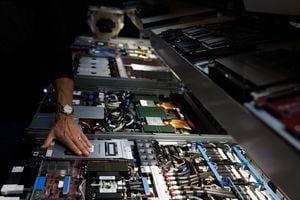
.The demand for Amazon's custom chips has become so intense that Jassy signaled the company may begin selling AI chips to third parties. "There's so much demand for our chips that it's quite possible we'll sell racks of them to third parties in the future," Jassy wrote in his shareholder letter
2
. This potential shift would follow Amazon's established playbook of building capabilities internally before offering them as external services, the same pattern that created AWS and Fulfillment by Amazon5
.
Source: Quartz
The appetite for Amazon's silicon is evident in customer behavior. Two large AWS customers asked whether they could purchase all available Graviton capacity for 2026, a request Amazon declined
5
. Graviton, Amazon's custom CPU, now delivers more than 40% better price-performance than comparable x86 processors and is used by 98% of the top 1,000 EC2 customers4
. Meanwhile, Trainium2 has largely sold out, Trainium3 is nearly fully subscribed, and Trainium4—still approximately 18 months from broad availability—has already been significantly reserved4
.In another significant disclosure, Jassy revealed that AWS's AI revenue run rate exceeded $15 billion in the first quarter of 2026, marking the company's first public statement of direct financial returns from its artificial intelligence efforts
2
.Source: Market Screener
These numbers are "ascending rapidly," Jassy noted, while adding that AWS as a whole would be growing even faster without the capacity constraints currently facing the tech industry
2
. To contextualize this figure, AWS overall had a $142 billion revenue run rate as of Q4 20255
.Jassy positioned Amazon AI as being "smack in the middle of this land rush," comparing the current wave to the early days of cloud computing. Three years after AWS launched commercially, the cloud division had a $58 million revenue run rate. Three years after generative AI took off, the company's AI business is nearly 260 times greater
5
. "We have never seen a technology more quickly adopted than AI," he wrote5
.Related Stories
The revelations come as Andy Jassy mounted a vigorous defense of Amazon's $200 billion capital expenditure plan for 2026, with the lion's share directed toward AI infrastructure investment including data centers, chips, and networking equipment
3
. This represents nearly a 60% increase from last year and exceeds the spending of any tech peer3
. Amazon shares have struggled this year as investors question the aggressive spending plans and grow impatient about when the investments will pay off, with the stock sliding more than 4% year to date3
."We're not investing approximately $200 billion in capex in 2026 on a hunch," Jassy wrote. "We're not going to be conservative in how we play this—we're investing to be the meaningful leader, and our future business, operating income, and free cash flow will be much larger because of it"
3
. He readily acknowledged that Amazon's free cash flow dropped from $38 billion to $11 billion last year, driven by a $50.7 billion increase in capital spending5
.The defense rests on committed customer demand rather than speculation. A substantial portion of the expected 2026 CapEx already has customer backing, including OpenAI's commitment of more than $100 billion to AWS, which expanded an existing $38 billion seven-year partnership
4
. This commitment includes OpenAI consuming approximately two gigawatts of Trainium capacity through AWS infrastructure4
.Trainium chips represent Amazon's most direct response to Nvidia's market dominance in AI accelerators. Trainium2 offers roughly 30% better price-performance than comparable GPU alternatives, while Trainium3 provides a further 30 to 40% improvement over Trainium2
4
. Major customers like Uber have already moved workloads onto Trainium3, which began shipping in early 20264
.At scale, Jassy projects that Trainium will "save us tens of billions of capex dollars per year, and provide several hundred basis points of operating margin advantage versus relying on others' chips for inference"
5
. Notably, Trainium4 will feature interoperability with Nvidia's NVLink Fusion interconnect technology, allowing customers to combine Trainium accelerators with Nvidia GPUs within the same system4
. Jassy carefully framed the competitive dynamic: "We have a strong partnership with NVIDIA, will always have customers who choose to run NVIDIA," while asserting that "virtually all AI thus far has been done on NVIDIA chips, but a new shift has started"4
.Summarized by
Navi
[4]
29 Apr 2026•Business and Economy

04 Dec 2024•Technology

02 Dec 2025•Technology

1
Policy and Regulation

2
Entertainment and Society

3
Technology