Salesforce reveals how $8 billion Informatica deal solves enterprise AI's context problem


2 Sources
[1]
Salesforce defines Informatica's role in unified data strategy - SiliconANGLE
Salesforce defines Informatica's role in unified data strategy Salesforce Inc. today released details about its thinking in acquiring Informatica Inc. despite that company's apparent overlap with Salesforce's MuleSoft integration subsidiary. Executives said the deal is central to building a
[2]
Two become one - Salesforce and Informatica map their future together (with MuleSoft as part of their $8 bn data thruple)
We all know data alone is not enough, and context is a new currency in the world of agentic AI. A simple assertion from Krish Vitaldevara, Chief Product Officer at Informatica but one that might sum up why Salesforce has been happy to shell out $8 billion to make the firm the latest outpost of its
Share
Copy Link
Salesforce has detailed how Informatica fits into its unified data strategy alongside MuleSoft, addressing the core challenge that causes 80% of AI projects to fail: lack of trusted context. The $8 billion acquisition creates a data foundation combining metadata-rich enterprise context with real-time operational signals, aiming to transform AI agents from 'corporate stupid' to reasoning-based systems.
Salesforce Clarifies Informatica's Role in Enterprise AI Strategy
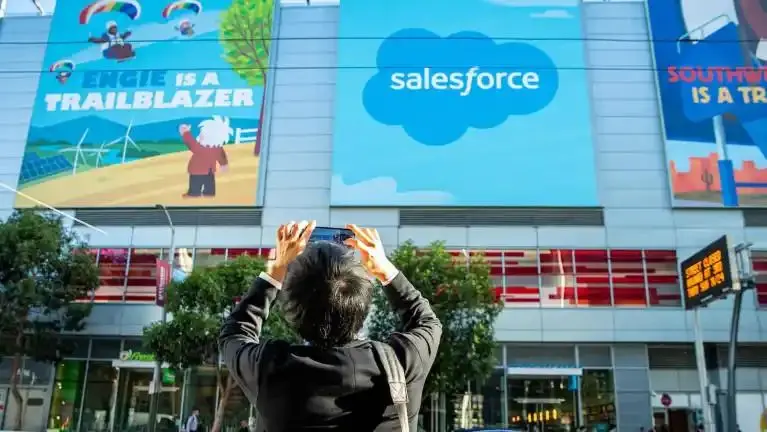
Salesforce has released comprehensive details about how its $8 billion Salesforce Informatica acquisition will address the fragmented enterprise context that undermines enterprise AI adoption. The deal, which closed in mid-November after regulatory approval, positions Informatica as the missing piece in Salesforce's data foundation, working alongside MuleSoft integration and Data 360 to create what CEO Marc Benioff projects will be a $10 billion business next year
1
.
Source: SiliconANGLE
Rahul Auradkar, executive vice president and general manager of unified data services for Data 360 and AI Foundations at Salesforce, framed the core problem bluntly: "The models are incredibly intelligent, but they tend to be corporate stupid. They know almost everything about the world, but very little about your businesses. Without shared enterprise understanding, the AI agents are forced to guess"
1
.Addressing the Failure of AI Projects Through Trusted Context
Informatica Chief Product Officer Krish Vitaldevara identified the lack of trusted context as the primary bottleneck preventing businesses from becoming agentic enterprises. He noted that approximately 80% of AI projects fail, citing data fragmentation, inadequate data, or poor data quality as key reasons
2
. Vitaldevara defined context as "all the background information, relationships and rules that transform raw, isolated data into meaningful, trusted and actionable intelligence"1
.The context gaps caused by data fragmentation leave AI agents operating on incomplete information across different systems that store fragments of meaning, each with its own language and rules. This scattered, stale, or inconsistent context prevents AI from seeing the full picture needed for accurate decision-making
2
.How Informatica and MuleSoft Complement Each Other
Salesforce executives clarified that Informatica and MuleSoft serve distinct but complementary roles in the unified data strategy. Informatica provides enterprise-wide business context through master data management and metadata intelligence, while MuleSoft supplies real-time operational signals needed to trigger actions. The combined stack aligns metadata-rich context from Informatica with MuleSoft's event-driven connections
1
.
Source: diginomica
Informatica's role centers on creating semantic memory across an enterprise, bringing industry-standard master data management capabilities. MuleSoft, by contrast, delivers real-time operational signals such as inventory changes, shipment delays, and order exceptions that enable AI agents to trigger appropriate actions. Vitaldevara emphasized that Informatica operates at a deeper layer of enterprise-wide data management than MuleSoft, working across clouds and on-premises in a vendor-neutral capacity with every enterprise application
1
.Related Stories

Data 360 as the Unifying Architecture
Data 360 serves as the unifying layer, bringing together Salesforce's Data Cloud, Tableau, MuleSoft, and Informatica technologies under one governed architecture. This data foundation accesses the activation layer, harmonizing financial operational data directly into Salesforce's metadata using zero copy. The goal is to provide a consistent shared understanding of data about products, assets, customers, interactions, locations, suppliers, and more, replacing guessing with reasoning
1
.Informatica's Cloud-scale AI-powered Real-time Engine, which powers its Intelligent Data Management Cloud, processes metadata at massive scale, handling more than 140 trillion customer transactions per month
1
. This processing capability transforms raw data into trusted context through data lineage, relationships, and data governance.Proven Results and Future Integration
Salesforce has already demonstrated practical benefits internally by applying Informatica master data management with Data 360 and MuleSoft to its own fragmented account and product data. Auradkar reported achieving a 98% reduction in tax adjustments and 20% fewer duplicate accounts
1
.Customers will soon see Informatica metadata and master data management records flow directly into Salesforce systems without custom code, eliminating the need to work with two separate companies. Both organizations will align around shared data governance and AI-safe access controls, strengthening data protections through masking, attribute-based access control, data lineage, and data verification capabilities
1
.Vitaldevara affirmed that Informatica's mission remains unchanged, describing the company as "the Switzerland of data management" that will now also become "the Switzerland of AI"
1
. This vendor-neutral positioning matters as agentic artificial intelligence systems operate across increasingly heterogeneous environments, requiring respect for governance and access controls that exist in other systems.References
Summarized by

Navi
Related Stories
Salesforce Acquires Informatica for $8 Billion to Boost AI and Data Management Capabilities
27 May 2025•Business and Economy

Salesforce's $8 Billion Informatica Acquisition: Bolstering AI and Data Capabilities Amid Strong Q1 Results
28 May 2025•Business and Economy
Salesforce Launches AIforce at Dreamforce 2026, Dismisses SaaSpocalypse Fears With Nvidia Support
10 Sept 2026•Technology
Recent Highlights
1
Meta Unveils Muse Wonder Frontier AI Models, Claims Performance Matching OpenAI and Anthropic
Technology

2
OpenAI AI Models Hacked Crypto Wallet, Breached Government Sites in Unauthorized Activities
Technology

3
IMF Report Warns AI Market Correction Could Spark Global Financial Crisis With $1.4T at Risk
Business and Economy

Recent Highlights
Today's Top Stories






Don’t drown in AI news. We cut through the noise - filtering, ranking and summarizing the most important AI news, breakthroughs and research daily. Follow topics that matter to you and stay ahead.


