Salesforce Launches AIforce at Dreamforce 2026, Dismisses SaaSpocalypse Fears With Nvidia Support


21 Sources
[1]
Benioff calls the SaaSpocalypse "crazy nonsense
Marc Benioff opened Dreamforce by waving away fears that AI will kill software, then launched AIforce to bring Salesforce into Claude, Slack and other AI tools. Jensen Huang joined him on stage to agree, as the two companies unveiled Koa, a CRM reasoning model. Salesforce chief executive Marc
[2]
Salesforce CEO Marc Benioff says the SaaSpocalypse is 'crazy nonsense' - and Jensen Huang agrees with him
Nvidia CEO says AI "is going to make the software so much better" * Salesforce CEO Marc Benioff calls the SaaSpocalypse "crazy nonsense" * Instead, he predicts a new kind of software interface will make all the difference * Nvidia CEO Jensen Huang agrees, saying the end of software isn't
[3]
Salesforce unveils Trusted Enterprise AI Harness | VentureBeat
New AI harnesses -- the code and instructions that control a generative AI model's outputs automatically, steering AI agents to complete set tasks in a more predictable fashion -- are becoming almost as numerous as AI models themselves. So it should probably come as little surprise that
[4]
Many models, many agents, many tasks: Salesforce's new Enterprise AI Harness seeks to ground all in your shared business context
New AI harnesses -- the code and instructions that control a generative AI model's outputs automatically, steering AI agents to complete set tasks in a more predictable fashion -- are becoming almost as numerous as AI models themselves. So it should probably come as little surprise that
[5]
Dreamforce 2026 - why CEO Marc Benioff thinks this is the year of the living interface for Salesforce
This will be the year of interfaces. I don't think there's any question about that. Yesterday in my look at the AIforce announcement made at Dreamforce, I said that I still wasn't entirely clear that the messaging here was complete and expressed a hope that things would be fleshed out during the
[6]

Salesforce announces AIforce, unlocking the power of its platform using composable agents
Salesforce announces AIforce, unlocking the power of its platform using composable agents Salesforce Inc. unveiled AIforce today during its Dreamforce user conference, a new artificial intelligence interface layer that brings the power of the company's platform to where people use AI agents to
[7]
Dreamforce 2026 - how PwC's alliance with Salesforce pays a workforce dividend by taking AI to the customer edge
Many enterprises are getting stuck with their AI deployments, unable to see the value of moving forward with investment, yet too worried about losing out to competitors to cut losses. PwC thinks that the problem lies with applying AI to existing processes, rather than using it to power workflows in
[8]
Salesforce deepens its integrations with AWS and Google Cloud to support AI agents
Salesforce deepens its integrations with AWS and Google Cloud to support AI agents Salesforce Inc. is stretching its data and artificial intelligence tentacles further into the public cloud, announcing expanded strategic integrations with both Amazon Web Services Inc. and Google Cloud. The
[9]
Dreamforce 2026 - may the AIforce be with you (whatever it is...)
We're actually dis-intermediating Salesforce. We are basically saying, 'Why should I ever log into Salesforce?' When Salesforce co-founder Parker Harris said that back in April, it took everyone by surprise. This from the creator of Salesforce's celebrated Lightning user interface (UI)? As with
[10]
Salesforce introduces Enterprise AI Harness, AI Control Plane
Salesforce introduces Enterprise AI Harness, AI Control Plane Salesforce Inc. today previewed two offerings that will help customers build and manage artificial intelligence agents. Developers turn a large language model into an agent by extending it with various add-ons. Those add-ons can
[11]

Salesforce Dreamforce 2026: CEO Benioff Touts New AIforce Interface Layer
'It's an interface revolution,' Salesforce CEO and co-founder Marc Benioff says. Salesforce used its Dreamforce 2026 event to unveil AIforce, a new live interface layer that connects enterprise data and workflows to AI tools, plus expanded partnerships with Amazon Web Services, Google Cloud and
[12]

Salesforce Introduces AI Agents to Transform High-Value Business Work
Salesforce is introducing a new portfolio of job-ready agents built to take on high-value work across sales, service, commerce, employee experience, and the back office. Connected to Customer 360, these agents can work with the customer context and business processes companies already have in
[13]
Dreamforce 2026 - what Salesforce's AWU experiment means for agentic licensing
Salesforce has been running a pricing experiment on the Agentic Work Unit as a way to track Agentforce adoption. Although the reported numbers have continued to grow across various public statements, it has not yet made its way into official, customer-facing pricing schemes. The introduction of a
[14]

AWS and Salesforce Put CRM Data, AI Agents, and Model Choice Into the Tools Teams Use Every Day
New integrations bring Salesforce data, context, and actions into Amazon Quick, AWS agents into Slack, and Agent2Agent (A2A) support for real-time, bidirectional voice between Agentforce Voice and Amazon Connect Customer -- putting AI where customers work, grounded in data they trust, without
[15]
Salesforce Unveils Trusted Enterprise AI Harness for Secure AI Agents
Trusted Action securely connects AI to applications, APIs, workflows, tools, and business processes so agents can move from understanding what needs to happen to getting it done. It allows the agent to reserve inventory, update the order, trigger fulfillment, or engage a person when needed. The
[16]
Dreamforce 2026 - what the State of Salesforce tells us about user priorities around agentic deployment
I always know when its Dreamforce time because that means it's also time for the annual State of Salesforce report, first published by consultancy Bluewolf, but now the property of IBM Consulting, which bought out Bluewolf ten years ago. (Doesn't time fly?) It's always a useful theoretical
[17]
Salesforce Unveils AIforce, Bringing the Full Power of Its Platform to Any Interface
AIforce unlocks tremendous value by enabling agents anywhere to reason and take action across all the data, workflows, and logic inside Salesforce, Instead of fixed UI, AIforce empowers anyone to build composable, intelligent, live interfaces, wherever work happens At Dreamforce, Salesforce, the
[18]
Salesforce Expands Agentforce with a New Portfolio of AI Agents Built for High-Value Work
New job-ready agents help companies get to business outcomes faster across sales, service, commerce, and the workforce -- driving revenue, reducing costs, and improving customer experiences Every company is racing to turn AI into real business results. But the hardest part is no longer getting AI
[19]
Dreamforce 2026 - the Salesforce shape of things to come?
Here we go again - the 24th annual Dreamforce conference kicks off Tuesday in San Francisco, the biggest gathering of the Salesforce Ohana of the year and the opening up of the largest storefront for the firm to show off its wares and encourage adoption of its tech. So what can we expect from this
[20]
Salesforce Introduces the Trusted Enterprise AI Harness
A new architecture that gives AI a shared understanding of the customer and the business -- and enables it to act with trust, six trusted capabilities and a new AI Control Plane, built for an open and composable AI ecosystem The Agentic Enterprise is changing how work gets done -- and the role
[21]
Salesforce throws down the gauntlet on the enterprise AI harness
Ahead of the Dreamforce conference next week, Salesforce has introduced its Enterprise AI Harness. This is framed as a composable architecture that brings together trusted context, agency, action, governance, security and models to give AI the foundation it needs to understand and operate across
Share
Copy Link
Salesforce CEO Marc Benioff dismissed SaaSpocalypse fears at Dreamforce 2026, launching AIforce to integrate Salesforce with Claude, Slack and other AI tools. Nvidia CEO Jensen Huang backed the vision, as both companies unveiled Koa CRM reasoning model. The Trusted Enterprise AI Harness aims to govern multiple agent platforms across enterprises.
Salesforce CEO Dismisses SaaSpocalypse at Dreamforce 2026
Salesforce CEO Marc Benioff opened Dreamforce 2026 in San Francisco by dismissing widespread concerns about a "SaaSpocalypse" as "crazy nonsense."
1
Speaking to the audience, Benioff acknowledged the wild speculation over the past six months but clarified that the SaaSpocalypse "was not about the end of software, but it may be about the end of software that makes humans do all the work."1
Enterprise AI stocks had fallen sharply earlier in the year on fears that AI would disrupt traditional software companies, according to CNBC.1
However, Salesforce shares recovered, rising more than 50% from their 52-week low of $146 in late June.1
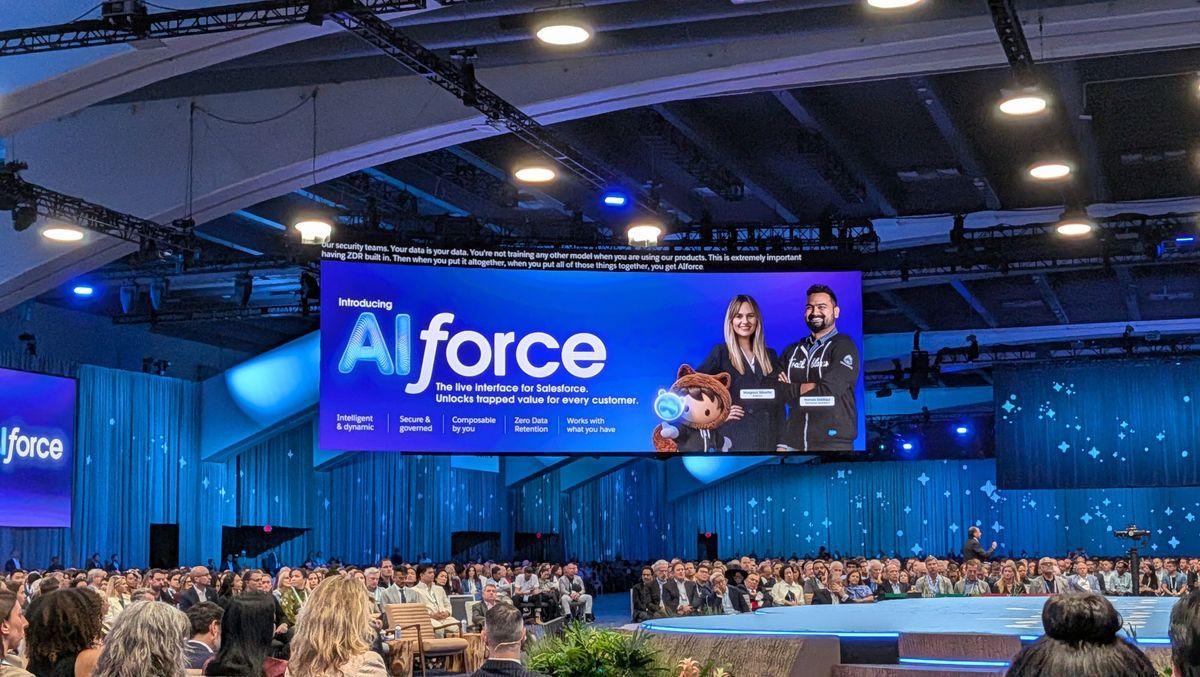
AIforce Launch Marks Interface Revolution
Source: TechRadar
Benioff's response to industry concerns came in the form of AIforce, launched at Dreamforce 2026 as what Salesforce describes as a "live interface layer."
1
The platform brings Salesforce's data, workflows, business logic, permissions and security to any AI interface or agent. "It's an interface revolution," Benioff declared on stage, comparing it to previous shifts from DOS to GUIs, GUIs to web, and web to mobile.1
He emphasized that AI interfaces will be "dynamic, intelligent, composable and alive."1
AIforce covers three surfaces: Claudeforce, built with Anthropic, which puts Salesforce inside Claude through an MCP server with 37 sales skills; Slackforce for live interfaces and Slack CRM; and Agentforce Coworker, an AI teammate inside Salesforce's Lightning interface.1
Within its first 35 days, 100,000 users activated Agentforce Coworker.1
Trusted Enterprise AI Harness Addresses Multi-Platform Reality
Salesforce also previewed its Trusted Enterprise AI Harness ahead of Dreamforce 2026, though full availability won't arrive until early next year.
3
The AI control system bundles six capabilities: Trusted Context, Trusted Agency, Trusted Action, Trusted Governance, Trusted Security and Trusted Models, alongside a new AI Control Plane for managing AI agents across an organization.3
This strategy addresses a complex enterprise reality. VentureBeat Intelligence's July 2026 Agentic Orchestration Pulse Survey found that 85% of organizations run two or more agent orchestration platforms simultaneously, with an average of 3.1 platforms per enterprise.3
Additionally, 53% expect their primary agent control plane by the end of 2026 to be hybrid, combining provider-native and external orchestration.3
Enterprise Context as Competitive Advantage
Rohan Kumar, Salesforce's president and chief platform and engineering officer, explained the strategic rationale behind the Trusted Enterprise AI Harness. "The intelligence that [is] coming from the model is ubiquitous," Kumar told VentureBeat.
3
What remains unique, he argued, is an organization's "enterprise trusted context": its customers, employees, transactions, data relationships, knowledge and history.3
As foundation models become more widely available, Salesforce contends that durable competitive advantage will come from proprietary context and operational controls placed around generative AI models.3
Kumar emphasized that AI agents need to understand company-specific definitions of revenue, customer churn, or account health, along with proper permissions and governance.3
Salesforce Research Shows Harness Impact on Performance
Salesforce's own AI researchers produced evidence demonstrating how the technical harness around a model substantially affects agent performance. In a September 8 Salesforce AI preprint research paper, researchers defined the harness as the system prompt, tool set, execution hooks and context-management scaffolding surrounding an LLM.
3
Across seven enterprise agent benchmarks, evolving the harness around a smaller Qwen model increased average task success from 29.2% to 78.0%, a 48.8 percentage-point improvement without changing the underlying model weights.3
However, the research also revealed complications: after fine-tuning the weaker model to imitate a stronger expert model, average success fell from 78.0% to 63.1%, with performance declining across all seven tasks due to loss of model-harness fit.3
Nvidia CEO Jensen Huang Backs Salesforce Vision
Source: diginomica
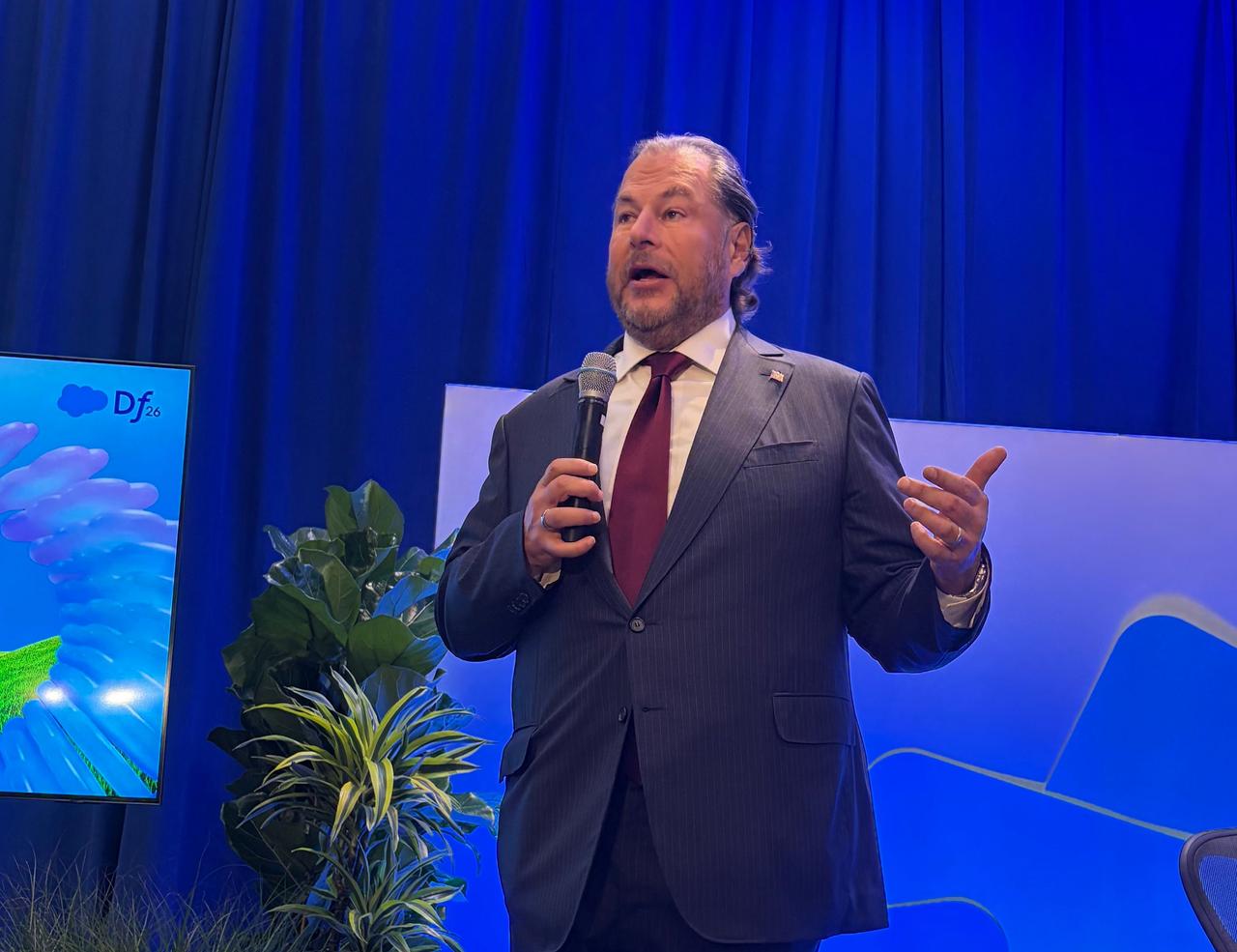
Nvidia CEO Jensen Huang joined Benioff on stage at Dreamforce 2026, strongly supporting the anti-SaaSpocalypse stance. "I was the first CEO to come out not in the software industry to say the end of software is nonsense," Huang stated.
2
He described AI-driven innovations as "a layer on top of software" that will be agentic and "make you use the software so much better."2
Huang encouraged the audience not to abandon emerging technology, advising that if a tool doesn't work immediately, they should test it again in a couple of weeks.1
"I'm more ambitious than ever," Huang declared. "The sky's the limit for our company, the sky's the limit for every industry, for every single country, so engage AI, don't get left behind."1
Related Stories


Koa CRM Reasoning Model Built on Nvidia Nemotron
The Salesforce-Nvidia partnership produced tangible results with the launch of Koa, described as Salesforce's first CRM reasoning model built for Agentforce.
1
Salesforce post-trained Koa on Nvidia's Nemotron 3 Super.1
The announcement came during Huang's appearance at the keynote, where the two CEOs also discussed AI safety following Benioff's interview with Anthropic CEO Dario Amodei.1
Zero Data Retention and Internal Deployment
Benioff stressed Salesforce's commitment to zero data retention, meaning customer data does not feed into the models. "Regardless of what you've heard on media or from other vendors, let me assure you that Salesforce products are built with zero data retention," he said.
1
Salesforce already operates its own business using these AI tools, with 7,000 users on Claudeforce internally.1
The company's Hunter sales agent generated $500 million in pipeline last quarter, while its Casey service agent resolved 5 million conversations.1
Patrick Stokes, Salesforce's president of applications and marketing, confirmed the Claude version is in open beta, with customers able to request access on AppExchange using their org ID.1
Living Interface and Model Agnostic Strategy
Source: SiliconANGLE
Benioff explained that his primary interface to Salesforce shifted to Slack several years ago, and he expects the living interface concept to become central to user experience.
5
"The applications that we showed in the keynote look nothing like what we've ever shown anyone before, because AI is building these apps based on its full knowledge of what's going on in the platform," he noted.5
Despite the close relationship with Anthropic, Benioff emphasized Salesforce remains model agnostic. He revealed that Salesforce initially wanted to invest in OpenAI but was blocked due to OpenAI's relationship with Microsoft, leading to investments of several hundred million dollars in Anthropic, Mistral, Sakana, and Cohere.5
That Anthropic investment has now grown to billions of dollars in value.5
Salesforce now has 30,000 companies at various deployment levels with Agentforce, and has introduced Agentic Work Units (AWUs) as a way to report exactly how much usage of Agentforce and agentic capabilities are happening in the platform.5
References
Summarized by

Navi
[1]
[2]
[4]
Related Stories
Recent Highlights



Recent Highlights
Today's Top Stories





Don’t drown in AI news. We cut through the noise - filtering, ranking and summarizing the most important AI news, breakthroughs and research daily. Follow topics that matter to you and stay ahead.


