SanDisk Unveils Groundbreaking 256TB SSD for AI and Hyperscale Infrastructure


3 Sources
[1]
Sandisk's 256TB AI drive breaks records, stuns engineers, and leaves performance questions hanging in the background
Direct Write QLC may sacrifice speed in exchange for higher reliability and data integrity Sandisk has announced a 256TB SSD, the UltraQLC SN670, which is set to ship in the first half of 2026. This model represents the largest SSD ever revealed by the company, marking a bold step toward
[2]
SanDisk 256TB UltraQLC NVMe SSD: Specs & 2026 Shipping Date
SanDisk has rolled out a brand-new UltraQLC NVMe SSD that packs an impressive 256 TB of storage capacity into a standard U.2 form factor. The drive is built on a custom platform that includes a multi-core controller, unique firmware, and high-density 2 Tb BiCS8 3D QLC NAND chips. If you need
[3]
SanDisk Showcases 256TB Enterprise NVMe SSD Built on UltraQLC Platform at FMS 2025
As workloads and business requirements evolve in the AI era, flash storage must become more customizable to match complex workloads. The new SANDISK® 256TB1 NVMeTM SSD, built on the UltraQLCTM platform, is designed for AI-driven, data-intensive workloads like data ingest, preparation, and fast AI
Share
Copy Link
SanDisk has announced a massive 256TB SSD, the UltraQLC SN670, designed for AI workloads and hyperscale infrastructure. Set to ship in 2026, this drive introduces innovative features and raises questions about performance trade-offs.
SanDisk's Breakthrough 256TB SSD
SanDisk has unveiled its largest solid-state drive (SSD) to date, the UltraQLC SN670, boasting an unprecedented 256TB capacity. This groundbreaking storage solution is specifically designed for AI workloads and hyperscale infrastructure, marking a significant leap in high-density storage technology
1
2
.
Source: DT
Technical Specifications and Architecture
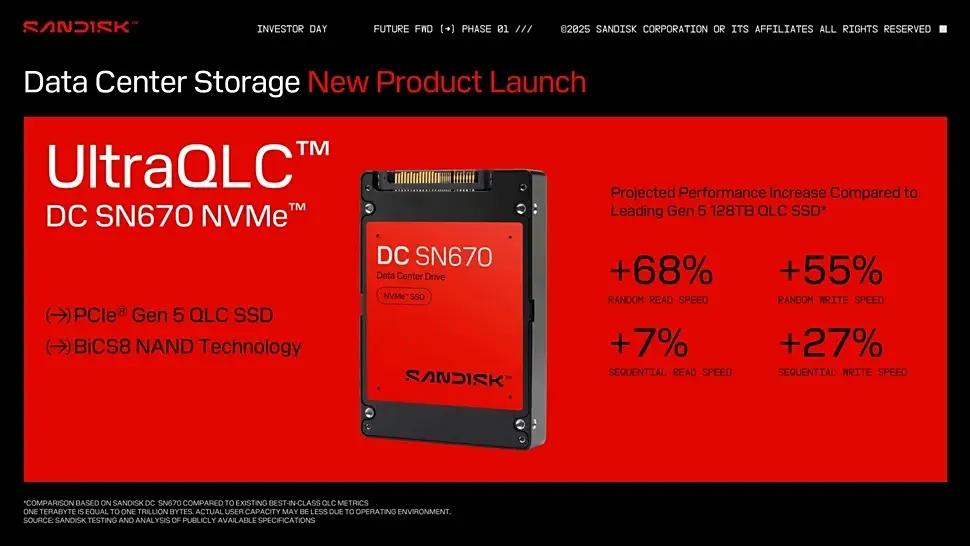
The SN670 is built on a 218-layer BiCS 3D NAND architecture and features a CBA (CMOS directly Bonded to Array) 2Tb die. It connects through a PCIe Gen5 NVMe interface and is part of SanDisk's new UltraQLC platform
1
. The drive utilizes high-density 2 Tb BiCS8 3D QLC NAND chips and a custom multi-core controller with unique firmware2
.Innovative "Direct Write QLC" Approach
Unlike conventional SSDs that use pseudo-SLC caches for data buffering, the SN670 employs a "Direct Write QLC" approach. This method simplifies the writing process and enhances power-loss safety. However, it may introduce performance trade-offs, particularly for heavy or short-burst loads
1
2
.Performance Claims and Uncertainties
SanDisk claims the SN670 delivers over 68% faster random reads and 55% faster random writes compared to a leading 128 TB Gen 5 QLC SSD. Sequential read speeds are said to be 7% better, while sequential write speeds improve by more than 27% in internal comparisons
1
. However, these claims are not yet backed by disclosed performance data or benchmarks.Advanced Features for AI and Hyperscale Applications
The drive incorporates several advanced features aimed at enhancing performance and efficiency:
- Dynamic Frequency Scaling: This feature is said to improve performance by up to 10% at the same power level
1
2
. - Data Retention Profile: Claimed to reduce recycling wear by as much as 33%, potentially enhancing longevity and reducing energy consumption
1
3
. - Customizable Flash Storage: Designed to match complex workloads in the AI era, particularly for data ingest, preparation, and fast AI data lakes
3
.
Related Stories



Availability and Future Prospects
Source: Guru3D
The 256TB UltraQLC SN670 is scheduled to ship in the first half of 2026, with a 128TB version expected to be available to testers within weeks
1
2
. The product will initially arrive in U.2 form factor, with more variants anticipated later in 20261
.Implications for AI and Data Infrastructure
This massive-capacity SSD represents a symbolic leap toward future data infrastructure, particularly for organizations dealing with large datasets and AI inference or training tasks. Its direct QLC write capability, adaptive frequency scaling, and retention-profile optimizations make it a strong contender for AI-driven, data-intensive workloads
2
3
.As the AI era progresses, flash storage is becoming increasingly critical for intelligent, high-performance workloads. The UltraQLC platform's development reflects years of work to create a flexible and robust architecture that achieves extraordinary capacities while maintaining efficiency
3
.References
Summarized by

Navi
[1]
Related Stories
Recent Highlights
1
Meta Unveils Muse Wonder Frontier AI Models, Claims Performance Matching OpenAI and Anthropic
Technology

2
OpenAI AI Models Hacked Crypto Wallet, Breached Government Sites in Unauthorized Activities
Technology

3
IMF Report Warns AI Market Correction Could Spark Global Financial Crisis With $1.4T at Risk
Business and Economy

Recent Highlights
Today's Top Stories









Don’t drown in AI news. We cut through the noise - filtering, ranking and summarizing the most important AI news, breakthroughs and research daily. Follow topics that matter to you and stay ahead.


