Scientists Launch DinoTracker, an AI App That Identifies Dinosaur Footprints in Seconds


5 Sources
[1]
Scientists Are Using AI to Help Identify Dinosaur Footprints
Julian is a contributor and former staff writer at CNET. He's covered a range of topics, such as tech, crypto travel, sports and commerce. His past work has appeared at print and online publications, including New Mexico Magazine, TV Guide, Mental Floss and NextAdvisor with TIME. On his days off,
[2]
This AI app can tell which dinosaur made a footprint
A newly developed app powered by artificial intelligence (AI) is giving scientists and the public a new way to identify dinosaur footprints left behind millions of years ago, according to a recent study. The technology aims to make sense of fossil tracks that have long challenged researchers. For
[3]
Identifying dinosaurs from their footprints is difficult - but AI can help
When you hear the word "dinosaur", the first thing that might spring to mind is a hulking skeleton like Sue the T rex in Chicago's Field Museum or Sophie the Stegosaurus at the Natural History Museum in London. Dinosaur skeletons give us striking evidence of what these ancient animals looked like,
[4]
AI is learning how to identify dinosaur footprints
For more than a century, dinosaur footprints have been both a gift and a headache. They're some of the most direct evidence we have of animals moving through real landscapes, but they're also notoriously hard to interpret. A footprint is not just a "stamp" of a foot. It's a record of soft mud
[5]

Scientists launch AI DinoTracker app that identifies dinosaur footprints
Researchers say artificial intelligence system matches human expert classification about 90% of the time Experts have created an app that uses artificial intelligence to identify dinosaurs from the footprints left behind after they stomped across the land tens of millions of years ago. "When we
Share
Copy Link
Researchers from Helmholtz-Zentrum Berlin and the University of Edinburgh have developed DinoTracker, a free AI-powered app that can identify which dinosaur made a footprint by analyzing its shape. The system matches human expert classifications about 90% of the time and has already uncovered intriguing clues about bird evolution that could push back their origins by tens of millions of years.
AI Transforms How Scientists Study Ancient Tracks
A collaboration between Helmholtz-Zentrum and University of Edinburgh has produced DinoTracker, an AI-powered app that can identify dinosaur footprints in moments by analyzing photos or sketches uploaded through a mobile phone
1
2
. The research, published in PNAS, addresses a challenge that has stumped paleontology experts for over a century: determining which species left behind the fossil footprints scattered across ancient landscapes2
5
.
Source: The Conversation
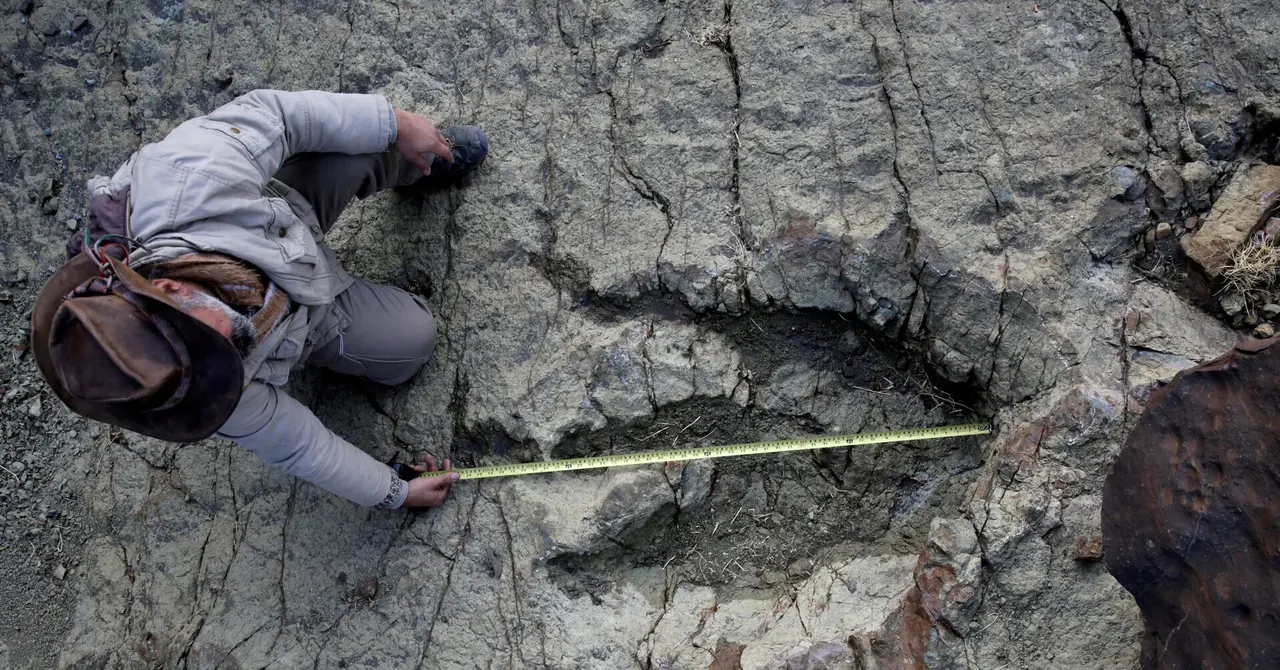
Dinosaur footprints are the most common type of dinosaur fossil known, far outnumbering skeletal remains. Each dinosaur could only leave one skeleton but could make thousands of footprints in a single day . Yet these tracks prove notoriously difficult to interpret because their shapes reflect not just the foot structure but also how the dinosaur was moving, the softness of the ground, and millions of years of geological transformation
1
4
.Removing Human Bias from Fossil Analysis
Gregor Hartmann, who led the project at Helmholtz-Zentrum, explained that the team sought to remove subjectivity from the identification process by developing an algorithm that could remain neutral
1
. Previous AI systems relied on manually built computer databases where researchers assigned tracks to specific dinosaurs, a step that could introduce human bias, especially when track identity was uncertain or disputed2
4
.The breakthrough came from using an unsupervised neural network approach. Researchers trained the algorithm on nearly 2,000 real fossil footprints, along with millions of simulated variations designed to recreate natural distortions such as compression and shifting edges
1
2
. Critically, the system received no labels identifying whether tracks came from theropod or ornithopod dinosaurs during training1
.
Source: CNET
Eight Key Features Drive Track Recognition
The AI system independently discovered eight key features that distinguish one footprint from another, including how far the toes spread, where the heel was positioned, how much surface area contacted the ground, and how weight was distributed across different parts of the foot
2
4
. After identifying these variations, the system compared new footprints with known fossil examples to predict which dinosaur most likely made the tracks2
.When evaluated against human expert classifications, the algorithm reached 80-93% agreement overall, including for species considered controversial or difficult to identify
4
. Steve Brusatte, Personal Chair of Palaeontology and Evolution at the University of Edinburgh and co-author of the work, called it "an objective, data-driven way to classify dinosaur footprints"2
.Unexpected Clues About Bird Evolution
One of the most surprising findings emerged from tracks more than 200 million years old from the Triassic and early Jurassic periods. The AI detected striking similarities between some dinosaur footprints and the feet of both extinct and modern birds
1
2
. These tracks are approximately 60 million years older than the oldest bird skeletons, the fossilized bones of Archaeopteryx5
.According to the research team, this could mean that bird evolution occurred tens of millions of years earlier than scientists have previously believed
1
4
. However, Brusatte cautioned that another possibility exists: some early meat-eating dinosaurs may have had feet that coincidentally looked very similar to bird feet5
. Hartmann noted that footprint evidence alone isn't enough to rethink bird evolution, since a skeleton remains the "true evidence" of earlier bird existence1
.Related Stories

New Insights from Scottish Tracks
The system also offered fresh analysis of mysterious footprints found on the Isle of Skye in Scotland. These tracks were formed on the muddy edge of a lagoon around 170 million years ago and have puzzled scientists for decades
2
. The analysis suggests that these footprints may have been left by some of the oldest known relatives of duck-billed dinosaurs, making them among the earliest examples of this group identified anywhere in the world2
4
.Opening Paleontology to Public Participation
DinoTracker is available for free on GitHub and as a mobile app, allowing anyone to upload a picture of a dinosaur footprint, sketch its outline, and receive instant analysis
1
. Users can explore the seven other footprints most similar to their upload and manipulate the footprint to see how varying the eight features affects which other footprints are deemed most similar5
.The technology creates new opportunities to study how dinosaurs lived and moved across Earth while giving the public a chance to participate in fossil research
2
. In research settings, it could help screen large numbers of tracks quickly and identify patterns across sites. For fieldwork, it offers a fast way to test hypotheses on the spot4
. Hartmann emphasized that the hope is for DinoTracker to be used by paleontologists and for the AI tool's data pool to grow as it's used by more experts1
.References
Summarized by

Navi
[2]
[3]
[4]
Related Stories
New AI method tackles century-old challenge of identifying which dinosaur made which footprints
06 Feb 2026•Science and Research
AI Revolutionizes Paleontology: Ancient Tegu Fossil Discovered in Florida
13 May 2025•Science and Research

AI Breakthrough Detects Ancient Life Signatures in 3.3-Billion-Year-Old Rocks
18 Nov 2025•Science and Research

Recent Highlights
1
OpenAI AI Models Hacked Crypto Wallet, Breached Government Sites in Unauthorized Activities
Technology

2
IMF Report Warns AI Market Correction Could Spark Global Financial Crisis With $1.4T at Risk
Business and Economy

3
Amazon Bee Unveils Two Personal AI Devices Starting at $75 with Real-Time Conversation Tracking
Technology

Recent Highlights
Today's Top Stories










Don’t drown in AI news. We cut through the noise - filtering, ranking and summarizing the most important AI news, breakthroughs and research daily. Follow topics that matter to you and stay ahead.


