South Korea proposes AI profit tax to fund citizen dividend as chip giants post record earnings


4 Sources
[1]
South Korea floats AI profit social tax as tech giants boom
Seoul (AFP) - A top South Korean official has proposed a tax on AI profits to be redistributed among society as a semiconductor boom drives massive earnings for tech giants Samsung Electronics and SK hynix. The two South Korean firms have emerged as key suppliers of high-performance chips powering
[2]
South Korea may use AI-driven tax gains to pay citizens: Top policymaker
A South Korean policymaker suggested a citizen dividend funded by AI profit taxes, sparking market volatility. The proposal aimed to redistribute gains from the AI boom, but was later clarified to target excess tax revenue rather than a new corporate levy, leading to a partial recovery in
[3]
South Korea official floats AI profit social tax as tech giants boom - The Economic Times
A top South Korean official has proposed a tax on AI profits to be redistributed among society as a semiconductor boom drives massive earnings for tech giants Samsung Electronics and SK hynix. Kim proposed what he tentatively called a "national dividend" for socially redistributing excess corporate
[4]
South Korea's radical 'AI dividend' proposal: A bold future or a market nightmare?
A senior South Korean policy official has sparked intense debate and a dramatic stock market swing by floating the idea of paying citizens a share of the economic windfall generated by artificial intelligence, spotlighting mounting pressure to more broadly distribute the enormous wealth flowing to
Share
Copy Link
A senior South Korean official has floated a controversial proposal to tax AI profits and redistribute them as a national dividend to citizens. The idea triggered sharp market swings, with the Kospi index plunging 5.1% before recovering after clarifications. The proposal highlights growing pressure to share wealth from the AI boom that's enriching Samsung Electronics and SK Hynix.
South Korea Floats AI Profit Tax Amid Semiconductor Boom
South Korea's senior presidential secretary for policy, Kim Yong-beom, has sparked intense debate by proposing what he calls a national dividend—a mechanism to redistribute wealth generated by AI through a tax on profits generated from AI
1
. The proposal comes as South Korean tech giants Samsung Electronics and SK Hynix post record first-quarter earnings, emerging as key suppliers of high-performance chips powering AI infrastructure globally3
. The AI boom has driven South Korea's benchmark Kospi index to repeatedly hit record highs, briefly approaching the 8,000-point mark1
.
Source: ET
Market Turbulence Follows AI Dividend Announcement
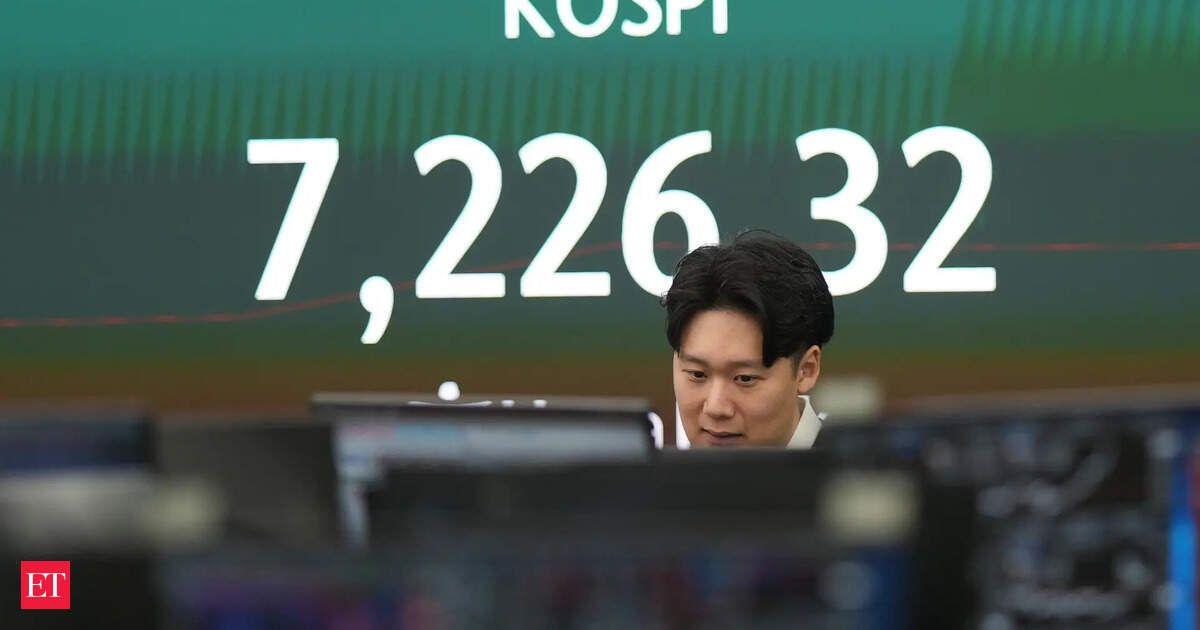
The top policymaker's Facebook post triggered immediate stock market fluctuation, with the Kospi plunging as much as 5.1% on Tuesday as investors struggled to understand the scope of the proposed AI profit tax
2
. Markets partially recovered after Kim clarified he intended to tap AI-driven tax gains from excess tax revenue rather than impose a new windfall levy on excess corporate profits. The index ultimately closed down 2.3%2
. The violent price swings reflect investor anxiety following a breathtaking rally that saw the Kospi rise nearly 86% through Monday, with performance heavily dependent on Samsung and SK Hynix, both of which have more than doubled in price this year4
.
Source: ET
Technology-Dominant Economy and Social Polarization Concerns
In his Facebook post, Kim argued that South Korea is shifting from a traditional export economy toward a technology-dominant economy driven by chip scarcity and sustained excess profits
1
. While acknowledging this shift represents "the core essence of the possibilities currently open before Korea," Kim warned it could deepen social polarization3
. He emphasized that using a portion of excess profits to ensure social stability and mitigate transition costs is "not merely redistribution, but also a type of system maintenance cost"1
. The proposal reflects mounting concern about wealth concentration, as Samsung's operating profit surged roughly 48-fold in the first quarter, while SK Hynix is expected to generate around 239 trillion won in profit this year4
.
Source: France 24
Related Stories

Proposed Uses for Citizen Dividend Program
The AI profit tax could fund multiple initiatives to redistribute wealth generated by AI, including startup support for young people, basic income programmes for rural and fishing communities, support for artists, and stronger pensions for the elderly
1
. Lawmaker Moon Geum-ju from the ruling Democratic Party argued last month that the semiconductor boom was built partly on "the sacrifice and patience of farmers and fishermen" and that profits should be returned to rural communities3
. However, the Blue House quickly distanced itself from the proposal, stating that Kim's post reflected "his personal opinion" and was "unrelated to any internal discussions or review within the Blue House"3
.Labor Tensions and Broader Redistribution Debate
The AI dividend proposal emerges amid labor tensions at Samsung Electronics, where the union has demanded removal of caps on performance bonuses and a system allocating 15 percent of operating profit to bonuses
1
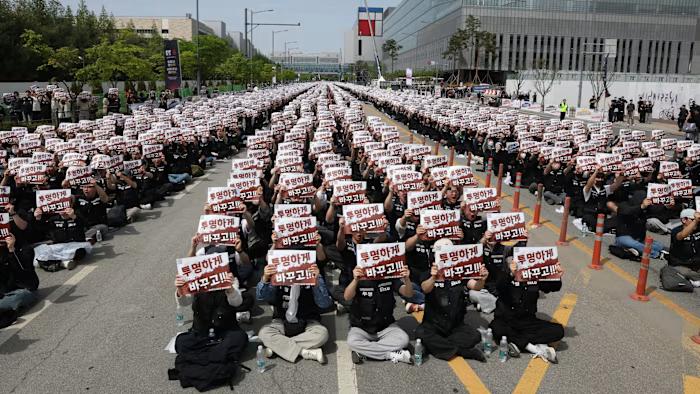
. Last month, tens of thousands of demonstrators gathered near Samsung's flagship chip campus demanding workers receive a larger share of AI boom profits, with the union threatening an 18-day walkout beginning May 214
. Workers point to rival SK Hynix, which pledged to channel 10 percent of annual operating profit into employee performance bonuses, as a benchmark4
. A global frenzy to build AI data centres has sent orders for advanced, high-bandwidth memory microchips soaring, while South Korea has said it will triple spending on artificial intelligence this year, aiming to join the United States and China as one of the top three AI powers1
.References
Summarized by

Navi
Related Stories
South Korea Creates $72 Billion Future Fund to Drive AI Investment and Support Youth Amid Chip Boom
21 Aug 2026•Policy and Regulation
South Korea Prioritizes AI Investment to Boost Economic Growth Amid Challenges
22 Aug 2025•Technology

South Korea lost 211,000 youth jobs to AI while senior employment surged—what it means globally
08 Jul 2026•Policy and Regulation
Recent Highlights
1
Microsoft and Nvidia Launch Surface Laptop Ultra: A $2,599 AI-Ready PC With RTX Spark Chip
Technology

2
Trump Consulted Grok AI Before Ordering Venezuela Invasion and Capture of Nicolás Maduro
Policy and Regulation

3
Scientists Build AI Model That Reconstructs Images From Brain Scans in Record Time
Science and Research

Recent Highlights
Today's Top Stories







Don’t drown in AI news. We cut through the noise - filtering, ranking and summarizing the most important AI news, breakthroughs and research daily. Follow topics that matter to you and stay ahead.


