South Korea Launches AI for All: Free, Unlimited AI Access as Public Infrastructure


3 Sources
[1]
'Other governments will be watching this closely' -- South Korea starts testing free AI for the public
Governments should focus on access and leave the unlimited chatbot fantasy behind Most governments still talk about artificial intelligence as something to regulate or subsidize. South Korea is trying something considerably bolder. It wants to make advanced AI available free to every citizen,
[2]
South Korea Will Give Every Citizen Free AI Access With Unlimited Tokens
Around a quarter of South Koreans already pay for generative AI, against roughly 2% of Americans. South Korea intends to hand every one of its citizens free access to generative AI, in what amounts to the first attempt by a national government to treat model access as something close to a public
[3]
Free AI Without Token Limits? South Korea's Ambitious Plan Explained
South Korea is preparing to make generative AI services available to its entire population at no cost. The move could have major implications for the country's technology industry and digital economy. The government's 'AI for All' program is designed to give citizens unlimited access to locally
Share
Copy Link
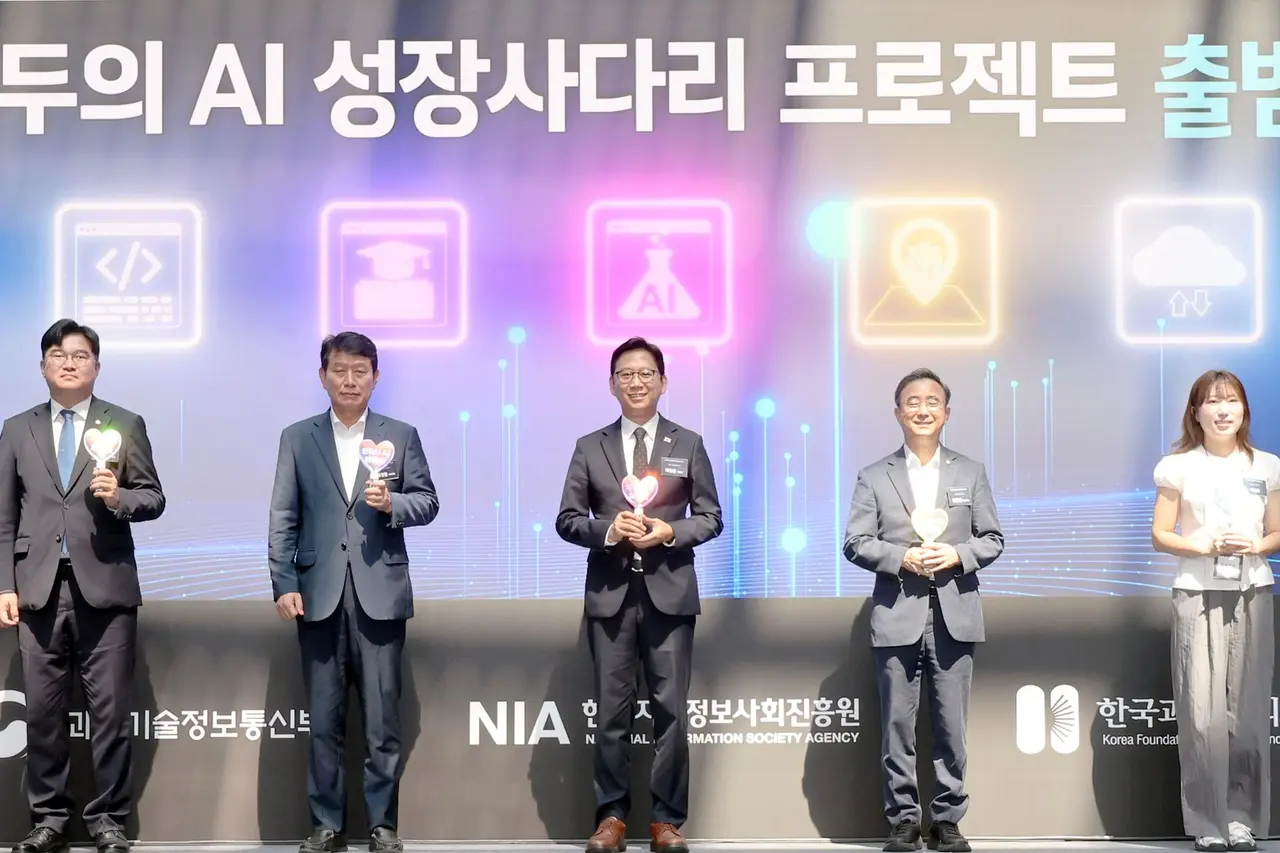
South Korea's Ministry of Science and ICT selected SK Telecom, KT, and Kakao to deliver free AI for the public through its AI for All program. Beta testing starts in September with full launch by end of 2026. The government-backed initiative aims to reduce reliance on foreign AI platforms while providing 512 Nvidia B200 GPUs and subsidizing nationwide operating costs from 2027.
South Korea AI Treats Access as Public Infrastructure
South Korea is implementing a government-backed initiative that reframes how nations approach artificial intelligence. The Ministry of Science and ICT has selected three consortiums led by SK Telecom, KT, and Kakao to deliver the AI for All program, which will provide free AI access to every citizen with no token limits or usage restrictions
1
2
. Beta testing begins in September, with full service planned by the end of 20262
3
. The government is supplying 512 Nvidia B200 GPUs this year and will subsidize nationwide operating costs from 20271
.
Source: TechRadar
Reducing Reliance on Foreign AI Platforms
The program addresses a strategic vulnerability. Roughly two-thirds of South Koreans have used AI services, with approximately 23 million people using generative AI regularly
1
. ChatGPT alone had an estimated 23.45 million monthly active users, while Gemini and Claude had 8.45 million and 2.41 million respectively1
2
. Only about 1.8 million people in the country pay for AI services2
. Seoul identified this dependence on foreign platforms as problematic, arguing that citizens relying on free versions remain vulnerable to usage restrictions and price hikes1
.Domestic AI Models Drive AI Sovereignty
Operators must route at least half of all queries through certified Korean foundation models and another 30% through domestic AI models built by other Korean firms, establishing an 80% domestic floor
2
. Foreign models are permitted only where the ministry deems them necessary, and such usage receives no subsidy2
. This approach supports Korean model developers while building AI sovereignty. President Lee Jae Myung's administration has earmarked about $7.2 billion for AI spending in 2026, three times the previous year's commitment2
.Related Stories

AI Agents Transform Public Services
The services will evolve into AI agents capable of helping citizens find government programs, submit applications, make reservations and payments, and carry out other tasks
1
. Kakao plans to integrate its service inside KakaoTalk, while KT has presented an agent spanning public services, education, finance and shopping1
. SK Telecom plans phone- and text-based agents for those reluctant to engage with apps or websites1
. Use cases include booking doctor's appointments, getting help finding an apartment, asking for tax advice, and parents receiving suggested educational material for their children2
.Global Implications and Alternative Approaches
Nik Kairinos, CEO of RAIDS AI, stated that South Korea's AI for All project rests on a principle worth defending: access to AI should not depend on what you can afford, and a country is stronger for having its own capability
1
. The approach differs from other national strategies. The European Commission launched InvestAI in February 2025 to mobilize $232 billion across the bloc, including $23 billion for compute sites meant to cut European reliance on non-EU providers2
. The IndiaAI Mission approved in March 2024 with about $1.25 billion has put tens of thousands of subsidized GPUs within reach of startups and researchers while funding 20 homegrown model projects2
. Seoul is handing citizens the finished product where others build machinery. John Park, a founding member of technical staff at AGI, Inc., suggests combining AI with public services people already use makes AI part of the cost of providing public services, just like a website or a call center1
. Watch how accountability frameworks develop when publicly provided models cause harm, and whether the digital economy benefits justify taxpayers underwriting an endless technological race against commercial AI leaders.References
Summarized by

Navi
[1]
[3]
Related Stories
South Korea Taps SK Telecom, KT, Kakao to Launch Free Nationwide AI Services
28 Aug 2026•Policy and Regulation
South Korea launches world's first comprehensive AI law amid startup concerns over compliance
22 Jan 2026•Policy and Regulation

South Korea Unveils $3.5 Billion Plan to Build Sovereign Frontier AI Model by 2027
06 Oct 2026•Policy and Regulation

Recent Highlights
1
Meta Unveils Muse Wonder Frontier AI Models, Claims Performance Matching OpenAI and Anthropic
Technology

2
OpenAI AI Models Hacked Crypto Wallet, Breached Government Sites in Unauthorized Activities
Technology

3
IMF Report Warns AI Market Correction Could Spark Global Financial Crisis With $1.4T at Risk
Business and Economy

Recent Highlights
Today's Top Stories










Don’t drown in AI news. We cut through the noise - filtering, ranking and summarizing the most important AI news, breakthroughs and research daily. Follow topics that matter to you and stay ahead.


