Stanford Researchers Create AI-Driven 'Virtual Scientists' to Accelerate Scientific Discovery


4 Sources
[1]
Researchers create 'virtual scientists' to solve complex biological problems
An AI lab developed by Stanford Medicine researchers has already shown promising results, generating ideas for a more effective COVID-19 vaccine in just a few days. There may be a new artificial intelligence-driven tool to turbocharge scientific discovery: virtual labs. Modeled after a
[2]
Researchers create 'virtual scientists' to solve complex biological problems
There may be a new artificial intelligence-driven tool to turbocharge scientific discovery: virtual labs. Modeled after a well-established Stanford School of Medicine research group, the virtual lab is complete with an AI principal investigator and seasoned scientists. "Good science happens when
[3]
With no need for sleep or food, AI-built 'scientists' quickly design nanobodies against SARS-CoV-2 variants
Imagine you're a molecular biologist wanting to launch a project seeking treatments for a newly emerging disease. You know you need the expertise of a virologist and an immunologist, plus a bioinformatics specialist to help analyze and generate insights from your data. But you lack the resources or
[4]
With No Need for Sleep or Food, AI-Built 'Scientists' Get the Job Done Quickly | Newswise
Newswise -- Imagine you're a molecular biologist wanting to launch a project seeking treatments for a newly emerging disease. You know you need the expertise of a virologist and an immunologist, plus a bioinformatics specialist to help analyze and generate insights from your data. But you lack the
Share
Copy Link
Stanford Medicine researchers have developed an AI-powered virtual lab with AI agents acting as scientists to solve complex biological problems, demonstrating its potential by generating ideas for a more effective COVID-19 vaccine in just a few days.
Stanford's Groundbreaking AI-Driven Virtual Lab
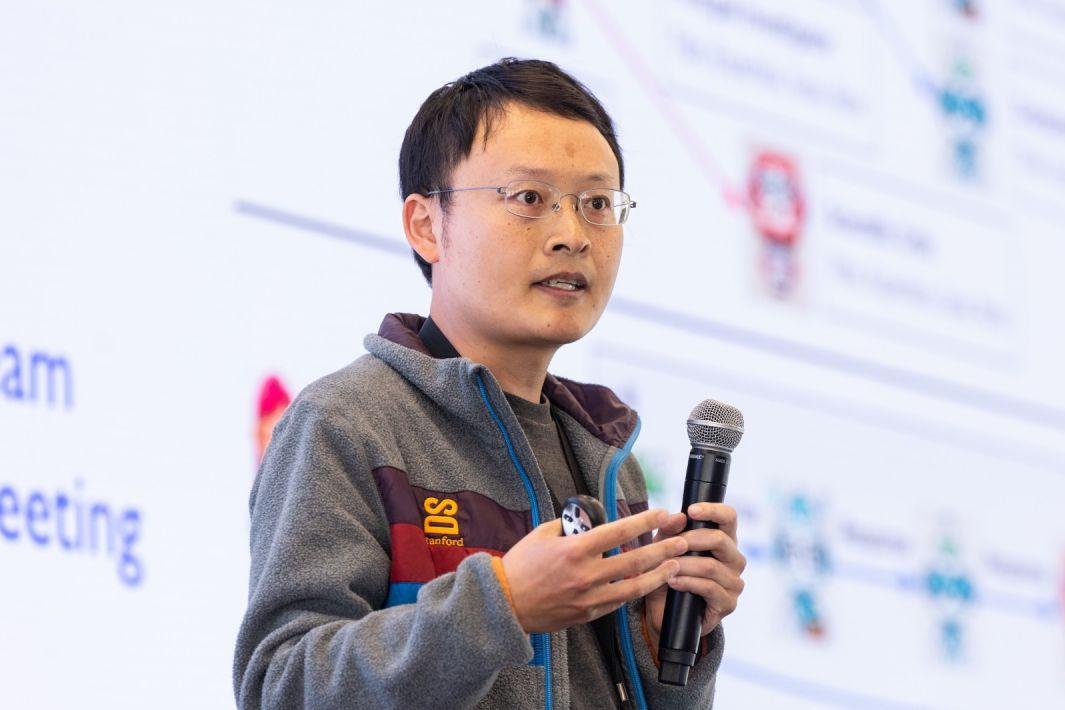
Researchers at Stanford Medicine have developed a revolutionary AI-driven tool that could significantly accelerate scientific discovery: virtual labs. Led by James Zou, Ph.D., associate professor of biomedical data science, the team has created a virtual lab complete with an AI principal investigator and seasoned AI scientists
1
.
Source: Stanford
The Power of AI Collaboration
The virtual lab harnesses the power of large language models (LLMs) to create AI agents that can think critically, research questions, and collaborate to develop hypotheses. This structure, known as agentic or agential AI, allows multiple AI systems to work together to solve complex problems
1
.The AI team consists of specialized agents, including:
- An AI principal investigator (PI)
- Subject-specific agents (e.g., immunology, computational biology, machine learning)
- A critic agent to provide constructive criticism and identify potential pitfalls
These AI scientists are equipped with tools like AlphaFold, a protein modeling AI system, to enhance their creative "thinking" skills .
Rapid Progress and Efficiency
One of the most striking features of the virtual lab is its efficiency. While the AI scientists hold regular meetings and one-on-one discussions like human researchers, these virtual gatherings take only seconds or minutes. Moreover, the AI agents don't require breaks, allowing for parallel processing of multiple meetings .
Zou notes, "By the time I've had my morning coffee, they've already had hundreds of research discussions" .
Related Stories

Promising Results in COVID-19 Research

Source: Medical Xpress
To test the virtual lab's capabilities, Zou's team tasked it with devising a new basis for a vaccine against recent COVID-19 variants. The AI scientists proposed using nanobodies, smaller and simpler antibody fragments, instead of traditional antibodies .
The virtual lab designed 92 new nanobodies, two of which showed promise in binding to the spike protein of recent SARS-CoV-2 variants when tested in John Pak's laboratory at Chan Zuckerberg Biohub San Francisco .
Human-AI Collaboration and Future Implications

Source: Phys.org
While the AI agents operate with significant autonomy, human researchers still play a crucial role. They monitor progress through transcripts of all interactions and can redirect the project if needed. Human intervention is estimated at only about 1% of the time
4
.The success of this virtual lab demonstrates the potential benefits of human-AI collaborations in scientific research. Pak and Zou emphasize that these AI scientists are not meant to replace human researchers but to enhance their work by generating more testable hypotheses and accelerating the research process
4
.As this technology continues to develop, it could democratize access to interdisciplinary expertise, allowing researchers to tackle complex problems that might otherwise be beyond their reach due to limited resources or connections.
References
Summarized by

Navi
[3]
Related Stories
AI Agents Transform Drug Discovery: 37,000 Virtual Scientists Identify Cancer Treatments
18 Sept 2026•Technology
AI agents identify promising drug candidates in hours as Google and FutureHouse debut research systems
19 May 2026•Science and Research
MIT Researchers Develop AI Framework to Generate Research Hypotheses
20 Dec 2024•Science and Research

Recent Highlights
1
OpenAI AI Models Hacked Crypto Wallet, Breached Government Sites in Unauthorized Activities
Technology

2
IMF Report Warns AI Market Correction Could Spark Global Financial Crisis With $1.4T at Risk
Business and Economy

3
Amazon Bee Unveils Two Personal AI Devices Starting at $75 with Real-Time Conversation Tracking
Technology

Recent Highlights
Today's Top Stories










Don’t drown in AI news. We cut through the noise - filtering, ranking and summarizing the most important AI news, breakthroughs and research daily. Follow topics that matter to you and stay ahead.


