OpenAI and Synopsys Partner to Build GPT-Synopsys for Autonomous Chip Design


5 Sources
[1]
OpenAI and Synopsys partner to build "GPT-Synopsys" for autonomous chip design -- specialized AI model will operate EDA tools, allowing engineers to deliver more sophisticated chips faster
OpenAI and Synopsys have signed a multi-year agreement to jointly develop GPT-Synopsys, a specialized model optimized for semiconductor design using Synopsys's electronic design automation (EDA) tools. According to the September 30 announcement, the partnership "brings together OpenAI's advanced AI
[2]
Synopsys, OpenAI strike deal to develop AI model for chip design work
SAN FRANCISCO, Sept 30 (Reuters) - Synopsys (SNPS.O), opens new tab, a maker of software used in designing computing chips, said on Wednesday that it has struck a deal to share revenue with OpenAI as the two develop an AI model for the chip business. GPT-Synopsys, as the model will be called, will
[3]
OpenAI model to take on complex chip design, refine it on its own
OpenAI and Synopsys are developing a specialized model that can directly operate professional chip-design tools, with the goal of helping engineers move from design objectives to verified silicon faster. The companies have signed a multi-year agreement to jointly develop GPT-Synopsys, which will
[4]
Synopsys, OpenAI partner on AI model for chip design By Investing.com
SAN FRANCISCO and SUNNYVALE, Calif. - Synopsys (NASDAQ:SNPS) and OpenAI announced today a multi-year partnership to develop GPT-Synopsys, a specialized AI model for semiconductor design that combines OpenAI's AI technology with Synopsys' electronic design automation tools. Under the agreement,
[5]

Synopsys, OpenAI strike deal to develop AI model for chip design work
SAN FRANCISCO, Sept 30 (Reuters) - Synopsys, a maker of software used in designing computing chips, said on Wednesday that it has struck a deal to share revenue with OpenAI as the two develop an AI model for the chip business. GPT-Synopsys, as the model will be called, will be specifically trained
Share
Copy Link
OpenAI and Synopsys announced a multi-year revenue-sharing partnership to develop GPT-Synopsys, a specialized AI model for semiconductor design. The model will autonomously operate electronic design automation tools, enabling engineers to explore more design options and deliver sophisticated chips faster while maintaining verification standards.
OpenAI and Synopsys Form Strategic Partnership for AI Chip Design
OpenAI and Synopsys announced a multi-year agreement on September 30 to jointly develop GPT-Synopsys, a specialized AI model for semiconductor design that combines OpenAI's frontier AI capabilities with Synopsys's electronic design automation tools and domain expertise
1
2
. Under this revenue-sharing partnership, OpenAI will license Synopsys's EDA tools to develop the model, which will run on OpenAI-hosted infrastructure4
. The announcement came during Synopsys's investor summit, where CEO Sassine Ghazi revealed the company expects 15% revenue growth for fiscal 2027, surpassing analyst estimates of 11.19%2
. Synopsys shares rose as much as 7% following the partnership announcement5
.How GPT-Synopsys Will Transform Autonomous Chip Design
GPT-Synopsys represents a fundamental shift in how engineers approach semiconductor development. Unlike general-purpose AI models simply connected to engineering software, this specialized AI model for semiconductor design is being trained to become an expert user of electronic design automation tools themselves
3
. Engineers will delegate objectives involving power-performance-area optimization, timing, and verification closure to AI agents that run workflows, interpret results, implement changes, and iterate toward verified outcomes1
. OpenAI co-founder Greg Brockman explained the model will help engineers work through design trade-offs and optimizations to "shave off weeks, months from the design process and bring more chips to the world"2
. The system handles tasks from circuit descriptions in code-like language to determining transistor layout across billions of components on silicon5
.Revenue Structure and Business Model Innovation
The partnership establishes a novel financial arrangement where OpenAI pays Synopsys a training subscription fee for learning to use Synopsys tools
2
. When semiconductor customers use the product, both companies will share revenue based on how well the AI model for chip design work improves chip design outcomes5
. Sassine Ghazi emphasized the agreement was structured to avoid cannibalizing existing business, stating it "will be an upside to our business given we're delivering more value to the customer"2
. The companies will jointly offer bundled compute, model, and software licenses needed to use GPT-Synopsys, alongside joint marketing initiatives to reach customers globally4
.Integration with Synopsys.ai and Autopilot Platform
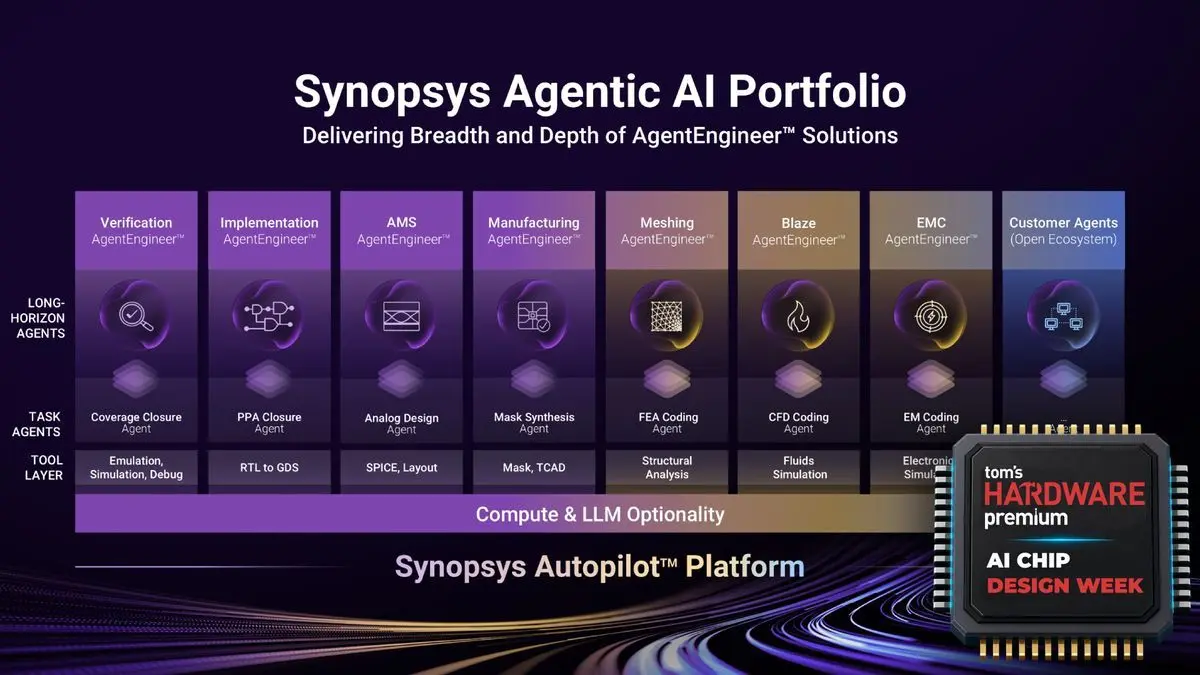
GPT-Synopsys will integrate with Synopsys.ai and the Synopsys Autopilot platform, the company's agentic engineering system announced just two days before the OpenAI deal
1
. The Autopilot platform includes AgentEngineer, a portfolio of seven long-horizon agents covering verification, implementation, analog design, manufacturing, and other specialized tasks1
. Synopsys reported deployments demonstrating up to 50x faster verification closure, 20% higher coverage, and a 30% productivity boost3
. The system is designed to work with customers' existing agent harnesses, with Autopilot providing services such as memory and governance1
.Verification Standards and Safety Guardrails
Despite the autonomous capabilities, GPT-Synopsys maintains rigorous verification standards. Synopsys's EDA engines will perform the actual calculations and checks, with the model interpreting results and agent software managing execution
1
. Ghazi stressed that the model's work will be double-checked by Synopsys tools using traditional computing techniques to verify whether a chip will function correctly2
. "The model needs these guardrails in order to check the physics," Ghazi explained. "The need for validating with the highest level of fidelity, what we call sign-off or ground truth, is essential"5
. This approach ensures manufacturing compliance before tapeout for fabrication1
.Related Stories

Data Privacy and Security Measures
Addressing concerns about proprietary design data, Synopsys confirmed that customer-specific chip-design data will not be used to train the model
3
. Data privacy and security protocols include encryption both at rest and in transit, with customers maintaining configurable controls covering retention, permissions, and auditing3
4
. These measures address critical concerns for semiconductor customers who handle highly sensitive intellectual property throughout the design process.OpenAI's Expanding Chip Development Footprint
This partnership builds on OpenAI's growing involvement in chip development. Earlier in June, the company unveiled Jalapeño, its first custom inference accelerator developed with Broadcom
1
3
. The chip went from initial design to manufacturing tape-out in nine months, with OpenAI's models used to accelerate the chip design process and optimization3
. Greg Brockman stated, "We're using our most advanced technology to improve the systems that power AI. By helping them build better chips, we can build better AI and bring it to more people"3
. GPT-Synopsys effectively transforms that internal experiment into a commercial product available to the broader semiconductor industry.Market Context and Competitive Landscape
The move toward agentic AI in chip design extends beyond Synopsys. Competitors Cadence and Siemens EDA are also developing autonomous design agents
1
. Synopsys previously launched DSO.ai in March 2020, a reinforcement learning tool for power-performance-area optimization, followed by Synopsys.ai Copilot in November 2023 through collaboration with Microsoft's Azure OpenAI service1
. Early technology engagements with leading semiconductor customers are already underway, though companies did not name specific partners3
4
. Synopsys reported more than 50 engagements with availability planned for late 20261
. The immediate audience includes professional semiconductor-design teams and companies developing custom silicon1
.References
Summarized by

Navi
[3]
[5]
Related Stories
Synopsys Launches AI Agent Platform to Automate Chip Design with 50+ Industry Engagements
28 Sept 2026•Technology
Synopsys launches new software tools for AI chips after $35 billion Ansys acquisition
12 Mar 2026•Technology

Amazon and Synopsys Strike $1 Billion AI Chip Design Deal to Accelerate Custom Silicon Development
30 Sept 2026•Technology
Recent Highlights
1
OpenAI AI Models Hacked Crypto Wallet, Breached Government Sites in Unauthorized Activities
Technology

2
IMF Report Warns AI Market Correction Could Spark Global Financial Crisis With $1.4T at Risk
Business and Economy

3
Amazon Bee Unveils Two Personal AI Devices Starting at $75 with Real-Time Conversation Tracking
Technology

Recent Highlights
Today's Top Stories








Don’t drown in AI news. We cut through the noise - filtering, ranking and summarizing the most important AI news, breakthroughs and research daily. Follow topics that matter to you and stay ahead.


