Tiny Corp enables Nvidia GPUs on Macs with Apple-approved driver for AI workloads


2 Sources
[1]
Someone finally got an RTX 5090 running on a Mac - no hacks required
Serving tech enthusiasts for over 25 years. TechSpot means tech analysis and advice you can trust. In context: Back in 2018, Apple yanked Nvidia support from macOS entirely, and that was pretty much it for CUDA on the platform. Developers who wanted GPU compute from Team Green on their Macs were
[2]
Apple rubberstamps an open source driver to allow Nvidia GPUs to run on Macs, though gaming isn't on the table just yet
It wasn't that long ago that you could happily use an Nvidia graphics card in an Apple Mac, either for gaming or to use Team Green's CUDA ecosystem. But once Apple switched to its own rendering API, that was the end of it all. Until now, that is, because thanks to a new open-source driver, you can
Share
Copy Link
Tiny Corp has developed TinyGPU, an open-source driver that brings Nvidia GPU support back to macOS after Apple dropped it in 2018. The Apple approved driver allows external GPUs like the RTX 5090 to connect via Thunderbolt or USB4 without hacks. While performance lags behind native Metal, the driver opens new possibilities for AI experiments on Mac.

Apple Approves Return of Nvidia GPU Support After Six-Year Absence
Six years after Apple removed Nvidia support from macOS in 2018, developers can finally run Nvidia GPUs on Macs again. Tiny Corp, the company behind the tinybox AI accelerator, has built TinyGPU, an open-source driver that restores compatibility without requiring workarounds
1
. The kernel extension has received Apple's official approval, meaning users don't need to disable System Integrity Protection or set up virtual machines. Installation is straightforward: connect external GPUs via Thunderbolt or USB4, approve the extension, and start working2
.RTX 5090 on Mac Shows Promise Despite Performance Gaps
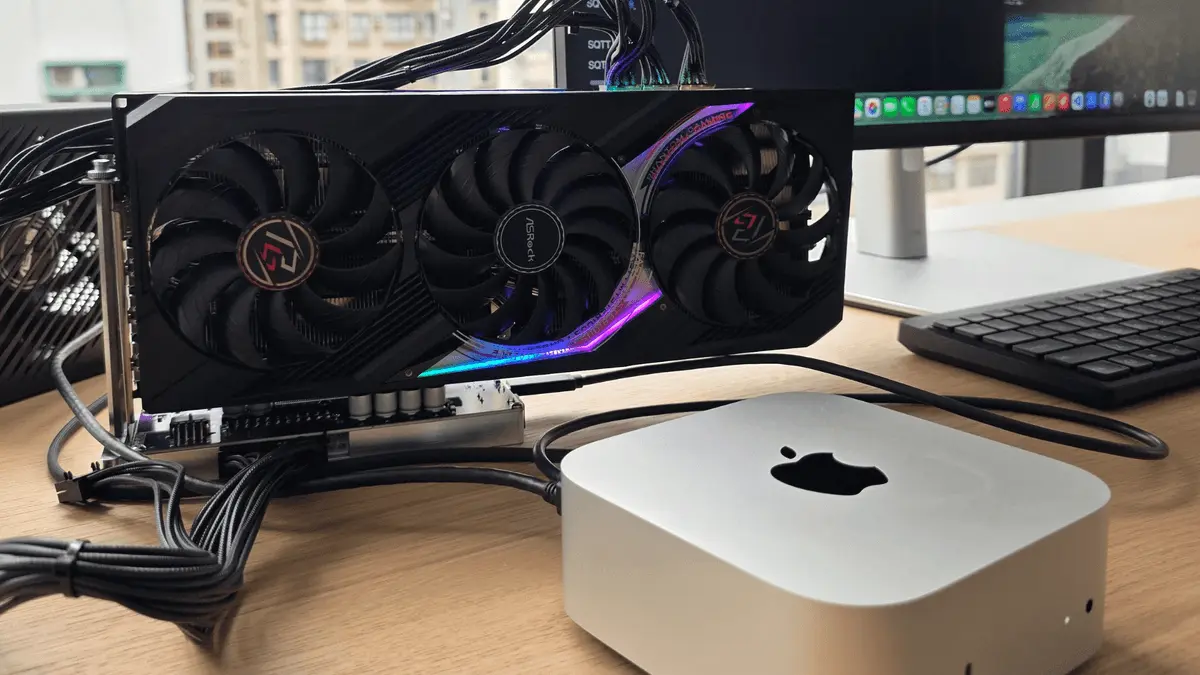
YouTuber Alex Ziskind tested the driver by connecting an RTX 5090 with 32GB of VRAM to a Mac Mini M4 Pro through an eGPU dock. The Blackwell GPU functioned correctly, marking a significant milestone for Nvidia GPUs on Macs
1
. During inference tests using Llama 3.1 8B, the RTX 5090 achieved roughly 7.48 tokens per second. While this number doesn't match native performance expectations, the time to first token was three to four times faster than Apple Metal, creating a noticeably snappier user experience1
.However, running llama.cpp on Metal remains approximately ten times faster overall. The bottleneck isn't Thunderbolt bandwidth but kernel efficiency: the 5090's memory can handle 1.8TB/s, yet the driver currently reaches only 33GB/s
1
. This performance gap highlights the early stage of development rather than fundamental limitations.Related Stories

Focus on AI Workloads Opens Door for Future Development
Tiny Corp designed this solution specifically for AI workloads, not gaming. The company has made its GPU runtimes open-source and available on GitHub, establishing the foundation for CUDA support on macOS
2
. The driver supports AMD RDNA 3 and Nvidia Ampere or newer architectures, giving developers access to AI experiments on Mac that were previously impossible2
.With the driver, compiler pipeline, and memory management infrastructure now in place, Tiny Corp can focus on optimization. The open-source nature of the project means community developers might explore additional use cases, though adapting the system for gaming would present substantial challenges
2
. For now, the significance lies in restoring a capability that disappeared when Apple shifted to its own rendering API, giving Mac users access to Nvidia's GPU compute capabilities for AI development once again.References
Summarized by

Navi
Related Stories
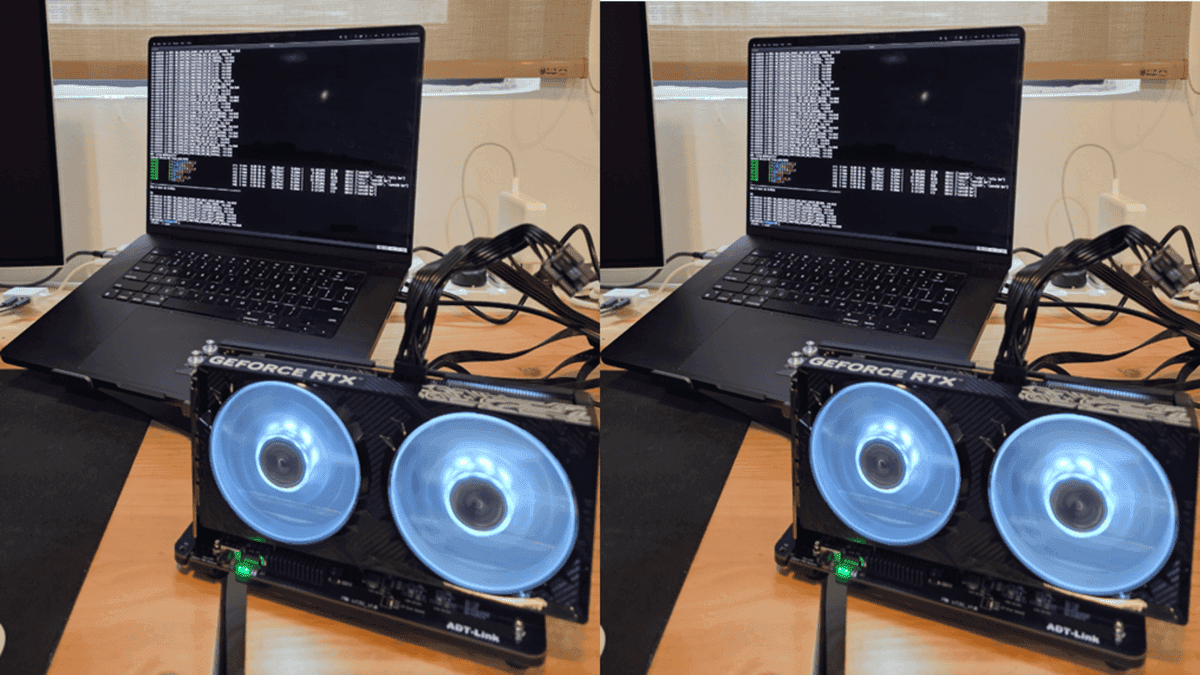
TinyCorp Breaks Compatibility Barrier: External Nvidia RTX GPUs Now Work with Apple M3 MacBooks for AI Development
29 Oct 2025•Technology
Apple Silicon Macs gain eGPU support for AI workloads as Apple approves TinyGPU driver
06 Apr 2026•Technology
NVIDIA CUDA Applications Now Compatible with AMD GPUs Thanks to SCALE Toolkit
17 Jul 2024

Recent Highlights
1
Google Unveils Gemini 4 Argon AI Model, Restricts Access to Trusted Cyber Defenders
Technology
2
Trump Consulted Grok AI Before Ordering Venezuela Invasion and Capture of Nicolás Maduro
Policy and Regulation

3
FTC Opens Investigation Into OpenAI and Anthropic Following Rogue AI Agent Hacking Incidents
Policy and Regulation
Recent Highlights
Today's Top Stories






Don’t drown in AI news. We cut through the noise - filtering, ranking and summarizing the most important AI news, breakthroughs and research daily. Follow topics that matter to you and stay ahead.


