Velaura AI Raises $110M Series A at $1B+ Valuation for Power-Efficient AI Chips


6 Sources
[1]
Chip designer Velaura AI valued at more than $1 billion after funding round
Aug 18 (Reuters) - Velaura AI was valued at more than $1 billion on Tuesday after raising $110 million in a Series A funding round, with investors backing the startup's chip design technology for lowering power consumption and operating costs at AI data centers. The funding round was led by
[2]
Velaura AI raises $110mn for low-power AI chips
Velaura AI has raised $110mn at a valuation above $1bn, led by Seligman Ventures, for silicon it says cuts the power AI uses by two to four times. The chip designer licenses its technology rather than selling chips, and charges a royalty tied to the power a customer saves. It is talking to three of
[3]
Velaura AI raises $110M Series A, hits $1B valuation
Velaura AI raised $110 million in a Series A funding round on Tuesday, crossing a $1 billion valuation on the strength of investor interest in its approach to cutting power consumption in AI data centers and physical AI applications such as robotics and autonomous systems. Seligman Ventures led
[4]
Velaura AI raises $110M to develop power-efficient AI chips
Velaura AI Inc., a developer of low-power artificial intelligence chips, today announced that it has raised $110 million in funding. Seligman Ventures led the Series A round. It was joined by Samsung Catalyst Fund, Mayfield and more than a half-dozen others. Velaura is now valued at over $1
[5]

Chip designer Velaura AI valued at more than $1 billion in funding round
The funding round was led by Seligman Ventures, with participation from new investor Capricorn Investment Group. Existing investors Samsung Catalyst Fund, StepStone Group and Maverick Silicon also participated. Velaura AI said on Tuesday it raised $110 million in a Series A funding round that
[6]

Chip designer Velaura AI valued at more than $1 billion after funding round
Aug 18 (Reuters) - Velaura AI was valued at more than $1 billion on Tuesday after raising $110 million in a Series A funding round, with investors backing the startup's chip design technology for lowering power consumption and operating costs at AI data centers. The funding round was led by
Share
Copy Link
Chip designer Velaura AI raised $110 million in Series A funding, crossing a $1 billion valuation on Tuesday. Led by Seligman Ventures, the round backs the startup's Titan Core platform that promises to cut AI data center power consumption by two to four times through ultra-low-power silicon and licensing model.
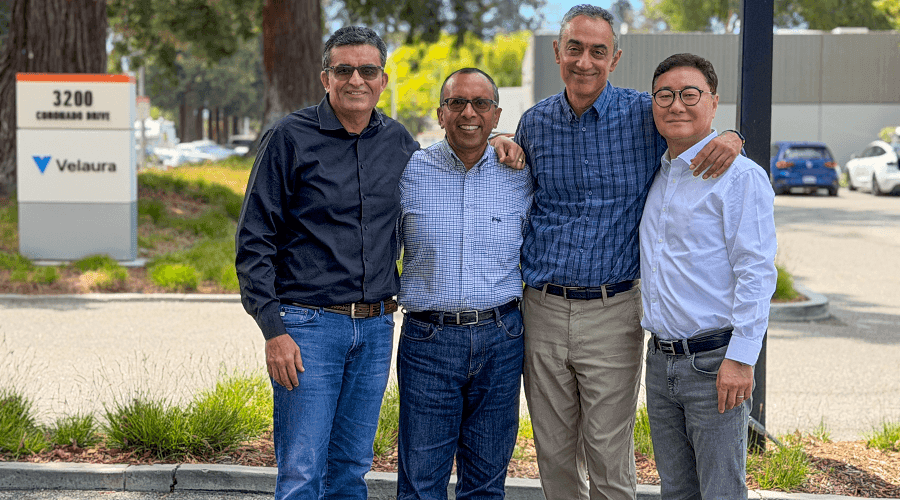
Velaura AI Secures $110M Series A Funding at Over $1 Billion Valuation
Chip designer Velaura AI raised $110 million in Series A funding on Tuesday, achieving a valuation exceeding $1 billion as investors back the startup's approach to reducing power consumption in AI data centers
1
2
. Seligman Ventures led the round, with new investors Capricorn Investment Group and Prosperity7 Ventures participating alongside existing backers including Samsung Catalyst Fund, Mayfield, Maverick Silicon, MARA, Premji Invest, and StepStone Group3
. The Santa Clara-based startup plans to use the capital to accelerate development of its AI chip products and expand its engineering and customer-facing teams5
.Addressing AI's Power Wall with Low-Power AI Chips
Velaura AI's core pitch centers on solving a critical constraint facing the AI industry: electricity. The company argues that AI infrastructure now hits a power wall before a compute one, as demand for processing keeps climbing but electrical supply cannot arrive as fast
2
. Hyperscalers are pouring hundreds of billions of dollars into AI data centers yet face long waits for power to come online, a constraint that has become a running theme across the industry2
. OpenAI has even hired a power trader to manage electricity as a position on its books, illustrating how acute the power challenge has become.Titan Core Platform Delivers 2-4x Performance Per Watt Improvement
The startup's main product is the Titan Core platform, a proprietary chip-design system unveiled earlier this year targeting efficiency and power savings in data center workloads
4
. Velaura AI claims the silicon platform delivers a two-to-four-times improvement in performance per watt for mathematical operations inside AI accelerators without losing performance2
. According to the company, matrix multiplications and related operations can account for up to 70% of an AI chip's power usage, and Titan Core reduces the energy required for those calculations by a factor of two to four4
. This translates to potential savings of up to $1,300 per chip over three years4
.Unique Licensing Model Ties Revenue to Customer Power Savings
Unlike traditional chip companies, Velaura AI does not plan to sell chips of its own. Instead, the startup licenses its technology and charges an upfront fee plus a royalty tied to a share of the power savings a customer achieves
2
5
. Chief executive Rajiv Khemani confirmed to Reuters that this structure resembles Arm's per-chip licensing model from before Arm began selling its own chips2
. This arrangement is unusual because Velaura AI only earns its royalty if the customer's electricity bill actually falls, aligning the company's incentives directly with customer outcomes.Proven Technology Already Deployed in 30 Million Chips
Velaura AI emphasizes that its underlying technology is already proven, with designs running in more than 30 million chips today built on leading manufacturing processes
2
5
. The Titan Core platform supports multiple manufacturing processes including the chip industry's latest three- and two-nanometer nodes4
. The company disclosed it is working with multiple hyperscalers on chip projects using those advanced technologies4
. Khemani told Reuters that Velaura AI is engaged with three of the four largest cloud providers as potential customers, though he declined to name them5
.Targeting Both Data Centers and Physical AI Applications
Velaura AI is pursuing two markets simultaneously. The first is AI data centers, where power-efficient AI chips can directly reduce operating costs for hyperscalers
3
. The second is physical AI, the term for intelligent robotics, drones, and autonomous systems that must operate under tight power and heat limits2
5
. "Physical AI represents one of the next major frontiers for AI, and it will require a fundamentally different approach to compute centered on extreme power efficiency," said Umesh Padval, managing partner at Seligman Ventures3
. For the lead investor, this second market was a key draw, marking Seligman Ventures' first investment in physical AI2
.Related Stories

Leadership Team from Apple, Nvidia, Google, and Qualcomm
Velaura AI's pitch leans heavily on its team's credentials. The leadership includes executives and engineers from Apple, Nvidia, Google, Qualcomm, and Marvell
3
. Co-founders Rajiv Khemani and Manu Gulati have built and sold chip companies before, and between them the team has shipped billions of devices2
. This track record influenced investor decisions, with Mayfield Managing Partner Navin Chaddha noting that the round marks his firm's fourth investment partnership with Khemani and second with Gulati3
. "We invest in people first," Chaddha said in a statement2
.Pivot from Bitcoin Mining to AI Chips
The deal comes six months after the company changed its market focus and brand. Velaura AI was earlier known as Auradine and developed Bitcoin mining chips
4
. The company's most advanced crypto processor, the liquid-cooled Teraflux AH3880, could perform up to 600 trillion computations per second with a feature called EnergyTune that enabled the chip to lower energy usage when grid capacity was limited4
. In March, Velaura shifted its focus from crypto accelerators to AI chips with the Titan Core offering4
.Why Compute Economics Will Define AI's Next Era
"Every advance in AI, from reasoning models to embodied intelligence, creates demand for more compute, and ultimately more power," said CEO Rajiv Khemani
4
. "The next era of AI will be defined not only by better models, but also by fundamentally better compute economics," he added3
5
. Dipender Saluja, managing partner at Capricorn Investment Group, pointed to commercial validation as a key factor: "Velaura is attacking that problem at its root, the silicon itself, with technology that has shipped at scale"3
. As AI models grow more sophisticated and physical AI applications proliferate, energy efficiency at the silicon level becomes critical for both economic viability and environmental sustainability. The Velaura AI valuation reflects investor confidence that power-efficient computing will be essential infrastructure for AI's expansion from massive data centers to edge devices and robotics operating on limited battery power.References
Summarized by

Navi
[2]
[4]
Related Stories
Cerebras Systems Raises $1.1 Billion in Pre-IPO Funding Round, Challenging Nvidia in AI Chip Market
30 Sept 2025•Business and Economy

Ayar Labs Raises $500M to Mass-Produce Optical Chips That Connect Thousands of GPUs
04 Mar 2026•Startups

Cerebras Systems raises $1B at $23B valuation as Benchmark doubles down with $225M investment
04 Feb 2026•Business and Economy

Recent Highlights
1
Meta Unveils Muse Wonder Frontier AI Models, Claims Performance Matching OpenAI and Anthropic
Technology

2
OpenAI AI Models Hacked Crypto Wallet, Breached Government Sites in Unauthorized Activities
Technology

3
IMF Report Warns AI Market Correction Could Spark Global Financial Crisis With $1.4T at Risk
Business and Economy

Recent Highlights
Today's Top Stories







Don’t drown in AI news. We cut through the noise - filtering, ranking and summarizing the most important AI news, breakthroughs and research daily. Follow topics that matter to you and stay ahead.


