Volvo and Nvidia Expand Partnership to Deliver AI-Powered Automated Driving by 2030


5 Sources
[1]
Volvo makes a bigger bet on Nvidia
Volvo is leveling up its automated driving system through an expansion of its nearly decade-long partnership with Nvidia. The companies announced on Thursday that Volvo will use three pieces of Nvidia hardware and software in its future vehicles to provide an automated driving system that can
[2]
Volvo will use Nvidia's tech for hands-free, point-to-point driving
Volvo plans to launch hands-free, point-to-point driving by 2030, powered by Nvidia's latest AI technology. The Chinese-owned, Swedish-designed automaker said Thursday it would use Nvidia's autonomous driving stack to power a new partially automated driving system similar to Tesla's Full
[3]
Volvo Cars and NVIDIA Expand Partnership to Advance Safe Automated Driving
Volvo Cars today announced it is expanding its partnership with NVIDIA to unlock new levels of safety in automated driving technology in future cars from Volvo, building on the companies' decade-long collaboration. Guided by Volvo Cars' pioneering safety knowledge and powered by the NVIDIA
[4]
Volvo Cars expands Nvidia partnership for self-driving tech By Investing.com
Investing.com -- Volvo Cars is expanding its partnership with Nvidia to develop a new generation of driver-assistance and automated-driving technology, the companies said Thursday. Volvo will combine its safety systems and engineering expertise with Nvidia's artificial intelligence and computing
[5]

Volvo Cars expands automated driving partnership with Nvidia
STOCKHOLM, Oct 15 (Reuters) - Volvo Cars is expanding its partnership with Nvidia to develop a new generation of driver-assistance and automated-driving technology, the companies said on Thursday, as carmakers race to bring increasingly advanced hands-free driving features to market. o The
Share
Copy Link
Volvo Cars is deepening its collaboration with Nvidia to bring advanced automated driving capabilities to its entire vehicle lineup before 2030. The partnership will combine Volvo's safety expertise with Nvidia's AI technology, including the Hyperion platform and Alpamayo software, to enable hands-free urban and highway driving across multiple regions.
Volvo Nvidia Partnership Targets Advanced Automated Driving
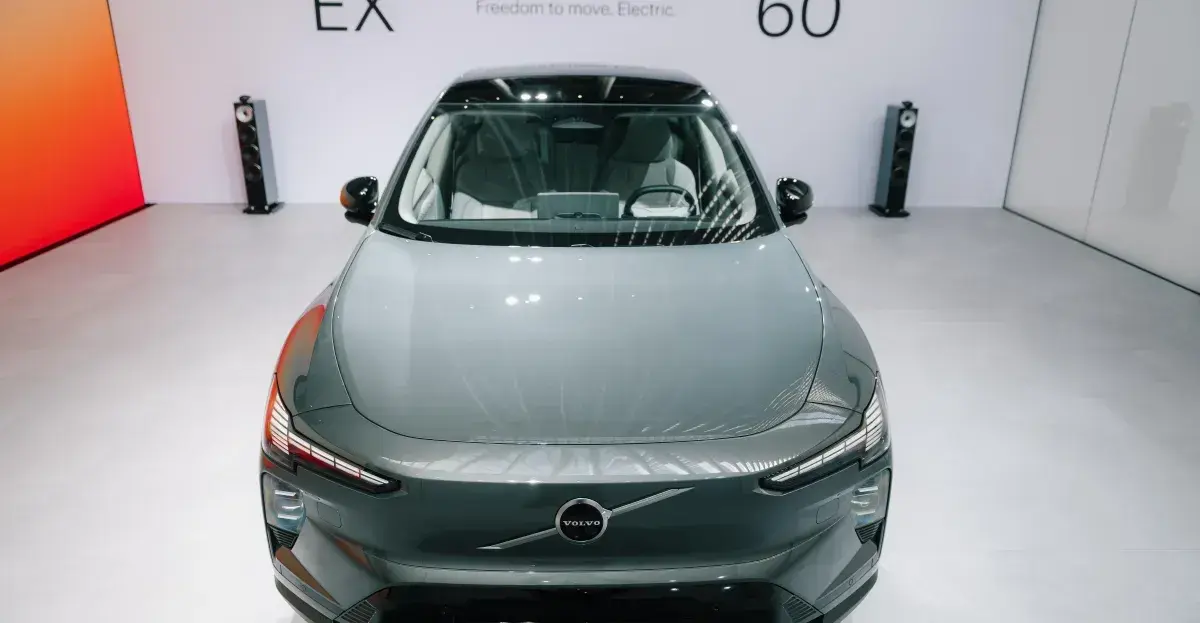
Volvo Cars announced an expansion of its nearly decade-long Volvo Nvidia partnership to develop safe automated driving technology that will debut in future vehicles before 2030
1
2
. The collaboration marks a shift in how Volvo approaches vehicle development, with Alwin Bakkenes, Volvo's head of software development, explaining that the automaker has "completely changed and migrated into being a full tech stack company"1
. This expanded partnership brings together Volvo's nearly century-long safety expertise with Nvidia's cutting-edge AI technology to create next-generation driver-assistance systems that can navigate complex real-world environments from door to door3
.
Source: The Verge
Hands-Free Point-to-Point Driving with Nvidia's Hyperion Platform
The new system will deliver hands-free point-to-point driving capabilities powered by Nvidia's Hyperion platform, which includes high-powered silicon and sensors mounted around the vehicle to perceive surroundings
2
. Volvo will utilize Alpamayo AI-driven driving software, which employs reasoning models to interpret complex road conditions and determine steering, braking, and acceleration decisions2
. The Alpamayo stack has already been downloaded by more than 650,000 developers and runs redundantly alongside classical software using machine learning and camera and radar perception1
. Ali Kani, who heads Nvidia's automotive division, emphasized that running dual stacks with multimodal sensors creates "a safer product"1
.
Source: TechCrunch
Level 2++ System Tackles Urban Complexity
Volvo's planned system will operate at Level 2++, handling complex urban environments including traffic lights, stop signs, and unprotected left turns without explicit driver control
2
. The technology resembles Tesla's Full Self-Driving (Supervised) and the Nvidia-powered system Mercedes-Benz recently introduced for its all-new CLA sedan2
. Under the expanded partnership, Volvo will combine three pieces of Nvidia hardware and software: the Hyperion sensor and compute architecture, Alpamayo stack driving software, and Halos safety evaluation layer1
3
. The first deployment will focus on supervised driving features, with drivers remaining responsible for the vehicle, before gradually introducing more advanced capabilities4
.Volvo's Safety Expertise Meets Nvidia's AI Technology
Volvo Cars brings its proprietary driver-understanding systems to the collaboration, which analyze driver behavior in considerably greater detail than basic driver monitoring systems
2
. Bakkenes stated that "our brand Volvo is synonymous with safety, and safety is synonymous with trust," emphasizing the company's commitment to protecting occupants from harm2
. Håkan Samuelsson, president and CEO of Volvo Cars, highlighted that combining "industry-leading safety knowledge and world-class AI technology" creates a unique opportunity to build safer and more attractive vehicles3
. Jensen Huang, founder and CEO of Nvidia, noted that "accelerated computing has transformed the car into an intelligent machine that can understand the world around it"3
.
Source: Market Screener
Connected Safety Technologies Extend System Awareness
Another component of the safe automated driving technology is Volvo's connected safety technologies that allow vehicles to exchange information about hazards and conditions ahead, including roadworks
2
. This information sharing can effectively extend the system's awareness beyond what an individual vehicle's sensors can detect, potentially improving the operating capabilities of the autonomous driving functionality2
. All of Volvo's battery-electric vehicles currently use Nvidia's Orin computer chip, which processes information from cameras, radar, and other sensors to help vehicles understand surroundings and make driving decisions1
. Bakkenes confirmed that Volvo will "standardize more on Hyperion" from a sensor set perspective to open up the stack for the wider partnership with Nvidia1
.Related Stories



Deployment Timeline and Market Strategy
The technology will appear in Volvo vehicles before 2030 and will be launched in multiple regions simultaneously, excluding China
4
5
. Volvo, which is majority owned by China's Geely Holding, has not chosen a pricing model yet, but Bakkenes confirmed that features would not be limited to higher-priced models4
5
. The automaker plans to make the new point-to-point driving system available across its vehicle lineup, from entry-level to high-end versions2
. Kani pointed to commercial implications, noting that point-to-point driving may prove more valuable than systems limited to highway assistance, and that Nvidia sees the partnership as an opportunity to help Volvo develop its business model around ongoing software-based offerings2
.Industry Context and Competitive Landscape
The expansion represents Volvo's effort to correct past automated driving setbacks. The automaker had to sideline its Ride Pilot Level 3 unsupervised autonomous driving system in the US after failing to obtain regulatory approval, and plans to add lidar sensors fell away after supplier Luminar went bankrupt
2
. Automakers including Mercedes-Benz, BMW, and Ford are targeting more advanced automated-driving systems, from hands-free highway driving to self-driving operations in limited conditions4
5
. Tesla is pushing for broader approval of its assisted-driving technology in Europe, including urban areas, with an EU-wide vote possible in December4
5
. Besides Volvo, Nvidia has partnerships with a wide range of automakers, including Mercedes, Jaguar Land Rover, and Hyundai4
5
.References
Summarized by

Navi
[1]
[5]
Related Stories
Recent Highlights
1
Meta Unveils Muse Wonder Frontier AI Models, Claims Performance Matching OpenAI and Anthropic
Technology

2
IMF Report Warns AI Market Correction Could Spark Global Financial Crisis With $1.4T at Risk
Business and Economy

3
OpenAI Releases 722 AI-Generated Math Solutions, Triggering Existential Crisis in Mathematics
Technology

Recent Highlights
Today's Top Stories










Don’t drown in AI news. We cut through the noise - filtering, ranking and summarizing the most important AI news, breakthroughs and research daily. Follow topics that matter to you and stay ahead.


