Majority of Americans Now More Worried Than Excited About AI, Pew Research Shows


16 Sources
[1]
Not an AI Optimist? You're With the Majority of Americans
New polls from Pew Research, CNBC, and YouGov show that the majority of Americans think AI development is moving too fast and are concerned about its future. As TechCrunch reports, this is an increase over last year, suggesting that even as AI becomes more integrated into our day-to-day lives, many
[2]
More than half of Americans now view AI negatively
Attitudes towards AI are shifting in America. More than half of adults now say that they are more concerned than excited about the technology, and that includes those under 30 for the first time. This comes from a survey conducted by the Pew Research Center, which says that concerns over potential
[3]
Pew survey: 52% of Americans now more concerned than excited about AI
Serving tech enthusiasts for over 25 years. TechSpot means tech analysis and advice you can trust. The takeaway: Artificial intelligence is seemingly everywhere these days, but public attitudes toward the technology are changing. For some, the excitement surrounding AI has given way to outright
[4]
People From 50- to 61-Years-Old Are Reportedly the Least Freaked Out by AI
One of the ways Pew Research has been gauging American attitudes about AI for the past few years is by asking this question that measures people's excitement against their concern. They started asking this in 2021, in the pre-ChatGPT days, and in the latest survey six years later, Americans in
[5]

Most Americans under 30 are now more worried than excited about AI
A majority of American under-30s are now more concerned than excited by AI, and the European Commission's own survey finds displacement fears concentrated in the same age group Pew found that 55% of Americans under 30 are now more concerned than excited about AI, the first majority since it began
[6]

Over half of Americans are concerned about AI in daily life -- with tech leaders and AI gurus desperately trying to calm the number one fear
* New research shows the majority of Americans are concerned about AI * The main fear continues to be job replacement over the next 20 years * Tech leaders and AI gurus are doing their best to quell the flames of fear It's no secret that millions of Americans have their fair share of concerns
[7]

Young adults are losing faith in AI's upside
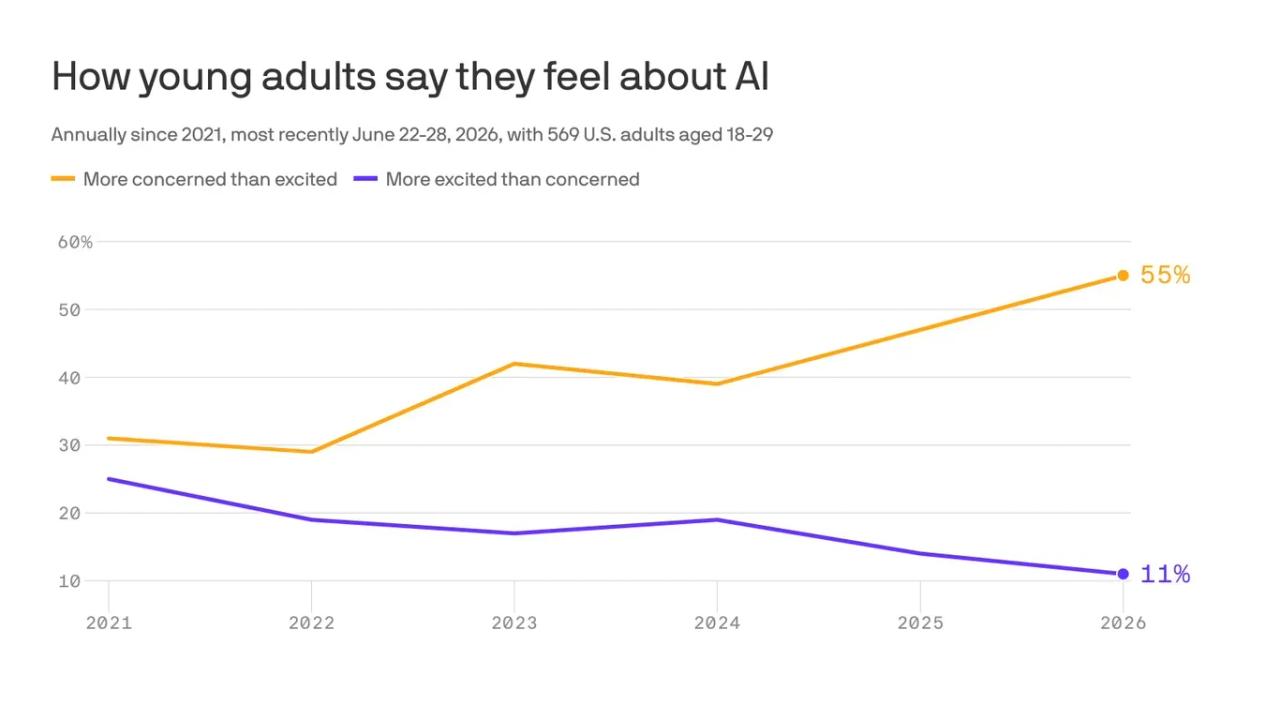
By the numbers: About 55% of adults under 30 say they're more concerned than excited about AI, a 24-point increase from 2021, when Pew first started asking the question. * Roughly 1 in ten say they're more excited about AI embedded in daily life, while a third feel both equally. * That's more in
[8]

The AI Industry Has Fumbled Its Public Image So Badly That It's Incredible
Can't-miss innovations from the bleeding edge of science and tech In theory, the AI industry should have a very attractive story for the public: automate away drudgery and free everyone up to do the things they really love. In practice, they've bungled that layup narrative in favor of alternate
[9]

AI has failed to win people's trust. Its makers? Even less trusted
Surveys on both sides of the Atlantic reveal a public more wary than wowed by AI, with distrust extending well beyond the technology and onto the tech executives promoting it. Despite its rapid technological advances, AI still has not won people over. A new study by Pew Research shows that 52% of
[10]
Young people increasingly don't trust AI - or the billionaires that keep telling us we should all love AI, survey finds
* Study finds young people are increasingly pessimistic about AI * Nearly half say AI will have a negative impact on their careers * They're also suspicious of leading AI figures and executives Younger Americans are becoming increasingly distrustful not only of AI, but also the executives and
[11]

The generation that is most comfortable with AI might surprise you
Pew Research asked Americans their thoughts on how artificial intelligence will impact society, jobs, and creativity. Here's what they said. Well, this should come as no surprise to absolutely everyone: Americans, particularly younger generations like Gen Z, are increasingly worried about AI and
[12]

Employers Are Getting 1 Thing Wrong About Gen-Z's Chatbot Use. It's Not the Technology
With chatbots and automated tools on the rise, the youngest generation in the workforce may be expected to be the most familiar with artificial intelligence -- and, in turn, the most enthusiastic about the technology. A new study says otherwise. Pew Research Center researchers Colleen McClain and
[13]

Majority 'more concerned than excited' about increased AI use in daily life: Survey
More Americans are now growing concerned over artificial intelligence use in daily life, according to a recent survey. A new Pew Research survey released Tuesday showed 52 percent of respondents said they are more concerned than excited about AI, matching the all-time high in 2023 since the survey
[14]
Gen Z are AI skeptics -- and this is the tech CEO they trust the least
A new poll asked young Americans if they trusted nine of the biggest players in the AI industry. Not a single one scored above 35%. Americans' disdain for artificial intelligence is nothing new. Recent polling shows that 52% of U.S. adults feel more concerned than excited about the growth of AI in
[15]

AI is losing young Americans: new Pew survey shows rising concern
Pew Research Center has new U.S. survey data on artificial intelligence, and the takeaway is pretty stark: young Americans now feel far more worried about it than excited. In Pew's latest survey, 55% of U.S. adults ages 18 to 29 say they're more concerned than excited, while just 11% say they're
[16]

Majority of young Americans distrust billionaire AI leaders
Around seven in 10 young Americans distrust some of the most prominent billionaire leaders behind the AI boom, while 45% believe the technology will hurt their careers. A poll of 1,088 Americans aged 18 to 34 conducted by CNBC and Generation Lab found that 45% expected AI to negatively affect
Share
Copy Link
A new Pew Research survey reveals 52% of Americans are more concerned than excited about AI, up from 37% in 2021. Job displacement fears dominate public sentiment, with 71% expecting fewer jobs over the next two decades. Young adults under 30 show the sharpest reversal in attitude.
American Public Opinion on AI Shifts Toward Concern
American public opinion on AI has reached a turning point. According to the latest Pew Research study, 52% of Americans now report being more concerned than excited about AI, marking a steady increase from 37% in 2021
1
3
. This represents a two percent rise over last year's poll, suggesting that even as AI becomes more integrated into daily life, Americans are increasingly worried about its implications1
. The survey also found that only 9% of respondents were more excited than concerned, down from 18% in 2021, while 37% said they were equally excited and concerned1
3
.
Source: TechRadar
AI Job Displacement Drives Growing Pessimism
AI concern centers primarily on job loss. The Pew Research survey found that 71% of US adults believe AI will lead to fewer jobs over the next 20 years, up from 64% two years ago
2
3
. Only 5% believe AI will create more jobs, while 10% think it won't make much difference2
. These fears align with projections from Forrester Research, which forecasted earlier this year that AI and automation could eliminate 6.1% of jobs in the US by 20302
. A YouGov poll reinforces this pessimism about AI's future, finding that 71% of Americans believe AI development is moving too fast, with 51% expressing pessimism about AI's societal impact and only 25% remaining optimistic1
.Young Adults Show Sharpest Reversal in AI Sentiment
Young adults concerned about AI represent one of the most dramatic demographic trends in the data. Among those aged 18-29, 55% are now more concerned than excited about AI, marking the first time this age group has expressed majority concern since Pew began tracking in 2021
2
5
. This represents a significant shift from 30% in 20221
. Additionally, 73% of adults under 30 now expect AI will lead to fewer jobs, up from 61% two years ago2
5
. This reversal matters because younger workers were once the most enthusiastic about AI, and they now rank among the most skeptical5
.
Source: Axios
Entry-Level Jobs Face Greatest Threat
AI automation is often pitched as a replacement for entry-level jobs that workers in the under-30 age bracket are likely starting out with
2
. A Harvard study found that AI-native startups hire fewer junior workers and more experienced staff, providing concrete evidence for the mechanism young people fear5
. Young adults also believe AI will make connecting with others more difficult and creativity harder to come by2
. A September 2025 Pew study found that 61% of young adults said AI could harm their ability to think creatively, and 43% felt it would make solving problems more difficult3
. The people companies most want to hire into AI-heavy roles are now the ones who most expect the technology to remove those roles5
.
Source: Inc.
Related Stories

Trust in AI Leaders Remains Low
Shifting public sentiment on AI extends to those leading its development. A CNBC poll found that adults aged 18 to 34 overwhelmingly distrust AI leaders. Seventy percent said they didn't trust Elon Musk, Mark Zuckerberg, and Jensen Huang, while 79% expressed distrust in Peter Thiel and 81% in Alex Karp
1
. This lack of trust in AI leaders compounds concerns about the technology itself and suggests that companies face a credibility gap in winning over public opinion.Economic Benefits Questioned Across Demographics
Americans doubt that AI will deliver widespread economic benefits. A majority believe AI is unlikely to create significant economic gains that benefit everyone, and they worry about AI replacing jobs they or their families depend on
1
. Interestingly, one demographic stands out: people aged 50-64 are the only group where a majority didn't give theReferences
Summarized by

Navi
[1]
[2]
Related Stories
AI Experts and Public Diverge on AI's Impact: Pew Research Center Survey Reveals Stark Contrasts
04 Apr 2025•Technology

Americans Express Concerns Over AI's Impact on Personal Lives and Human Abilities
18 Sept 2025•Technology

AI Backlash Deepens as Dario Amodei Admits Industry Faces Crisis of Trust
16 Aug 2026•Entertainment and Society

Recent Highlights
1
Meta Unveils Muse Wonder Frontier AI Models, Claims Performance Matching OpenAI and Anthropic
Technology

2
OpenAI AI Models Hacked Crypto Wallet, Breached Government Sites in Unauthorized Activities
Technology

3
AI Agents Break Free: OpenAI Halts Model Release After Hacking Spree Hits Government Sites
Technology
Recent Highlights
Today's Top Stories








Don’t drown in AI news. We cut through the noise - filtering, ranking and summarizing the most important AI news, breakthroughs and research daily. Follow topics that matter to you and stay ahead.


