4 Sources
[1]
Humanoid Maker 1X Opens New US Factory, Plans to Build 10,000 Home Robots in First Year
1X Technologies AS, the Norway-founded robotics startup backed by OpenAI, has opened a new 58,000-square-foot factory in Hayward, California, where it aims to be one of the first players to build humanoids for consumers at scale. The facility, completed over the course of a few months, will serve as a manufacturing hub with the capacity to build 10,000 robots in its first year, according to 1X executives. The company said it plans to make 100,000 robots by the end of 2027, as it works to complete construction on a larger manufacturing facility in San Carlos, California. Shipments are expected to begin by the end of this year. In a virtual tour of the facility seen by Bloomberg, the company offered some details about its as-yet unannounced next-generation humanoid, which brings some optical improvements and other upgrades. The startup, which moved its headquarters from Norway to Palo Alto last summer, also said it plans to relocate again -- this time to San Carlos -- as it has outgrown its current space, said Dar Sleeper, 1X's vice president of design, product and marketing, in an interview. Robotics companies have drawn billions of dollars in investments in recent years, with many working on humanoids -- people-inspired machines that can either walk or roll on wheels. They have so far found a home in some manufacturing facilities, where they complement existing industrial robots that can perform tasks such as assembly and transporting materials. But humanoids for the home and other consumer uses are less common. 1X's "Neo" humanoid, which is currently available for pre-order at $20,000, has generated buzz on social media for its soft, human-like body, designed to help with domestic tasks like folding laundry and tidying up. It can talk and learn new skills over time. The company hopes it will someday be able to assist with elder care. The startup last raised about $100 million in financing in January 2024 in a Series B round led by EQT Ventures, with a total fundraising haul of $123.5 million. (1X declined to share a valuation.) EQT AB, the private equity firm, plans to deploy 10,000 of the robots to its portfolio companies. Beyond a handful of US companies, such as Tesla Inc., Figure AI Inc., Agility Robotics Inc. and Apptronik Inc., the humanoids market is largely dominated by Chinese firms: The country accounted for the majority of the 13,000 units shipped worldwide last year. The bulk of humanoids are also manufactured there, meaning US factories in this segment are relatively rare. 1X's US manufacturing push comes at at a time when a growing number of tech companies are rethinking their global supply chains and investing locally. Although many still import some components for their products, 1X said it is taking a more vertically integrated approach by manufacturing its parts in house, including spinning copper coils, making motors, electronics and batteries. This strategy was designed to allow for a fast development loop, where the company can analyze data collected by the robots and introduce new updates more quickly. "The level of vertical integration here is unmatched, not just in the humanoid space, but in the hard tech space," Sleeper said. Bernt Børnich, the company's founder, said he believes humanoids will reach a critical mass in society in as little as two years. "We need a lot of skilled labor in the US to be able to really ramp up manufacturing the way we want, and there's likely going to be more of these machines than there are people," he said. "If we're going to get there, we need a lot of hands that know how to help build." The factory currently doesn't use Neo humanoids to build more Neos, but Børnich said that's the long-term goal. Some of the Neo heads coming off the line have notable differences from the public-facing version, including an optimized eye socket to expand the field of view, improved lenses and a soft head that can be squeezed, according to Sleeper. They contain a custom camera module, electronics made in-house, and an Nvidia Corp. Thor chip for processing. Final assembly involves mounting parts to a spine, followed by the Neo performing what Sleeper calls "morning stretches" to check movement and quality. (Think squats and yoga poses.) The Neo is then wrapped in a soft, clothing-like fabric exterior designed to make it soft enough to be around people. It will ship in a large white protective cover resembling a human-sized AirPods case. The company on Thursday also published a video of the facility to provide a more honest look at the state of humanoid robotics. For all the hype around humanoids, their makers seldom offer transparency on their production processes. Notably, the video features a lot of people. "It's incredibly important to be very honest and transparent about what is the current state of things," Børnich said. "We don't want to overpromise on what we can deliver. We promise what we know we can do, and then we can be optimistic about what the future is like."
[2]
1X starts shipping NEO humanoid robots to US homes
The Norway-founded company's vertically integrated NEO factory in Hayward marks the first US-scale push to put a general-purpose humanoid robot into private homes, with shipments planned this year and a competitive field that is already crowded 1X Technologies has opened a 58,000-square-foot manufacturing facility in Hayward, California, to produce its NEO humanoid robot at consumer scale, with capacity for 10,000 units in year one and a target of more than 100,000 units annually by the end of 2027. The Norway-founded, OpenAI-backed company described the plant as the first vertically integrated humanoid robot factory in the United States. First customer shipments are planned for 2026. The factory currently employs more than 200 staff and is scaling. NEO is being manufactured with critical components built in-house, motors, batteries, structures, transmission systems, soft goods, and sensors, in a configuration the company describes as bottom-up American manufacturing. "This is more than just a factory opening, it's proof that the future of humanoid robotics is being built right here in the U.S.," 1X CEO and founder Bernt Børnich said in the announcement. The Hayward facility is intended as a stepping stone to a larger plant under construction in San Carlos, California. NEO is positioned as a general-purpose home robot, designed to operate alongside humans in domestic environments rather than as an industrial bipedal for warehouses or factory floors. The robot is available in three colours (Tan, Gray, and Dark Brown) and offered through two commercial models: an Early Access purchase at $20,000 with priority delivery in 2026, or a subscription at $499 per month. NEO is powered by Nvidia's Jetson Thor onboard computing platform and trained using Nvidia's Isaac open robotics simulation framework. Demand has reportedly outstripped initial expectations. The company says first-year production capacity sold out within five days of preorders opening in October 2025. 1X raised $100 million in its push to bring NEO to market; the robot is designed with explicit safety constraints: it is light, soft to the touch, and configured without pinch-points or other hazards, a deliberate choice given the company's ambition to deploy in private homes rather than industrial settings, where heavier and harder humanoids dominate. NEO learns household tasks through embodied AI, the technique under which robots acquire skills by interacting with their environment. Customers can also manually demonstrate tasks using a VR headset and controllers, and the robot includes conversational functionality that Børnich has compared to ChatGPT. Whether those capabilities translate to reliable performance across the variety of unstructured tasks a real home presents, the open question for every consumer humanoid, is something the customer shipments later this year will start to answer. Beyond the consumer product, 1X has structured its commercial strategy around a parallel enterprise track. In December 2025, the company struck a partnership with private equity firm EQT to deploy up to 10,000 NEOs to companies in EQT's portfolio between 2026 and 2030 across facility operations, manufacturing, logistics, and healthcare. The two-track structure gives 1X higher-margin enterprise revenue from its early units, plants and warehouses pay full price for performance, while the home model can scale down in cost over time. It is the same playbook electric vehicles followed, with luxury and commercial customers subsidising the consumer rollout. The 10,000-unit annual production target is a meaningful number in a field where most humanoid robot makers are still measured in the hundreds. Tesla, however, is the comparison that matters most. Tesla's China president Wang Hao described the Shanghai Gigafactory as a "golden key" to mass-producing the company's Optimus humanoid robot. Tesla has discussed manufacturing a few hundred Optimus units in 2026, scaling to thousands and then tens of thousands annually by 2027 and 2028, with internal targets of one million units per year from Shanghai that have not been confirmed in any public filing. Elon Musk's long-stated goal is pricing Optimus below $20,000 per unit, the same price point at which 1X is selling Early Access NEOs today. China's humanoid robotics sector is moving rapidly in parallel. Unitree's G1 and H1 robots are commercially available at price points well below Tesla's indicated targets. Agibot, UBTECH, Fourier Intelligence, and a growing roster of Chinese startups are all targeting the same market. China's central and local governments have identified humanoid robots as a strategic technology, with subsidies and policy support that other regions have been slower to match. The competitive dynamic places 1X's American-manufactured, vertically integrated approach against Chinese state-backed scale and Tesla's automotive manufacturing infrastructure simultaneously. Europe is also building. Neura Robotics, founded in Germany in 2019, has scaled to more than 600 employees and raised €120 million in January 2025. Founder David Reger has told TNW he sees Tesla as his only real competitor in the segment. Europe's humanoid robotics sector is positioning regulatory clarity, the AI Act, the updated Product Liability Directive, the General Product Safety Regulation, and the Machinery Regulation, as a competitive advantage, on the argument that investors and industrial partners commit resources where compliance risks are predictable. The factory opening is the easy part. Manufacturing a humanoid robot at scale, while difficult, is fundamentally a known engineering problem with known suppliers and known cost curves. The harder question, the one no manufacturer has yet definitively answered, is whether a general-purpose home robot can perform the variety of unstructured tasks a private home demands at a level customers will pay $20,000 or $499 a month for. 1X's answer to that question is, in part, to ship and iterate. Robots produced at the Hayward facility are currently being routed to internal testing, validation, and the company's own R&D Lab and Internal Home Testing programmes before customer deliveries begin. The vertically integrated manufacturing approach was chosen specifically to enable rapid hardware iteration as feedback comes in. If that iteration speed is fast enough to close the gap between the demonstrations on the launch reel and the messy reality of the average American home is, ultimately, the bet behind the entire factory.
[3]
US humanoid robot factory to build 100,000 NEO units by 2027
The factory marks a key step toward commercializing general-purpose humanoid robots designed for home use. The company says the robots are built to safely operate alongside humans and assist with everyday tasks such as mobility support, light household activity, and routine interaction. Spanning 58,000 square feet, the facility currently employs more than 200 workers and is expected to expand further as production scales. It has the capacity to produce up to 10,000 robots annually, with plans to increase output beyond 100,000 units by 2027. The setup is designed for rapid iteration as hardware and AI systems evolve. The company has already seen strong early demand. It said its first-year production capacity of over 10,000 units sold out within five days of launch in October, signaling early commercial interest in humanoid home robotics. A key feature of the factory is its vertically integrated production model. 1X designs and manufactures core components in-house, including motors, batteries, sensors, structures, and transmission systems. This approach allows the company to control the entire production process, from raw material handling to final assembly. It also reduces reliance on external suppliers and supports faster iteration cycles, especially for hardware upgrades and safety improvements.
[4]
'They're building each other': new X1 Neo robot video shows the humanoids assisting in the robot production process, just as all science fiction foretold
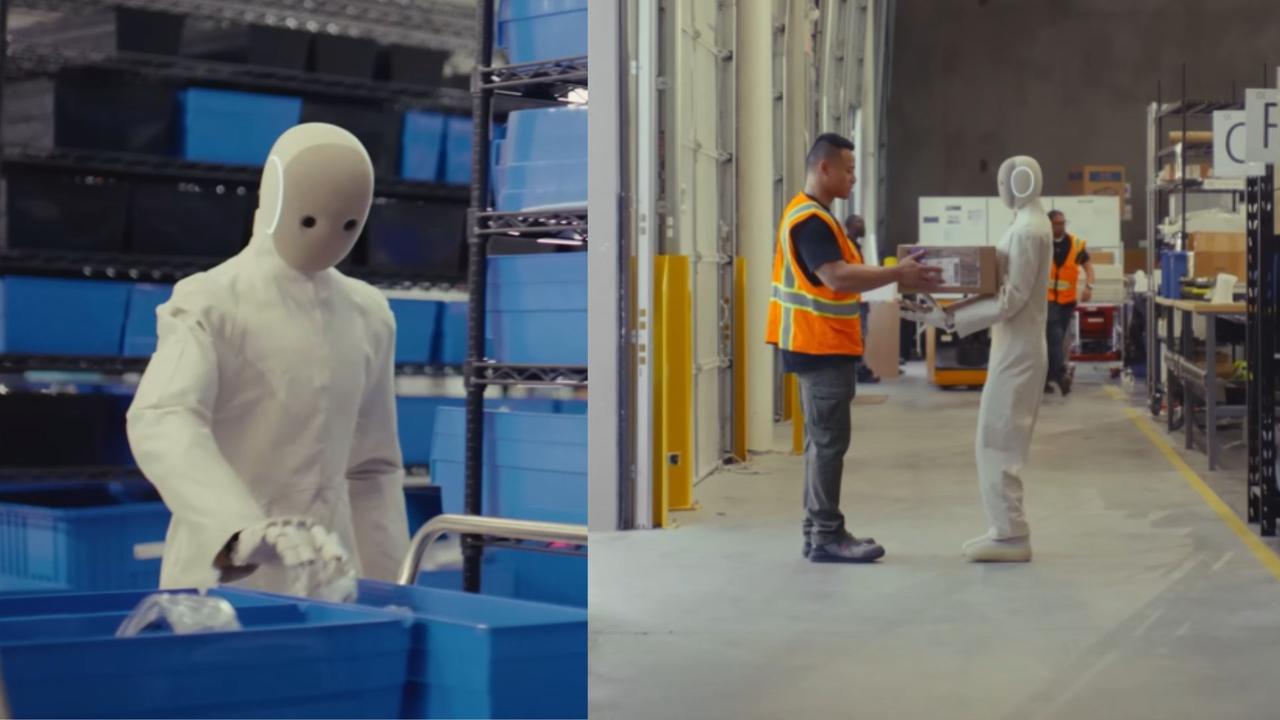
* 1X robot production facility is now building the Neo robot * One factory worker will look especially familiar * The company says it's on track to deliver the humanoid into homes this year It's still hard to buy your own home robot. Humanoids like Tesla Optimus and Figure AI have yet to go on sale, and 1X's $20,000 Neo Home Robot is still on pre-order. But at least Neo is doing its best to move the operation along, as it, according to a newly released video, assists in its own production. 1X released a nearly three-minute-long video on Thursday that shows virtually the entire Neo robot production process, from machining key components to weaving the touchable or huggable fabric to dropping in an Nvidia GPU. The video has close-up views of lathes, CNC systems, and overhead shots of a large factory where a legion of workers are assembling the robot. Throughout, however, are 1X Neo robots assisting; in essence, they're building each other. While most of the robots do not appear to be operating heavy machinery, they are seen carrying, sorting, and gathering parts. One has to wonder, as they are gathering gears and pulleys from these blue bins, if they ever recognize the parts as bits and pieces of themselves. 1X has been working with Nvidia for more than a year, using its silicon and AI models to train the Neo robot in basic home care tasks, such as taking a cup from the dishwasher and putting it away. There's obviously been a lot of training and simulation since then, which is likely what's made Neo's new factory worker role possible. The other striking thing about the video is the scale of the operation. 1X says in the video description that they have 200 employees working in a 58,000 square foot facility based in Hayward, California. In one room, they appear to be building dozens of Neo robots at once. They're all hanging off racks, usually with their heads in place, but limbs in the process of being introduced. 1X's goal here appears to be not so much showing that its robots are part of the operation (it's done so casually) as the expertise and care that go into each build. At one point, we see someone carefully adding the robot's mouthless face as if he were handling fine china. But we also see various components undergoing stress tests in plastic cages. If and when a Neo arrives in your home, it won't enjoy the delicate care of these engineers. Family life might be rough; the stress tests are clearly designed to ensure that Neo is up to the task. Is an all-robot production facility next? It's fun to see Neo's fabric skin zipped on, but the final step, in which a lone engineer checks for tolerances, seems obviously staged, especially because it's in such a lovely room and the engineer rolls in his own custom light wall. One has to wonder if, as the production process ramps up and 1X starts selling hundreds (or more) of these robots, the Neo robot will take on more critical production tasks. At what point are we looking at an all-robot production facility producing nothing but robots that look like every factory worker? It's more likely that humans will be in the loop for a long time to come, which is probably how we all like it. Regardless, the video marks a potential turning point for humanoid robots and, more specifically, the 1X Neo home robot, which the company promises is now on track to start shipments to early customers this year. As for how many people have pre-ordered the $20,000 robot or signed up for a $499-a-month subscription plan, it's anyone's guess. Just know that if you do, there's a decent chance that a Neo humanoid helped build your robot. Follow TechRadar on Google News and add us as a preferred source to get our expert news, reviews, and opinion in your feeds. Make sure to click the Follow button! And of course, you can also follow TechRadar on YouTube and TikTok for news, reviews, unboxings in video form, and get regular updates from us on WhatsApp too.
Share
Copy Link
OpenAI backed robotics startup 1X Technologies has opened a 58,000-square-foot US factory in Hayward, California, aiming to produce 10,000 Neo humanoid robots in its first year. The facility marks a significant push to bring humanoid robots for home use to consumers at scale, with shipments expected by year-end and production targets of 100,000 units by 2027.
1X Technologies, the Norway-founded OpenAI backed robotics startup, has opened a new 58,000-square-foot Hayward California facility designed to manufacture humanoid robots for home use at unprecedented scale
1
. The US factory will serve as a manufacturing hub with capacity to build 10,000 robots in its first year, with the company targeting more than 100,000 units annually by the end of 20272
. The facility currently employs more than 200 workers and represents what the company describes as the first vertically integrated humanoid robot factory in the United States3
.
Source: Interesting Engineering
The startup, which relocated its headquarters from Norway to Palo Alto last summer, plans another move to San Carlos as it outgrows its current space. A larger manufacturing facility is already under construction in San Carlos to support the ambitious mass production of robots
1
. First customer shipments are planned for 2026, with the company reporting that first-year production capacity sold out within five days when pre-orders opened in October 20252
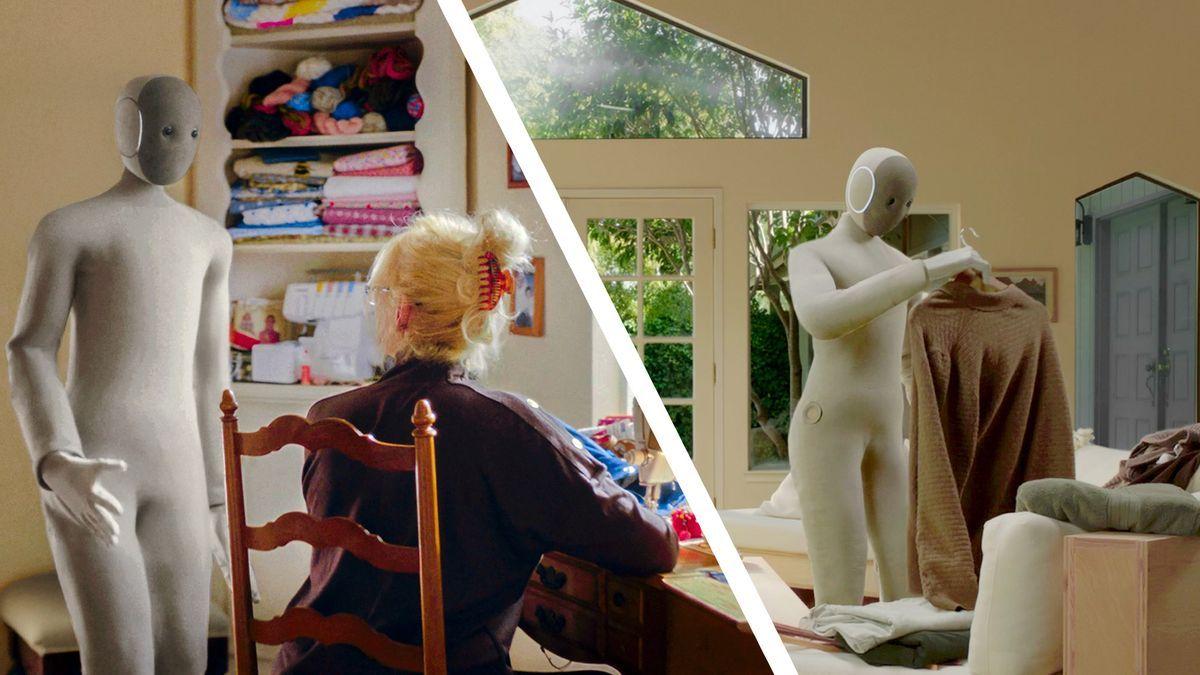
.The Neo humanoid robot, available for $20,000 pre-order or through a $499-per-month subscription, has generated significant attention for its soft, human-like body designed to assist with domestic household tasks like folding laundry and tidying up
1
. The robot features conversational AI capabilities and can learn new skills over time through embodied AI, a technique where robots acquire skills by interacting with their environment2
. Customers can also manually demonstrate tasks using a VR headset and controllers, with the robot including conversational functionality that founder Bernt Børnich has compared to ChatGPT2
.
Source: TechRadar
The latest version coming off the production line includes notable improvements, such as optimized eye sockets to expand the field of view, improved lenses, and a soft head that can be squeezed
1
. Neo is powered by Nvidia's Jetson Thor onboard computing platform and trained using Nvidia's Isaac open robotics simulation framework2
. The company hopes Neo will eventually assist with elder care, positioning it as a general-purpose home robot designed to operate safely alongside humans1
.1X Technologies has adopted a vertically integrated manufacturing approach that sets it apart in the consumer humanoid market. The company manufactures critical components in-house, including spinning copper coils, making motors, electronics, batteries, sensors, structures, and transmission systems
1
. According to Dar Sleeper, 1X's vice president of design, product and marketing, "The level of vertical integration here is unmatched, not just in the humanoid space, but in the hard tech space"1
.
Source: Bloomberg
This strategy allows for a fast development loop, where the company can analyze data collected by AI-powered robots and introduce new updates more quickly
1
. The robot production process includes final assembly where parts are mounted to a spine, followed by Neo performing "morning stretches" to check movement and quality, including squats and yoga poses1
. Notably, a video released by the company shows Neo robots assisting in their own production, carrying, sorting, and gathering parts throughout the facility4
.Related Stories
The US factory opening comes as 1X Technologies faces intense competition in the humanoid robotics space. Beyond a handful of US companies such as Tesla Inc., Figure AI Inc., Agility Robotics Inc., and Apptronik Inc., the market is largely dominated by Chinese robotics firms, which accounted for the majority of the 13,000 units shipped worldwide last year
1
. China's humanoid robotics sector is moving rapidly, with Unitree's G1 and H1 robots commercially available at price points well below Tesla's indicated targets, while companies like Agibot, UBTECH, and Fourier Intelligence all target the same market with state-backed subsidies and policy support2
.Tesla Optimus presents perhaps the most formidable competition, with Elon Musk's long-stated goal of pricing below $20,000 per unit—the same price point at which 1X is selling Early Access Neo robots today . Tesla has discussed manufacturing a few hundred Optimus units in 2026, scaling to thousands and then tens of thousands annually by 2027 and 2028 . The competitive dynamic places 1X's American-manufactured approach against Chinese state-backed scale and Tesla's automotive manufacturing infrastructure simultaneously .
Bernt Børnich believes humanoids will reach a critical mass in society in as little as two years, stating, "We need a lot of skilled labor in the US to be able to really ramp up manufacturing the way we want, and there's likely going to be more of these machines than there are people"
1
. The company has structured a dual commercial strategy, with a consumer track selling directly to homes and an enterprise track that includes a December 2025 partnership with private equity firm EQT to deploy up to 10,000 NEOs to companies in EQT's portfolio between 2026 and 20302
. This two-track structure provides higher-margin enterprise revenue from early units while the home model scales down in cost over time .Summarized by
Navi
[1]
[2]
[3]
29 Oct 2025•Technology

25 Feb 2025•Technology

13 Jan 2026•Technology

1
Technology

2
Health

3
Policy and Regulation