21 Sources
[1]
Nvidia's AI Hardware Comes to Windows in RTX Spark PCs
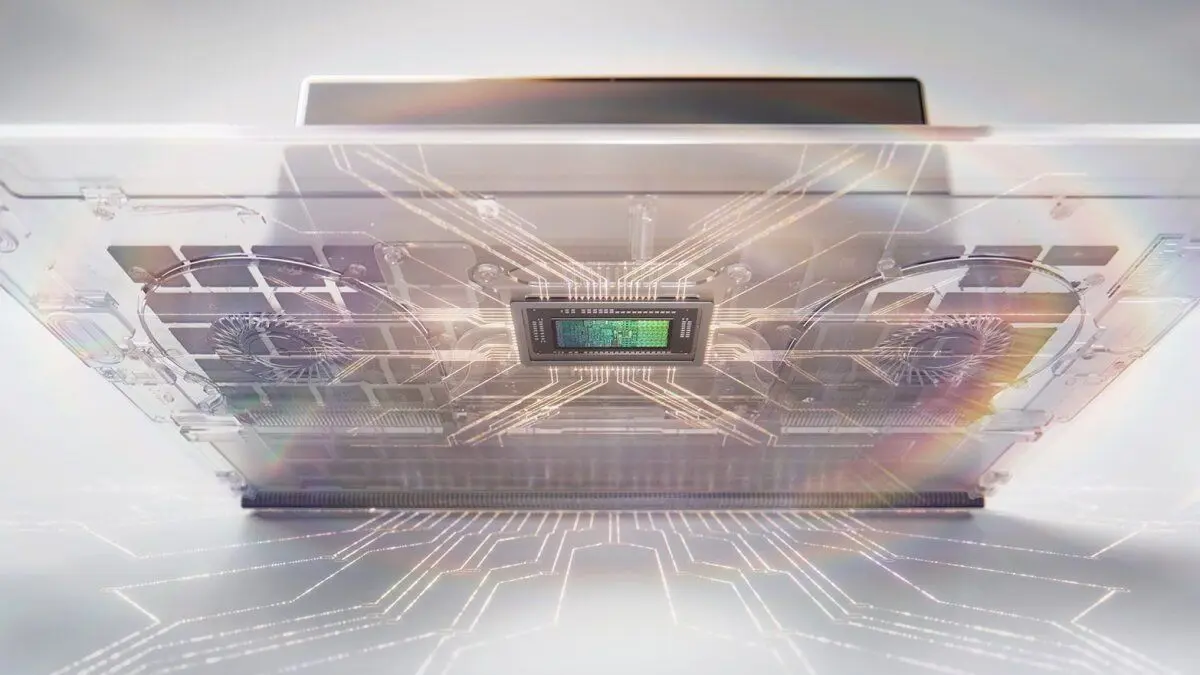
RTX Spark combines CPU and GPU cores into an Arm-based system-on-chip. The platform also features a dedicated NPU. At Computex 2026, an annual computer trade show held in Taipei, Taiwan, Nvidia made a long anticipated announcement -- a version of the company's Blackwell GB10 superchip for Windows PCs, called RTX Spark. Originally rumored to launch in 2025, it was finally introduced at this year's show. It came with full support from Microsoft, which announced two new devices powered by RTX Spark: the Surface Laptop Ultra and the Surface RTX Spark Dev Box. Asus, Dell, Lenovo, HP, and MSI also announced Windows PCs with RTX Spark. If this is triggering déjà vu, that's for good reason. In June 2024, Qualcomm and Microsoft partnered to launch AI-focused Copilot+ PCs. Qualcomm's Arm-based chips provided an alternative to x86-based chips from AMD and Intel used across dozens of budget and mid-range Windows laptops. It was met with mixed commercial success, however, and Intel remains the dominant supplier of chips for Windows laptops. But that doesn't mean RTX Spark will follow the same path, as Nvidia's involvement is an important part of the equation. "Nvidia just has more clout and more industry weight to push and make things happen that Qualcomm couldn't do early on, and that even Microsoft struggled with," says Ryan Shrout, president at Signal65, a third-party testing firm. "They can get game developers on board, and get software developers in the emerging AI space to pay attention." What is RTX Spark? At its core, RTX Spark is an iteration of the hardware found in the DGX Spark mini-workstation, which was released in late 2025. Officially badged N1X, the silicon is Nvidia's Blackwell GB10 "superchip," a system-on-a-chip with 20 Arm CPU cores, 6,144 GPU cores, and support for up to 128 gigabytes of LPDDR5X memory. There are some small differences between the mini-workstation and PC system, and the most significant is power consumption. The DGX Spark was designed for GB10 to operate with a power consumption up to 140 watts without overheating. RTX Spark laptops are likely to use less power, which may lower performance, though the details will depend on each PC maker's particular implementation and remain to be seen. RTX Spark will also include a neural processing unit (NPU) that qualifies the system for Microsoft's Copilot+ certification. The NPU is used for some background AI features, like Windows Recall. However, the GPU will remain in the driver's seat for active AI tasks, including large language models (LLMs) and image generation. Though RTX Spark laptops took the spotlight, the news is also relevant to desktop workstations. Currently, DGX Spark ships with a custom version of Linux called DGX OS, not Windows. Nvidia says RTX Spark desktops with Windows are coming in the third quarter of 2026. Windows is also coming to Nvidia's DGX Station, the full-sized desktop iteration of Nvidia's hardware. The launch of RTX Spark is of course in part an AI play, and that is taking the lion's share of attention. But Anshel Sag, principal analyst at Moor Insights & Strategy, thinks Spark is just as relevant for professional work and gaming. "I think the AI play is mostly to appease investors," he says. "Creators and gamers are also excited about RTX Spark, and someone like me who does all three is even more excited, because having a machine that can do all three well has been a challenge." Nvidia's advantage may lie in software Though Nvidia refers to the GB10 as a "superchip," it's similar to other high-performance system-on-a-chip designs, such as Apple's M-series silicon and AMD's Ryzen AI Max. All three include a CPU, GPU, and NPU. All three support large amounts of DRAM. And all three have a unified memory architecture (meaning the system memory is a shared resource accessible to the CPU, GPU, and NPU). The existing DGX Spark also provides a baseline for performance expectations. RTX Spark will likely deliver GPU performance similar to an RTX 5070 mobile GPU which, if correct, would put it ahead of Apple and AMD's competing systems. On the other hand, GB10's CPU cores aren't as quick as the CPU cores found in leading competitors. Nvidia's biggest edge might stem not from hardware performance, but from software. The company's GPUs are essentially the industry standard across gaming and professional work, with estimates placing Nvidia's GPU market share above 90 percent. That in turn has made Nvidia the target for most software that benefits from a GPU. "Nobody doubts that Nvidia is the leader in GPU capability and the software stack around it," says Shrout. Sag agrees, saying Nvidia has the advantage of "extremely mature drivers." Microsoft touts AI, but Windows on Arm remains a question Nvidia announced RTX Spark was in lockstep with Microsoft, which held its Build developer conference in San Francisco while Computex was taking place across the Pacific in Taipei. Repeating the Copilot+ PC launch, Microsoft's vision of Windows on the RTX Spark leans heavily on AI. But unlike Copilot+ PCs -- which used the NPU to accelerate AI features integrated into the Windows user experience, such as quickly recalling anything you've opened or translating live video calls -- the pitch for Windows running on RTX Spark seems more focused on using the Spark's GPU to accelerate LLMs. Microsoft announced an "early preview" of Windows SDK called Microsoft Execution Containers (MXC), which sandboxes AI agents, allowing them to work autonomously while isolating them from functions the user doesn't want the agent to access. Still, the real test for both Nvidia and Microsoft remains the same challenge Microsoft and Qualcomm faced: establishing Windows on Arm PCs as an alternative to Windows PCs powered by x86 chips from Intel and AMD. Whether RTX Spark will succeed in this remains to be seen. "Even with all of the talk from Nvidia and Microsoft about the future of the PC and revolutionizing the PC, everybody understands that it needs to be a great general-purpose PC first," says Shrout.
[2]
4 Nvidia RTX Spark laptops I'm most excited to try - including Microsoft's new Ultra
Follow ZDNET: Add us as a preferred source on Google. After years of speculation, Nvidia announced a new CPU for consumer laptops, competing with industry giants Intel, AMD, and Qualcomm. Its new RTX Spark chip will be found on laptops and desktops from all the big PC brands: HP, Lenovo, Acer, Asus, Microsoft, MSI, and Dell, with some available as early as this fall. Nvidia, in partnership with Microsoft, says its new Arm-based RTX Spark is a reinvention of the PC to reflect the age of AI agents, offering up to 1 petaflop of AI performance, full-stack graphics technology, and up to 128GB of unified memory to power creative tasks. Also: Dell's new XPS 13 is a MacBook Neo rival that costs $599 and retains premium features Nvidia CEO Jensen Huang announced the partnership on stage at Computex 2026 in Taipei, promising a native Windows experience centered around personal agents, with agentic AI features soon to be accessible directly from the Windows taskbar itself. "We've worked with Microsoft for two and a half years: reinventing the PC and reinventing Windows," Huang said during a press Q&A in Taipei. "We're reinventing the PC." Nvidia has bold claims for its RTX Spark-powered laptops, which it is calling "the most efficient PC chip ever built," but specific details remain a little light, including performance metrics, hardware specs, and, of course, pricing. With premium tandem OLED displays, 128GB of unified memory across the board, and premium builds, however, you can expect all of the new models to be in "high-end creator machine" territory, well over the $2,000 mark. Microsoft Surface Laptop Ultra Microsoft's language surrounding this device is nothing short of dramatic. Designed for "world builders," it says, with a commanding 15-inch mini-LED PixelSense Ultra touchscreen and the largest haptic touchpad on any of its laptops. Also: I tested the Surface Pro with 5G, and it's Microsoft's most complete business 2-in-1 yet As the flagship Windows PC, Microsoft says it's the most powerful Surface laptop ever built, optimized for RTX Spark. It will feature an Nvidia Blackwell RTX GPU and up to 128GB of unified memory that can be dynamically allocated for high performance across creative tasks, such as 3D rendering and multimodal workflows. Dell XPS 16 Creator Edition Dell's new 16-inch XPS with the RTX Spark is designed for creators, AI developers, and gamers, with up to 128GB of unified memory, all-day battery life, and a tandem OLED display with support for True Black HDR 600. It'll also come with an SD card reader and HDMI port. Also: Dell XPS 13 (2026) vs. MacBook Neo: I compared both budget laptops, here's which one I'd buy Although Dell hasn't been very forthcoming on details yet, the XPS 16 is a logical place to house the new RTX Spark CPU as a creator-focused powerhouse in an ultra-premium form factor. With this kind of build and hardware, it's certain to carry a price point to match, and it's a laptop I personally can't wait to go hands-on with. Asus ProArt P14 and P16 Following the theme of high-end creative workstations, Asus' ProArt lineup pairs both the 14- and 16-inch models with the RTX Spark CPU and up to 128GB of unified memory, 2TB of local storage, a haptic touchpad, and a Lumina Pro tandem OLED display at 3840 x 2400 resolution -- surpassing 4K. Asus says it will be swapping out its famous DialPad for haptic features -- an interesting choice as the DialPad is one of the lineup's most unique features and a potential differentiating factor from the other RTX Spark devices. MSI Prestige N16 Flip AI Plus MSI's N16 Flip AI Plus will be a convertible device that pairs with its Nano Pen stylus, but details on hardware configurations remain under wraps. At MSI's Computex booth, it was powered down and positioned away, with gloved staff standing guard next to the device to ensure it wasn't being handled. Also: Finally, an ultraportable Windows laptop for work with some serious horsepower It'll feature an OLED display that will likely match the 1,200-nit brightness for HDR content. If it follows suit with the rest of these devices, we can expect up to 128GB of RAM and a haptic touchpad. While MSI had no comment on cost, I'd expect around the same $2,000-plus price point.
[3]
Welcome to the Superchip Era: 6 Ways the Nvidia RTX Spark Will Upend the PC Industry
Nvidia kicked Computex off with massive news: a full-scale consumer laptop play, powering a new class of power-user AI PCs with its RTX Spark superchip. This isn't just about throwing an Nvidia sticker on a keyboard deck and dropping a jumped-up Arm chip inside. Nvidia's move represents a major shift in laptop hardware. By taking the heavy-lifting AI components of Nvidia's DGX Spark developer desktop, embracing Windows on Arm, and using the unified-memory, system-on-a-chip (SoC) playbook of the Apple MacBook Pro, this architecture dramatically levels up consumer compute. Simultaneously, it gives Microsoft the hardware foundation it needs to rewrite Windows from the ground up for deep, local agentic AI capabilities. Oh, and for good measure, it finally tackles the Achilles' heel of Windows on Arm by delivering native, competitive gaming capabilities. RTX Spark is absolutely dominating the conversation at Computex, powering ultra-premium new laptops, which will arrive this fall, from the likes of Asus, Dell, HP, and Microsoft, with its souped-up Surface Laptop Ultra. It's an exciting time to cover laptops and AI, as the threads of earlier hardware announcements are finally coming together. It's the anticipated fruit of seeds Nvidia planted with last year's DGX Spark debut, introducing personal-scale AI devices that are effectively supercomputer hardware. RTX Spark also gives us a glimpse of what we might see from Nvidia's partnership with Intel, as the two chip giants will likely collaborate to bring similar GPU power and unified memory to x86 in the near future. However, looking back only maps the fault lines, and we're watching the ground move now (and again this fall). Here's how I see the laptop landscape shifting around Nvidia's new RTX Spark chips. Opening Up the Field for More Competition and Innovation The biggest, most obvious change with Nvidia's entry into laptop processing is that Intel, AMD, and Qualcomm will now compete directly with Nvidia, turning what was once a two-player competition between Intel and AMD, with a scrappy third fighter taking potshots, into a four-way melee. (That's not even counting Macs, which use Apple's own Arm-based silicon.) That's both good and bad news. On the plus side, more competition means more innovation. The four chip makers will race to outdo each other on features, capabilities, and price. If my economics classes taught me anything, it's that this sort of competition drives down prices and results in better products. The current memory shortage actually highlights this sort of supply and demand, as the market for memory has exponentially increased while the number of suppliers has stayed the same. (I'm flashing back to blackboard drawings of supply and demand curves.) When those pressures come to bear, someone eventually finds a way to meet demand. We're seeing it now with the AI need for local compute, and I'm sure we'll see something similar in memory manufacturing or implementation in the next year or two. Remember the flipside here, however: More players means more fragmentation. Intel and AMD are still cranking out x86 processors, but Nvidia will join Qualcomm in making Arm chips, enabled by Microsoft's own Windows on Arm software efforts. Windows developers will have to either pick a side or work to support both camps. I've found a silver lining, though. Adding Nvidia as a new player actually helps with some of that fragmentation, because it throws Nvidia's sizable weight behind Windows on Arm, which will further the new platform with expansions into gaming and heavy-duty AI. The sheer gravity Nvidia exerts by playing in that space means that more developers will support Windows on Arm, and more refinements will come to the platform. Nvidia's vote for the Arm ecosystem will move investment dollars, developers large and small, and even consumers, who may be more likely to buy a laptop powered by the well-known Nvidia than the less-prominent Qualcomm. The Superchip Era: Is This What We're Calling It? The RTX Spark is an Nvidia product, but it's actually the result of the same Nvidia and MediaTek collaboration we saw with the DGX Spark. Nvidia designed the graphics and AI hardware, but utilized MediaTek's platform integration of Arm Cortex CPU cores, with TSMC handling the physical 3-nanometer manufacturing to physically make the superchip SoC. Back when Intel and Nvidia announced their team-up last fall, I suggested that they would adopt exactly the sort of CPU/GPU+Unified memory approach we're seeing in the RTX Spark. Seeing Nvidia use that exact approach for its own hardware has me quite confident that I'll be proven right on the Intel collaboration doing the same. It makes a lot of sense. That giant SoC approach not only goes way beyond what traditional integrated graphics can do, but it also makes for a larger pool of memory that works for anything, from gaming to AI. As AI features increasingly rely on memory for broader context windows and larger model support, it's a key innovation for allowing more powerful local AI on individual laptops and desktops. We're still in that awkward stage where the new technology doesn't seem to have a proper name yet. Nvidia calls it a superchip, but the industry could coalesce around a new name within the week. With major laptop announcements coming from Computex and new Surface and Windows on Arm details coming from Microsoft Build, everyone in the computing world is talking about this exact technology. The days of awkwardly saying, "It's an SoC, but, like, a more powerful SoC, with unified memory" could quickly give way to a cleaner, more concise term. (I clearly hope so.) RTX Spark is also something of a threat to Apple, with the superchip promising the same sort of power and capability as its MacBook Pro chips. Apple has long had a grasp on the creative class, most recently by making video editors and digital artists choose between Apple's unified memory or Nvidia's CUDA ecosystem. With the RTX Spark, that trade-off shifts dramatically, presenting a non-Apple option with the same sort of developer buy-in and impressive unified memory to enable fast, AI-enhanced workflows. Gaming Grows in Unexpected Ways New Nvidia hardware also points to another happy outcome: More gaming on more devices! With RTX Spark featuring power on par with an Nvidia RTX 5070 Laptop GPU, we now have undeniably gaming-grade hardware in a Windows on Arm device. Here's the thing: We already have some gaming capability with Windows on Arm. If you're willing to settle for playable frame rates in the 30s and 40s, and tinker with things like AMD's FSR, you can game on some of the better Qualcomm Windows machines today. They're also well past low-impact games like Minecraft and World of Warcraft, supporting relatively recent games like Cyberpunk 2077. Regardless, gaming on Arm has faced some major roadblocks. Graphics power is one of them -- the lack of a discrete GPU has left most Qualcomm machines underpowered for modern gaming. Still, the bigger bottlenecks have been the need to use Prism emulation, or worse, many games are simply unplayable due to kernel-level anti-cheat technology that won't run on Arm, until now. Nvidia's stature in the gaming world is hard to overstate. The company has been a mainstay of modern gaming for decades, and the CUDA platform went from being the first GPU compute model to see wide adoption to becoming the backbone for recent advances like DLSS 4. If Nvidia is making an Arm processor for Windows machines, you'd better believe that game makers will start making more Arm-compatible games. In fact, we're already seeing the changes. Microsoft will fix the Anti-Cheat technology on Arm, a detail included in the RTX Spark announcement. The Windows maker also announced that Riot Games and Krafton, developers of Valorant and PUBG, respectively, will bring their game libraries to Arm with native support. Nvidia will also bring DLSS 4.5 to the new RTX Spark laptops. The company specifically named a number of new games in its briefing, showing off hits like Doom: The Dark Ages, Fortnite, and Half-Life 2 RTX, along with demos of Alan Wake 2, Indiana Jones and the Great Circle, and Pragmata. That's all to say that Windows on Arm will soon see a huge gaming upgrade, and I'm sure I'm not the only one saying that it feels a bit overdue. The Biggest Upgrade: Massive AI Power The most significant improvement that Nvidia's RTX Spark will bring to consumer systems is AI power. This is the same server-grade AI muscle that Nvidia has packed into the Nvidia DGX Spark, but optimized for Windows, and with a neural processor (NPU) added to the mix to handle all of Microsoft's Copilot+ features. That makes these new machines the most powerful AI PCs yet, handling all of the on-device features Copilot+ has. These systems will also provide the horsepower to run a 120-billion-parameter open-source model, or run OpenClaw and Hermes AI agents on your laptop. So far, the selection of laptops (or even desktops) that pack that sort of power has been a rarified few -- the DGX Spark, custom-built multi-GPU rigs, and the few laptops with unified memory, like the MacBook Pro and systems with AMD's Strix Halo family. That level of computing is about to get a lot more common, thanks to Nvidia. This shouldn't be a huge surprise. Of all the companies making hay in the AI goldrush, Nvidia has been churning out the digital shovels as fast as physics allows. From new chips to fresh server hardware and new software frameworks, there is no bigger player in the AI sandbox when it comes to providing compute power. With this announcement, it's clear that Nvidia intends to stay at the top, even as locally run AI and agents become the next big thing. Flipping the Power vs. Battery Life Script Qualcomm has made major gains in laptops, in part, by delivering killer battery life. However, the whole value proposition has been that you enjoy better energy efficiency at the expense of true x86 support and peak graphical power. With Nvidia cannonballing into the Windows-on-Arm swimming pool, that proposition changes. Nvidia's name is synonymous with GPUs, and the graphics power on display here is a huge step up from Qualcomm's best. Nvidia's trade-off may still be battery life, however. The company promises "all-day battery" and high efficiency, but that may only hold true for day-to-day productivity. When gaming or heavy, continuous AI use enters the picture, I suspect we'll see much shorter battery times. How short will have to wait for testing to confirm, but the limits of energy efficiency can only be stretched so far when you're powering a GPU's worth of graphics cores or running an AI agent, even when you're not at the keyboard. The Trickle-Down Effect and a Pricing Reality Check We've obviously heard a lot about the heights the new RTX Spark will be able to reach with the full complement of CUDA cores, Grace cores, and 128GB of unified memory. However, those top-specced models won't be the only systems with RTX hardware inside. Manufacturers will have more than one RTX Spark chip to choose from. Nvidia hasn't specified, but pre-announcement rumors clearly mentioned two different classes of chip (code-named N1 and N1X). Manufacturers will be able to configure systems with as little as 16GB of memory, more in line with current consumer systems. That all adds up to lower-powered lower-priced RTX Spark hardware. We may not know what those lesser chips are called, but they're obviously going to exist. Regardless, this is good news. With skyrocketing RAM prices and fierce competition from Intel, AMD, and Qualcomm, we might see Nvidia systems that people can actually afford. For context, the DGX Spark, which has similar specs to the RTX Spark, initially sold for $3,999 for the 128GB model with a 4TB SSD. Retailers actually dropped the price a bit in late 2025, dipping as low as $3,969 through some retailers. Still, eventually Nvidia bumped the price up to $4,699 citing memory shortages as the cause. Top-tier versions of RTX Spark, with the full 128GB of memory, will almost certainly sell for $3,000 or even $4,000. Charging that much for a developer desktop is one thing for professional users investing in cutting-edge AI equipment, but for personal devices, that's a stretch. Even when we compare it with gaming laptops with discrete GPUs, that's a premium most people can't even consider. If Nvidia wants this to be a mass-market product, and not just a niche option for AI developers, content creators, and gamers, it must have affordable versions for the average consumer to buy. The World of Nvidia's Shake Up Whether budget shoppers and mainstream consumers can buy the premium Nvidia RTX Spark laptops that are coming this year almost misses the point. By bridging the gap between desktop-class AI and gaming or creation hardware, Nvidia will force the whole industry to move in several directions. Qualcomm sees both a big boost to Windows on Arm and an incentive to start adding graphics hardware, or risk playing only in the shallow end of the pool with affordable and mid-market machines. Apple's MacBook will face real competition in the AI space as Windows machines can now compete with Apple silicon for local AI models and always-on agents -- a trend that's niche now, but exploding in developer and AI circles. The changes coming for gaming, for Windows on Arm, and graphics in general will similarly spur competitive growth in the laptop world. Like I said at the start, Nvidia's move isn't just a tremor, it's an earthquake. This Computex announcement will cause aftershocks that I expect we'll still feel in the coming years.
[4]
Nvidia's AI PC push banks on unproven demand beyond niche users
June 8 (Reuters) - Nvidia's (NVDA.O), opens new tab entry into the AI PC market with its RTX Spark superchip last week is less a breakthrough for regular users than a high-stakes bet that a largely unproven concept can find wider appeal, analysts said. At the Computex trade show in Taiwan, the chipmaker pitched a future where laptops run large AI models locally and act as personal digital agents, no cloud needed. It's a claim that PC makers HP (HPQ.N), opens new tab and Dell (DELL.N), opens new tab have made for nearly three years now, only to be met with skepticism from Wall Street and consumers, with high prices outweighing tangible benefits. Nvidia, though, appears to be selling a different version of the AI PC than what exists today, one aimed more at developers and content creators who have long favored Apple's (AAPL.O), opens new tab high-end MacBook Pros. Six companies - Microsoft (MSFT.O), opens new tab, Asus (2357.TW), opens new tab, HP, Lenovo (0992.HK), opens new tab, Dell, and MSI (2377.TW), opens new tab - will make PCs using the chip. These stocks surged after Nvidia's announcement on June 1. "RTX Spark doesn't make traditional PCs obsolete. It creates a new category between the workstation and the AI server," said Kevin Hein, analyst at Tirias Research. The chip combines a central processor, graphics engine and up to 128 gigabytes of unified memory, making it capable of running large AI models locally, something current AI PCs cannot do at scale. Nvidia says it could reshape how people interact with computers, with AI agents handling tasks such as generating videos or debugging code. Existing AI PCs, marketed heavily over the past two years, have centered on modest features like transcription or image editing and have failed to drive meaningful sales for the device manufacturers and their partners such as Arm and Qualcomm (QCOM.O), opens new tab. COST BARRIERS LOOM A premium price and a memory chip crunch, which has already driven up device cost, are likely to limit RTX Spark devices to niche adoption, analysts said. The cost "won't deter all the big computer makers from working with Nvidia on this, but the bulk of PC sales for the next several years will still be more traditional Windows-based PCs with chips from Intel (INTC.O), opens new tab, AMD and Qualcomm," said Bob O'Donnell, president at TECHnalysis Research. HP and Dell stock had been climbing even before the launch of Nvidia's superchip, up 18% and 223%, respectively, so far this year. But that rally has been driven less by AI PCs and more by a wave of corporate upgrades to Windows 11, as well as booming demand for AI infrastructure, particularly for Dell. In its latest quarter, HP warned of a sharp decline in the PC market in the latter half of the year. The company did note strong demand for AI PCs, especially from enterprise customers, although the overall PC business recorded shrinking sales. The outlook for PC sales looks dour this year, with IDC estimating global PC shipments to decline 11.3% in 2026. COMPETING WITH APPLE It is unclear if devices powered by the Nvidia chip will outperform Macs. Nvidia said details on battery life and other metrics would be shared closer to the launch of the products this fall. Still, the Nvidia-powered laptops could make Windows machines competitive with Macs for the first time on memory bandwidth, a key bottleneck for AI software that constantly shuttles data back and forth between a machine's processor and memory, adding latency. That brings it closer to Apple's in-house chips, which have bundled unified memory since 2020. "I expect some companies will take the leap to test out the long-term viability of on-device inferencing," said Tom Mainelli, a group vice president at IDC. Reporting by Aditya Soni amd Anhata Rooprai in Bengaluru; Editing by Sayantani Ghosh and Anil D'Silva Our Standards: The Thomson Reuters Trust Principles., opens new tab
[5]
This thin MSI laptop hides gaming muscle under its professional disguise, thanks to Nvidia's RTX Spark
* RTX Spark already appears in devices, including Microsoft's Surface and MSI's Prestige N16 Flip AI+. * MSI's Prestige N16 Flip AI+ is a thin-and-light convertible for work, creation, and gaming. * RTX Spark may match RTX 5070 power, enabling local AI agents and gaming like Cyberpunk 2077. Usually, when we hear about a new piece of hardware, it begs the question: when will we actually see it arrive in devices? Any tech company can stand on a stage and announce a new chip, but if no manufacturers decide to actually use it, then it's pretty much dead on arrival. Fortunately, Nvidia and Microsoft's new chip, the RTX Spark, has already found itself on multiple devices. We've already seen Microsoft's own Surface Laptop Ultra, which the company claims is the most powerful Surface it has ever released. Now, at Computex 2026, we're seeing third-party manufacturers take a shot at designing an RTX Spark laptop, and while MSI's entry looks like a simple work-focused laptop, it's anything but. MSI reveals the Prestige N16 Flip AI+ for work, creation, and gaming Yes, this thing can game Over on the MSI blog, the company has revealed the Prestige N16 Flip AI+. As the name implies, you can flip the screen around to transform the device from a laptop top atablet and vice versa. It also makes use of the newly revealed RTX Spark to help people deploy and run local AI agents without breaking a sweat. The part that stands out to me the most about the Prestige N16 Flip AI+ is that it looks like a productivity laptop, but has far more power under the hood than it lets on. In fact, MSI has a small FAQ on the product page that explicitly states it's suitable for playing games on: Is the Prestige N16 Flip AI+ suitable for gaming? Yes. The system leverages NVIDIA's full suite of RTX technologies to deliver immersive gaming and entertainment experiences within a thin-and-light form factor. If that's true, then where's the laptop drawing the graphical might from? While we haven't seen any benchmarks just yet, there are whispers that the RTX Spark itself can deliver as much GPU power as an RTX 5070. If true, it would explain why this seemingly professional-looking laptop could run Cyberpunk 2077 and set a precedent for future gaming laptops. Nvidia's RTX Spark will "reinvent the PC," giving Windows on Arm the huge boost it deserves It already has a home in a powerful new laptop. Posts By Simon Batt
[6]
The Nvidia RTX Spark Era Starts Here: Hands On With Microsoft's Surface Laptop Ultra
TAIPEI -- In the wake of Nvidia's huge announcement of RTX Spark laptops, and the subsequent news that Microsoft was leading the charge with the Surface Laptop Ultra -- arguably the flagship for this new class of laptops -- we've been eager to get our hands on the new Surface and see what these new Nvidia-powered laptops will actually look and feel like. (Hit the preceding link for a rundown of all the partner OEM models.) Well, at Computex, we finally got our chance, with a first look at the Microsoft Surface Laptop Ultra. No, system makers aren't yet powering on RTX Spark laptops for the press to play with, but here's what we were able to suss out in a short time with the device, and some of what the announcement didn't tell you. What Is Nvidia's RTX Spark? A Quick Refresher If you missed the news about Nvidia's new RTX Spark laptop hardware, here are the key bits. Nvidia has announced its own laptop-processor hardware platform, called RTX Spark, with the first chip dubbed the N1X. It combines a 20-core CPU with the equivalent of an Nvidia GeForce RTX 5070 laptop GPU (that's the claim, anyway) into one massive system-on-a-chip (SoC) with up to 128GB of unified memory. This superchip mega-SoC is very similar to the "Grace Blackwell" GB10 hardware used in the high-powered AI developer box, the DGX Spark, but optimized for Windows on Arm, complete with an NPU to support all of Microsoft's Copilot+ AI features. Beyond that, Microsoft claims that the RTX Spark-powered Surface Laptop Ultra will deliver up to 1 petaflop of AI compute, drastically outperforming any other AI PC Microsoft offers. That combination of power and portability in a thin-and-light laptop sounds like the holy grail of modern laptop technology. Like the DGX Spark, Nvidia says this hardware will allow users to run full 120-billion-parameter AI models locally on the device, giving consumers a level of AI capability that has thus far been limited to professionals with servers and enthusiasts with purpose-built systems that use multiple GPUs for processing muscle and memory. To be sure, these machines are being purpose-built for agentic AI tasks run locally on the device. We saw a few demos of games being played, and optimized creative software being run, but that stuff is secondary to the pure AI horsepower. Surface Laptop Ultra: Design and Hands-On Impressions The press releases shared the basic dimensions for the new laptop: Less than 18mm thick. Under 4.5 pounds. The all-metal chassis looks just as slick as other Surface laptops, right down to the polished Windows logo on the lid, coming in Platinum and Nightfall finishes. Indeed, at a casual glance, it's almost indistinguishable from the 15-inch Surface Laptops we know. Look closer, though, and you'll see that the chassis has a raised design so that it looks like the laptop is floating off the desk. Microsoft has outfitted it with a 15-inch mini-LED PixelSense Ultra touch screen and square-ish 3:2 aspect ratio. Along the sides are all the expected ports, including a full-size HDMI output, USB Type-C and USB Type-A connections, a 3.5mm headphone jack, and a full-size SD card reader. Open the lid, and you'll be greeted by the big, bright mini-LED display, with up to 2,000 nits peak HDR brightness -- Microsoft is calling it their brightest laptop display. This is a creator-class panel, with a crisp 262 pixels per inch and vivid color. In the briefing, we quizzed the team. There will be VRR support and 120Hz peak refresh, and while mini-LED may be a slightly larger draw on the battery, Microsoft says it will be manageable to maintain all-day battery. The keyboard is the same as what we've seen on past Surface Laptops, but that's not a bad thing, since we've loved the typing feel those full-size keyboards offered. The snap is the same, and having relied on 15-Inch Surface machines as daily drivers for years, they're the same experience. The keyboard is joined by the largest haptic touchpad Microsoft has ever put on a Surface device. That expansive touchpad gives you room to gesture and tap, and the haptic response gives you feedback for every action. A Microsoft rep also pointed out that the touchpad will be replaceable in the event repairs are needed, and Microsoft is working with various software partners to customize the haptic experience. Above the display is a webcam, with Windows Hello facial recognition; the reps would not share further details, such as the native resolution. But it was well masked into very thin bezels, and inobtrusive. RTX Spark Inside: A Look at the Specs, Internals, and Upgradability The real story here isn't the chassis, the ports, or even that impressive display -- it's the RTX Spark hardware inside. Powering 6,144 CUDA cores and wrangling giant AI models requires serious thermal management, and Microsoft had a display set up with the various internals separated out like an exploded diagram. The dual-fan, dual heat-pipe cooling means that the Surface Laptop Ultra will have more than twice the thermal capacity of the earlier 15-inch Surface Laptop 7th Edition from 2024. The fans are much thinner and more closely packed with fins. The airflow path is from the sides and out the back, funneling air not only over the heat pipes but to surrounding components. Indeed, a lot of attention was paid to the thermal design and airflow. Microsoft gave an excellent airflow demo that employed smoke to show the flow of air from the intakes into the fans... While a lot of noise is being made about the "up to 128GB of memory" spec, the reality is that some of these laptops will ship with significantly less, with configurations as low as 16GB of unified memory -- nowhere near enough to handle sprawling conversations locally with an offline AI. Four screws at the undersize corners allow access to the inside of the unit. Microsoft notes that the SSD will be swappable (it's a Type-2280 M.2) and the battery is accessible for replacement when its lifetime is up. Plus, QR codes inside the body next to components lead you to service instructions, a la Framework Computer. We did not see any SO-DIMM slots on the sample motherboard shown, so the memory is likely to be soldered down. Surface Laptop Ultra Availability: Coming This Fall, Pricing a Question Mark Like the rest of the RTX Spark laptops being announced this week, Microsoft wasn't sharing much in the way of firm details. Indeed, OEMs were not even allowed to power them up in the presence of the press. As for when the Surface Laptop Ultra will actually be a product you can buy, the most we could get out of the PR reps was "this fall." Whether that means early fall for back-to-school season or late fall for the holidays is still undisclosed, though our money is on a launch just in time for Christmas shopping. Pricing is even less specific, but one thing is for sure: These aren't low-end laptops by any stretch of the imagination. Seeing as they are being positioned as "Ultra," like the Microsoft entry here, or Lenovo Yoga Pro, Asus ProArt, and MSI Prestige, these are upscale AI-first models for AI early adopters looking to get their agentic game on under Windows. The bigger questions of performance, user experience, and true AI capability were never going to be answered now: We're still early in the hype cycle. We'll have to wait until we have the laptop in the PC Labs to actually dig into those details, and develop new benchmarks to measure how and whether they do what they say they'll do.
[7]
NVIDIA's RTX Spark chip could give Windows its true Apple Silicon moment - Engadget
Arm CPU cores, a powerful GPU and gobs of unified RAM? That sounds familiar! There's a lot we still don't know about NVIDIA's RTX Spark AI chip -- we're still waiting on deeper technical details and pricing for the first batch of systems -- but it has a decent shot of changing the way we think of Windows PCs entirely. RTX Spark should offer the raw performance that the first batch of Copilot+ systems lacked, and it will also push Microsoft to make the Windows experience even better for Arm CPUs (something I argued was the real highlight of the whole Copilot+ initiative, more so than AI support). With Qualcomm's latest Snapdragon chips powering low-end and mid-range Windows PCs, there's room for NVIDIA to fill the gap at the high end, delivering powerful (and likely very expensive) PCs that will appeal to memory-hungry content creators, developers and AI enthusiasts. Windows might finally get its Apple Silicon moment this year -- a bigger push to optimize the aging OS for more efficient Arm chips, while also rethinking what's possible when you can give GPUs direct access to insane gobs of memory. The MacBook Pro comparisons were immediately clear from the first batch of RTX Spark machines like the Surface Pro Ultra and ASUS's new ProArt systems. Of course, powerful Windows laptops are nothing new, but they typically had tradeoffs like thick and heavy cases, or enormous battery-draining power demands. What if you could get a powerhouse PC that didn't feel like a brick, and also lasted as long as a low-power ultraportable? That's the promise of RTX Spark systems, but there are plenty of details still up in the air. Based on NVIDIA's description of the chip, RTX Spark appears to be the same hardware that's in the DGX Spark AI workstation that launched last year for $3,999, but now sells for $4,699. That makes me think the initial RTX Spark systems could start around $4,000 or more. Its 20-core CPU is made up of 10 Cortex X-925 cores and 10 Cortex-A275, which are both slower than Arm's newer C1-Ultra core, Engadget Editor-in-Chief, Aaron Souppouris, points out. That hardware is currently only found in the Mediatek Dimensity 9500 chip, powering the new Oppo Find X9 Pro. NVIDIA's Arm cores are also slower than the latest Snapdragon Elite Oryon cores, as well as Apple's M5 chips. If NVIDIA is charging a premium for RTX Spark systems, you'd expect them to at least be using CPU cores from 2026. The real stars of the RTX Spark systems will be their 6,144 RTX Blackwell GPU cores, which is the same as the RTX 5070 desktop GPU, along with their support for up to 128GB of unified memory. Conceptually, that's not far off from what Apple did with its M-series chips, which also combined Arm cores, beefy GPUs and tons of unified memory. Apple Silicon gave Macs a huge performance and efficiency boost over PCs, and the entire Windows ecosystem has been struggling to keep up. The only competition for NVIDIA's hardware on the PC side is AMD's Ryzen AI Ultra lineup, which are also complex system-on-chip designs with powerful CPU cores, built-in graphics, a powerful NPU and integrated memory. Last year's flagship Ryzen AI Max+ 395 (AKA "Strix Halo") chip supported up to 128GB of RAM, and the newer AI Max 400 series brings that up to 192GB of unified memory. The Ryzen AI Max lineup is still based on the x86-64 architecture, giving them total compatibility with legacy Windows software, but none of the power efficiency benefits of Arm cores. NVIDIA RTX Spark systems, just like the Snapdragon X Elite Copilopt+ machines, will have to run x86 software through Microsoft's Prism emulator. I found that to be a pretty seamless experience while reviewing the Surface Pro Copilot+ in 2024, and Microsoft says it's also been working together with NVIDIA to optimize Windows 11 even more for the RTX Spark. Last year, Microsoft's Copilot+ initiative for AI PCs seemed like a dud, but I argued at the time that it at least pushed PC makers to solidify new standards for their premium laptops. Finally, just about everyone started offering their PCs with at least 16GB of RAM. The real failure of Copilot+ was that it hinged on AI features few people wanted, and which were fraught with privacy issues, like Microsoft's Recall. Things are a bit different now, as many developers and power users are adopting AI agents like OpenClaw. NVIDIA is clearly trying to target that crowd with the RTX Spark systems -- the people willing to spend a ton of money to get PCs with lots of RAM just so they can use the latest AI tools and models. (Those folks are also why the Mac Mini has been out of stock for months, and you can partially blame them for the death of the $599 model.) Beyond AI enthusiasts, I could also see content creators and non-AI developers tempted by the possibility of an exorbitant amount of unified memory. RTX Spark systems theoretically would be able to handle massive video editing jobs far better than existing laptops. Their Blackwell GPUs also mean you'll have full access to NVIDIA's DLSS AI upscaling and frame generation for games (and you'll likely have more than enough overhead for serious gaming while working on AI and rendering jobs in the background). As powerful as RTX Spark systems may be, they'll ultimately be limited by their pricing. Based on what we know so far, these will be incredibly expensive machines for deep-pocketed consumers. Still, there's hope for the future: Rumors point to NVIDIA working on stripped down versions of the chip for cheaper systems, and potentially genuine ultraportables. And hopefully by that point, the RAMaggedon will be over, and more people will actually be able to afford RTX Spark systems.
[8]
Nvidia's RTX Spark Laptops Are the Kick in the Ass Gaming PCs Needed
When Nvidia first revealed its new RTX Spark chip, built for graphically capable PCs, CEO Jensen Huang was his usual self, making sweeping statements that verge on ludicrous. The black-jacketed face of Nvidia proclaimed the following: "This computer literally runs everything the world has ever created, plus it runs [AI] agents." He was exaggerating a bit, of course: this year's Windows machine will clearly not be starting up a spinning jenny to help with your rustic crochet hobby (yet). Still, Haung was adamant that the RTX Spark would be able to manage "every application that Windows has ever run." The Nvidia CEO showed these systems running games on stage, such as Forza Horizon 6 and 007 First Light, but it was impossible to tell from across the auditorium how well they were actually performing. Huang's claims, if true, would be significant. Nvidia's new, seemingly powerful processors -- co-designed with MediaTek -- are based on ARM architecture. For years, ARM on PC seemed like a pipe dream given the massive task of translating decades' worth of software and drivers from the age-old x86 architecture. And suddenly, Nvidia shows up and promises everything will be right as rain. But Huang's keynote, somewhat conveniently, did not dive deeply into the extent to which ARM chips need to lean on emulation. Emulators eat up the headroom of a CPU and lead to worse performance than you would get normally. So I hope Nvidia can forgive me for feeling skeptical down to my bones, fully prepared for a subpar gaming experience, as I walked into Nvidia's RTX Spark demo suite. What I saw there wasn't flawless, nor was it the finished product. But the demos did leave me feeling more intrigued than skeptical, which seems like -- dare I say it? -- a promising sign. In the gaming room, four preproduction Microsoft Surface Ultra PCs were spinning up recent titles via the Microsoft Prism x86 emulator, which emulates the behavior of typical Intel and AMD chips in software. I started playing Pragmata, a game that can look very atmospheric when you push its ray-traced lighting to its extremes. The game was running at around 60 fps, and the smoothness floored me; it ran with no stuttering, odd graphics artifacts, or hitching to be seen. That's significant for an emulated title. There are a few caveats here. The system was using Nvidia's DLSS 4.5 upscaling to boost frame rates by rendering the game at a lower resolution. Nvidia was also adamant that it couldn't reveal graphics settings because the hardware and software were still unfinished ahead of the RTX Spark Laptops' vague fall release date. And this was a single slice of a single game, of course, which won't be indicative of how the thousands and thousands of available games with ARM builds will run. I also played several minutes of Alan Wake II, which Nvidia told me was running with path tracing enabled, producing truly spectacular reflections and environment lighting. The game was also leveraging Nvidia's newly announced DLSS 4.5 Ray Reconstruction model, which reduces ghosting and brings back environmental detail at the cost of frame rates. It looked beautiful. What I played looked great, without the need for frame generation to artificially smooth things out. And there's still a lot in the works when it comes to the in-game experience. Nvidia is essentially combining brute-force GPU power to overcome emulation hurdles and working with developers and publishers to push for compatibility. These laptops will support anti-cheat systems for multiplayer titles such as Fortnite, Valorant, and League of Legends. RTX Spark is supposed to have support from publishers like Remedy Entertainment (of Control and Alan Wake II fame) and Riot Games. The big pull is Xbox, which will supposedly support Nvidia's CPUs with future titles. Nvidia also claimed that it's working on support for major anti-cheat software, such as Denuvo and BattleEye. Under the hood, Nvidia's Blackwell GPU is also putting in the work. RTX Spark -- which Jensen also referred to by its internal designation of N1X in a Q&A with journalists -- uses 6,144 CUDA cores, equivalent to an RTX 5070. That doesn't mean, of course, that this chip will deliver RTX 5070 desktop performance. The thermal design power (TDP) of a laptop of this size can't provide that. Microsoft hasn't revealed the TDP of its laptop, though -- in fact, none of the OEMs putting out Spark PCs, such as MSI, HP, or Asus, have revealed much that would speak to precise performance. These devices also sport up to 128GB of unified memory, which is like RAM with a shared memory pool between components to boost graphics performance when you need it. That means these PCs won't be as upgradable as many might hope, though at least the Surface Ultra has a single lane for a replaceable SSD. Nvidia also claims RTX Spark devices will deliver "all-day battery," which can mean any number of things depending on your use case and likely doesn't apply if you're gaming. This would be on par with the innumerable gaming-capable laptops I've tested with Nvidia's discrete GPUs inside, but Nvidia hasn't provided enough details about its chip to be sure. Microsoft's principal program manager, Peter Dawoud, told Gizmodo that Microsoft has gone the extra mile with Nvidia's chip. "Not all ARM cores are the same," he said. "We did do very specific optimizations for the [RTX Spark architecture] to take advantage of the emulator and the emulator to take advantage of the cores." He added that the Windows maker also put more time into the emulator to improve 1% lows, which may explain why I wasn't seeing stuttering in any of my demos. It's that fine-tuning of that emulator that may make or break RTX Spark. SolidWorks, a 3D design software running on ARM emulation, let me rotate and expand a car model without any slowdowns or hitching. In addition to my gaming demos, I fiddled with a prototype Surface Ultra running Adobe Premiere and AI agents in OpenClaw environments. Again, we don't know how this will perform with the full gamut of x86-exclusive software. There's just more reason to be hopeful here than with other ARM on PC projects. Once the gaming demos were done, I took a look at the other models set to arrive this fall, including the Surface Ultra and its ultra-premium chassis. It includes an extra-large cooling solution with fans optimized not to sound like a jet engine at full speed. Microsoft seems to be positioning its Ultra device as a serious MacBook Pro competitor, or, at least, something that could entice potential MacBook Pro M5 Max buyers. The development community is full of gamers, and despite Apple's efforts and entreaties to devs, MacBooks are still worse for gaming than PCs. Given the way emulation is shaping up, it looks like ARM PCs will maintain their lead this cycle. Asus, meanwhile, is producing ProArt P14 and P16 models with tandem OLED displays for better brightness and contrast. HP's pushing an Omnibook Ultra with an added thermal shelf for enhanced cooling. MSI is augmenting its Prestige 14 lineup with the Prestige N16 Flip AI, a 2-in-1 with a built-in stylus. The laptop maker insists that the stylus will adhere to the laptop without issue, which was not the case with the most recent Prestige 14. ARM itself isn't the end-all be-all. Intel's Panther Lake chips have proved very capable of x86 gaming at lower resolutions around 1080p. AMD has its latest Gorgon Halo chips built for heavy GPU workloads. I don't need a crystal ball to predict that RTX Spark PCs will be very, very expensive -- they're built for folks who need a mobile workstation and don't mind paying up -- so x86 isn't going away. The potentially more interesting question here is how Intel and AMD will compete with Nvidia in the gaming-capable chip market. For that reason, it's a good thing for the whole market that the RTX Spark exists -- but Huang needs to let the chip do the talking, for once.
[9]
NVIDIA's RTX Spark looks like a PC chip, but it's built like a smartphone
NVIDIA's new RTX Spark "superchip" makes some bold claims, melding powerhouse on-device AI processing with AAA-tier graphics for gamers, powered by the Windows on Arm PC platform. The chip is set to debut in a wave of premium Windows laptops later this year, with early designs announced from Microsoft Surface, ASUS, Dell, HP, Lenovo, and MSI. RTX Spark systems will span thin-and-light 14-inch creator laptops, to larger 16-inch workstations, and mini-desktop PCs, all built around the same unified-memory architecture and Blackwell GPU technology. As someone who's used a Snapdragon X-powered Windows PC for a while now, the everyday performance and battery life have been exceptional, but promises of revolutionary on-device AI haven't materialized. Running any advanced model is essentially impossible with just 16GB of RAM and no viable accelerator. The RTX Spark aims to be quite different, packing a colossal 128GB of unified system memory alongside a Blackwell GPU and Arm-based Grace CPU designed specifically for AI workloads. The price will undoubtedly be exorbitant in the current RAM-restricted market, but if your interest is piqued, here's a lower-level look at what NVIDIA has packed into the RTX Spark. Peeking inside the CPU department reveals a lot about where the superchip has come from, making it a good place to start. The RTX Spark is powered by NVIDIA's N1X, aka the GB10 Grace Blackwell Superchip. The GB10 already powers the $4,700 DGX Spark, which runs NVIDIA's DGX Linux OS instead of Windows. The GB10 uses a modern Armv9 CPU design, the same architecture found in high-end phone chipsets, that should deliver strong everyday performance. The chip is built from 10 Arm Cortex-X925 and 10 A725 cores, for a total of 20 CPU cores. The X925 launched in 2024 and was found in last year's MediaTek Dimensity 9400 for smartphones, albeit in a single-big-core configuration. Interestingly, MediaTek helped NVIDIA design the CPU inside the RTX Spark, which helps explain some of the similarities. Not only does the RTX Spark have ten powerhouse cores and ten performance cores (far more than your phone), but it also runs its X925 at 4.0GHz and A725 at 2.85GHz, providing a step up in per-core performance over last-generation smartphone implementations as well. The GB10 has a similar cache setup to the Dimensity, up to 2MB L2 for the X925 and 512KB L2 for the A725, paired with 16MB L3 and 16MB system cache. It might not quite match the highest-end Apple Silicon or Qualcomm Oryon implementations in lightly threaded workloads, but its 20-core configuration should still provide substantial CPU performance. Perhaps the more important server-class technology that NVIDIA is including in the RTX Spark is the NVLink-C2C interconnect. The memory link provides up to 600 GB/s of bidirectional bandwidth between the CPU and GPU, enabling the two to share a unified address space with virtually no overhead. Again, we see this shared-memory approach in smartphones. Modern smartphone SoCs increasingly rely on large shared caches to efficiently feed CPU, GPU, and AI workloads with data, along with a single LPDDR5X pool shared by apps, games, and on-device AI models like Google's Gemini Nano. NVIDIA notes that its interconnect is roughly 5x faster than PCIe Gen5's bidirectional bandwidth, which can be a notable bottleneck if large AI models must be split between system and GPU RAM. However, NVIDIA's choice of LPDDR5X RAM has an effective memory bandwidth of 273GB/s, much slower than the 768 GB/s or so you'll find on graphics cards with dedicated GDDR6/7 memory. So I don't expect the RTX Spark to deliver gaming performance on par with a very top-end PC GPU. Even so, NVLink-C2C enables the CPU and GPU to share the large 128GB package-level LPDDR5X memory pool for apps, graphics, and AI workloads that demand extreme memory performance. NVIDIA notes that its 128GB unified memory is sufficient to hold a 120-billion-parameter AI model. GPT-OSS 120B is around 80GB, while NVIDIA Nemotron 3 Super is 83GB. By comparison, Google's on-device mobile AI models fit in less than 4GB of RAM, showcasing just how much more memory you need to go from pocketable to server-class AI. Of course, to crunch through those AI workloads, you need a processing unit built specifically for this purpose. This is where the RTX Spark really aims to differentiate itself: it sports an integrated Blackwell GPU -- the same architecture that powers NVIDIA's 5000-series gaming GPUs. The GPU inside the RTX Spark sports 6,144 CUDA cores, matching the GeForce RTX 5070 on paper. However, significantly lower memory bandwidth and a much tighter power envelope mean gaming performance will likely fall well short of a desktop RTX 5070. Even so, it supports DLSS 4.5, Reflex, and hardware ray tracing, bringing many of the same feature capabilities found in NVIDIA's desktop gaming GPUs. While gaming will be possible, this GPU is designed to bring the CUDA and TensorRT AI ecosystem into the hands of everyday users. NVIDIA claims up to 1 petaflop of FP4 AI performance, aiming to run large quantized models directly from the 128GB unified memory on those CUDA cores. For very large models that exceed conventional GPU memory limits, the RTX Spark's 128GB unified memory will be more practical than relying on a faster GPU with only 16GB or 32GB of VRAM. In many ways, the RTX Spark represents the convergence of two computing worlds. Its efficient yet powerful Arm CPU architecture, unified memory design, and power-efficient packaging borrow heavily from ideas that have already transformed smartphones and Apple Silicon Macs. Yet NVIDIA combines those concepts with a Blackwell GPU, CUDA acceleration, and an unusually large memory pool aimed at local AI inference and server-tier workloads. Whether the pivot to AI-first workstations proves a success will hinge on the price. While we don't know what the first wave of laptops launching this fall will cost, the existing DGX Linux desktop version suggests prices will be very high indeed. Still, the platform looks promising for that small but growing section of Windows users eager to run their own powerhouse AI workloads.
[10]
Asus' New ProArt P16 and P14 Pack Nvidia's Powerful RTX Spark Chip
* Asus has unveiled the ProArt P16, P14, and a ProArt Mini PC powered by Nvidia's Arm-based RTX Spark. * The P16 offers up to 6,144 Blackwell RTX cores, 128GB of unified LPDDR5X RAM, and 1 petaflop of AI performance. * The P16/P14 are thin, color-accurate creator laptops, while the Mini PC is compact. Pricing and availability is unknown. Asus has revealed an array of refreshed workstation devices at Computex 2026: the ProArt P16, ProArt P14, and its new ProArt Mini PC. All three devices are the first from Asus to be powered by Nvidia's Arm-based RTX Spark CPU, a powerful new chip designed specifically with AI and complex workflows in mind. The RTX Spark represents a key upgrade from the current array of Arm-powered Qualcomm Snapdragon X devices and a notable step forward for Windows on Arm. The core of both the P16 and P14 is the RTX Spark platform, the same chip that was also announced to be coming to Microsoft's Surface Laptop Ultra. Similar to its collaboration with Microsoft, Nvidia worked directly with Asus on the development of the ProArt P16 and P14 to create a powerful Blackwell RTX GPU experience it says it's positioning as "premium AI" laptops focused on creators. The ProArt P16 is surprisingly thin and light Pricing and availability still isn't known On the P16 side, the laptop features up to 6,144 Blackwell RTX cores and 128GB of unified LPDDR5X RAM, delivering 1 petaflop of AI performance. Other features include a 16-inch 16:10 4K Tandem OLED touchscreen with 1,600 nits of peak brightness. On the other hand, the P14's 14-inch screen features a 3K HDR 120Hz display. Both panels offer 100% of the DCI-P3 color gamut. The P16 is also incredibly thin and light, coming in at just 0.5-inches (12.9mm) and 3.9lbs (1.77kg). Lastly, the ProArt Mini PC features 128GB of unified memory, 10GbE wired networking, a nM.2 PCIe Gen 5 x4 expansion, all packed in a 150 × 150 × 51mm body. Pricing and availability for all three RTX Spark-powered CPUs hasn't been revealed yet. The Asus ProARt P16 and ProArt P14 are among the first Windows 11 laptops to be announced with Nvidia's powerful new RTX Spark chip. We've also seen Dell's XPS 16, Lenovo's Yoga Pro 9n, MSI's Prestige N16 Flip AI, and more. Microsoft's Nvidia RTX Spark-powered Surface Laptop Ultra will push Windows on Arm further than ever The tech giant says that the Surface Laptop Ultra's RTX Spark chip has been optimized for Windows 11 with developer and creator workloads in mind. Posts By Patrick O'Rourke
[11]
This is how RTX Spark and Windows will finally make AI agents practical for your PC
Nvidia is keen to tout the RTX Spark as a fast all-round "superchip," but the centerpiece isn't the computational power. Rather, it's the very notion of building a consumer PC and its interface around AI agents that complete tasks across apps. There have been steps toward this before, with tools like OpenClaw serving as assistants for power users. Google is already weaving agents into Android 17 and Googlebooks through Gemini Intelligence. However, Nvidia and its new ally Microsoft aren't just grafting agentic AI on to ordinary devices -- they're building the hardware and software together. Provided the blend is seamless, you might not use your PC the same way again. What are Microsoft and Nvidia doing to make AI agents real? Windows will unlock the hardware's full potential To date, AI agents have been strangers on Windows PCs. The hardware isn't usually optimized for them, and Windows itself doesn't know how to deal with them. AI models have deleted user profiles and whole company databases. Right now, using agentic AI frequently requires a lot of technical expertise, whether it's choosing the right computer parts or setting very strict guardrails. RTX Spark and key Windows changes should make agents feel right at home. The chip itself can effectively meld its CPU and RTX 5070-class GPU into a massive single processor with enough computing power (a claimed 1 petaflop) and unified memory (up to 128GB) to handle sophisticated AI agents on-device -- up to 120 billion parameters. You shouldn't need a dedicated AI PC or an expensive cloud subscription to get a smooth experience. Importantly, Windows will also make it easy to run agents. New security primitives (building blocks) will define what the AI can and can't do, so you won't have to worry that an agent will wipe your files or leak data. While Microsoft hasn't given Windows a native agent so far (Scout is for Microsoft 365 in the workplace), it should be simple for OpenClaw, Hermes Agent, and similar tools to hook into the OS. The combination could make agentic AI as simple as buying an off-the-shelf Windows laptop and installing an agent. Moreover, major apps are already becoming agent-friendly: Adobe, Blackmagic, and other creative app builders are already promising at least some level of support. Microsoft Surface Laptop 7 Brand Microsoft Operating System Windows 11 Home $1000 at Best Buy Expand Collapse What can I do with AI agents on RTX Spark? Handle tricky tasks without juggling apps Provided everything clicks, RTX Spark hardware and the Windows software will translate to a major shift in how you compute. Instead of managing apps, you'll be focused on what you want to achieve -- potentially including the most demanding tasks. AI agents work by using reasoning to plan and act on the steps needed to complete a goal, including control of apps and the operating system. The classic example is booking a trip: instead of spending hours checking travel websites and tourist attractions, you can have an agent purchase tickets and plan your itinerary in minutes. Developers already use tools like OpenAI's Codex and Anthropic's Claude Code to write, test, and submit software. RTX Spark promises to amplify this by delivering the power to both run advanced AI agents and the computationally-intensive apps they might need. If you need to create graphics for a video, for instance, your agent might generate the images in a tool like ComfyUI, pull them into Adobe Photoshop for edits, and insert them into a Premiere project. How AI Agents Could Bring a Smart Home Revolution The AI butlers we've been waiting for? Posts By Sydney Butler Crucially, AI agents can also adapt to your workflow. They understand which apps you use, learn from your corrections, and alter their plans if something fails mid-process. This isn't classic automation -- ideally, you're getting companions that tailor themselves to your jobs. The power to run complex AI agents locally also addresses some common complaints. They'll be faster, as they won't have to offload much (if any) work to distant servers. Higher-end models are also more likely to be reliable and complete tasks on the first try. And yes, they should be more private: if your data never has to leave your PC, there's less risk of someone snooping on that data. Will the RTX Spark live up to the AI agent hype? As I've written before, there's a real chance RTX Spark will fail. While Nvidia is initially catering to pros and enthusiasts, it's advertising a dream scenario that doesn't factor in practical challenges or the competition. AI demand is lackluster, and even Microsoft is dialing back Copilot in Windows 11. Some Windows apps also won't run on ARM chips, so your agent might be at a loss if the necessary software isn't available. And Nvidia isn't the first out of the gate. Apple and Qualcomm already have chips that excel at local AI, some of which don't carry the high prices expected for the first wave of RTX Spark systems. Even so, RTX Spark holds a lot of potential. There hasn't been a direct collaboration on this scale for agentic AI hardware and software. And while Google wants agents at the heart of Googlebooks, they're not guaranteed to have Nvidia's computing resources or Microsoft's software flexibility. This might represent the future of computing, even if it's just an early peek.
[12]
I just tested Nvidia RTX Spark laptops for video editing, gaming and AI -- and the MacBook Pro is in trouble
So, to start my thoughts on testing Nvidia RTX Spark laptops, some context is needed. My daily driver is the M5 MacBook Pro for its lightning fast performance and power efficiency to be just as fast on and off the charger, but I have to carry a Steam Deck for the gaming side of it. Enter RTX Spark, and that compromise is gone. With Microsoft in tow, working in lockstep to rebuild Windows 11 for Nvidia's agentic vision for the future of computing, these are going to be some truly mighty notebooks that may very well revolutionize the Windows laptop and truly stand on their own as the future of computing. But even if you're not interested in the AI features, Nvidia has created the silicon that actually can kill the MacBook. No joke. Let me explain. Nvidia RTX Spark: Adobe Premiere Pro boost Nvidia worked closely with key creative app developers to ensure serious speed increases with that on-board GPU. Adobe Premiere Pro is 2x faster in key tasks that you can automate with AI, like cutting down massive clips. Meanwhile, in Unreal Engine 5, a massive cityscape of trillions of polygons can be loaded and moved around with ease. And even better? All of this can be done both while plugged in unplugged. That crucial MacBook Pro advantage is no longer limited to Apple's notebooks. With these big specs (128GB RAM in this economy!?) these particular variants will be limited to only the absolute pro creators, but it's not too far of a stretch of the imagination to see lower-end versions of these chips being more than enough for putting your projects together. Nvidia RTX Spark: Gaming This is the main weakness of any MacBook. Don't get me wrong, they do offer game support, and apps like GameHub can navigate the compatibility issues and give you some form of PC gaming. But none of it compares to a DLSS-armed RTX Spark system. Whether it's Arm-native games like Alan Wake 2 taking full advantage of DLSS 4.5 ray reconstruction for some eye-catching visuals, or games that are being emulated like Pragmata, you're getting a buttery smooth experience across the board. Nvidia wouldn't show us FPS numbers, so based on eyeing it, I saw both these games in excess of 100 FPS on these laptop screens (which I assume are 120Hz). The questions I don't have answers to yet are how much that emulation harms performance (if at all), and whether battery life is impacted. But based on early impressions, these are laptops you can work on and play on. Nvidia RTX Spark: Going agentic Let's get into Team Green's mission to "reinvent the PC" to begin with. I got to try out some demos of some of its agentic features. First, there was a mutli-device OpenClaw situation of talking to your computer. This was done on a DGX Spark mini PC, but given the silicon is practically identical to RTX Spark (just that the latter is optimized for Windows), you can do this too. And the idea of your computer being something that you can work with from anywhere no matter what device came into view. From complex things like coding a website landing page to simpler things like translating a menu and picking the right dish with low salt if you have high blood pressure, the long memory context that can be saved and loaded into the massive memory on tap here is significant. Second, there was the multi-app pipeline of getting something done. I got to recreate the demo from the keynote where a griffin was AI generated in Photoshop based on a sketch, turned into a 3D model and animated via ComfyUI (the visual way of connecting AI models together). The speed was seriously impressive, though you did see the limitations of the current local AI models, where the legs would disappear in what I assume was some hallucination madness. Then came the developer side of things. I won't go into the vibecoding bit of it (I don't really agree this is the way to create sites and apps), but what I will talk about is the system taking agentic control of the website. The last time I tested something agentic on a web browser was Opera's Browser Operator, which would take a screenshot and then send it to an LLM in the cloud to devise the next move. All happening securely on the system, the speed difference is night and day -- tearing through a site and filling in a form in mere seconds. This is a glimpse of what telling your laptop to just do something can be. And yes, the bird creation turned into video definitely screams AI slop, but the principle is there. You can imagine the natural language prompts with an image to tweak the colors and contrast, or turning your pencilled ideas into something that can inspire a real-life idea. Also, shout-out to the tweaks being made to Windows 11 too! Attaching the taskbar to the side of the monitor is a revelation to getting it out of the way and focusing on your work. The Nvidia RTX Spark laptops are seriously good Then there's the laptops themselves. I won't spend too much time talking about them here, as I want to rank them in a future piece (spoiler alert: that Asus ProArt P14 is calling to me). But to match that expected high price, there are some seriously sleek hardware options coming. One thing you'll notice is that these are very familiar shells with maybe a tweak for cooling here and there. This lines up well with what Nvidia CEO Jensen Huang told me about wanting users to "go on the journey at your own pace" when it comes to the agentic side of things. So to completely flip the laptop build would probably terrify some folks. For the 2-in-1 crowd, the MSI Prestige N16 Flip AI+ is a seriously nice system, Microsoft's Surface Laptop Ultra is a luxurious device, HP's Omnibook 14X has an amazing keyboard, and the Dell XPS 16 Creator Edition gives you a nice upmarket feel. These partners have truly pulled out all the stops to provide some primo shells for Nvidia's silicon. RTX Spark outlook I was speaking with our video producer extraordinaire Paul Antill in an uber around Taipei, and he asked about whether RTX Spark could beat the MacBook. To me, that question is always a bit of a poison pill, but one that is fair -- every tech news outlet is guilty of saying "this laptop is good, but it's not quite as good as the MacBook." But now, finally, after years and years of waiting for an Apple killer, Nvidia has stepped up and done the damned thing. AI slop laptop potential aside (lapslop?), this is a phenomenal chip that delivers big on making an extremely powerful machine both on and off the charger with serious power efficiency, while also being a peak gaming machine, too. Follow Tom's Guide on Google News and add us as a preferred source to get our up-to-date news, analysis, and reviews in your feeds. Subscribe to Tom's Guide on YouTube and follow us on TikTok. Finally, you can visit our dedicated Tom's Guide Savings Squad hub for expert help on getting the best products for less.
[13]
Nvidia's RTX Spark laptops are doomed to fail -- here's why
If you ask Nvidia, its RTX Spark chip represents a fundamental shift in computing: we'll soon rely on AI agents to get most of our work done, and enjoy a powerhouse for creativity and gaming in the meantime. And the ingredients are certainly there between a wildly fast integrated GPU, a solid CPU, and talk of "all-day" battery life. Dig a little deeper, however, and you'll see flaws appear. Nvidia is betting on an AI renaissance that isn't reflected in actual demand; app compatibility remains a problem for ARM-based Windows PCs; and the company is effectively chasing an audience Apple cornered years ago. I see a very real chance RTX Spark laptops will fail in the market, and it's easy to understand why. Nvidia is pushing AI features people aren't asking for Agents may be too much, too soon AI agents theoretically make computing trivial: instead of launching apps, you just ask your system to perform a task and watch as it handles everything for you. However, there's a mismatch between what Nvidia is advertising and what everyday people want. Circana analysts reported in January that 35 percent of surveyed U.S. adults "are not interested" in AI. It's telling that Microsoft is scaling back Copilot in Windows 11 by either reducing its prominence or removing access altogether. That makes the RTX Spark's AI focus extremely risky. While Nvidia is partly hawking the chip to AI-savvy pros who'll happily set up agents, it's also meant for gamers and other mainstream users who just want speedy processors. I and many others see AI as a "nice-to-have" bonus (as Circana explains) in its current state. I'm not going to buy a premium laptop whose computing power will go untapped, and I'd rather wait until AI is truly ready before I make such a large investment. App compatibility for Windows on ARM is still a mess A gaming laptop that can't run all your games RTX Spark is based on Nvidia's 20-core Grace CPU, and that means using ARM architecture. And as much as Microsoft and Qualcomm have done to improve app compatibility, it remains a problem. You just don't have the it-will-run guarantee that you do with x86 PCs. It's only now that ARM-powered Windows PCs can run games with common anti-cheat platforms (such as Fortnite and Valorant), and many games either have to run in performance-limited emulation or won't run at all. Even major productivity apps like the Adobe Creative Cloud suite still have missing features on ARM, such as working with RAW video in Premiere. Snapdragon C is Qualcomm's answer to the MacBook Neo You'll finally see cheap ARM-based Windows laptops. Posts By Jon Fingas What good is a gaming laptop that can't play your favorite game, or a media editing workstation that can't handle a common workflow? I can thankfully get my work done on ARM, but others aren't so lucky. RTX Spark laptops will face the same resistance that has prevented Snapdragon-based systems from overtaking x86 to date: they simply won't be options unless you're certain that the apps you want are compatible. Apple and Qualcomm beat Nvidia to the punch years ago RTX Spark is fast, but late There's also the simple matter of poor timing. Nvidia and its partners will ship the first RTX Spark laptops in fall 2026, including Microsoft's flagship Surface Laptop Ultra. That's a long time to wait between announcement and release, especially when Nvidia is already late to market. Apple cornered the premium ARM-based laptop market in 2021, when it released MacBook Pro models based on the M1 Pro and M1 Max. It had unified memory, brisk performance, and long battery life before Grace and Blackwell had reached any product, let alone consumer PCs. While RTX Spark has a quick RTX 5070-class GPU and a wider selection of games, it's taking on an incumbent with a happy base. There's a good reason why Macs are frequently considered go-to AI and media editing machines, to the point where some configurations are completely sold out. Asus Zenbook A16 (2026) 9/10 Brand ASUS Operating System Windows 11 Home $1700 at Best Buy $2000 at ASUS Expand Collapse Moreover, Qualcomm has snapped up some of Nvidia's potential customers since the Snapdragon X debut in 2024. If you're more interested in efficiency than raw performance, you don't need to wait. I wouldn't -- I'd happily buy a laptop like Asus' Zenbook A16 if I wanted some of ARM's advantages and didn't care about graphical prowess. Who, exactly, is left to buy RTX Spark? The price question I'm fully prepared to eat crow if RTX Spark proves to be a hit. In the right circumstances, it could easily be amazing. However, none of the PC makers involved so far (including Asus, Dell, HP, and Microsoft) are sharing prices as I write this, and the cost could easily seal Nvidia's fate even if the hardware and software prove compelling. The price floor could be relatively low when some configurations can ship with as little as 16GB of RAM. But that's not enough for many gamers and pros, and we'd expect more realistically-equipped systems (32GB or more ) to be costlier. If the typical RTX Spark laptop is more expensive than its Apple- or Qualcomm-fueled equivalent, let alone an x86 computer, it's going to lose appeal no matter how fast it might be.
[14]
Asus arms its new ProArt P16 and P14 laptops with Nvidia's beefy RTX Spark processor
The AI PC race has mostly been about squeezing more neural processing power into thinner laptops. Asus is taking a different route. Its latest ProArt P16 and ProArt P14 creator laptops are built around Nvidia's new RTX Spark platform, a chip package that sounds like something you'd expect to find inside a workstation. And that's exactly the point. The new ProArt machines are targeting creators, developers, and power users who increasingly want desktop-class AI performance without being tethered to a desk. A creator laptop that thinks like a workstation The biggest story here isn't the laptops themselves. It's the hardware inside them. NVIDIA's RTX Spark platform combines an RTX GPU based on the Blackwell architecture with a 20-core Grace CPU, creating a package designed to handle AI workloads that would typically require a much larger machine. Asus claims users can work with enormous 3D scenes, edit ultra-high-resolution video, generate AI content locally, and even run massive language models without relying on cloud servers. That matters because AI workflows are quickly becoming part of everyday creative work. Whether you're generating concept art, cleaning up footage, creating visual effects, or experimenting with local AI assistants, performance is becoming just as important as battery life. The promise here is simple: fewer compromises between portability and raw compute power. Thin, light, and surprisingly ambitious Despite the workstation-like ambitions, Asus says both laptops are slimmer and lighter than the previous-generation ProArt models. That's a notable achievement considering the amount of hardware packed inside. The displays are equally impressive on paper. The larger ProArt P16 features an OLED panel with a high refresh rate and variable refresh rate support, while the P14 focuses on delivering sharp visuals in a more compact form factor. Both are aimed squarely at photographers, video editors, designers, and anyone who spends their day staring at timelines and color palettes. Asus is also leaning heavily into its broader creative ecosystem. Tools like Creator Hub, MuseTree, and StoryCube are designed to simplify AI-assisted workflows, while partnerships with popular creative software makers should help these machines feel useful from day one rather than serving as expensive tech demos. The challenge, of course, is convincing creators that they need this much AI horsepower in a laptop. But as generative AI tools continue to become part of mainstream creative software, that argument gets easier every month. For now, the new ProArt P16 and P14 look like Asus' most ambitious creator laptops yet -- thin enough to carry anywhere, but powerful enough to make many desktop PCs feel a little nervous.
[15]
All 8 laptops launching with Nvidia RTX Spark this fall -- and what they can do
Nvidia's brand new chip promises rapid speeds with power efficiency Nvidia has stormed Computex 2026 with the official announcement we all knew was coming: the company's first all-in-one laptop silicon called the RTX Spark Super Chip family. Analysts are calling this Nvidia's most disruptive move in a decade, and my colleague Jason England likens it to the moment Apple unveiled its own M1 chip back in 2020. By moving beyond GPUs into integrated processors, Nvidia is throwing the gauntlet down to Qualcomm, Intel and AMD. Nvidia CEO Jensen Huang revealed RTX Spark during his keynote in Taipei, and the first laptops powered by the new chip should arrive in the fall. Beyond that, we can expect to see the RTX Spark appearing in mini PCs and small form-factor desktops from the likes of Dell, HP, Lenovo, Asus, MSI, Acer and Gigabyte. Huang noted that Nvidia and Microsoft have been working away on this for the last three years to "reinvent the PC for the first time in 40 years," aiming to move towards a responsive, proactive AI experience. Microsoft itself is coming out of the gate with an RTX Spark-powered Surface Laptop Ultra that could be a MacBook Pro killer. Here's the list of the first eight RTX Spark-equipped laptops, along with a few details we know about them. Microsoft Surface Ultra Microsoft hasn't confirmed many details about its upcoming RTX Spark-powered Surface Laptop Ultra, but we know it'll have a 15-inch mini-LED touchscreen with 2,000 nits of peak brightness. It will benefit from a large haptic touchpad and all the required ports: HDMI, USB-C, USB-A, SD card and a headphone jack. Microsoft claims this will be "the most powerful Surface Laptop ever built" when it arrives later this year. Microsoft also claims it can run AI models locally and that the chip delivers power comparable to a mobile RTX 5070 GPU. Asus ProArt Asus is planning to launch two RTX Spark-powered ProArt laptops later this year: the ProArt P16 and the ProArt P14. Both laptops will feature 120Hz OLED touch panels in the 16:10 format (one will be 16-inch, one 14-inch) and be geared towards creative professionals. Memory will be up to 128GB LPDDR5X 9400, while storage can be configured up to 2TB on the P16 and 1TB on the P14. Regardless of which model you choose, you'll get a full suite of ports: 3x USB-C, 1x USB-A, 1x HDMI 2.1, 1x headphone jack and 1x standard SD. MSI Prestige N16 MSI is set to launch the 2-in-1 Prestige N16 Flip AI Plus, which, it says, will represent "a new generation of premium thin-and-light PCs." Sadly, we've got no further information on the specs, dimensions, or -- crucially -- the price. All we can say is that this will be a 16-inch laptop with a 3,840 x 2,160 OLED panel and a peak brightness of over 1,000 nits. Dell XPS 16 Dell will launch an RTX Spark-equipped version of the XPS 16, which likely won't deviate much from the current model in terms of outward design. We can expect an aluminum 16.3-inch workhorse with three USB-C ports, an HDMI port, an SD card slot, and a headphone jack. Price and specifications haven't been revealed yet. HP OmniBook and Ultra 16 HP has confirmed two forthcoming RTX Spark laptops, the OmniBook X 14 and Ultra 16, but stopped short of announcing any specific details. The company says it will create "the world's thinnest RTX Spark, built for powerful performance" and has confirmed it will follow up on the laptops with a compact desktop in the future. "Our expanded portfolio pairs compact, powerful hardware with pre-configured environments and open-source toolchains to eliminate setup friction and accelerate the path from idea to execution," said Samuel Chang, senior vice president and division president, Consumer Personal Systems at HP. Lenovo Yoga Pro 9n Lenovo's flagship 16-inch laptop will also be getting the RTX Spark treatment, but we haven't had any details about exactly what changes to expect. Like the other laptops on this list, Lenovo's creator-focused 16-inch machine boasts a durable aluminum chassis and configurable specs tailored to your needs. One area ripe for improvement would be battery life, and we'd hope that the RTX Spark-equipped Yoga Pro 9n can surpass the 9.45-hour battery life we recorded on the Intel-powered Lenovo Yoga Pro 9i. Bottom line In addition to announcing that over 30 laptops will come with the RTX Spark chip, Nvidia also revealed that Adobe is rebuilding Photoshop and Premiere Pro from the ground up for compatibility. Suffice it to say, the above laptops will kick off a silicon war in the fall that could be good news for consumers. Especially for gamers and creative video editors. The Spark's Blackwell-architecture GPU, with 6,144 CUDA cores, brings Windows-on-Arm compatibility with Nvidia's gaming suite, including DLSS 4.5. You're going to get thin, light laptops capable of running triple-A games at 100 FPS with real-time ray tracing. Finally, these laptops will be positioned to move Windows into a truly agentic AI future, with RTX Spark delivering 1 Petaflop of local AI performance. In a nutshell, it'll have the power and efficiency to work on the user's behalf across various apps to achieve the desired outcome. So we're potentially looking at laptops with a thin-and-light form factor, elite battery life, and the power to crush desktop-class AI development, heavy creative production, or cutting-edge gaming. The only question is: how much will these devices cost when they arrive? Follow Tom's Guide on Google News and add us as a preferred source to get our up-to-date news, analysis, and reviews in your feeds. Subscribe to Tom's Guide on YouTube and follow us on TikTok. Finally, you can visit our dedicated Tom's Guide Savings Squad hub for expert help on getting the best products for less.
[16]
I expected Nvidia's keynote to leave out gaming entirely, but the RTX Spark's purported 5070-like performance is a pleasant surprise
It's not lost on me that Nvidia isn't a primarily gaming-focused company anymore. On the off-chance you've been living under a cool mossy rock for the last few years, Nvidia were once primarily known for their powerful graphics cards, but are now very much all-in on AI. Why? Well, let me put it this way: during the first quarter of 2026, the data centre segment of Nvidia's business raked in $75.2 billion alone. Supplying the AI industry with hardware has proven incredibly lucrative for the company, leading Nvidia to become the world's first $5 trillion company last year. So, imagine my surprise when at this year's Computex, Nvidia finally unveiled the much-leaked RTX Spark. Billed as a "superchip," machine learning applications definitely feature in the elevator pitch -- that's hardly surprising because, as our Jeremy so expertly explains, it is "basically a rebadge of the GB10 superchip in the DGX Spark desktop AI box that it launched in October last year." However, the full hardware sell isn't only geared towards AI agents but flesh and blood gamers too, promising 100 fps at 1440p in the latest games. In other words, we could be looking at performance comparable to the RTX 5070 GPU from a mobile SoC. The company is also apparently working with all the anti-cheat vendors to make competitive games work on RTX Spark, going as far as to tell us, "We are working closely with game developers to ensure all the top games run great." It's such a simple thing, but it sure is nice to hear Nvidia talk about gaming again. As someone who desperately tried to keep a bulky Acer Aspire 5755 G alive for well over a decade, I'm also definitely intrigued by what the RTX Spark could offer laptop gamers. Now, if you spend any amount of time pining after the best gaming laptops like I do, you'll know you can already get mobile RTX 5070 GPUs. Unfortunately, this form factor often has some significant drawbacks. Basically, if the laptop chassis ain't bulky, it will be hot, and either way under load the fan will likely sound like it's threatening to take off. On top of that, the battery life may be somewhat lacking, giving you a scant few hours of unplugged gaming. That all goes without saying anything about the price, but I'll get into why I'm doubting RTX Spark machines will save our wallets from devastation a little later. On the subject of practical matters, the pre-release RTX Spark machines we've seen so far have all been pretty sleek. I will also take a gaming battery life that Nvidia purports to be "better than anything you've seen before on RTX laptops." That said, it definitely doesn't hurt to maintain some showfloor scepticism for hardware hypemen. Firstly, it's worth noting that the aforementioned RTX 5070-level performance is based on an early specs role call, which lists 'up to' 20 Grace CPU cores, 6144 RTX Blackwell GPU cores, and 128 GB of unified LPDDR5x memory. To dissect the use of 'up to', the RTX Spark isn't just a single laptop processor but a full lineup of notebook SoCs that we'll start seeing more of later this year. Mark Aevermann, the consumer product marketing lead of RTX Spark, told our Dave that over time we will eventually see about "30 laptops and over ten or so desktops," all attacking different price points. Memory configurations will range from 16 GB to 128 GB, and based on that detail alone I'm expecting most RTX Spark machines to be too rich for my blood. Back in the day, my Acer Aspire 5755 G cost me a little over £700 -- in light of the memory supply crisis, I would be extremely surprised if any RTX Spark machines rock up around that price point. But perhaps I could be persuaded to save my pennies. Our Dave went hands-on with a native Arm build of Alan Wake 2 on a pre-release version of the Surface Laptop Ultra, hardware that Microsoft has apparently been working on with Nvidia for about three years. Though a very tightly controlled demo on the showfloor at Computex, Dave highlights "This is still a DirectX 12 game, with a native Arm port running smoothly on this thin-and-light gaming laptop without blowing a gale out the back." Now, not every studio can invest the resources to create a native Arm build, so in those instances there's Prism emulation. Jo Vivoli, the senior manager in Nvidia's tech marketing team, told Dave, "If you're a developer and your game is running through an emulator, we're going to work with you to make sure it's a good experience. If you want to make a native Arm build, we're going to work with you to make sure it's a good experience." Another Microsoft representative also said "We've been looking at the 200 largest, most used creative applications, most used games and we're on track to have those working in time for launch." That sort of support represents a huge amount of investment in Nvidia's new PC platform from multiple partners. We already know the likes of MediaTek, Microsoft, and MSI (mm-hm), have been working with Nvidia on RTX Spark machines for years now -- once the ball drops later this year, it will get rolling with a fair bit of momentum behind it. As exciting as all of that is though, I wouldn't be surprised if the price of an RTX Spark machine leaves many PC Gamers in the dust.
[17]
MSI's First RTX Spark Laptop Targets AI Workloads, Creators and Developers
It is MSI's first laptop developed with Nvidia's RTX Spark platform MSI Prestige N16 Flip AI+ was announced at Computex 2026 on Tuesday. It is the company's first laptop developed in collaboration with Nvidia and powered by the new RTX Spark platform. The Taiwanese PC maker has positioned the laptop as a next-generation AI PC that combines Nvidia's full-stack AI platform, RTX technologies, and a 2-in-1 design. The MSI Prestige N16 Flip AI+ sports a 16-inch Ultra HD+ Tandem OLED screen. It comes with a convertible form factor and stylus support, backed by a 99.9Wh battery. MSI Prestige N16 Flip AI+ Features, Specifications The MSI Prestige N16 Flip AI+ sports a 16-inch UHD+ Tandem OLED touchscreen display. As per the company, the screen uses a dual-layer emissive structure that stacks two OLED layers to increase brightness while improving longevity and power efficiency. MSI claims the display can exceed 1,000 nits of peak brightness. For creative professionals, the panel is claimed to cover 100 percent of the DCI-P3 colour gamut and is Calman Verified with a Delta E value below 1. The display also supports a variable refresh rate (VRR), along with touch and pen support. At the centre of the laptop is the RTX Spark. Nvidia touts it as a new "superchip" that combines a Blackwell RTX GPU with 6,144 CUDA cores, fifth-generation Tensor cores, and up to a 20-core Nvidia Grace CPU. MSI describes it as a new computing platform built for AI-enhanced Windows experiences. It is claimed to be capable of handling local AI workloads such as personal AI agents, large language models (LLMs), generative AI applications, AI-assisted productivity tools, and RTX-accelerated gaming without affecting portability. The laptop can transition between laptop, tablet, tent, and presentation modes. The Prestige N16 Flip AI+ is bundled with a Nano Pen stylus for note-taking, sketching, presentations, and creative applications. As per the company, it can be stored underneath the laptop chassis when not in use. The laptop also features the MSI Action Touchpad with customisable gesture controls for navigation and workflow shortcuts. MSI has equipped the Prestige N16 Flip AI+ with a 99.9Wh battery. It also features a quad speaker setup for multimedia consumption. The company has yet to reveal pricing and market availability details.
[18]
Can Nvidia's RTX Spark do for Windows what Apple silicon did for Macs?
Nvidia unveils RTX Spark, a chip designed for AI agents, aiming to transform personal computers. This move is compared to Apple Silicon's impact on Macs. RTX Spark combines CPU, GPU, and memory for local AI tasks. Major PC makers will launch RTX Spark-powered devices soon. This innovation could usher in an era of AI-native Windows machines. When Apple launched its first M-series chips in 2020, it didn't just replace Intel processors inside Macs. It fundamentally changed expectations around what a laptop could be. Suddenly, users no longer had to choose between performance and battery life. MacBooks became thinner, quieter and significantly more powerful, while a unified memory architecture allowed them to handle everything from video editing to AI workloads with remarkable efficiency. Also Read: As AI shifts from training to inference, Intel moves up the stack Six years later, Nvidia believes the next major shift in personal computing will not be driven by traditional applications at all, but by artificial intelligence (AI) agents. At Computex 2026 in Taiwan, the company unveiled RTX Spark chip and with it, it is attempting something remarkably similar to what Apple did with Apple Silicon. Combine CPU, GPU and memory into a single system designed around a new era of computing. The difference is that while Apple built its chips around the Mac, Nvidia is building RTX Spark around AI. What is Nvidia RTX Spark? RTX Spark is Nvidia's first serious attempt to move beyond discrete graphics cards and power entire personal computers. The chip combines a 20-core Arm-based CPU, a Blackwell GPU with 6,144 CUDA cores and up to 128GB of unified memory. Nvidia says the system can deliver up to one petaflop of AI performance and run AI models with as many as 120 billion parameters locally on a laptop. The company has positioned RTX Spark as a chip built specifically for what CEO Jensen Huang calls the era of "personal AI agents" -- software capable of performing tasks across applications with minimal human intervention. Nvidia is partnering with Microsoft to build Windows experiences around these agents, allowing users to run AI workloads directly on their devices rather than relying entirely on cloud services. Major PC makers including Dell, HP, Lenovo, Asus, MSI and Microsoft Surface are expected to launch RTX Spark-powered devices later this year. Why is everyone comparing RTX Spark to Apple Silicon? The comparison is hard to ignore. Like Apple's M-series chips, RTX Spark combines Arm-based CPU cores, a powerful integrated GPU and large amounts of unified memory in a single package. The promise is similar as well: desktop-class performance inside relatively thin and portable devices. For years, Apple Silicon has been the benchmark for efficient computing. Its combination of performance, battery life and unified memory helped Macs win over developers, creators and even AI enthusiasts looking to run large language models locally. RTX Spark appears to be the closest thing Windows has seen to that vision so far. The chip is designed to deliver workstation-class AI performance without requiring the bulky laptops and power-hungry discrete GPUs traditionally associated with high-end Windows machines. Where Nvidia may have an advantage Ironically, Nvidia's biggest advantage may not be the CPU at all. The real attraction of RTX Spark is its Blackwell GPU and the CUDA software ecosystem that comes with it. Unlike Apple, Nvidia already dominates AI development. Most modern AI models are trained and deployed on Nvidia hardware, and developers have spent years building software around CUDA, the company's programming platform. RTX Spark effectively brings that ecosystem directly into laptops. For AI developers, that could be a significant advantage. The combination of a large GPU and up to 128GB of unified memory means RTX Spark systems may be able to run AI models locally that would otherwise require expensive cloud infrastructure or high-end desktop graphics cards. Nvidia is positioning the chip as a bridge between personal computers and data-centre AI infrastructure. The company is also working closely with software makers including Adobe, Blackmagic Design and Blender. Adobe, for example, is rearchitecting Photoshop and Premiere Pro for RTX Spark, with Nvidia claiming up to twice the AI and graphics performance in some creative workflows. Why Apple still has the upper hand in some areas That does not mean RTX Spark automatically beats Apple's latest M-series chips. Several analysts note that Nvidia's CPU cores are based on off-the-shelf Arm designs rather than the custom processors Apple develops in-house. Early assessments suggest Apple's M5 chips are likely to retain advantages in CPU performance, power efficiency and battery life. More importantly, Apple controls the entire computing stack. Its chips, operating system and software are designed together, allowing for levels of optimisation that Windows hardware makers have historically struggled to match. Nvidia, by contrast, must rely on Microsoft's Windows-on-Arm ecosystem, which remains a work in progress. While compatibility has improved significantly, some applications and games still require emulation, which can affect performance. Analysts warn that Nvidia could face many of the same software compatibility hurdles that Qualcomm encountered with its Snapdragon-powered Windows PCs. Also Read: Nvidia CEO Jensen Huang says robotics is South Korea's next big sector, points to 'some suprises' The bigger story isn't Apple. It's AI. The most important question may not be whether RTX Spark beats Apple's M-series chips. Instead, it is whether Nvidia can create a new category of AI-first computers. For decades, personal computers have largely been defined by applications. Users open a browser, launch software and manually complete tasks. Nvidia believes AI agents could change that model entirely, allowing users to describe what they want done while software handles the execution. That vision remains largely unproven. But it helps explain why Nvidia is entering a market traditionally dominated by Intel, AMD and Apple. As Patrick Moorhead, chief analyst at Moor Insights & Strategy, noted in a LinkedIn post, the company's ultimate goal may be less about selling laptops and more about extending its CUDA ecosystem from notebooks all the way to data centres. In that sense, developer lock-in could prove more valuable than hardware sales themselves. Verdict: Can RTX Spark do for Windows what Apple Silicon did for Macs? The short answer is: not yet. Apple Silicon succeeded because it combined breakthrough hardware with deep software integration and immediately improved the experience for millions of mainstream users. RTX Spark appears to be targeting a narrower audience initially -- AI developers, creators and power users willing to spend thousands of dollars for local AI capabilities. Analysts expect many systems to cost between $3,000 and $4,000, putting them in direct competition with high-end MacBooks. But if Nvidia succeeds in making AI agents a core part of personal computing, RTX Spark could become something just as significant: the chip that turned Windows PCs into AI-native machines.
[19]
How NVIDIA Packed an RTX 5070 and 128GB of RAM Into a 14Mm Laptop
NVIDIA's RTX Spark represents a significant step in laptop hardware, merging high-performance components with a focus on portability. As detailed by Dave2D, this chip includes a 20-core ARM-based CPU, the RTX 5070 GPU and up to 128GB of unified RAM, making it capable of handling tasks like real-time ray tracing and AI-driven workflows. Despite these specifications, the RTX Spark is designed for ultra-thin laptops, with some models measuring just 14mm in thickness, catering to users who need both mobility and performance. Dive into how the RTX Spark supports advanced AI-driven automation to simplify complex workflows and enhance productivity. Discover its creative applications, such as accelerated rendering for video editing and efficient management of high-resolution projects. Additionally, examine its gaming capabilities, including DLSS and ray tracing, alongside the challenges NVIDIA faces with pricing and hardware integration. Innovative Hardware Specifications The RTX Spark introduces a suite of advanced hardware features that prioritize both performance and efficiency: * 20-core ARM-based CPU: Offers exceptional computational power, allowing seamless multitasking and handling of resource-intensive applications. * RTX 5070 GPU: Provides desktop-grade graphics performance, supporting smooth rendering, real-time ray tracing and AI-powered processing. * Unified RAM: Configurable up to 128GB, making sure rapid data access and smooth performance for complex workflows. Despite its robust capabilities, the RTX Spark is optimized for ultra-thin laptops, with some models measuring as slim as 14mm. This compact design is complemented by all-day battery life, making it an ideal choice for professionals who require mobility without compromising on power. AI Agents and Local Processing: Enhancing Productivity A defining feature of the RTX Spark is its ability to support advanced AI agents, which are designed to autonomously execute multi-step tasks. These agents streamline workflows, enhance productivity and reduce the manual effort required for repetitive processes. The chip's substantial memory capacity and local processing power are critical for running these AI-driven applications efficiently, even without constant internet connectivity. NVIDIA's CUDA software stack further amplifies the chip's AI capabilities, allowing developers to optimize tools and frameworks for maximum performance. However, the success of these features depends on seamless integration with the Windows operating system. NVIDIA's collaboration with Microsoft will play a pivotal role in making sure a smooth and intuitive user experience. Find more information on NVIDIA by browsing our extensive range of articles, guides and tutorials. Empowering Creative Professionals The RTX Spark is specifically designed to cater to the needs of creative professionals, offering significant performance improvements for industry-standard tools such as Adobe Premiere, Photoshop and Blender. Key advantages include: * Accelerated rendering: Drastically reduces the time required for exporting videos and processing complex visual effects. * Enhanced editing capabilities: Handles high-resolution footage, intricate designs and multi-layered projects with ease. * Support for large-scale projects: The high RAM capacity ensures smooth management of resource-intensive workflows. Whether you are a video editor, graphic designer, or 3D artist, the RTX Spark's architecture is tailored to meet the demands of modern creative tasks. It is expected to power premium laptops such as the Lenovo Yoga, Dell XPS and ASUS ProArt series, making it a compelling option for professionals seeking top-tier performance. Gaming Capabilities: A Secondary Strength Although the RTX Spark is primarily designed for productivity and creative applications, its hardware also makes it a viable option for gaming enthusiasts. The RTX 5070 GPU supports advanced features like ray tracing and DLSS (Deep Learning Super Sampling) technology, delivering enhanced visuals and smoother gameplay. However, gaming remains a secondary focus, with the chip's primary audience being professionals and creators who prioritize work-related performance. Challenges and Market Considerations While the RTX Spark offers impressive capabilities, several challenges could influence its adoption and success in the competitive laptop market: * Premium pricing: The advanced hardware and features come with a high cost, potentially limiting accessibility for budget-conscious users. * Integration complexities: Seamless integration of AI agents and other features into operating systems requires close collaboration with Microsoft, which could delay widespread adoption. * User acceptance: Privacy concerns and skepticism about AI-driven features may hinder the willingness of some users to embrace the technology. Addressing these challenges will be crucial for NVIDIA to ensure the RTX Spark's success and establish it as a leader in the high-performance laptop segment. Driving the Future of Laptop Innovation The RTX Spark represents a significant step forward in laptop technology, combining innovative hardware, advanced AI capabilities and optimized software to redefine the user experience. By focusing on the needs of professionals and creators, NVIDIA aims to set a new standard for high-performance laptops that balance power, portability and efficiency. However, the chip's ultimate impact will depend on how effectively NVIDIA addresses challenges such as pricing, integration and user concerns. If successful, the RTX Spark could solidify NVIDIA's position as a leader in the industry and pave the way for future innovations in laptop design and functionality. Media Credit: Dave2D Disclosure: Some of our articles include affiliate links. If you buy something through one of these links, Geeky Gadgets may earn an affiliate commission. Learn about our Disclosure Policy.
[20]
Will Nvidia RTX Spark laptops end the Mac vs Windows debate for creatives?
Powerful new laptops from Asus, Dell and Microsoft could be game changers - at a price. Mac vs Windows is a debate that continues to polarise creatives. This was apparent in the comments section here on Creative Bloq when we asked over a year ago why graphic designers use Macs. Apple's switch from Intel to its own silicon with the M1 chip in late 2020 has helped maintain a view that Macbooks are more powerful and efficient for creative work. Windows laptops offer more choice, with multiple manufacturers offering devices powered by Intel, AMD Ryzen and more recently ARM-based processors like Qualcomm's Snapdragon, but Macs tend to come out on top when it comes to balancing performance with battery life. Nvidia's out to change that. The graphics card giant has announced a move into laptop processing chips for the first time with the launch of RTX Spark, which it's billing as nothing less than a reinvention of the personal computer. Could it change which laptop you choose for creative work? Nvidia's RTX Spark is intended to reshape the Windows laptop ecosystem. Apple has already demonstrated the power of ARM-based silicon with its M series chips. Traditional PCs use the x86 architecture CISC, which relies on highly complex instructions. ARM employs Reduced Instruction Set Computing (RISC), with simpler instructions that allows tasks to be executed faster while the hardware runs cooler. On the Windows side, Qualcomm's chips have offered advances in endurance but struggled on the graphics performance side. Nvidia hopes to change that equation. It claims RTX Spark is the "most efficient PC chip ever built". The superchip packs a Nvidia Blackwell RTX GPU with up to 6,144 CUDA cores and fifth-generation Tensor Cores with FP4 precision, connected via NVLink-C2C chip-to-chip interconnect to a high-performance, 20-core Nvidia Grace CPU designed with MediaTek. There will be configurations with up to 128GB of unified LPDDR5X memory. Nvidia says the integrated graphics processing will be comparable to that of a discrete RTX 5070 Laptop GPU, although there are no benchmarks to peruse as yet. It also claims 1 petaflop of AI performance, with the chip specifically designed to run AI agents locally rather than relying on cloud computing. Nvidia's working with Microsoft to create RTX Spark-powered Windows agents that will be accessible from the taskbar user interface. As for the devices that this will power, six RTX Spark laptops have been confirmed (above), including upcoming iterations of the Asus Pro Art 16, which already tops our guides to the best laptops for CAD and the best laptops for animation. There will also be an RTX Spark-powered Dell XPS 16 and the new Microsoft Surface Laptop Ultra (below), which Microsoft describes as "the most powerful thing we've ever made". RTX Spark laptops are designed with AI firmly in mind. Nvidia CEO Jensen Huang spent much of his keynote at Computex, talking about AI agents. But the devices are also aimed squarely at creators. Over 1,000 apps and games will be optimised for improved performance on RTX Spark chips, including DaVinci Resolve Studio, Blender and Adobe's Photoshop and Premiere. Nvidia says users will be able to render ultralarge 3D scenes with OptiX and DLSS, edit 12K 4:2:2 video with the NVIDIA Blackwell decoder, run 120-billion-parameter large language models with 1 million tokens context and play AAA games at 1440p resolution and over 100 frames per second with ray tracing, DLSS and Reflex. In addition to support for existing technologies, RTX Spark will power new RTX capabilities, including DLSS 4.5 Ray Reconstruction featuring a second-generation transformer model coming to Blender 5.3 and RTX Video with 4x Frame Generation, coming to ComfyUI. The RTX Spark could be transformative for Windows. It won't end the Mac vs Windows debate, but it could shift it from performance to price. The RTX Spark's high entry cost may prevent it from replicating Apple's M1 breakthrough. Pricing is expected to start at around $2,000-$2,500, while that top configuration with 128GB in memory could cost up to $6,000. That's a stark contrast to Apple's launch of the M1 chip in 2020, which began with the relatively affordable MacBook Air, which started at $1,000. Nvidia's skipping straight to an M1 Max/Ultra moment, betting that premium buyers will drive adoption first. In that range, Apple currently sells its 16-inch M5 Max-chipped MacBook Pro with 128GB unified memory and 2TB of internal storage for $5,399. Will creatives embrace Nvidia RTX if it works out more expensive than a top-of-the-range MacBook Pro? Some might argue that whether the gamble pays off could depend not only on Nvidia's hardware, but on Microsoft's ability to deliver a smoother, better-designed operating ecosystem. Meanwhile, RTX Spark isn't the only powerful new AI chip on the horizon. Intel plans to start shipping a chip later this year that it says uses cheaper memory and cooling tech.
[21]
NVIDIA Bets on AI PCs With New RTX Spark Windows Laptops and Desktops
NVIDIA has unveiled RTX Spark processors for Windows laptops and desktops, combining Grace CPUs and Blackwell GPUs to power AI applications, content creation, and gaming. The new platform targets the growing AI PC market, challenging Intel, AMD, and Qualcomm with advanced on-device AI capabilities. NVIDIA and MediaTek have introduced the RTX Spark processor for Windows laptops. The new lineup marks a major expansion beyond graphics chips and intensifies competition with Intel and AMD in the rapidly growing AI PC market. The platform is designed for AI workloads, content creation, and gaming in slim laptops and compact desktops. The reimagined PC will deliver advanced agentic AI performance, support content creation and gaming, and fit within a thin, efficient package.
Share
Copy Link
Nvidia unveiled its RTX Spark superchip at Computex 2026, marking its first major entry into consumer laptops. The Arm-based chip combines 20 CPU cores, 6,144 GPU cores, and up to 128GB of unified memory. Microsoft, Dell, Asus, HP, Lenovo, and MSI announced RTX Spark devices launching this fall, targeting creators and developers with local AI agent capabilities.
At Computex 2026 in Taipei, Nvidia announced the RTX Spark superchip, marking Nvidia's entry into the AI PC market with hardware designed to run large AI models locally on consumer laptops and desktops
1
. Originally rumored for a 2025 launch, the RTX Spark arrived with full backing from Microsoft, which unveiled two new devices: the Surface Laptop Ultra and Surface RTX Spark Dev Box1
. Major manufacturers including Asus, Dell, Lenovo, HP, and MSI also announced Windows on Arm PCs powered by the chip, with devices expected to launch in fall 20262
.
Source: ET
The announcement represents a significant shift in the laptop hardware landscape. Nvidia CEO Jensen Huang stated the company worked with Microsoft for two and a half years on what he called "reinventing the PC" for the age of AI agents
2
. The RTX Spark superchip is built on Nvidia's Blackwell GB10 architecture, the same foundation used in the DGX Spark mini-workstation released in late 20251
.The RTX Spark is a system-on-chip featuring 20 Arm CPU cores, 6,144 GPU cores, and support for up to 128GB of LPDDR5X unified memory
1
. This unified memory architecture means system memory serves as a shared resource accessible to the CPU, GPU, and NPU, similar to Apple MacBook Pro designs3
. The chip also includes a neural processing unit that qualifies systems for Microsoft's Copilot+ certification1
.
Source: Android Authority
Nvidia claims the RTX Spark delivers up to 1 petaflop of AI performance
2
. Performance estimates suggest the GPU capabilities may match an RTX 5070 mobile GPU, which would position it ahead of competing systems from Apple and AMD1
5
. However, power consumption differs from the DGX Spark mini-workstation, which operated at up to 140 watts. RTX Spark laptops will likely use less power, potentially affecting performance depending on each manufacturer's implementation1
.Nvidia's AI hardware positions the RTX Spark to run large AI models locally without cloud connectivity, a capability current AI PCs cannot deliver at scale
4
. The reinvention of the PC centers on agentic AI features that will be accessible directly from the Windows taskbar, handling tasks like video generation and code debugging2
4
.While the NPU handles background AI features like Windows Recall, the GPU remains primary for active AI tasks including large language models and image generation
1
. Anshel Sag, principal analyst at Moor Insights & Strategy, noted that RTX Spark addresses professional work and gaming alongside AI capabilities: "Creators and gamers are also excited about RTX Spark, and someone like me who does all three is even more excited, because having a machine that can do all three well has been a challenge"1
.Related Stories
Microsoft's Surface Laptop Ultra features a 15-inch mini-LED PixelSense Ultra touchscreen and the largest haptic touchpad on any Surface laptop, with up to 128GB of unified memory for 3D rendering and multimodal workflows
2
. Dell's XPS 16 Creator Edition includes a tandem OLED display with True Black HDR 600 support, SD card reader, and HDMI port2
. Asus ProArt P14 and P16 models feature Lumina Pro tandem OLED displays at 3840 x 2400 resolution and up to 2TB of local storage2
.
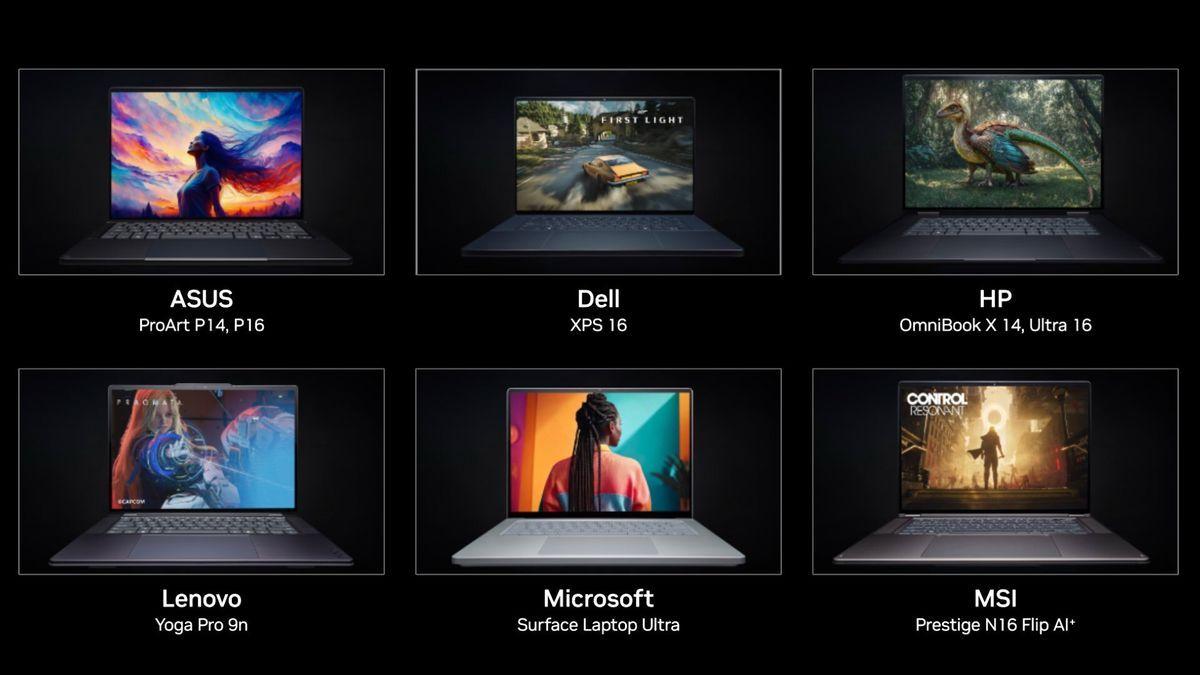
Source: Tom's Guide
MSI's Prestige N16 Flip AI+ takes a convertible approach with stylus support and explicitly states suitability for gaming, leveraging "NVIDIA's full suite of RTX technologies to deliver immersive gaming and entertainment experiences within a thin-and-light form factor"
5
. All devices are expected to exceed $2,000, positioning them in high-end creator machine territory2
.Nvidia's entry transforms the PC processor market from a three-way competition between Intel, AMD, and Qualcomm into a four-way battle
3
. Ryan Shrout, president at Signal65, believes Nvidia brings advantages Qualcomm lacked during the initial Copilot+ PC launch in June 2024: "Nvidia just has more clout and more industry weight to push and make things happen that Qualcomm couldn't do early on. They can get game developers on board, and get software developers in the emerging AI space to pay attention"1
.However, analysts express caution about mass market adoption. Kevin Hein at Tirias Research stated, "RTX Spark doesn't make traditional PCs obsolete. It creates a new category between the workstation and the AI server"
4
. Premium pricing and ongoing memory chip shortages may limit adoption to niche users, particularly content creators and developers who have historically favored Apple MacBook Pro devices4
. IDC estimates global PC shipments will decline 11.3% in 2026, adding pressure to the market4
.Nvidia's software advantage may prove decisive. With GPU market share above 90 percent across gaming and professional work, the company benefits from "extremely mature drivers" and industry-standard status
1
. Windows support is also expanding to DGX Station desktop systems in Q3 2026, broadening the platform beyond consumer laptops1
. Tom Mainelli, group vice president at IDC, expects "some companies will take the leap to test out the long-term viability of on-device inferencing"4
.Summarized by
Navi
04 Jun 2026•Technology

20 Jun 2026•Technology

01 Jun 2026•Technology

1
Startups

2
Policy and Regulation

3
Policy and Regulation