AI Agents Transform Leadership as CEOs Deploy AI Tools for Strategic Thinking and Workflow Automation


11 Sources
[1]
AI agents free up CEOs' time to think ahead
Agentic tools are helping to make everyday tasks more efficient, allowing leaders to focus more on strategy As the agentic revolution makes AI personal assistants a reality, a growing number of chief executives are beginning to deploy them to help run their companies. Agentic tools, generative
[2]
AI tools aim to support staff without judgment
Coaching and development products help offer advice, but need to be treated cautiously When thousands of managers at Merck meet their team members for year-end performance reviews in the coming months, many should be better prepared than usual. The US pharmaceutical company is giving about 5,000
[3]
What is it like to work when your co-workers are AI agents?
Using AI for roles from executive assistants to chiefs of staff, companies are boasting about doing more with less, creating tension with their human workers On an average workday, Dhruv Amin chats with dozens of colleagues to get things done at his AI startup Anything. He might ask Gwen, his
[4]
Meeting the challenges of AI leadership
Exploring the importance of deploying intelligent systems responsibly and at scale Until recently, Amdahl's Law was one of computing's more obscure dictates: If you optimize a single piece of a larger system without removing any bottlenecks, your overall performance gains will be modest at best.
[5]
How to Cut Through AI Data for Better Decision-Making
AI makes data more accessible to people across your organization, but they may not have the context for decision-making. Over the past two years, most leadership teams have watched AI compress the time required per task. A market analysis that once required outside help arrives in a few hours, and
[6]
Four ways to manage an AI agent successfully
Is AI a tool, a teammate or... something else? Here's how to get the most out of the technology on the job. Last month, a friend told me that by the end of the year, his startup will have seven employees and over 20 AI agents. He has led several previous successful organizations and has a
[7]

Everyone is Using AI Now. Here's What Sets the Companies Using It Well Apart.
Opinions expressed by Entrepreneur contributors are their own. Key Takeaways * Every company has the same AI tools now, so access is no longer a differentiator. * Using AI to speed up existing work improves productivity but doesn't enhance your competitive advantage. AI adoption has become
[8]
AI Doesn't Create Value Until You Redesign the Work Around It
Organizations need to establish new workflows to maximize AI at the task level. For the past few years, businesses have largely measured AI in minutes saved and headcount avoided. Those metrics matter, but they offer a view of what AI is doing inside an organization. The most consequential
[9]
As the AI experimentation era ends, a manager's work begins
The Fast Company Executive Board is a private, fee-based network of influential leaders, experts, executives, and entrepreneurs who share their insights with our audience. Many leaders are feeling pressure to show fast return on investment (ROI) on agentic AI initiatives. The instinct is to point
[10]

Former Goldman Sachs Analyst Turned Creator Says AI-Ready Workers Need More Than Prompting Skills - Micro
The AI skills gap in American workplaces may soon have less to do with who can write the smartest chatbot prompt and more to do with who can safely delegate work to software that can research, make critical decisions, and act. That is the distinction Nate Herk, a 24-year-old Chicago-based AI
[11]
Companies Are Hiring AI Agents to Save Time. Who's Checking Their Work?
Corporate America has a new productivity problem: The AI agents hired to save employees time may be creating more work than expected. Companies are deploying AI agents to automate tasks, accelerate decisions, and free employees to focus on higher-value work. But when agents lack reliable company
Share
Copy Link
CEOs deploy AI agents as personal assistants and chiefs of staff, automating tasks from board papers to performance reviews. While 53 per cent of workers now use AI tools, companies expect 10-15% workforce reductions. Leaders face challenges balancing AI-driven decision-making with human judgment and ethical concerns.
AI Agents Reshape Executive Work
AI agents are transforming how CEOs run companies, with leaders deploying AI agentic tools to handle complex tasks autonomously
1
. Microsoft CEO Satya Nadella uses at least 10 custom Microsoft Copilot agents, describing them as AI chiefs of staff1
. Nvidia CEO Jensen Huang uses AI as a tutor, while Meta creates avatars of CEO Mark Zuckerberg to engage with staff1
. Christian Nentwich, CEO of British AI software developer Duco, built a "critic agent" that tracks his meetings, emails, and messages to keep him focused on priorities1
. Airbnb CEO Brian Chesky trained an intelligence corpus using 18,000 keynote slides and 50,000 Google Docs, cutting his required meetings in half1
. This shift enables strategic thinking by freeing executives from routine tasks1
.Widespread AI Adoption Across Organizations
AI in the workplace is expanding rapidly beyond basic productivity tools. In the second quarter of 2024, 53 per cent of global workers were expected to use AI in their roles, up from 51 per cent in the first quarter
2
. Of those not using AI systems, 84 per cent said they would use corporate tools if offered2
. About 40% of large organizations used AI agents between May 2025 and June 2026, up from 27% the year before, according to McKinsey's State of AI Global Survey3
. Companies are deploying AI tools for employee wellbeing, performance management, and workflow automation2
. Merck provides about 5,000 employees with an AI coaching tool called Nadia for performance reviews and high-stakes discussions2
.AI Co-Workers Outnumber Humans at Startups
AI co-workers are becoming status symbols in Silicon Valley, demonstrating companies can do more with less
3
. At startup Anything, 15 human employees work alongside roughly 150 AI agents handling tasks from executive assistance to coding and customer onboarding3
. CEO Dhruv Amin predicts that within a year, every company will have more AI co-workers than human co-workers3
. Lindy, after laying off one-third of its staff, now operates with about 20 employees and has filled many open roles with AI agents instead3
. Companies like Viktor, Lindy, OpenAI's Dots, Anthropic's Claude Cowork, and Microsoft's Scout offer customizable agents for sales, customer support, and administrative work3
.Workforce Reductions and Job Displacement Concerns
Companies expect to scale back their workforce by 10% to 15% over the next few years as they delegate more work to AI, according to Boston Consulting Group
3
. Morningstar CEO Kunal Kapoor removed candidates with low AI token usage during a recent internal hiring process, stating he's not looking for someone who might have been acceptable two years ago1
. Lindy's AI agents now handle product announcements, social media posts, and marketing videos—work previously done by about 100 people in its creator program3
. Personal assistants express nervousness that CEOs with AI will leave them understretched, according to Global PA Association founder Rosemary Parr1
. Job displacement raises concerns about next-generation workers entering the job market3
.AI Leadership Requires Strategic Implementation
Successful AI leadership demands redesigning workflows with AI in mind rather than simply deploying tools
4
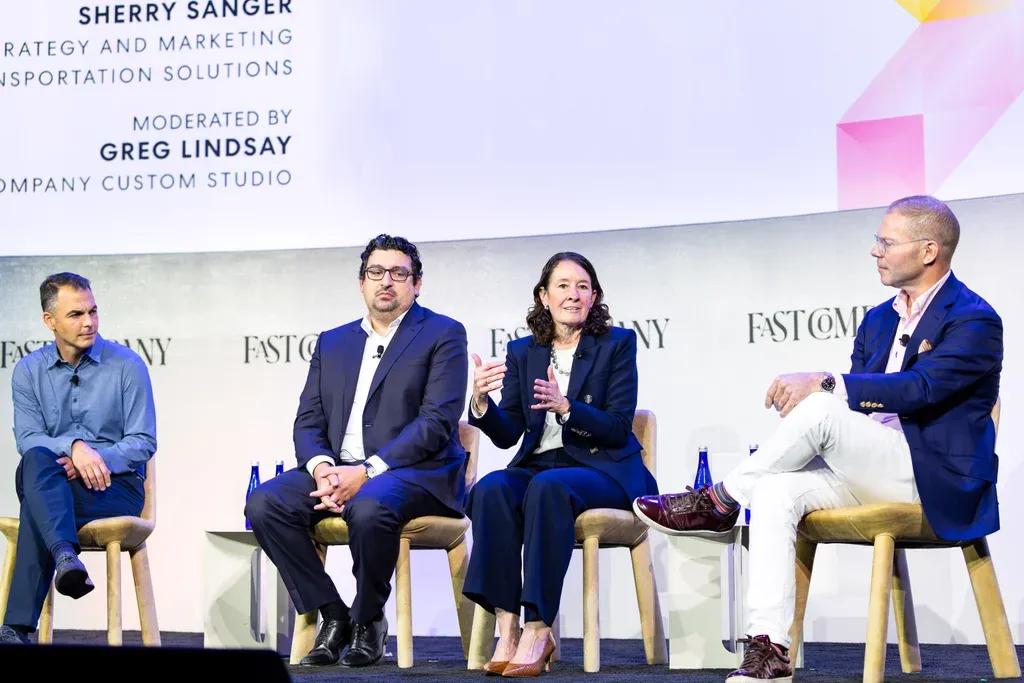
. Penske Transportation Solutions developed its own suite of intelligent tools drawing on decades of operational expertise and real-world fleet data4
. At Nvidia AI, chip design verification that once took weeks now takes hours—a 40-fold improvement—using semiautonomous agents running tests and fixing bugs4
. Organizations must focus on data utilization, as the challenge isn't data scarcity but putting data to use effectively4
. AI adoption requires treating agents like employees, providing credentials and organizational placement rather than unrestricted access4
.Related Stories

Balancing AI-Driven Decision-Making With Human Judgment
While AI tools accelerate analysis, they don't necessarily speed up high-level organizational decision-making
5
. Only 20 per cent of organizations excel at decision-making, and just 37 per cent make decisions that are both high quality and fast, according to McKinsey Global Survey5
. Leaders must define decision rights, decision criteria, and AI's role to reduce risk5
. Human judgment remains essential—Culture Amp CEO Caroline Rawlinson emphasizes that performance evaluation is inherently a human judgment call, not something AI should answer2
. Organizations must ensure humans review consequential work rather than allowing automated decisions5
.Ethical Concerns and Data Privacy Challenges
AI implementation raises significant ethical concerns around surveillance and trust. If AI feels like surveillance, employees will stop being honest and lose trust in both employers and platforms, warns Culture Amp's Rawlinson
2
. Data privacy safeguards are essential to ensure information from coaching or sentiment surveys cannot identify poor or disengaged workers2
. Some users trust AI more than human managers because they don't feel judged, while others who lost jobs to AI-based redundancy remain polarized2
. Workplace analysts caution that AI coaching may struggle with subtle body language and conversational nuance2
. AI agents are alienating customers and colleagues seeking human interaction, creating workplace tension3
. Board Intelligence CEO Pippa Begg emphasizes that implementing AI strategy must start at the top, requiring leaders to change their behavior and work methods1
.References
Summarized by

Navi
[3]
[4]
Related Stories
AI adoption is stalling because businesses are optimizing tools instead of redesigning workflows
31 Jul 2026•Business and Economy

AI Adoption Hits Reality Check: Why 27% of Companies See Zero ROI Despite Productivity Gains
14 Oct 2026•Business and Economy

AI Adoption Stumbles: Why 88% Use AI But Only 7% Scale It Successfully
03 Oct 2026•Business and Economy

Recent Highlights


Recent Highlights
Today's Top Stories










Don’t drown in AI news. We cut through the noise - filtering, ranking and summarizing the most important AI news, breakthroughs and research daily. Follow topics that matter to you and stay ahead.


