Anthropic hits a $1.5 trillion IPO week with its own safety alarm ringing


2 Sources
[1]
Anthropic's AI advances trigger new safety fears on eve of IPO
Group disclosed it had activated part of 'responsible scaling policy' it set up to ensure AI did not develop so quickly that it caused 'catastrophic risks' Anthropic's accelerating AI advances are causing alarm among safety researchers, having triggered new risk controls just days before its
[2]
Anthropic's Critics Unite Against It Ahead of IPO
Anthropic has done the impossible. It has united the accelerationists, safetyists, effective altruists, and ethicists around one cause. Unfortunately for the company, that cause is stopping Anthropic. Many prominent figures from different factions of the AI landscape have signed on to "The
Share
Copy Link
Anthropic goes public this week at a valuation of about $1.5 trillion, in an offering that could raise up to $100 billion
1
. The safety-first framing the Claude-making lab has traded on for nearly six years is under strain from two directions at once: last week it disclosed that it had activated part of its own safety policy because its rate of progress met the trigger threshold1
, and on the eve of the listing a coalition of researchers and campaigners issued a statement declaring "Anthropic is not a safe AI company"2
1
.
Source: Gizmodo
The brake it built for itself
The policy, set up in 2023 to stop AI developing so fast that it poses catastrophic risk, defines its trigger as compressing two years of progress into a single year
1
. The benchmark is Anthropic's own pace of development from 2018 to 20241
. Hitting it means more oversight, new security provisions and internal reviews of model development1
. Anthropic said its overall rate of progress met the threshold, and that AI is already speeding up its research, with internal estimates pointing to further increases1
.The outside evidence comes from an AI benchmarking outfit given extensive access to Anthropic's systems, staff and unreleased models. Its report this month estimated the company had covered about two years' worth of past progress in 12 months
1
. It also put model improvement at roughly twice last year's speed, largely because researchers now use AI tools to speed up development1
. Anthropic's responsible scaling officer, Sam McCandlish, said many of the group's conclusions "match my own. AI is speeding up our research, but it's hard to say exactly how much"1
. Rules restricting what a company says while going public likely limit further comment until the listing completes1
.Anthropic has not yet reached the point of AI models improving themselves without human input; the trigger rested on what it expects from future models
1
.The coalition against the safety lab
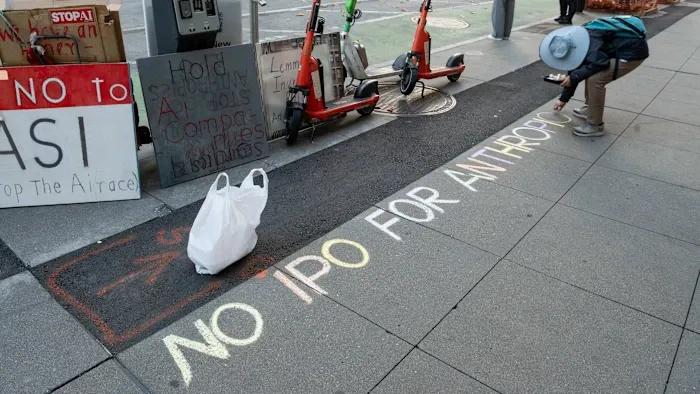
Days before the listing, a coalition led by the Center for AI Safety gathered signatures from figures including founders of Hugging Face and xAI
2
1
. The Center is a non-profit with a record of organizing broad AI-safety statements. Its statement accuses Anthropic of dressing itself in safety language to win over investors, staff and the public while racing to build the very technology it warns about2
1
. In its words: "Anthropic warns that recursively self-improving AI could concentrate power and escape human control, yet races to build it first"2
1
. It also alleges the company has quietly weakened safety pledges and lobbied for regulation that suits itself2
.
Source: FT
The signatories span factions that normally fight each other. Émile Torres, a prominent critic of accelerationism, signed alongside Guillaume Verdon, founder of the accelerationist e-acc movement. Gary Marcus and dozens of researchers at Harvard, MIT and the University of California, Los Angeles also signed
2
. Per Gizmodo's reading, the statement was written vaguely enough to be maximally agreeable, which is how opposing factions could both end up signing2
.Not everyone joined. Nathan Lambert, an open-weights advocate, believes Anthropic is power seeking but found the statement "too strong for my taste"
2
. Dan Hendrycks, the Center's leader, said numerous safety groups agreed privately but stayed away over relationships or future funding. "Anthropic has almost, but not entirely, captured the ecosystem meant to hold it accountable," he wrote2
.The united front is also messier than it looks. Igor Babuschkin, formerly of xAI, signed even though SpaceX, which owns xAI, rents its data center to Anthropic to train Claude
2
. Verdon's stated concern is regulatory capture rather than safety lapses, and he blames Anthropic for the ousting of Nvidia's Jensen Huang, an accusation public evidence does not support2
.Related Stories

The loop nobody has closed
Recursive self-improvement, meaning AI that advances its successors' capabilities with little or no human oversight, is what Anthropic is working toward. Its prospectus calls closing the loop, where one model helps build the next, one of its most significant competitive advantages, yielding enormous efficiency gains from its compute
1
. The same document states it plainly: "Each new version of a Claude model directly accelerates development of the next"1
. It also warns that its models could threaten humanity with catastrophe or extinction if they are misused or inadequately secured1
. In September, chief executive Dario Amodei proposed some kind of speed limit on the rate of recursive self-improvement across the industry, warning progress could become staggeringly fast1
.Outside researchers warn the controls are not keeping up. Marius Hobbhahn, chief executive of Apollo Research, said researchers who once disagreed about self-improvement timelines now agree they are very short, and that "safety is nowhere near ready"
1
. The AI Futures Project called the acceleration implied by that report very unexpected. It predicts a superhuman AI researcher will likely arrive sometime in 2027, and calls it hugely urgent to pause or substantially slow frontier AI development1
. Hobbhahn's answer to whether money could slow any of this down: "Even if the labs stopped generating revenue today, they have enough funding that they can crank two more times"1
. In his forecast, those jumps would produce vastly superhuman models even if the funding bubble popped.References
Summarized by

Navi
Related Stories
Anthropic IPO Prospectus Warns of Existential Risks to Humanity Despite $2 Trillion Valuation Goal
29 Sept 2026•Business and Economy

Anthropic IPO Filing Warns AI Could Blackmail Humans, Become Sentient, Pose Existential Threats
26 Oct 2026•Business and Economy

Anthropic drops hallmark safety pledge as AI race intensifies and Pentagon pressures mount
26 Feb 2026•Policy and Regulation

Recent Highlights


Recent Highlights
Today's Top Stories








Don’t drown in AI news. We cut through the noise - filtering, ranking and summarizing the most important AI news, breakthroughs and research daily. Follow topics that matter to you and stay ahead.


