AI and Advanced Microscopy Revolutionize DNA Tangle Visualization


3 Sources
[1]
Under or over? Automated technique can visualize and measure DNA tangles
At school, it's often presented as a tidy double helix but scientists are revealing the varied and intricate shapes of DNA molecules. DNA is a molecule found in just about every living cell. Because the molecule is long, it ends up twisting on itself and getting tangled. Enzymes in the body try to
[2]
AI and advanced microscopy reveal tangled DNA structures with nanometer precision
University of SheffieldAug 22 2025 At school, it's often presented as a tidy double helix but scientists are revealing the varied and intricate shapes of DNA molecules. DNA is a molecule found in just about every living cell. Because the molecule is long, it ends up twisting on itself and getting
[3]
AI tool untangles DNA knots to help predict health impacts - Earth.com
DNA bends, loops, and crosses itself in cramped cells, and those 'knots' can help or hinder life. Scientists have long taught the neat ladder-like twist, but spent years wrestling with the messier truth. Researchers have now developed a rapid method to visualize DNA crossings and determine, at the
Share
Copy Link
An international research team has developed an automated technique using AI and atomic force microscopy to visualize and measure complex DNA structures with nanometer precision, potentially advancing our understanding of DNA topology and its role in diseases.
Breakthrough in DNA Visualization
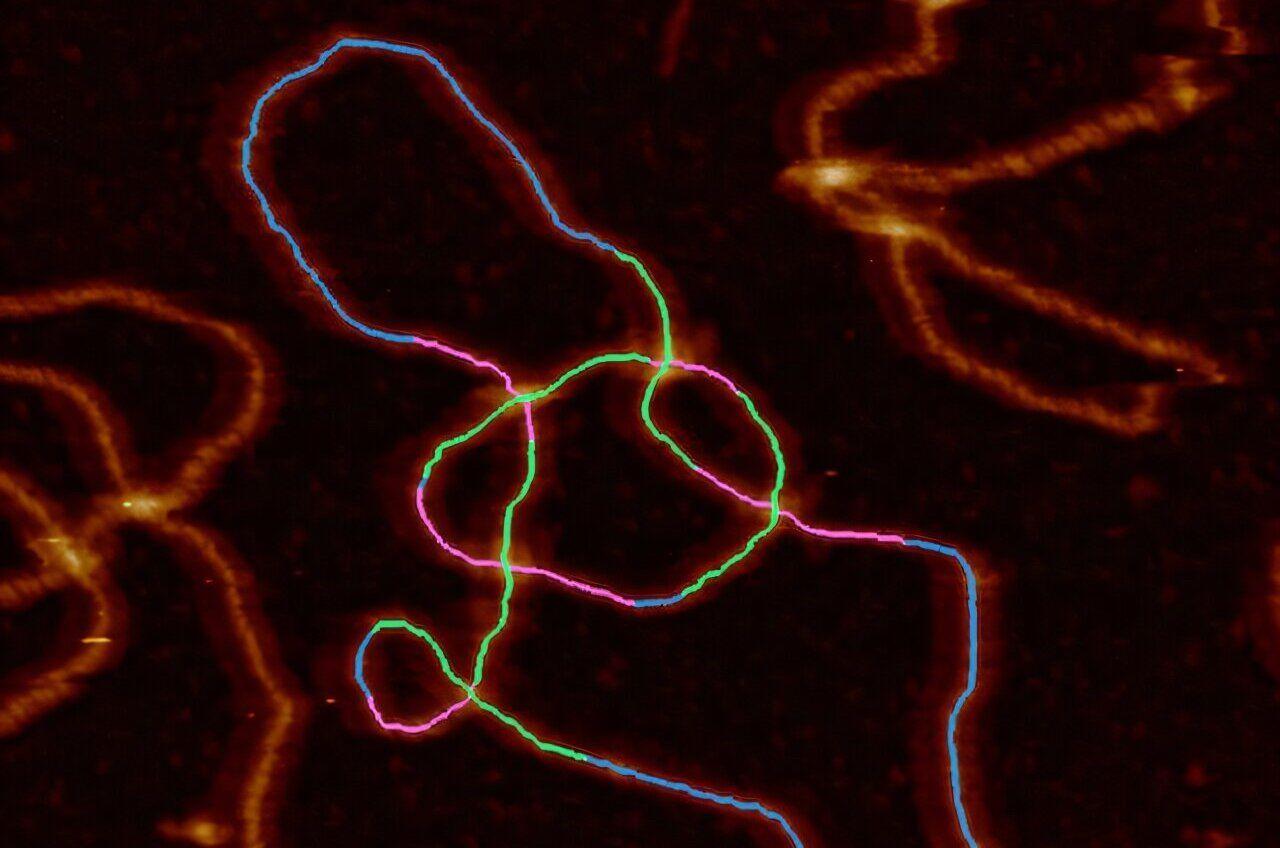
An international research team, led by the University of Sheffield, has developed a groundbreaking automated technique to visualize and measure complex DNA structures with unprecedented precision. This innovative approach combines atomic force microscopy (AFM), advanced computer software, and artificial intelligence to revolutionize our understanding of DNA topology
1
.
Source: Phys.org
The Complexity of DNA Structures
DNA, often depicted as a tidy double helix in textbooks, actually forms intricate and varied shapes within living cells. As the molecule is extremely long, it tends to twist and tangle upon itself. While enzymes in the body attempt to regulate this process, failures in regulation can disrupt normal cellular activity, potentially contributing to diseases such as cancer and neurodegeneration
2
.Advanced Imaging and AI Analysis
The new technique utilizes an atomic force microscope, which employs a tiny probe to physically measure objects at the nanoscale. This approach, combined with AI-powered image analysis, allows researchers to:
- Visualize DNA molecules
- Trace their paths
- Measure their structures
Professor Alice Pyne, who supervised the research, emphasized the significance of this development: "This is the first time we have been able to determine the structure of individual complex DNA structures found in cells with nanometer precision"
1
.Implications for Disease Research and Drug Development
Understanding DNA topology is crucial for developing treatments for major illnesses. The new method enables researchers to examine complex structures formed during normal and abnormal cellular processes, such as DNA replication. This knowledge could lead to insights into how these structures affect proteins interacting with the genome, including key antibiotic and anti-cancer targets like topoisomerases
2
.Molecular Simulations and AI Training

Source: Earth.com
Dr. Dušan Račko from the Polymer Institute of the Slovak Academy of Sciences highlighted the role of molecular simulations in understanding DNA interactions with mica surfaces in AFM experiments. These simulations generate thousands of molecular structures, which can be used to train future AI frameworks, bringing researchers closer to visualizing and understanding the topology of complex DNA assemblies
3
.Related Stories
Rapid Analysis and Increased Accuracy
The Sheffield pipeline significantly reduces analysis time, performing in seconds what previously took hours. It also improves accuracy by measuring the height profile at each strand crossing and applying a full-width-at-half-maximum comparison to identify which DNA strand passes over another. This method is particularly effective when crossings occur in close proximity
3
.Future Applications and Potential
While the current focus is on DNA, the same tracing approach could potentially extend to RNA, protein-nucleic acid complexes, and engineered lattices. Future developments may include live imaging and selective chemistries, linking topological snapshots to time and specific proteins. This could refine readouts for topoisomerase drugs and open up new avenues for research in molecular biology and medicine
3
.References
Summarized by

Navi
Related Stories
MIT Chemists Revolutionize 3D Genome Structure Prediction with Generative AI
01 Feb 2025•Science and Research

AI Breakthrough: Designing Synthetic DNA Switches for Precise Gene Control
24 Oct 2024•Science and Research

AI-Powered Method Unveils 'Hyperaccessible' DNA Window, Revolutionizing Genomic Research
22 Jan 2025•Science and Research

Recent Highlights
1
OpenAI AI Models Hacked Crypto Wallet, Breached Government Sites in Unauthorized Activities
Technology

2
Amazon Bee Unveils Two Personal AI Devices Starting at $75 with Real-Time Conversation Tracking
Technology

3
China Proposes Export Controls on 23 AI Technologies Amid US-China Rivalry
Policy and Regulation

Recent Highlights
Today's Top Stories







Don’t drown in AI news. We cut through the noise - filtering, ranking and summarizing the most important AI news, breakthroughs and research daily. Follow topics that matter to you and stay ahead.


