DeepMind's AlphaGenome: Decoding the 'Dark Matter' of DNA with AI


9 Sources
[1]
DeepMind's new AlphaGenome AI tackles the 'dark matter' in our DNA
Nearly 25 years after scientists completed a draft human genome sequence, many of its 3.1 billion letters remain a puzzle. The 98% of the genome that is not made of protein-coding genes -- but which can influence their activity -- is especially vexing. An artificial intelligence (AI) model
[2]
DeepMind's latest AI tool makes sense of changes in the human genome
The human genome offers a complete instruction manual for building a person, but it's a tough read. How does a given letter among billions of DNA bases affect how the body functions? Now, DeepMind, the Google spinoff behind the artificial intelligence (AI) model AlphaFold that mastered how proteins
[3]
Google's new AI will help researchers understand how our genes work
Now Google's DeepMind division says it's made a leap in trying to understand the code with AlphaGenome, an AI model that predicts what effects small changes in DNA will have on an array of molecular processes, such as whether a gene's activity will go up or down. It's just the sort of question
[4]
Google unveils new AI model to decode one million DNA letters at once
It brings base-resolution insight to long-range genomic analysis, decoding the impact of mutations with speed, scale, and unprecedented depth. The model processes up to 1 million base pairs in a single pass and predicts thousands of molecular properties, including gene expression, splicing
[5]

AlphaGenome: AI for better understanding the genome
Introducing a new, unifying DNA sequence model that advances regulatory variant-effect prediction and promises to shed new light on genome function -- now available via API. The genome is our cellular instruction manual. It's the complete set of DNA which guides nearly every part of a living
[6]

Google's AlphaGenome AI Makes DNA Readable -- And It's on GitHub
Google's model is available to researchers via API, signaling a new era of more open and accessible genomics. Google DeepMind's AlphaGenome, which was announced today, isn't just another entry in the AI-for-science arms race. With API access available for non-commercial research -- and extensive
[7]

DeepMind Launches AlphaGenome to Predict How DNA Variants Affect Gene Regulation | AIM
The model could help link genetic mutations to diseases like cancer, paving the way for better treatments. DeepMind has launched AlphaGenome, a new artificial intelligence (AI) model that can predict how single DNA variants affect gene regulation across the human genome. The model, now available
[8]

DeepMind launches AlphaGenome to predict how DNA mutations affect genes - SiliconANGLE
DeepMind launches AlphaGenome to predict how DNA mutations affect genes Alphabet Inc.'s Google DeepMind today introduced AlphaGenome, a new artificial intelligence tool that can comprehensively predict how mutations or variants in human DNA sequences impact gene regulation. The genome is the
[9]

AlphaGenome reshapes how scientists interpret mutations
A new artificial intelligence tool, AlphaGenome, has been introduced to predict how DNA sequence variations impact gene regulation, now available via API for non-commercial research. The genome functions as the cellular instruction manual, containing the complete set of DNA that directs an
Share
Copy Link
Google DeepMind unveils AlphaGenome, an AI model that predicts how DNA sequences affect gene expression and regulation, potentially revolutionizing genomic research and disease understanding.
DeepMind Introduces AlphaGenome: A Breakthrough in DNA Analysis
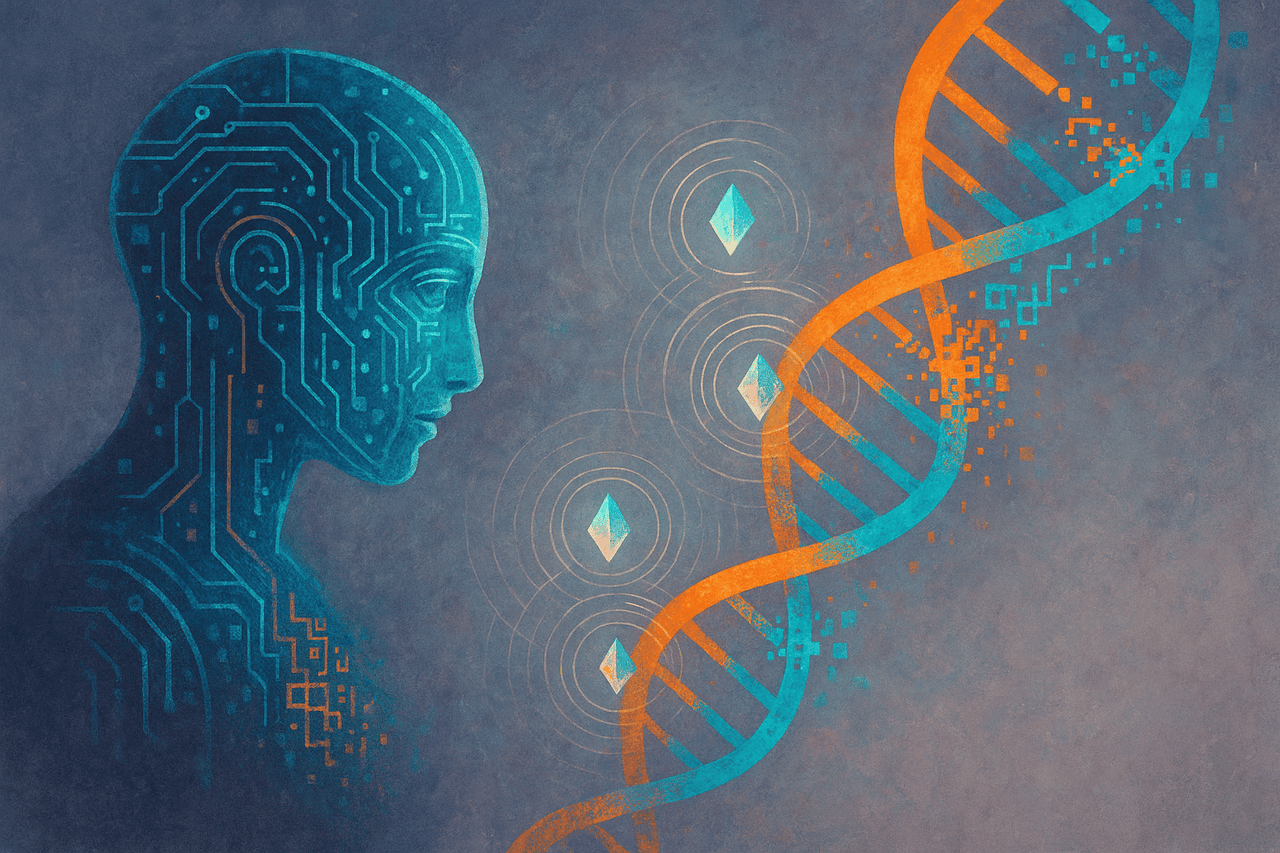
Google DeepMind has unveiled AlphaGenome, a groundbreaking artificial intelligence (AI) model designed to tackle one of science's most fundamental challenges: decoding the 'dark matter' of our DNA. This innovative tool aims to help scientists make sense of the 98% of the human genome that doesn't code for proteins but plays a crucial role in gene regulation and cellular function
1
.
Source: SiliconANGLE
Unraveling the Genome's Mysteries
AlphaGenome represents a significant leap forward in genomic research. The model can process up to one million DNA base pairs at once, predicting thousands of molecular properties that characterize regulatory activity
4
. It offers insights into gene expression, splicing patterns, protein-binding sites, and chromatin accessibility across diverse cell types5
.Pushmeet Kohli, DeepMind's head of AI for science, emphasized the model's significance: "This is one of the most fundamental problems not just in biology -- in all of science"
1
.Advanced Capabilities and Potential Applications
AlphaGenome's ability to predict the consequences of single DNA letter changes sets it apart from existing models. This feature allows researchers to:
- Identify consequential genetic variations in cancer studies
2
. - Understand how genetic changes affect immune function
2
. - Guide synthetic biology efforts in designing new genes
2
.
Technical Advancements and Performance
The model's architecture combines convolutional layers for detecting short DNA patterns with transformers for analyzing entire genetic code stretches. This design allows AlphaGenome to outperform 22 of 24 other computer models in identifying specific DNA features and 24 of 26 models in predicting variant effects on gene regulation
4
2
.
Source: MIT Tech Review
Related Stories

Limitations and Future Developments
Despite its advancements, AlphaGenome has room for improvement. The model struggles with predicting the effects of sequences on genes located more than 100,000 base pairs away. Additionally, it doesn't yet capture how a cell's changing nature affects DNA sequence function
1
.DeepMind plans to expand AlphaGenome's capabilities, aiming to provide better insights into how genetic variations lead to complex traits or diseases
2
.Availability and Impact on Research
AlphaGenome is currently available for non-commercial research through DeepMind's API, with plans for a fuller release in the future
3
. This accessibility is expected to accelerate genomic research and potentially lead to breakthroughs in understanding diseases and developing new treatments5
.
Source: Dataconomy
As the scientific community begins to explore AlphaGenome's potential, it stands poised to revolutionize our understanding of the human genome and its role in health and disease, much like its predecessor AlphaFold did for protein structure prediction.
References
Summarized by

Navi
[3]
[4]
Related Stories
Google DeepMind's AlphaGenome AI tackles the 98% of human genome that doesn't code for proteins
28 Jan 2026•Science and Research
Google DeepMind Maps All 9 Billion Possible Human Gene Mutations in New AlphaGenome Atlas
08 Sept 2026•Science and Research

Evo-2: AI Model Revolutionizes Genomic Research and DNA Generation
20 Feb 2025•Science and Research

Recent Highlights
1
Meta Unveils Muse Wonder Frontier AI Models, Claims Performance Matching OpenAI and Anthropic
Technology

2
IMF Report Warns AI Market Correction Could Spark Global Financial Crisis With $1.4T at Risk
Business and Economy

3
OpenAI Releases 722 AI-Generated Math Solutions, Triggering Existential Crisis in Mathematics
Technology

Recent Highlights
Today's Top Stories










Don’t drown in AI news. We cut through the noise - filtering, ranking and summarizing the most important AI news, breakthroughs and research daily. Follow topics that matter to you and stay ahead.


