AI in Chemistry Reveals How Fast Chemical Reactions Proceed Using Machine Learning


2 Sources
[1]
Organic chemists harness AI to uncover how fast chemical reactions proceed
Chemists routinely optimize reactions to maximize the yield of their desired products, but understanding why those reactions work can require laborious experiments that track reactions over time. Researchers at the University of Tokyo have developed a method to extract hidden information about
[2]
Organic Chemists Harness AI to Reveal Reaction Secrets - a New Method Uses Machine Learning to Extract Reaction Speeds From Yield Data Obtained During Reaction Optimization | Newswise
Newswise -- Chemists routinely optimize reactions to maximize the yield of their desired products, but understanding why those reactions work can require laborious experiments that track reactions through time. Researchers at the University of Tokyo have developed a method to extract hidden
Share
Copy Link
University of Tokyo researchers developed CYAN, a machine learning method that extracts reaction speeds from yield data during reaction optimization. The AI-powered approach eliminates the need for separate kinetic experiments while uncovering unexpected insights about how nickel-mediated reactions work.
Machine Learning Transforms Chemical Reaction Analysis
Researchers at the University of Tokyo have bridged a longstanding gap in chemistry by developing Concentration-dependent Yield Analysis (CYAN), a method that uses machine learning to extract kinetic information from yield data obtained during reaction optimization
1
. Published in Advanced Science, this approach allows organic chemists to understand reaction speeds without conducting separate time-consuming kinetic experiments1
.For decades, chemists have treated reaction optimization and mechanistic understanding as distinct objectives requiring different experimental approaches. Professor Hiroyuki Isobe from the Department of Chemistry explained the frustration that sparked this innovation: "We had previously developed a machine-learning tool that was very good at finding better reaction conditions, but it behaved like a black box, telling us what worked without telling us why"
2
. CYAN emerged as a solution to interpret those machine-learning results while maintaining the chemical rigor that organic chemists demand.How CYAN Bridges Optimization and Kinetics
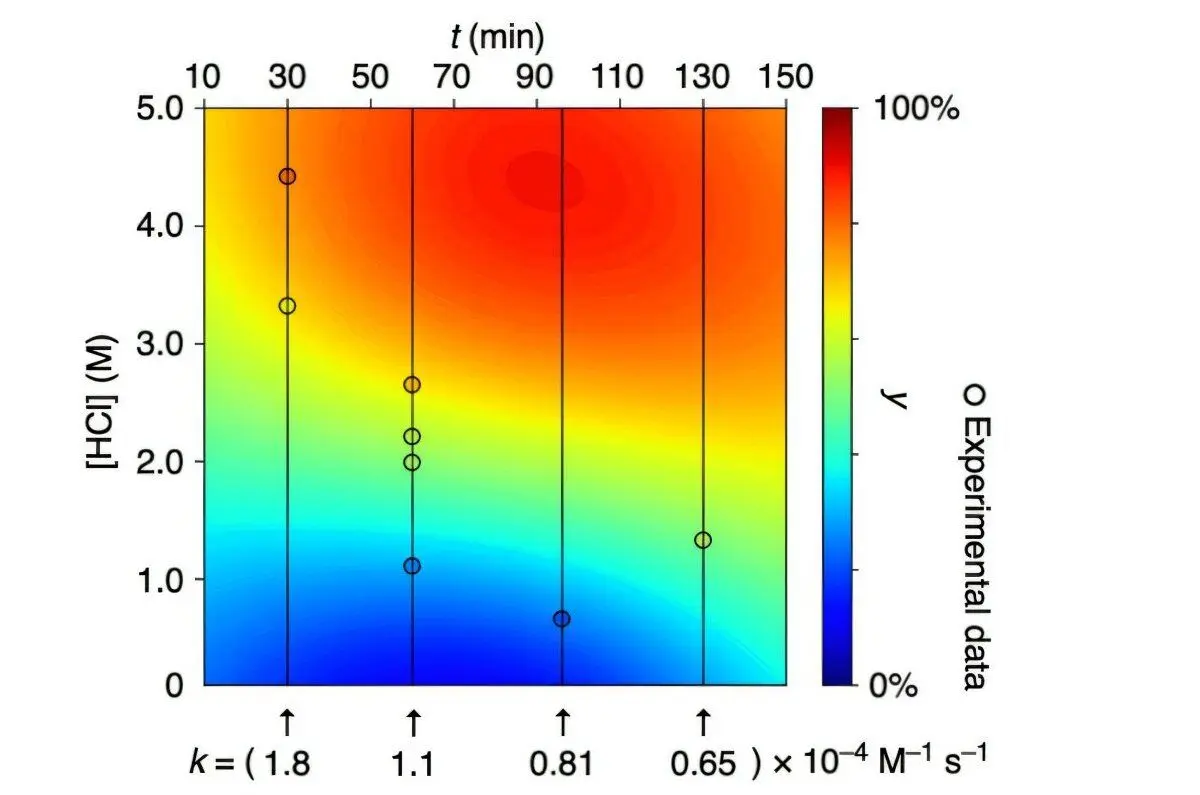
The CYAN method operates through a two-stage process that combines AI in chemistry with traditional chemical knowledge. Machine learning first augments the yield data from reaction optimization experiments, filling gaps between experimental results to create a comprehensive picture of how product amounts change under different conditions
1
. Chemists then apply rate equations based on their hypotheses about reaction mechanisms to extract rate constants from these augmented data sets2
.
Source: Phys.org
This collaborative framework between machine learning and organic chemists allows a single set of experiments to serve dual purposes. "We see it as a two-way collaboration between machine learning and organic chemists, in which we contribute the chemical hypotheses and experimental data, while machine learning contributes a wealth of augmented yield data," Isobe noted
1
. The approach transforms synthetic chemistry workflows by eliminating the need for laborious time-course experiments that track chemical reactions through multiple time points.Nickel-Mediated Reaction Reveals Counterintuitive Insights
To validate CYAN, the research team studied a nickel-mediated reaction used to construct large ring-shaped molecules. The analysis successfully extracted kinetic information from optimization data and uncovered an unexpected feature of the chemical reaction process
2
. While nickel accelerated formation of the desired molecular ring, it simultaneously slowed a secondary reaction that would otherwise produce unwanted products.This dual action steered the reaction toward producing a single target molecule rather than a mixture. Isobe used a river analogy to explain the counterintuitive finding: "If one channel becomes narrower, more water naturally follows the other route. We believe nickel creates a similar effect by restricting one competing pathway, allowing the reaction to concentrate its effort on producing the desired ring-shaped molecule"
1
. This inhibitory effect challenges conventional understanding of template effects, which are typically conceived as accelerating reactions rather than retarding them.Related Stories

Implications for Future Chemical Design
The mechanistic insights revealed by CYAN carry significant implications for designing metal-templated reactions across synthetic chemistry. The discovery that nickel's template effect works through selective inhibition rather than pure acceleration opens new strategies for controlling reaction selectivity
2
. This understanding may prove useful for developing other metal-catalyzed processes where steering reactions toward specific products is essential.The researchers emphasize that CYAN complements rather than replaces traditional kinetic experiments. When highly precise measurements are required, time-course analysis remains essential
1
. However, CYAN offers a practical pathway to extract reaction speeds and mechanistic information from existing yield data, potentially helping researchers design new synthetic methods while making better use of both new and previously collected optimization data. As AI in chemistry continues advancing, tools like CYAN demonstrate how machine learning can enhance rather than replace chemical expertise, creating more efficient workflows for understanding and improving chemical reactions.References
Summarized by

Navi
Related Stories
AI in Chemistry breakthrough: Two systems accelerate molecule design and drug discovery by 10x
29 Jan 2026•Science and Research

MIT Researchers Develop FlowER: A Generative AI Approach for Accurate Chemical Reaction Predictions
04 Sept 2025•Science and Research

AI-Driven Mobile Robots Revolutionize Chemical Synthesis Research
07 Nov 2024•Science and Research

Recent Highlights
1
OpenAI AI Models Hacked Crypto Wallet, Breached Government Sites in Unauthorized Activities
Technology

2
IMF Report Warns AI Market Correction Could Spark Global Financial Crisis With $1.4T at Risk
Business and Economy

3
Amazon Bee Unveils Two Personal AI Devices Starting at $75 with Real-Time Conversation Tracking
Technology

Recent Highlights
Today's Top Stories












Don’t drown in AI news. We cut through the noise - filtering, ranking and summarizing the most important AI news, breakthroughs and research daily. Follow topics that matter to you and stay ahead.


