AI-Driven Mobile Robots Revolutionize Chemical Synthesis Research


4 Sources
[1]
AI-driven mobile robots team up to tackle chemical synthesis
Researchers at the University of Liverpool have developed AI-driven mobile robots that can carry out chemical synthesis research with axtraordinairy efficiency. In a study publishing in the journal Nature, researchers show how mobile robots that use AI logic to make decisions were able to perform
[2]
AI-driven mobile robots team up to tackle chemical synthesis
Researchers at the University of Liverpool have developed AI-driven mobile robots that can carry out chemical synthesis research with extraordinary efficiency. In a study published in the journal Nature, researchers show how mobile robots that use AI logic to make decisions were able to perform
[3]
Robots with AI brains perform chemical research faster than humans
According to the team at the University of Liverpool, their AI allowed them to make decisions similar to human researchers but much more quickly -- cutting hours of work into a fraction of the time. Chemical synthesis research is time-consuming and costly. It involves physical experiments and
[4]
Autonomous mobile robots for exploratory synthetic chemistry - Nature
Autonomous robotic laboratories have the potential to change our approach to chemical synthesis, but there are barriers to their widescale adoption. Autonomy implies more than automation; it requires agents, algorithms or artificial intelligence to record and interpret analytical data and to make
Share
Copy Link
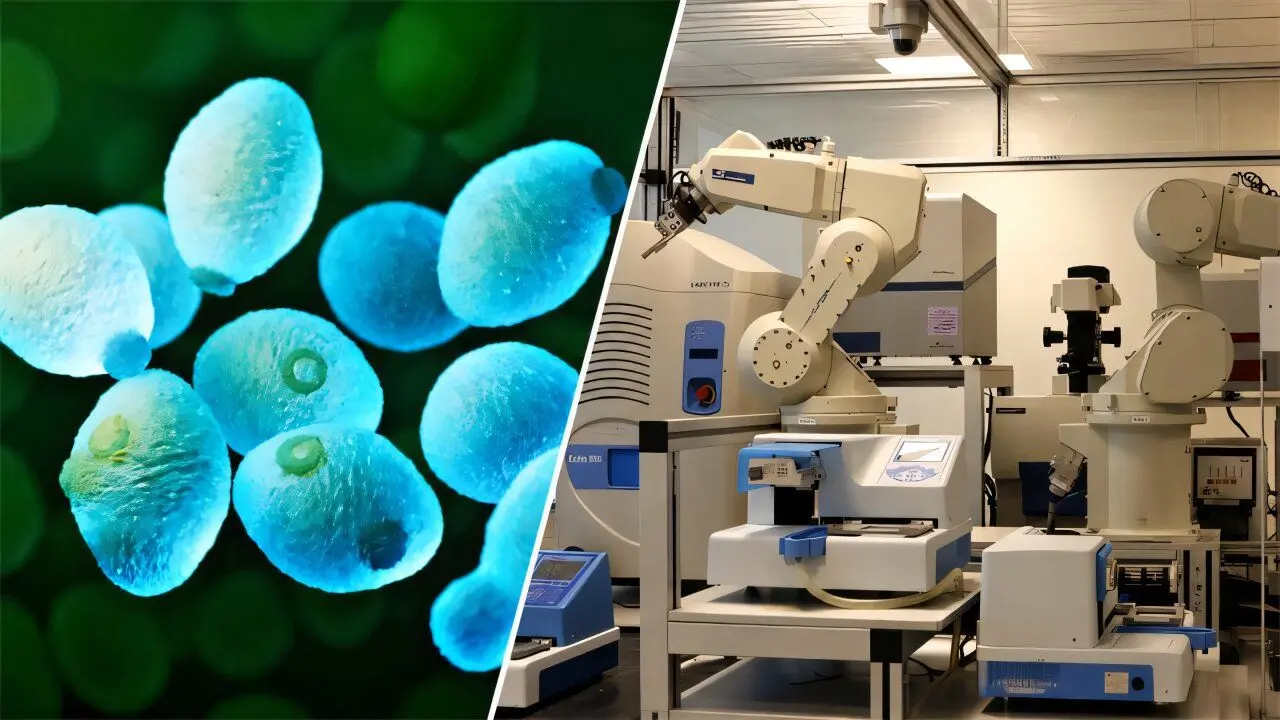
Researchers at the University of Liverpool have developed AI-powered mobile robots capable of performing chemical synthesis tasks with extraordinary efficiency, matching human-level decision-making but at a much faster pace.

AI-Driven Robots Tackle Complex Chemical Synthesis
Researchers at the University of Liverpool have developed a groundbreaking system of AI-driven mobile robots capable of performing chemical synthesis research with extraordinary efficiency. The study, published in the journal Nature, demonstrates how these robots can match human-level decision-making in exploratory chemistry tasks while operating at a significantly faster pace
1
2
.Robot Design and Capabilities
The research team, led by Professor Andrew Cooper, designed 1.75-meter-tall mobile robots to address three primary challenges in exploratory chemistry:
- Performing chemical reactions
- Analyzing reaction products
- Making data-driven decisions for subsequent steps
These robots collaborated to tackle problems in structural diversification chemistry, supramolecular host-guest chemistry, and photochemical synthesis
1
2
.AI Decision-Making in Chemistry
A key innovation in this system is the AI logic that enables rapid decision-making. Dr. Sriram Vijayakrishnan, who led the synthesis work, explained:
"We built an AI logic for the robots that processes analytical datasets to make autonomous decisions. If the robot does the analysis at 3:00 am, it will have decided by 3:01 am which reactions to progress. By contrast, it might take a chemist hours to go through the same datasets."
1
2
This AI-driven approach allows the robots to make complex decisions about which reactions are interesting or worth pursuing, considering factors such as novelty, yield, and synthetic route complexity
3
.Advantages Over Traditional Methods
The autonomous mobile robot system offers several advantages over traditional chemical synthesis methods:
- Speed: Decisions are made almost instantaneously, dramatically reducing research time
1
2
. - Efficiency: The robots can work 24/7, potentially performing hundreds of experiments in days
4
. - Scalability: There is no limit to the size of robot teams that could be employed
1
2
. - Integration: The system can be easily integrated into existing laboratory setups
4
.
Related Stories

Challenges and Future Directions
While the AI-driven robots have shown impressive capabilities, they still face some limitations. Professor Cooper noted:
"The robots have less contextual breadth than a trained researcher, so in its current form, it won't have a 'Eureka!' moment. But for the tasks we gave it, the AI logic made more or less the same decisions as a synthetic chemist across these three different chemistry problems."
2
Future developments aim to expand the contextual understanding of the AI, potentially by incorporating large language models to connect the system directly to relevant scientific literature
1
2
.Potential Applications
The Liverpool team envisions using this technology to:
- Discover chemical reactions relevant to pharmaceutical drug synthesis
- Develop new materials for applications such as carbon dioxide capture
- Scale up to larger industrial laboratories
1
2
This advancement builds upon the team's previous work, which introduced the world's first "mobile robotic chemist" in 2020
2
. As the technology continues to evolve, it has the potential to significantly accelerate chemical research and discovery across various fields.References
Summarized by

Navi
[1]
[3]
Related Stories
AI in Chemistry breakthrough: Two systems accelerate molecule design and drug discovery by 10x
29 Jan 2026•Science and Research

AI Agents Transform Drug Discovery: 37,000 Virtual Scientists Identify Cancer Treatments
18 Sept 2026•Technology

Chalmers University Creates AI Scientist That Runs Experiments From Hypothesis to Results
02 Oct 2026•Science and Research
Recent Highlights
1
Meta Unveils Muse Wonder Frontier AI Models, Claims Performance Matching OpenAI and Anthropic
Technology

2
IMF Report Warns AI Market Correction Could Spark Global Financial Crisis With $1.4T at Risk
Business and Economy

3
OpenAI Releases 722 AI-Generated Math Solutions, Triggering Existential Crisis in Mathematics
Technology

Recent Highlights
Today's Top Stories









Don’t drown in AI news. We cut through the noise - filtering, ranking and summarizing the most important AI news, breakthroughs and research daily. Follow topics that matter to you and stay ahead.


