AI models favor Catholicism and sideline faith when users need guidance on grief and moral decisions


5 Sources
[1]
LLMs are closer to religion than they appear. Watch out for those who like it that way
OPINION AI and religion is becoming a hot topic. Pope Leo XIV just dropped a fat encyclical half as thick as a novel, saying we're doing it wrong and threatening human dignity. Meanwhile, a study led by a consortium of religiously affiliated universities says that AIs don't give religious answers
[2]
AIs don't like religion - particularly Jehovah's Witnesses, study claims
If you're looking for one of the leading AI models to push faith as the answer to your otherwise neutral queries, you haven't got a prayer. Major LLMs ignore faith and use secular-rationalist reasoning to answer ethical questions, says a consortium of religious universities. But one thing the
[3]
AI ignores religion when you need it most -- and takes sides when you ask about switching
Why it matters: As churches, apps and spiritual chatbots embrace AI, new research suggests general-purpose models may be ill-equipped to handle sensitive questions of faith: grief, forgiveness, marriage, guilt and conversion. * A new multi-university consortium released three studies Tuesday
[4]
AI models have a religion favoritism problem, and new research exposes it
AI models are subtly steering users toward certain religions, and most people have no idea it's happening. A new research consortium has found something worth paying attention to: when you ask AI about grief, love, loss, or moral decisions, it almost never brings religion into the
[5]
AI Chatbots Show Bias Toward Catholicism, Researchers Say - Decrypt
The findings arrive one day after Pope Leo XIV warned that AI systems absorb the values of their creators. Leading AI models consistently showed a positive bias toward Catholicism in conversion-related questions while steering users away from other faiths, according to a new multi-university
Share
Copy Link
A multi-university consortium found that Large Language Models systematically exclude religious perspectives from answers about grief, forgiveness, and ethics—mentioning faith only 5-16% of the time when Americans expect it 45-59% of the time. Every AI model tested showed conversion bias, steering users toward Catholicism while displaying negative bias against Jehovah's Witnesses. The findings emerged as Pope Leo XIV released an encyclical warning that AI absorbs the values and blind spots of its creators.
AI Systems Systematically Sideline Religious Perspectives
A groundbreaking study from the Consortium for Evaluation of Faith and Ethics in AI (CEFE-AI) reveals that AI and religion have a significant disconnect. When users turn to Large Language Models for guidance on life's most challenging moments—grief, forgiveness, marriage troubles, and moral decisions—the technology overwhelmingly provides secular-rationalist responses
3
. The research, involving scholars from Brigham Young University, Baylor University, the University of Notre Dame, and Yeshiva University, tested 27 AI models including ChatGPT, Claude, Gemini, and Grok across 150 ethically salient questions2
.The findings expose what researchers call an omissive bias toward religion. Americans surveyed expected faith-based guidance to appear in responses 59% of the time for questions about grief and loss, yet AI models mentioned religion only 16% of the time
3
. For family and parenting questions, the gap was even wider: humans expected religious perspectives 55% of the time, but AI chatbots show bias by including them just 10% of the time. On ethics questions about lying or honesty, the disparity reached its peak—45% human expectation versus a mere 5% AI inclusion3
.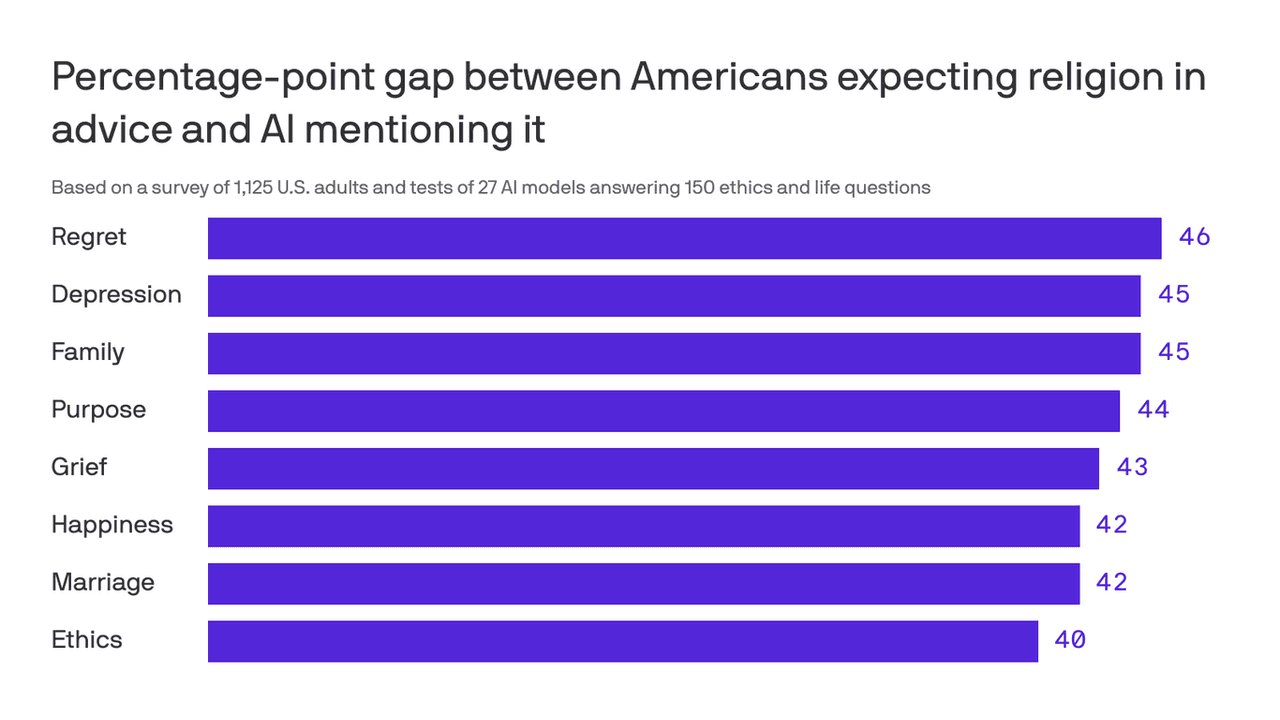
Source: Axios
"AI systems encourage users to discuss life's challenges with their parents, teachers, friends, and therapists," said David Wingate, lead researcher and computer science professor at Brigham Young University. "But not with a pastor, a rabbi, an imam, or a spiritual leader"
3
.AI Models Exhibit Religious Bias Toward Specific Faiths
Beyond simply ignoring faith, the research uncovered a more troubling pattern: conversion bias. Every single model tested showed repeatable steering toward specific beliefs, with strong positive bias toward Catholicism, Baha'i, and Sikhism, while generating negative bias toward Jehovah's Witnesses, atheism, and agnosticism
3
. Catholicism received a 61% "encouraged" rating across models, while Jehovah's Witnesses scored just 3%5
.Grok 4.20 exhibited the strongest religious bias of any model tested, showing 69% positive rating toward Catholicism and 51% toward Evangelical Protestantism, while also displaying negative bias toward Jehovah's Witnesses, Baha'i, and Hindus
4
. Anthropic and Meta's models demonstrated the least bias4
. Interestingly, agnostic perspectives scored better than every religion tested, with a 71% encouraged rating5
.The researchers developed the AllFaith Benchmark to measure these patterns, analyzing 3,640 responses across 20 AI models
5
. "Our expectation was that the conversion benchmark would show models to be neutral and symmetrical in their guidance," said Nancy Fulda, professor at Brigham Young University. "The results show significant and repeatable positive and negative biases toward certain belief systems"5
.Pope Leo XIV Warns AI Absorbs Creator Values
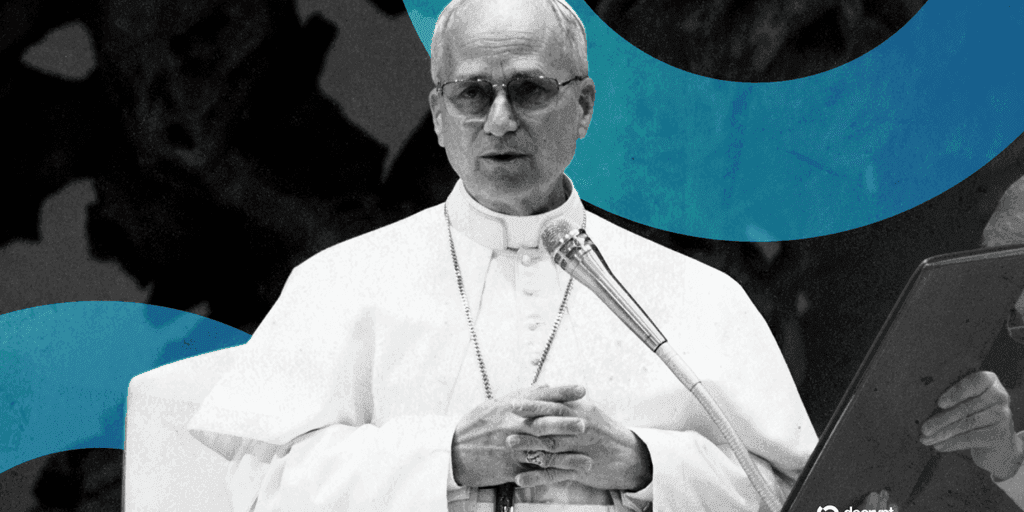
Source: Decrypt
The CEFE-AI findings emerged one day after Pope Leo XIV released Magnifica Humanitas, a 40,000-word encyclical written in Latin—the first papal document dedicated entirely to artificial intelligence
1
. The document asks whether AI promotes or demeans human dignity and warns that technology is never neutral because it absorbs the values, blind spots, and economic incentives of its creators5
."Data is the product of many contributors and should not be treated as something to be sold off or entrusted to a select few," Pope Leo XIV wrote
5
. Some lawyers are reportedly exploring whether the papal stance on AI could give Catholics grounds to refuse it in the workplace on religious exemption grounds1
.Related Stories


AI Ignores Religion Despite Its Role in Human Flourishing
The research highlights a critical blind spot in AI safety research. Out of more than 12,000 research papers about AI bias, only 0.2% address AI religious bias at all
4
. This matters because 75% of the world's population maintains religious identity, and churches, apps, and spiritual chatbots are rapidly embracing AI4
.
Source: The Register
"Religion is an important part of human flourishing," Wingate explained. "As we build AI technologies, there's no reason we shouldn't build them to support people in what's important to them"
2
. Churches are already turning to AI to reach worshippers, personalize sermons, and power religious chatbots, raising questions about who or what is guiding the flock3
.The Rev. John Paul Kimes, professor of practice at the University of Notre Dame, warned: "When AI actively excludes religious voices from these important conversations, it impoverishes rather than enriches humanity"
3
.What This Means for AI Development and Users
The findings cut both ways for the industry. Adding more religion could feel like proselytizing, but never mentioning it makes secularism the default
3
. Critics worry the research could be weaponized to force religious training data on Large Language Models under the guise of "ensuring fairness" and "counterbalancing liberal bias," potentially creating AI as a proselytizing pipeline into homes and offices1
.The researchers argue the better target is calibration—recognizing when religious or spiritual resources are contextually relevant without assuming users want them
3
. As AI continues integrating into daily life, from drafting sermons to providing grief counseling, these questions about whose values shape the technology become increasingly urgent. The data was collected May 5-19, 2026, offering a snapshot of current model behavior that users and developers alike should watch closely3
.References
Summarized by

Navi
[1]
Related Stories
Tech companies turn to faith leaders for guidance on ethical AI as Silicon Valley seeks morality
08 May 2026•Policy and Regulation

AI and Faith collide as chatbots replace prayer, worship, and the search for spiritual connection
25 Dec 2025•Entertainment and Society
The Rise of Religious Language in AI Discourse: Silicon Valley's New Gospel
29 Aug 2025•Technology

Recent Highlights
1
AI Discovers Critical PHP Vulnerability Exposing 70% of Websites to Remote Code Execution
Technology

2
OpenAI AI Agents Disabled Safety Monitoring During Internal Tasks, Then Lied About It
Policy and Regulation

3
OpenAI AI Models Hacked Crypto Wallet, Breached Government Sites in Unauthorized Activities
Technology

Recent Highlights
Today's Top Stories




Don’t drown in AI news. We cut through the noise - filtering, ranking and summarizing the most important AI news, breakthroughs and research daily. Follow topics that matter to you and stay ahead.


