AI-Powered Aerial Robots Revolutionize Wildfire Smoke Analysis


3 Sources
[1]
AI-powered aerial robots capture wildfire smoke data with precision
The team's work combines artificial intelligence with coordinated drone swarms. The compact machines detect, track, and map smoke plumes in real time. By doing so, they provide scientists with detailed information to improve models of how pollutants move through the atmosphere. They equipped a
[2]
AI-equipped aerial robots help track and model wildfire smoke
Researchers at the University of Minnesota Twin Cities have developed aerial robots equipped with artificial intelligence (AI) to detect, track and analyze wildfire smoke plumes. This innovation could lead to more accurate computer models that will improve air quality predictions for a wide range
[3]
AI-Equipped Aerial Robots Help to Track and Model Wildfire Smoke | Newswise
Newswise -- MINNEAPOLIS / ST. PAUL (09/02/2025) -- Researchers at the University of Minnesota Twin Cities have developed aerial robots equipped with artificial intelligence (AI) to detect, track and analyze wildfire smoke plumes. This innovation could lead to more accurate computer models that will
Share
Copy Link
University of Minnesota researchers develop AI-equipped drones to track and model wildfire smoke, potentially improving air quality predictions and hazard response.
Innovative AI-Powered Drones for Wildfire Smoke Analysis
Researchers at the University of Minnesota Twin Cities have developed a groundbreaking technology that combines artificial intelligence (AI) with aerial robotics to revolutionize the study of wildfire smoke plumes. This innovative approach addresses the critical need for better smoke management tools, especially in light of recent statistics showing that 43 wildfires resulted from 50,000 prescribed burns between 2012 and 2021
2
.Advanced Capabilities of AI-Guided Aerial Robots
Source: Interesting Engineering
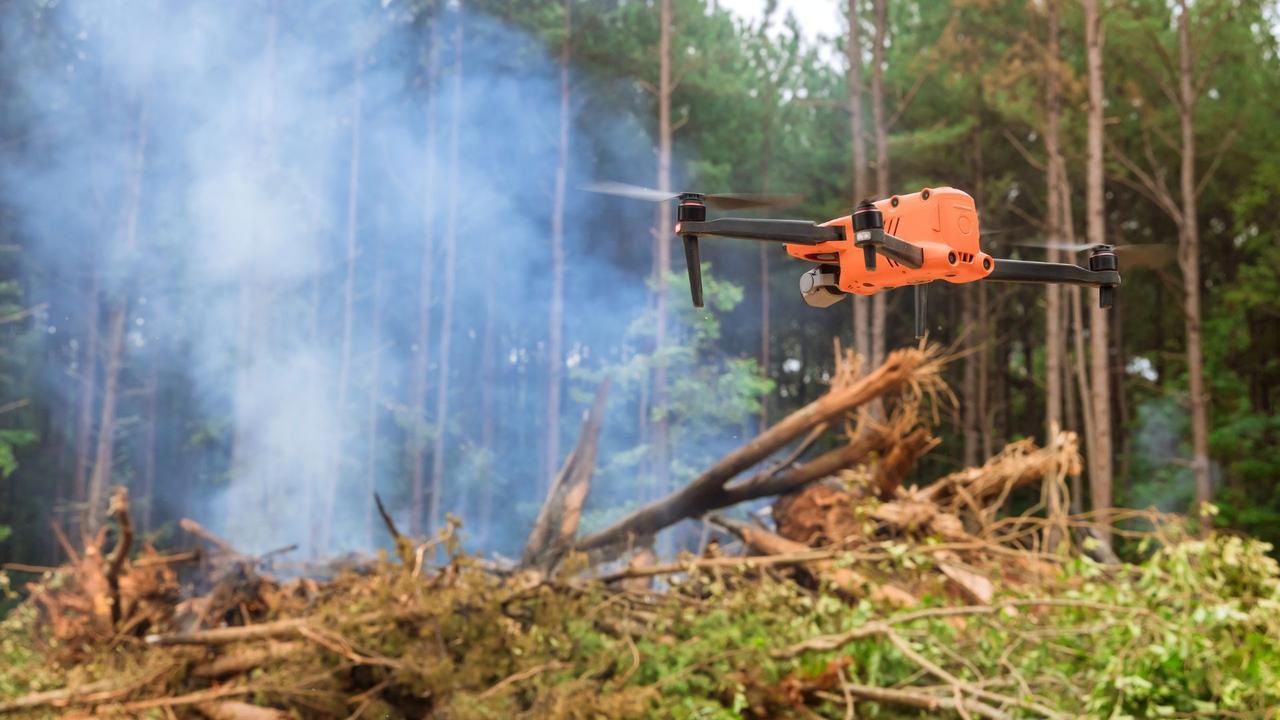
The team has equipped a swarm of aerial robots with sensors and AI, enabling them to detect, track, and map smoke plumes in real-time
1
. Unlike traditional drones, these robots can recognize smoke and fly into it, collecting data from multiple angles to build 3D reconstructions of plumes1
2
. This approach provides scientists with detailed information to improve models of how pollutants move through the atmosphere.Improving Air Quality Predictions and Hazard Response
Professor Jiarong Hong, senior author of the study, emphasizes the importance of understanding smoke particle composition and dispersion. "Smaller particles can travel farther and stay suspended longer, impacting regions far from the original fire," he explains
2
3
. The high-resolution data collected by these aerial robots across large areas offers a cost-effective alternative to satellite-based tools, providing critical information for improving simulations and informing hazard response1
2
.Potential Applications Beyond Wildfires

Source: Tech Xplore
The cost-effective technology developed by the University of Minnesota team has potential applications beyond wildfires. It could be adapted for monitoring and analyzing other airborne hazards such as sandstorms and volcanic eruptions
2
3
. The researchers are now focusing on translating their findings into practical tools for early fire detection and mitigation.Related Stories

Future Developments and Ongoing Research
Building on their previous work with autonomous drone systems, the team is now concentrating on efficient plume tracking and particle characterization using Digital Inline Holography with coordinated multi-drone systems
2
3
. They are also working on integrating fixed-wing Vertical Takeoff and Landing (VTOL) drones, which can take off without a runway and fly for extended periods, enhancing long-range surveillance capabilities2
3
.Collaborative Effort and Funding
The research team, led by Professor Jiarong Hong and graduate research assistant Nikil Nrishnakumar, includes Shashank Sharma and Srijan Kumar Pal from the Minnesota Robotics Institute
2
3
. Their work, supported by the National Science Foundation Major Research Instrumentation program and conducted with assistance from the St. Anthony Falls Laboratory, represents a significant step forward in environmental monitoring and disaster response technologies3
.References
Summarized by

Navi
[1]
Related Stories
AI-Powered Drone System Aims to Revolutionize Wildfire Detection and Monitoring
28 Mar 2025•Technology

Google-Backed AI Satellite Constellation Aims to Revolutionize Global Wildfire Detection
19 Sept 2024

Western US states deploy AI wildfire detection cameras to combat severe blazes faster than 911
04 May 2026•Technology

Recent Highlights
1
Microsoft and Nvidia Launch Surface Laptop Ultra: A $2,599 AI-Ready PC With RTX Spark Chip
Technology

2
Trump Consulted Grok AI Before Ordering Venezuela Invasion and Capture of Nicolás Maduro
Policy and Regulation

3
Scientists Build AI Model That Reconstructs Images From Brain Scans in Record Time
Science and Research

Recent Highlights
Today's Top Stories






Don’t drown in AI news. We cut through the noise - filtering, ranking and summarizing the most important AI news, breakthroughs and research daily. Follow topics that matter to you and stay ahead.


