AI-Powered Ear Wax Analysis: A Breakthrough in Early Parkinson's Disease Detection


7 Sources
[1]
AI sniffs earwax and detects Parkinson's with 94% accuracy
Most treatments for Parkinson's disease (PD) only slow disease progression. Early intervention for the neurological disease that worsens over time is therefore critical to optimize care, but that requires early diagnosis. Current tests, like clinical rating scales and neural imaging, can be
[2]
Ear Wax Reveals Parkinson's Disease Biomarkers - Neuroscience News
Summary: A novel screening method for Parkinson's disease (PD) analyzes the volatile compounds in ear wax to detect early signs of the condition. Researchers found that four specific volatile organic compounds (VOCs) are significantly different in people with PD. Using this information, they
[3]
New screening method for Parkinson's analyzes odors in ear wax
American Chemical SocietyJun 18 2025 Most treatments for Parkinson's disease (PD) only slow disease progression. Early intervention for the neurological disease that worsens over time is therefore critical to optimize care, but that requires early diagnosis. Current tests, like clinical rating
[4]
Ear wax composition shown to be early warning sign of Parkinson's
Analysis of ear wax to detect Parkinson's Disease would be a cheap, non-invasive way to detect the condition in its early stages Catching the onset of Parkinson's Disease early can be critical to slowing the disease's progression and improving a patient's life. A new test that uses nothing more
[5]

Ear Wax as a Possible Screening Medium for Parkinson's Disease | Newswise
Newswise -- Most treatments for Parkinson's disease (PD) only slow disease progression. Early intervention for the neurological disease that worsens over time is therefore critical to optimize care, but that requires early diagnosis. Current tests, like clinical rating scales and neural imaging,
[6]

Ear wax may hold the key to early Parkinson's diagnosis
An unlikely body byproduct may be able to help doctors diagnose Parkinson's Disease early. According to a new Chinese study, which was published in Analytical Chemistry, ear canal secretion, or ear wax, contain chemical compounds which can be telltale signs of Parkinson's. During the study,
[7]

Scientists Use AI -- and Earwax -- for Early Detection of Parkinson's Disease With 94 Percent Accuracy
A groundbreaking study from researchers in China analyzing earwax with the help of artificial intelligence offers a glimmer of hope in the fight against Parkinson's disease. Using an innovative diagnostic method that could transform early detection, scientists at Zhejiang University achieved a
Share
Copy Link
Researchers develop an AI-based system that analyzes ear wax to detect Parkinson's disease with 94% accuracy, potentially revolutionizing early diagnosis and treatment.
Innovative Approach to Parkinson's Detection
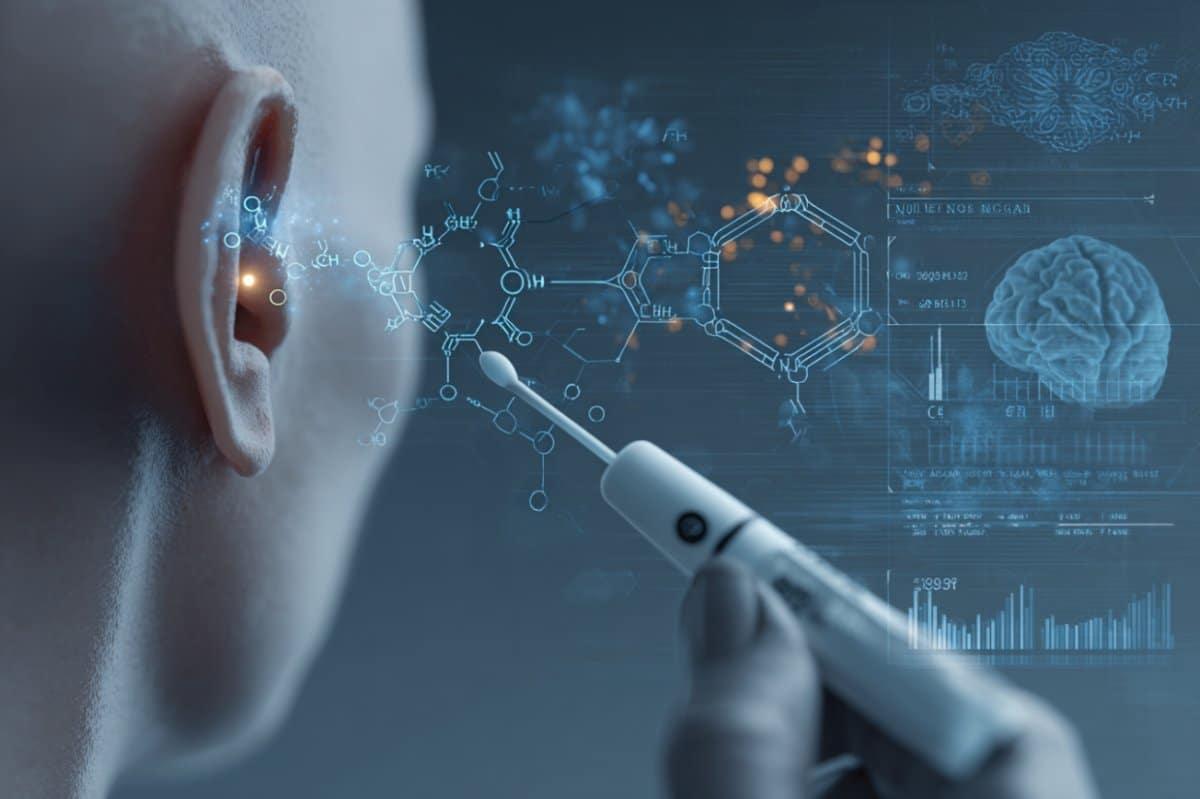
Researchers have developed a groundbreaking method for early detection of Parkinson's disease (PD) using artificial intelligence to analyze ear wax samples. This novel approach, detailed in ACS' Analytical Chemistry, offers a potentially inexpensive and non-invasive screening tool for PD, addressing the critical need for early diagnosis in optimizing patient care
1
2
3
.
Source: New Atlas
The Science Behind Ear Wax Analysis
The study focuses on sebum, an oily substance secreted by the skin, which has been previously linked to PD. Researchers chose to analyze ear wax because it is rich in sebum and protected from environmental factors that can alter its composition
1
2
.Key findings include:
- Identification of four volatile organic compounds (VOCs) in ear wax that differ significantly between PD patients and healthy individuals.
- The four potential biomarkers are ethylbenzene, 4-ethyltoluene, pentanal, and 2-pentadecyl-1,3-dioxolane
1
3
4
.
AI-Powered Olfactory System

Source: News-Medical
The research team, led by Hao Dong and Danhua Zhu, developed an artificial intelligence olfactory (AIO) system trained on the ear wax VOC data. This AI-based screening model demonstrated remarkable accuracy:
- 94% success rate in distinguishing between PD and non-PD samples
1
2
3
4
5
.
Study Methodology
The research involved:
- 209 human subjects, including 108 diagnosed with PD
- Ear canal swabbing for sample collection
- Analysis using gas chromatography and mass spectrometry techniques
1
2
3
4
5
.
Potential Impact and Future Directions
This AI-powered ear wax analysis method could serve as a first-line screening tool for early PD detection, potentially leading to earlier medical interventions and improved patient outcomes. However, the researchers emphasize the need for further studies:
"This method is a small-scale single-center experiment in China," says Dong. "The next step is to conduct further research at different stages of the disease, in multiple research centers and among multiple ethnic groups, in order to determine whether this method has greater practical application value."
1
3
4
5
Related Stories

Broader Context of PD Diagnosis
Source: Neuroscience News
Currently, PD diagnosis relies on subjective and costly methods such as clinical rating scales and neural imaging. This new approach could provide a more objective and accessible diagnostic tool, complementing existing methods like the recently developed eye test for early PD detection
4
.Funding and Future Research
The study was supported by the National Natural Sciences Foundation of Science, Pioneer and Leading Goose R&D Program of Zhejiang Province, and the Fundamental Research Funds for the Central Universities
2
5
. As research progresses, this innovative method could pave the way for more effective early interventions in Parkinson's disease management, potentially improving the lives of millions affected by this neurodegenerative condition.References
Summarized by

Navi
[1]
[2]
[3]
Related Stories
AI-Powered Voice Analysis: A Promising Tool for Early Parkinson's Disease Detection
21 Nov 2024•Health

AI-Powered EEG Analysis Achieves Near-Perfect Parkinson's Disease Detection Through Emotional Brain Responses
17 Dec 2024•Science and Research

AI-Powered Speech Tool Shows Promise for Early Parkinson's Detection
25 Jul 2025•Health

Recent Highlights



Recent Highlights
Today's Top Stories



Don’t drown in AI news. We cut through the noise - filtering, ranking and summarizing the most important AI news, breakthroughs and research daily. Follow topics that matter to you and stay ahead.


