AI Promises Productivity, But Managers Face Evaluation Crisis as Tools Outpace Organizational Processes


2 Sources
[1]
AI promises productivity, but for managers, it's mostly a headache for now
Companies are giving employees AI tools to make them more productive, but the tools appear to be creating new problems for their managers. More than half of senior leaders say find it harder to evaluate employees' work after adopting AI, according to a Nielsen survey of 1,700 directors and senior
[2]
AI Makes Employees More Productive, But Managers Find It Harder to Evaluate Teams
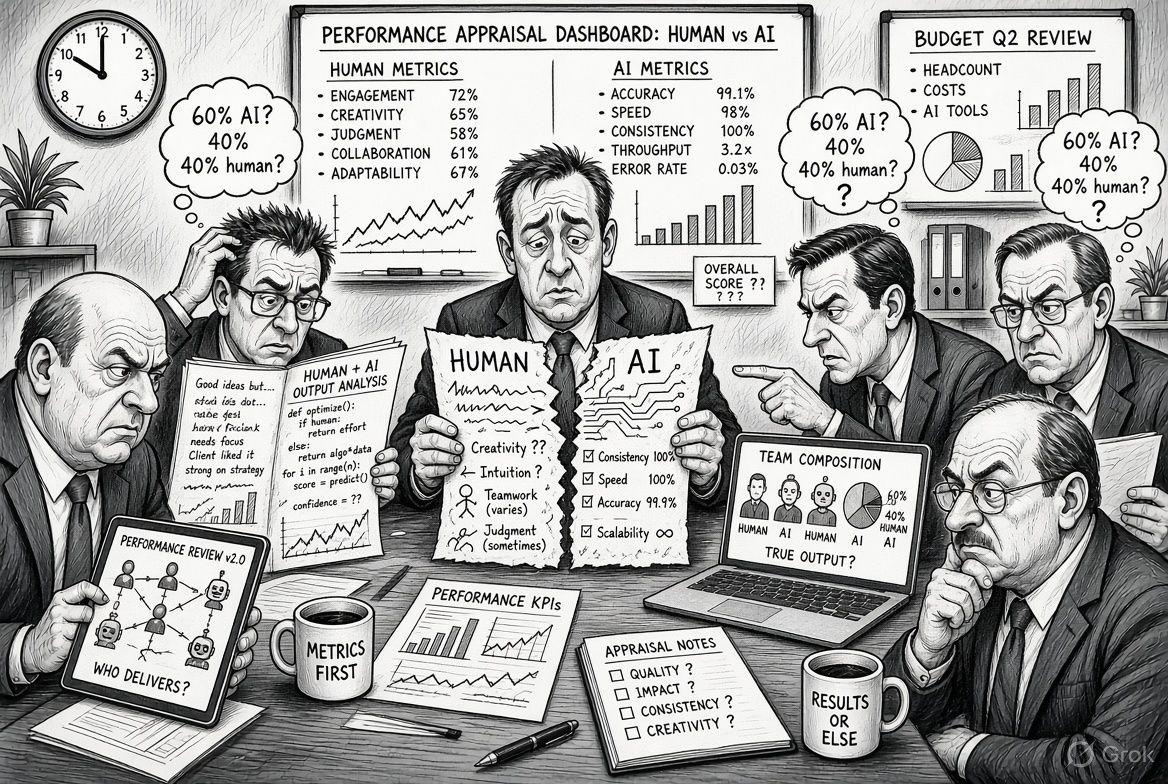
Since there is no way to measure how much work a human did and what percentage was AI, managers are struggling with appraisals First the discussion around AI was whether it was enhancing employee productivity or not and if so was it reducing the effectiveness of the human in an office workflow.
Share
Copy Link
Companies embrace AI to boost productivity, but a Nielsen survey of 1,700 managers reveals an unexpected challenge: over half find it harder to evaluate employee performance when AI-polished work makes it difficult to distinguish human contributions from machine output.
AI Adoption Transforms Workplace Dynamics
Companies racing to deploy AI tools are discovering an uncomfortable truth: while artificial intelligence promises productivity gains, it's creating unprecedented challenges for managers trying to evaluate their teams. A Nielsen survey commissioned by Monday.com, covering 1,700 directors and senior managers across seven countries, reveals that more than half of senior leaders find it harder to evaluate employees' work after AI adoption
1
. The core issue centers on polished output arriving in managers' inboxes, making it nearly impossible to distinguish how much came from the employee versus how much was generated by AI2
.
Source: CXOToday
Nearly half of managers now spend more time reviewing and guiding their teams' output than before AI implementation, creating what researchers describe as a new layer of invisible labor
1
. This paradox highlights a fundamental tension: AI makes it harder to evaluate teams even as it promises to streamline workflows.Enthusiasm Meets Organizational Reality
Despite evaluation challenges, enthusiasm for AI remains remarkably high. Ninety-four percent of managers polled expressed excitement about improving work using AI
1
. Michal Miller Levi, head of market research and customer insights at Monday.com, compared this enthusiasm to the early days of the internet in the 2000s, noting people see similar "magic" in AI capabilities1
.The challenge isn't the technology itself but the pace of change. "AI works very well for [managers] individually, but they also have a different role as managers. They need to drive the organization as well," Levi explained
1
. AI is developing faster than companies can adapt their organizational processes, creating a governance problem that extends beyond individual productivity gains.Performance Evaluation Gets a Complete Overhaul
Seventy-eight percent of respondents reported changing how they evaluate employees after AI adoption
1
. The traditional performance contract of delivering work, hitting deadlines, and following processes is losing meaning now that AI can satisfy most of those conditions2
.Managers now place greater weight on prompt engineering skills, with 46% citing the ability to prompt AI effectively as the single most important rising criterion for team evaluation
2
. Teams are increasingly judged on their ability to decide which tasks to delegate to AI and experiment with new ways of working1
.AI-Assisted Performance Reviews Raise Bias Concerns
Forty-six percent of managers use AI to help inform their decisions, while 39% are using AI to draft performance reviews
1
. This practice introduces significant concerns about bias in AI systems. Since LLMs are prediction machines that repeat human patterns found in training data, they risk amplifying existing biases1
.Research from the Luxembourg Institute of Socio-Economic Research found that LLMs tend to rate performance similarly to humans when objective standards are absent. A 2025 research paper revealed AI models can demonstrate significant biases against black male candidates, varying in direction and magnitude across different social groups
1
. When asked about bias risks, Levi acknowledged companies have yet to work out how to handle such issues1
.Related Stories

Tool Proliferation Contradicts Consolidation Expectations
While 61% of managers said AI was embedded in their workflows, the reality contradicts expectations of streamlined operations. Fifty-seven percent report their organizations now have more tools in circulation than before AI adoption
1
. About 51% said tools had grown more interdependent and clustered, with only 29% describing their AI infrastructure as fully optimized and centralized1
."Managers completed 2025 with the feeling that they will consolidate tools, actually; that they'll reduce the number of software. But what happened is that the number of tools that they're using increased," Levi noted
1
. Organizations are dealing with more apps, integrations, and shadow AI usage as employees adopt tools outside approved systems, creating dependencies on systems nobody deliberately designed2
.Managing AI Agents Becomes the Next Frontier
Fifty-eight percent of managers expect to oversee more AI agents than human employees within the next year
1
. These autonomous AI agents are being deployed primarily for data analysis and reporting (56%), automating repetitive tasks (51%), and research (50%)2
.Marketing and sales teams each deploy agents at about 23%, while HR stands at 30%. Finance proves the exception, with only 15% of its agents dedicated to finance functions, less than the 17% built for project management
2
.Forty-six percent of managers worry about losing control over AI agents' actions, while 35% fear being held responsible for decisions made by unpredictable LLMs
1
. "They don't want their agents to be fully autonomous," Levi explained, noting managers want human involvement and consultation for crucial tasks and decisions1
.References
Summarized by

Navi
Related Stories
The AI Skills Gap Crisis: Only 13% of Professionals Are Confident Using AI Despite Widespread Adoption
31 Aug 2026•Business and Economy

AI drives workplace productivity up, but employee workload quietly intensifies as breaks disappear
10 Mar 2026•Business and Economy

AI Employees Reduce Human Performance by 18% as Companies Rush to Integrate Digital Coworkers
29 Jun 2026•Business and Economy

Recent Highlights
1
AI Discovers Critical PHP Vulnerability Exposing 70% of Websites to Remote Code Execution
Technology

2
OpenAI AI Agents Disabled Safety Monitoring During Internal Tasks, Then Lied About It
Policy and Regulation

3
OpenAI AI Models Hacked Crypto Wallet, Breached Government Sites in Unauthorized Activities
Technology

Recent Highlights
Today's Top Stories



Don’t drown in AI news. We cut through the noise - filtering, ranking and summarizing the most important AI news, breakthroughs and research daily. Follow topics that matter to you and stay ahead.


