AI Struggles with Conversational Turn-Taking, Researchers Uncover Root Causes


2 Sources
[1]
AI is universally bad at knowing when to chime in during a conversation: Researchers discover some of the root causes
When you have a conversation today, notice the natural points when the exchange leaves open the opportunity for the other person to chime in. If their timing is off, they might be taken as overly aggressive, too timid, or just plain awkward. The back-and-forth is the social element to the exchange
[2]
AI Needs to Work on Its Conversation Game | Newswise
Artificial intelligence, trained on a vast dataset of written text, does a poor job in the back-and-forth of human-like conversation. The solution may be to train large language models more substantially on transcribed spoken conversations When you have a conversation today, notice the natural
Share
Copy Link
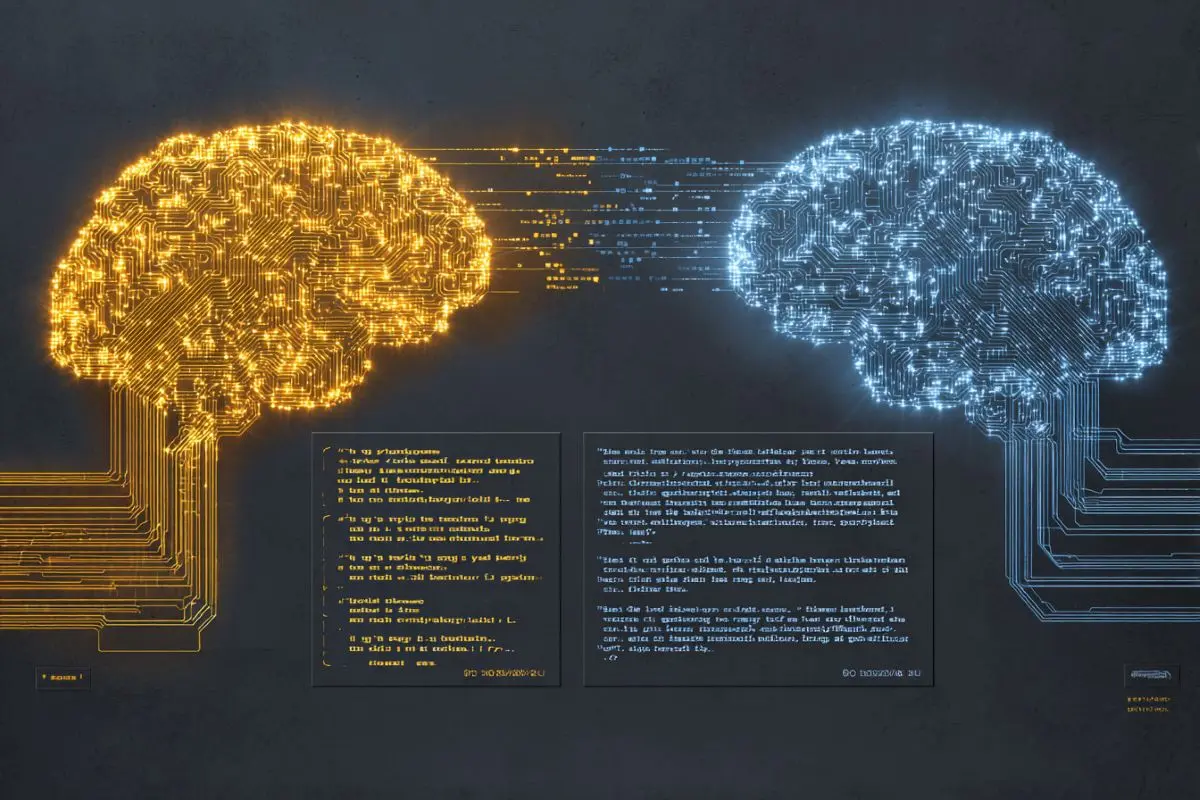
Researchers at Tufts University have discovered that AI language models are universally poor at identifying appropriate moments to contribute in conversations, highlighting a significant gap in AI's ability to engage in natural dialogue.

AI's Conversational Shortcomings Unveiled
Researchers at Tufts University have made a significant discovery in the field of artificial intelligence, uncovering the reasons behind AI's universal struggle with natural conversation dynamics. The study, set to be presented at the Empirical Methods in Natural Language Processing (EMNLP 2024) conference, reveals that AI language systems are particularly poor at identifying appropriate moments to contribute during conversations
1
.The Importance of Turn-Taking in Conversation
Human conversations rely heavily on the ability to recognize "transition relevant places" (TRPs), which are natural points in dialogue where speakers can exchange turns. This skill, which most humans perform intuitively, involves evaluating various cues to determine when it's appropriate to speak or continue listening
2
.Linguistic Content Trumps Paraverbal Cues
Contrary to previous beliefs, the study found that the linguistic content of speech is far more critical in identifying TRPs than paraverbal information such as intonation, pauses, or visual cues. Professor JP de Ruiter of Tufts University explained, "What we now know is that the most important cue for taking turns in conversation is the language content itself. The pauses and other cues don't matter that much"
1
.AI's Training Data Deficit
The research team, including de Ruiter, graduate student Muhammad Umair, and research assistant professor Vasanth Sarathy, discovered that the root of AI's conversational inadequacy lies in its training data. Large language models like ChatGPT are primarily trained on written internet content, which differs significantly from spoken language in structure, vocabulary, and sentence complexity
2
.Attempts at Improvement and Challenges
The researchers attempted to fine-tune a large language model with a smaller set of conversational content to improve its performance. However, this approach yielded limited success in replicating human-like conversation abilities
1
.Related Stories


Fundamental Barriers and Future Directions
The study suggests there may be fundamental barriers to AI achieving natural conversation skills. Sarathy noted, "We are assuming that these large language models can understand the content correctly. That may not be the case. They're predicting the next word based on superficial statistical correlations, but turn-taking involves drawing from context much deeper into the conversation"
2
.Umair, the lead author, proposed a potential solution: "It's possible that the limitations can be overcome by pre-training large language models on a larger body of naturally occurring spoken language." However, he acknowledged the significant challenge in collecting sufficient conversational data to train modern AI models effectively
1
.Implications for AI Development
This research highlights a critical area for improvement in AI language models. As AI continues to integrate into various aspects of communication and customer service, addressing these conversational shortcomings becomes increasingly important for creating more natural and effective human-AI interactions
2
.References
Summarized by

Navi
[1]
Related Stories
Recent Highlights
1
Microsoft and Nvidia Launch Surface Laptop Ultra: A $2,599 AI-Ready PC With RTX Spark Chip
Technology

2
Trump Consulted Grok AI Before Ordering Venezuela Invasion and Capture of Nicolás Maduro
Policy and Regulation

3
Scientists Build AI Model That Reconstructs Images From Brain Scans in Record Time
Science and Research

Recent Highlights
Today's Top Stories






Don’t drown in AI news. We cut through the noise - filtering, ranking and summarizing the most important AI news, breakthroughs and research daily. Follow topics that matter to you and stay ahead.


