AI tools boost individual scientists 3x but shrink science's collective scope, major study reveals


4 Sources
[1]
Artificial intelligence tools expand scientists' impact but contract science's focus - Nature
Although our analysis provides new insight into AI's impact on science, clear limitations remain. Our identification approach -- although validated by experts -- misses subtle and unmentioned forms of AI use, and our focus on natural sciences excludes important domains in which AI adoption patterns
[2]
Are Scientists Sacrificing Originality for Speed With the Use of AI?
New analysis suggests AI tools narrow the span of ideas explored AI is turning scientists into publishing machines -- and quietly funneling them into the same crowded corners of research. That's the conclusion of an analysis of more than 40 million academic papers, which found that scientists who
[3]
AI has supercharged scientists -- but may have shrunk science
Analysis of 41 million papers finds that although AI expands individual impact, it narrows collective scientific exploration As artificial intelligence tools such as ChatGPT gain footholds across companies and universities, a familiar refrain is hard to escape: AI won't replace you, but someone
[4]
AI tools boost individual scientists but could limit research as a whole
Artificial intelligence is influencing many aspects of society, including science. Writing in Nature, Hao et al. report a paradox: the adoption of AI tools in the natural sciences expands scientists' impact but narrows the set of domains that research is carried out in. The authors examined more
Share
Copy Link
A groundbreaking analysis of over 41 million academic papers reveals a stark paradox: while artificial intelligence tools help scientists publish three times more papers and gain nearly five times more citations, they're simultaneously narrowing the breadth of scientific inquiry. The study, published in Nature, shows AI-driven research clusters around popular, data-rich problems, creating a tension between individual career advancement and collective scientific progress.
AI Boosts Scientists' Productivity While Narrowing Research Horizons
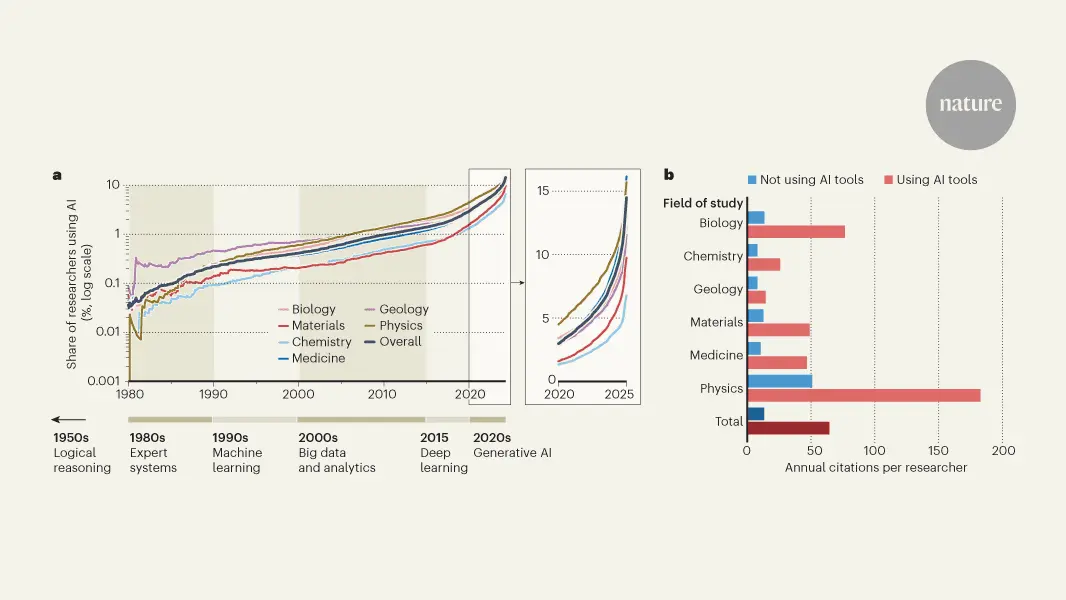
Artificial intelligence tools are transforming scientific research in ways that benefit individual careers but may harm science as a whole. A comprehensive analysis published in Nature examining over 41 million academic papers reveals that scientists who adopt AI tools publish 3.02 times more papers and receive 4.84 times more citations than their peers who don't use these technologies
1
3
. However, the impact of AI tools on science extends beyond productivity gains. The study found that AI-driven research clusters around the same data-rich problems, covering 4.6% less topical ground than conventional research3
. This creates what researchers call a "conflict between individual incentives and science as a whole," according to James Evans, a sociologist at the University of Chicago who led the study2
.
Source: Nature
Machine Learning to Generative AI: Patterns Across Three Eras
The research team analyzed papers from the OpenAlex database spanning 1980 to 2025, covering biology, medicine, chemistry, physics, materials science, and geology
1
. They divided AI development into three key eras: traditional machine learning (1980-2014), deep learning (2015-2022), and generative AI (2023-present)1
. Across all three periods, the narrowing scope of scientific inquiry remained consistent. The pattern held whether scientists used early machine learning methods, tools like AlphaFold, or ChatGPT and other generative AI systems. Papers that used AI drew nearly twice as many citations per year as those that did not, demonstrating the significant AI impact on individual metrics of success3
.Individual Career Advancement Accelerates With AI Adoption
The benefits for individual scientists extend well beyond publication counts. Researchers who embraced AI reached leadership roles 1.5 years earlier than their peers
3
. Junior scientists who used AI were also less likely to drop out of academia, suggesting these tools provide tangible advantages for career progression3
. The study identified roughly 311,000 papers that incorporated AI in some way through data processing and pattern recognition tasks2
4
. To identify these papers, researchers trained a natural language processing model to scan titles and abstracts, with human experts confirming the model was about as accurate as a human reviewer3
.Collective Scientific Progress Suffers From Feedback Loop of Conformity
While individuals thrive, the broader scientific enterprise faces concerning trends. AI-driven research spawned 22% less engagement across natural sciences disciplines, with papers tending to orbit a small number of superstar papers rather than forming dense networks of interconnected ideas
3
. "We are digging the same hole deeper and deeper," warns Luís Nunes Amaral, a physicist at Northwestern University2
. The researchers hypothesize this clustering results from a feedback loop: popular problems motivate the creation of massive datasets, those datasets make AI tools appealing, and advances made using AI attract more scientists to the same problems3
. This feedback loop of conformity threatens research originality and intellectual breadth.
Source: IEEE
Related Stories

Automating Established Fields Rather Than Exploring New Frontiers
The findings demonstrate that currently attributed uses of AI in scientific research primarily augment cognitive tasks through data processing and pattern recognition, automating established fields rather than supporting the exploration of new ones
1
4
. "When your attention is attracted by star papers like AlphaFold, all you're thinking is how you can build on AlphaFold and beat other people to doing it," explains Tsinghua University co-author Fengli Xu. "But if we all climb the same mountains, then there are a lot of fields we are not exploring"3
. The study suggests that to preserve collective exploration, the scientific community will need to reimagine AI systems that expand not only cognitive capacity but also sensory and experimental capacity, enabling scientists to search and gather new types of data from previously inaccessible domains1
.Future Implications for Science and AI Development
Experts warn that these trends could intensify as generative AI reshapes research workflows faster than scientific institutions can adapt. "Science is seeing a degree of disruption that is rare," notes Dashun Wang, who researches the science of science at Northwestern University
3
. Lisa Messeri, a sociocultural anthropologist at Yale University, argues these results should set off "loud alarm bells" for the community. "Science is nothing but a collective endeavor," she says. "There needs to be some deep reckoning with what we do with a tool that benefits individuals but destroys science"3
. The history of major discoveries has been most consistently linked with new views on nature, suggesting that expanding the scope of AI's deployment in science will be required for sustained scientific research and to stimulate new fields1
.References
Summarized by

Navi
[1]
Related Stories
AI in Scientific Research: Boosting Citations but Raising Equity Concerns
12 Oct 2024•Science and Research

AI agents identify promising drug candidates in hours as Google and FutureHouse debut research systems
19 May 2026•Science and Research

AI's Double-Edged Sword: Revolutionizing Scientific Research While Raising Ethical Concerns
06 Jan 2025•Science and Research

Recent Highlights



Recent Highlights
Today's Top Stories










Don’t drown in AI news. We cut through the noise - filtering, ranking and summarizing the most important AI news, breakthroughs and research daily. Follow topics that matter to you and stay ahead.


