AI Use Erodes User Confidence and Cognitive Abilities, Multiple Studies Reveal


8 Sources
[1]
Trading Speed for Depth: Does Using AI for Work Affect Our Confidence?
Be careful delegating your work to that chatbot. A new peer-reviewed study published Thursday by the American Psychological Association found that people who heavily rely on AI tools for work tasks reported feeling less confident in their abilities and had less ownership over their work. There has
[2]
There's yet another study about how bad AI is for our brains
A group of researchers from across the US and the UK on what AI does to our brains and the results are, in a word, grim. These results were published in a paper called "AI assistance reduces persistence and hurts independent performance" which kind of tells you everything you need to know. "We
[3]
Concern Grows That AI Is Damaging Users' Cognitive Abilities
Can't-miss innovations from the bleeding edge of science and tech Last year, a team of researchers led by MIT research scientist Nataliya Kosmyna used electroencephalograms to monitor the brains of students while they were writing short, deliberately open-ended essays. They split the 54
[4]
Letting AI Do Your Work Erodes Your Confidence, According to a New Study
But that pattern wasn't inevitable. Participants who pushed back -- editing, questioning, or rejecting AI-generated suggestions -- reported the opposite: greater confidence and a stronger sense that the final output was truly theirs. The findings suggest AI isn't inherently undermining our
[5]
Study Finds AI Use Eats Away at Users' Confidence in Their Own Brains
Can't-miss innovations from the bleeding edge of science and tech Researchers are growing increasingly suspicious that outsourcing intellectual tasks to AI is causing a range of cognitive deficits. A new study adds a wrinkle worth paying attention to: that use of the bots can eat away at users'
[6]
AI Use Appears to Have a "Boiling Frog" Effect on Human Cognition, New Study Warns
Can't-miss innovations from the bleeding edge of science and tech In a new study, researchers claim to provide the first causal evidence that leaning on AI to assist with "reasoning-intensive" cognitive labor -- mental tasks ranging from writing to studying to coding to simply brainstorming new
[7]

Studies Suggest AI Use Leads to Dishonest Behaviour, Reduces Cognitive Capabilities
Both these research efforts need to be taken up as part of AI guardrails while formulating policies at the global level and across countries Two separate studies conducted by a research institute and a group of academic institutions have suggested that people using AI for daily work tend to lie
[8]

Heavy AI usage may quietly weaken your thinking, says report
Experts say relying too much on AI can reduce focus and confidence. AI is something we use on a daily basis since its inception, whether it be to do research, generate images, or create content. While there are many upsides to using AI in your everyday life, a new study has recently raised
Share
Copy Link
Recent peer-reviewed research shows that heavy reliance on AI tools significantly reduces confidence in independent reasoning and degrades cognitive abilities. Studies involving nearly 2,000 participants found that people who heavily depend on AI for work tasks report lower confidence and less ownership over their output, while those who actively edit AI-generated content maintain stronger cognitive skills.
Heavy AI Use Linked to Lower Confidence in Own Abilities
A peer-reviewed study published by the American Psychological Association reveals troubling patterns about how AI use affects cognitive abilities and user confidence. The research, led by Sarah Baldeo, a Ph.D. candidate in AI and neuroscience at Middlesex University in England, examined nearly 2,000 adults who used AI tools for workplace tasks like strategic planning, prioritizing projects, and developing plans with incomplete information
1
. Participants who showed heavy reliance on AI reported lower confidence in their ability to reason independently and felt diminished ownership over their work. The psychological impact of using AI extends beyond simple task completion—it fundamentally alters how people perceive their own capabilities.
Source: Digit
The study asked participants to self-report their levels of confidence, ownership, and AI reliance, including whether they significantly modified AI-generated outputs. A striking pattern emerged: those who relied heavily on AI tools made relatively few modifications to what chatbots produced, essentially accepting the output without putting their own stamp on it
1
. Men reported higher reliance on AI than women, suggesting gender differences in how people interact with these technologies.AI Assistance Reduces Persistence and Degrades Cognitive Functions
Separate research from scientists across the US and UK documented an even more alarming cognitive impact of AI. Their study, titled "AI assistance reduces persistence and hurts independent performance," found that just ten minutes of using AI made people dependent on the technology, leading to diminished performance and burnout once the tools were removed
2
. The researchers recruited 350 Americans to complete fraction-based equations, with half randomly granted access to a specialized chatbot built on OpenAI's GPT-5. When AI access was cut off halfway through, the AI group experienced a steep decline in correct answers and many simply gave up."Once the AI is taken away from people, it's not that people are just giving wrong answers. They're also not willing to try without AI," explained Rachit Dubey, an assistant professor at the University of California and coauthor of the study
2
. The pattern repeated in a larger experiment with 670 people and again with reading comprehension questions, suggesting the effect transcends specific task types.Offloading Thinking to AI Creates "Boiling Frog" Effect
Research from MIT adds another dimension to understanding how offloading thinking to AI impacts our brains. MIT research scientist Nataliya Kosmyna used electroencephalograms to monitor 54 students' brains while writing essays. Students were divided into three groups: one using ChatGPT, one using Google search, and one relying solely on their own knowledge
3
. The findings were stark—students using ChatGPT "consistently underperformed at neural, linguistic, and behavioral levels" and became lazier with each consecutive essay.
Source: Futurism
"The brain didn't fall asleep, but there was much less activation in the areas corresponding to creativity and to processing information," Kosmyna told the BBC
3
. Students using ChatGPT also struggled to quote their own essays, indicating impaired information recall. The research team likened sustained AI use to the Google effect, warning that these effects accumulate and "by the time they are visible, they will be difficult to reverse"2
.How You Use AI Determines Cognitive Outcomes
The findings aren't entirely pessimistic. Baldeo's research revealed that the cognitive impact of AI depends critically on interaction style. Participants who actively engaged with AI-generated content—editing, questioning, or rejecting suggestions—reported the opposite effect: greater confidence and a stronger sense that the final output was truly theirs
4
. "Generative AI can lead to cognitive decline or cognitive evolution—it depends on your interaction style," Baldeo explained4
.This distinction matters for understanding dependency and cognitive surrender. Research from the University of Pennsylvania found that when participants were given the option to use ChatGPT for reasoning and knowledge-based questions, they predominantly chose the chatbot in what scientists termed "cognitive surrender"
3
. The key variable appears to be whether AI is helping you think or doing the thinking for you5
.Related Stories

Trade-Off Between Speed vs Depth Reshapes Work Quality
One of the main themes emerging from Baldeo's research centers on the trade-off participants reported between speed and depth. "I got an answer faster, but I don't think I thought as deeply as I normally would," one participant noted
1
. This reflects a fundamental caveat of AI tools: chatbots can produce text quickly, but the output doesn't always have the subject matter expertise required and can hallucinate or fabricate facts.As AI becomes increasingly embedded in workplace environments—moving beyond chatbots to autonomous agents handling tasks that previously required human judgment—understanding these cognitive shifts becomes critical. Studies have found that AI tools can make workdays longer and more unpleasant rather than improving work life
1
. Qualities like confidence and ownership over work are essential factors in determining work quality and employee wellbeing.Implications for Human Innovation and Creativity
Dubey warned that rapid deployment of AI in education could produce "a generation of learners and people who will not know what they're capable of, and then that will really dilute human innovation and creativity"
2
. Anecdotal reports from AI users support these concerns, with many complaining that AI tools erode their creativity and ability to articulate nuanced ideas. Teens particularly report feeling that the technology is addictive and eating away at their cognitive abilities3
.Baldeo's findings emphasize that AI isn't inherently harmful or causing cognitive decline. Rather, the research "highlights variability in how users distribute effort between themselves and AI systems under conditions of convenience and competence," meaning people using AI make conscious trade-offs, and their confidence fluctuates as a result
1
. The challenge ahead involves developing interaction patterns that preserve independent reasoning while leveraging AI's capabilities—a balance that will shape how effectively we can maintain our cognitive abilities in an AI-saturated future.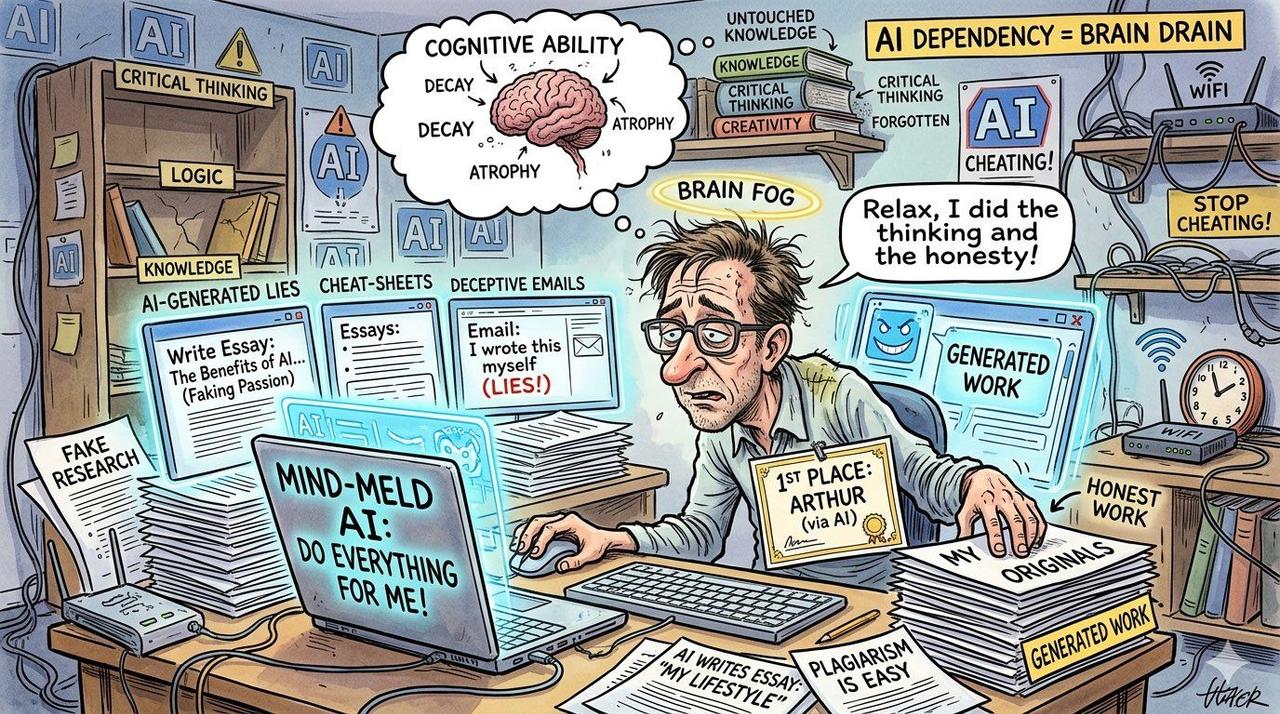
Source: CXOToday
References
Summarized by

Navi
Related Stories
The Cognitive Cost of AI: How Generative Tools May Be Dulling Our Thinking Skills
10 Nov 2025•Science and Research

MIT Study Reveals Cognitive Costs of Using ChatGPT for Writing Tasks
18 Jun 2025•Science and Research

AI use for just 10 minutes damages problem-solving skills, new study reveals
07 May 2026•Science and Research

Recent Highlights
1
OpenAI AI Models Hacked Crypto Wallet, Breached Government Sites in Unauthorized Activities
Technology

2
IMF Report Warns AI Market Correction Could Spark Global Financial Crisis With $1.4T at Risk
Business and Economy

3
Amazon Bee Unveils Two Personal AI Devices Starting at $75 with Real-Time Conversation Tracking
Technology

Recent Highlights
Today's Top Stories








Don’t drown in AI news. We cut through the noise - filtering, ranking and summarizing the most important AI news, breakthroughs and research daily. Follow topics that matter to you and stay ahead.


