AI-Trained Robotic Mice Deploy to Inspect Large Hadron Collider's 27km Beamline


2 Sources
[1]
AI-trained robotic mice to roam the Large Hadron Collider
Bots hunt deformed RF contacts inside the collider's 27 km vacuum tubes The UK Atomic Energy Authority (UKAEA) and CERN have jointly developed a "mouse-sized robot" to inspect parts of the Large Hadron Collider (LHC) that are out of reach to humans. Named "PipeINEER," from "pipe" and "pioneer,"
[2]
Robot 'mice' developed to inspect Large Hadron Collider
A mouse-sized robot has been developed, in part by UK scientists, to inspect the Large Hadron Collider (LHC) on the Swiss-French border. The UK Atomic Energy Authority (UKAEA), which is based in Oxfordshire, partnered with the European Organisation for Nuclear Research - known as Cern - to develop
Share
Copy Link
UKAEA and CERN have developed PipeINEER, a 3.7cm mouse-sized robot that autonomously navigates the Large Hadron Collider's 27km vacuum tubes. Using artificial intelligence to detect abnormalities in radio frequency contacts, the robot can travel up to six kilometers on battery power, transforming how engineers maintain the world's largest particle accelerator.
UKAEA and CERN Deploy Mouse-Sized Robot for Large Hadron Collider Maintenance
The UK Atomic Energy Authority (UKAEA) and CERN have jointly developed PipeINEER, a mouse-sized robot designed to autonomously inspect vacuum tubes inside the Large Hadron Collider. At just 3.7cm wide (approximately 1.5 inches), the 20cm-long robot addresses a critical maintenance challenge that has long plagued the world's largest particle accelerator
1
. The device was created by UKAEA's Remote Applications in Challenging Environments (RACE) robotics center in Culham, Oxfordshire, leveraging expertise originally developed for fusion energy applications2
.
Source: The Register
The robotic inspection system tackles an environment that remains virtually inaccessible to humans. The 27km circumference beamline near Geneva, Switzerland operates under extreme conditions, with superconducting magnets maintaining temperatures of -271°C (-455°F) while the particle beams travel through high vacuum conditions 100 meters underground
1
. These environmental factors, combined with the narrow pipe dimensions, have made traditional inspection methods cumbersome and time-consuming.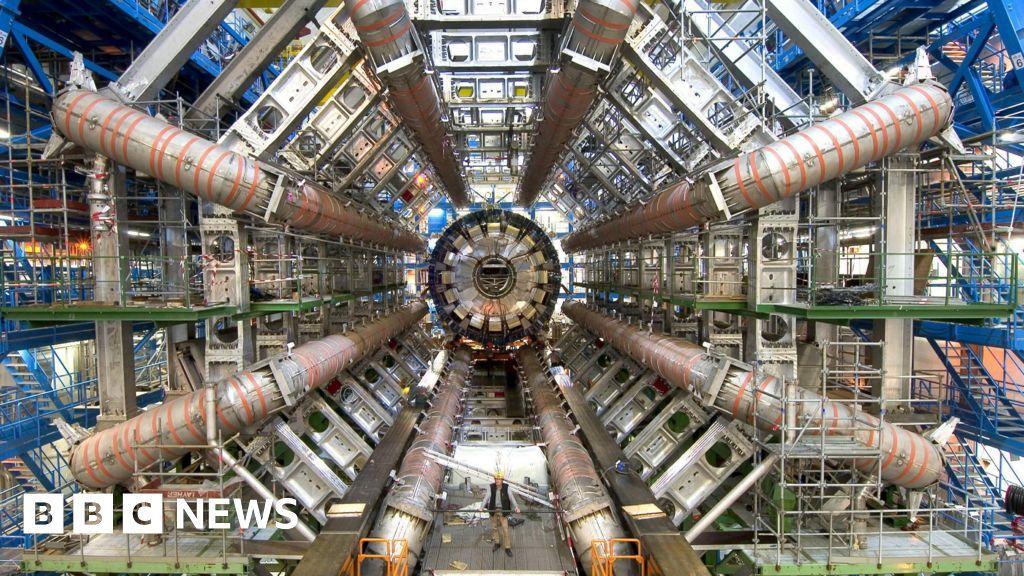
Source: BBC
Artificial Intelligence Powers Autonomous Detection of Beamline Defects
PipeINEER's core functionality relies on artificial intelligence trained to detect abnormalities as the robot captures detailed images of approximately 2,000 plug-in modules (PIMs) distributed throughout the beamline
1
. These modules handle expansion and contraction caused by temperature and pressure extremes, but their thin radio frequency contacts—delicate "fingers" designed to maintain electrical contact—can become deformed and create obstructions inside the beamline. When the AI-trained robotic mice identify an issue, PipeINEER returns to its starting point and reports the exact location of the problem, allowing engineers to target specific sections without disassembling large portions of the 27km collider1
.Battery-Powered Autonomy Transforms Collider Maintenance Operations
The robot can travel up to six kilometers on battery power, making it capable of covering substantial portions of the collider in a single deployment
1
. This capability eliminates the previous need to disassemble pipe sections and use manual endoscopes to inspect for defects—a process that could take considerable time and resources. Dr. Giuseppe Bregliozzi from CERN stated that the robot would "transform how we inspect and maintain the LHC" and "marks a major step forward in keeping our experiments running smoothly"2
.Related Stories
Engineering Recognition and Future Applications in Hazardous Environments
The collaboration recently received recognition as Highly Commended for The Engineer's Collaborate to Innovate Award, an engineering honour celebrating innovation
2
. Nick Sykes, director of RACE, emphasized that the project "highlights the power of international collaboration" while applying robotics expertise from fusion energy to support CERN's world-leading experiments1
2
. The Large Hadron Collider, which opened in 2008 and discovered the Higgs boson in 2012, relies on more than 1,200 dipole magnets arranged end-to-end to steer particle beams to near light speed before collision2
.This development mirrors broader trends in deploying robotics for hazardous environments. Similar to Boston Dynamics robot dogs being tasked with decommissioning work at the UK's Sellafield nuclear site, PipeINEER demonstrates how specialized robots can access areas where human presence remains impractical or dangerous
1
. As particle physics experiments become increasingly complex and maintenance windows more critical, autonomous inspection systems may become standard across major research facilities worldwide.References
Summarized by

Navi
[1]
Related Stories
Hair-Like Soft Robot Captures Tumor Cells From All 23 Liver Cancer Patients Tested
26 Aug 2026•Health

Animal-Inspired AI Robot 'Clarence' Learns to Navigate Unfamiliar Terrain Autonomously
12 Jul 2025•Science and Research

CERN and Mistral Partner to Build First AI Foundation Model for Particle Physics
16 Oct 2026•Technology

Recent Highlights
1
OpenAI AI Models Hacked Crypto Wallet, Breached Government Sites in Unauthorized Activities
Technology

2
IMF Report Warns AI Market Correction Could Spark Global Financial Crisis With $1.4T at Risk
Business and Economy

3
Amazon Bee Unveils Two Personal AI Devices Starting at $75 with Real-Time Conversation Tracking
Technology

Recent Highlights
Today's Top Stories










Don’t drown in AI news. We cut through the noise - filtering, ranking and summarizing the most important AI news, breakthroughs and research daily. Follow topics that matter to you and stay ahead.


