Berkeley Lab's TEM Agent Lets Scientists Control Atom-Scale Microscope Using Plain English


2 Sources
[1]
700 GB in 15 seconds: Smart system helps scientists keep pace with atom-scale microscope
Running one of the world's most powerful electron microscopes used to take weeks of training. At Lawrence Berkeley National Laboratory, researchers can now describe an experiment in plain English and let an AI agent run it. The system, called TEM Agent, was built at the Molecular Foundry, a U.S.
[2]
New Virtual Assistant Streamlines One of the Most Advanced Microscopes
Newswise -- Some of the most important discoveries in materials science and structural biology come down to a simple question: where, exactly, are the atoms? The arrangement of atoms determines nearly everything about how a material behaves in the real world -- how strong it is, how it conducts
Share
Copy Link
Scientists at Lawrence Berkeley National Laboratory developed TEM Agent, an AI system that operates transmission electron microscopes through plain-language instructions. The breakthrough addresses a critical bottleneck where microscopes generate 700 gigabytes in 15 seconds, far exceeding human processing capacity.
AI System Transforms Access to Advanced Microscopy
Researchers at the Molecular Foundry, a U.S. Department of Energy user facility at Lawrence Berkeley National Laboratory, unveiled TEM Agent, an AI system that operates transmission electron microscopes through plain-language instructions
1
. The breakthrough addresses a fundamental challenge in materials science: while these atom-scale microscopes grow increasingly powerful, capable of imaging structures roughly half the size of a hydrogen atom, the number of scientists who can expertly operate them hasn't kept pace2
.The AI-powered virtual assistant eliminates weeks of training previously required to run these sophisticated instruments. Visiting researchers, even those arriving with a semester of electron microscopy coursework, traditionally needed extensive hands-on training before conducting experiments
1
. Now they can describe experiments in plain English and let TEM Agent handle the technical execution.Processing 700 GB in 15 Seconds
The system tackles an overwhelming data challenge that has created a significant bottleneck in scientific research. A single detector at the facility generates approximately 700 gigabytes of data in just 15 seconds, far too fast for manual processing
1
. This data deluge, equivalent to several smartphones' worth of photos, previously required hours of expert analysis2
.Peter Ercius, the staff scientist who led the study published in npj Computational Materials, explained the transformation from rigid automation to adaptive intelligence. The team had previously built automated routines for repetitive tasks like imaging large numbers of nanoparticles, but these systems operated like factory lines, breaking when unexpected situations arose
1
. Only robotics engineers could modify these programs, limiting their flexibility.Model Context Protocol Enables Safe AI Control
Rather than rebuilding from scratch, the team rewrote existing automated functions using the Model Context Protocol, an open standard that provides AI with a fixed set of specific, pre-written actions instead of open-ended control
1
. This approach allows TEM Agent to string steps together for requests no one specifically programmed, while maintaining safety boundaries.The system performed beyond expectations during initial testing. "We just gave it access and started asking it to do things that I would normally ask a user or myself to do on a microscope, and it just started working," Ercius said. "It was pretty amazing that it worked out of the box"
2
.Mastering Complex Techniques Through Natural Language
TEM Agent handles sophisticated procedures including electron tomography, which reconstructs three-dimensional views of atomic structures from tilted images and can take hours to complete
1
. During early testing, the agent confused rotating the sample with rotating the scan direction, but a short written explanation corrected the error, demonstrating the system's ability to learn from plain-language instructions1
.Stephanie Ribet, a research scientist at the Molecular Foundry, pushed the system into experimental territory with ptychography, a computational imaging technique that reconstructs high-resolution images from diffraction patterns and typically requires significant expertise to set up
1
. The AI-powered virtual assistant successfully bridged the gap between scientific hardware and intelligent control.Related Stories

Integration with Supercomputing and Data Infrastructure
The system connects to the National Energy Research Scientific Computing Center, a DOE supercomputing facility, and Crucible, a Molecular Foundry data platform that organizes experiment metadata
1
. This integration enables raw data processing in seconds instead of hours. Researchers can query previous experimental settings weeks later without manually searching through files or notebooks.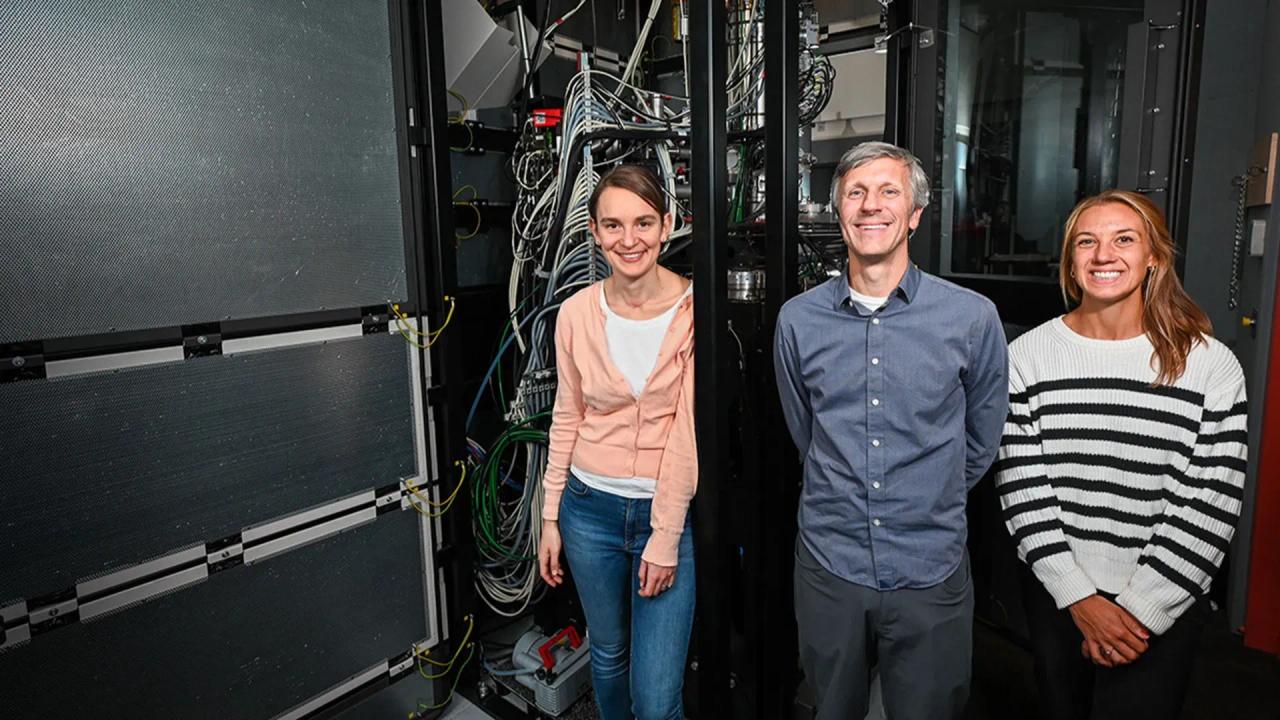
Source: Interesting Engineering
Morgan Wall, who leads Crucible's development, emphasized the streamlined workflow: users can communicate in natural language through one interface instead of managing five scripts across five computers
1
. Wall's team is helping other nanoscale research centers adopt Crucible, potentially extending this approach to instruments with open interfaces.Democratizing Advanced Scientific Tools
The development aims to extend expertise rather than replace it, providing both new and experienced researchers faster pathways from concept to experiment. Ercius expects such assistants to democratize access to advanced microscopy, allowing more scientists to leverage these powerful tools without extensive specialized training
1
. The research, supported by the DOE Office of Science, signals a shift in how scientific facilities can serve broader research communities while maintaining the precision required for atomic-scale investigations.References
Summarized by

Navi
[1]
Interesting Engineering
|700 GB in 15 seconds: Smart system helps scientists keep pace with atom-scale microscope
Related Stories
AI and Machine Learning Revolutionize Synchrotron Science at NSLS-II
01 Mar 2025•Science and Research

SLAC National Accelerator Laboratory Harnesses AI to Advance Scientific Research
06 Dec 2024•Science and Research

ChemGraph AI framework automates chemistry simulations to accelerate battery and materials research
07 Jul 2026•Technology
Recent Highlights
1
OpenAI's AI Models Disprove 27-Year Exponential Time Hypothesis, Rendering Decades of Research Obsolete
Science and Research
2
Google DeepMind unveils Genie 4 world model with audio and 2-minute interactive simulations
Technology

3
Microsoft AI Diagnostic Tool Beats Doctors With 83% Accuracy on Complex Medical Cases
Health

Recent Highlights
Today's Top Stories







Don’t drown in AI news. We cut through the noise - filtering, ranking and summarizing the most important AI news, breakthroughs and research daily. Follow topics that matter to you and stay ahead.


