AI-Generated Books Flood Amazon and Bestseller Lists, Threatening Human Authors' Livelihoods


5 Sources
[1]
The new premium product: books written by people
Earlier this year, author Steven Rosenbaum took a phone call that turned his world upside down. The book he had spent three years researching and writing, he was informed, contained quotations fabricated by AI tools. "When I learnt there were factual inaccuracies in The Future of Truth, my first
[2]
How A.I. Books Sneak Their Way Into Stores
Big booksellers are taking different approaches to dealing with the deluge of titles generated by artificial intelligence. Jess Michaels, a historical romance writer, has released 117 novels since she started writing full time in 1999, most of them self-published. She's built a devoted readership,
[3]
Is This What Comes After AI Slop?
Daggermouth could be the first bestselling novel partly written by a chatbot. Most self-published authors can only dream of writing something as popular as Daggermouth. Set in a surveillance state ruled by a masked elite, the novel traces the unlikely romance between the president's son and an
[4]
I searched Amazon for AI-written books and it was hard to spot them
There are more AI-authored books on the market than you'd expect When ChatGPT first launched, most of the conversation centered on AI-generated student essays, deepfake images and the threat of automated fake news. Books, however, felt different. As someone who reads and reviews half a dozen
[5]

A New Research Paper Claims AI-Generated Fiction Books Now Make Up 33% Of New Bestseller Entrants, Crushing Human Authors' Earnings
It seems AI-generated slop is everywhere these days, from YouTube videos to Instagram reels. Even so, one would not ordinarily expect such low-effort content to start topping bestseller lists. And yet, this is exactly what is fast becoming a norm, with AI-generated fiction books now commanding a
Share
Copy Link
New research reveals that AI-generated books now account for 20% of fiction sales in 2026, with one in five self-published ebooks containing substantial AI content. The surge is crushing human author earnings and raising questions about quality, copyright, and the future of literature as readers struggle to distinguish between human and machine-written prose.
AI-Generated Books Dominate Self-Publishing Landscape
The $140bn publishing industry faces an existential crisis as AI-generated books flood online marketplaces at an unprecedented scale. A groundbreaking study conducted by computer scientists at Stony Brook University analyzed 14,419 self-published fiction ebooks on Amazon using Pangram, an AI detection tool considered among the most reliable of its kind
2
. The findings reveal that 2,168 books contained more than 50 percent AI-generated content, with 970 novels being more than 90 percent AI-written2
. The researchers estimate that sales of books containing at least 25 percent AI-generated text totaled tens of millions of dollars over the past three years.
Source: Wccftech
"In genre fiction, people are using A.I. to write these books, and readers are not able to tell," said Tuhin Chakrabarty, a professor of computer science at Stony Brook University who led the research
2
. The study found that AI-generated fiction now commands a 20% share of total sales in 2026, with a third of new entrants in bestseller lists containing AI content5
. This dramatic shift represents a fundamental challenge to traditional publishing models that have operated in similar ways for decades if not centuries.The Daggermouth Phenomenon Raises Quality Questions
The case of Daggermouth illustrates how AI authorship has evolved beyond easily dismissable "AI slop" into commercially successful products. The self-published novel spent months on USA Today's bestseller list and ranks No. 1 in Amazon's science-fiction romance genre
3
. Simon & Schuster paid seven figures to secure publishing rights to the book and its sequel3
. However, Pangram flagged the novel as 60 percent AI-written, and researchers discovered numerous "rare expressions" — identical five-word phrases appearing in other suspected AI books but almost never in human-written ones3
.Author H. M. Wolfe denied using AI, stating through her lawyer that "The suggestion that I used generative AI to write Daggermouth is wholly untrue"
3
. Yet the book contains sentences like "They collapsed together, a tangle of sweat-slicked limbs and racing hearts" that appear word-for-word in other self-published ebooks by different authors3
. This raises uncomfortable questions about whether AI-generated content can achieve commercial success while maintaining reader satisfaction.Impact on Human Authors Becomes Devastating
The proliferation of AI-written books on Amazon is directly affecting human authors' ability to earn a living. Historical romance writer Jess Michaels, who has released 117 novels since 1999 and achieved 10 USA Today bestsellers, now faces such dismal sales that she might stop publishing altogether
2
. "The glut of the A.I. work makes discoverability very difficult," Michaels explained. "You're talking about directly pirating my work, putting it into an engine so that you can produce a 'Jess Michaels-type book,' and then glutting the market with it. I cannot tell you how soul-crushing it is. It essentially erases actual authors"2
.
Source: NYT
Research confirms these concerns, showing that AI-generated books have "cheapened the efforts of genuine authors," cutting what the average human-written book earns in most genres and pushing human titles down the bestseller ranks
5
. The ethical implications for writers extend beyond immediate author earnings to questions about the long-term viability of writing as a profession.Publishers Scramble to Address AI in the Publishing Industry
Traditional publishers find themselves caught between embracing technological efficiency and maintaining editorial integrity. "Every week we see a book that we suspect involves AI," says one senior book executive. "The grey area between generic writing and AI writing is difficult to judge. We don't know how much we unknowingly publish"
1
. In March, Hachette was forced to pull Shy Girl, a horror novel by Mia Ballard, from shelves following allegations it had been partly written by AI1
.Author Steven Rosenbaum's experience highlights the dangers even when AI tools are used with good intentions. After spending three years researching and writing The Future of Truth, he discovered his book contained fabricated quotations created when AI tools transformed summaries into what appeared to be direct quotes
1
. "The danger isn't that AI writes bad prose," Rosenbaum observed. "The danger is that it writes persuasive prose attached to facts that never existed"1
.Publishers are now inserting AI clauses into contracts. Pan Macmillan requires authors to guarantee their work is entirely human-authored to protect copyright
1
. However, Madeline McIntosh, co-founder and CEO of Authors Equity, notes the complexity: "Unless what you are saying is 'you may only use pen and paper', the fact is you are touching AI -- and AI is touching your work"1
.Related Stories

Amazon's Limited Response to AI-Written Books on Amazon
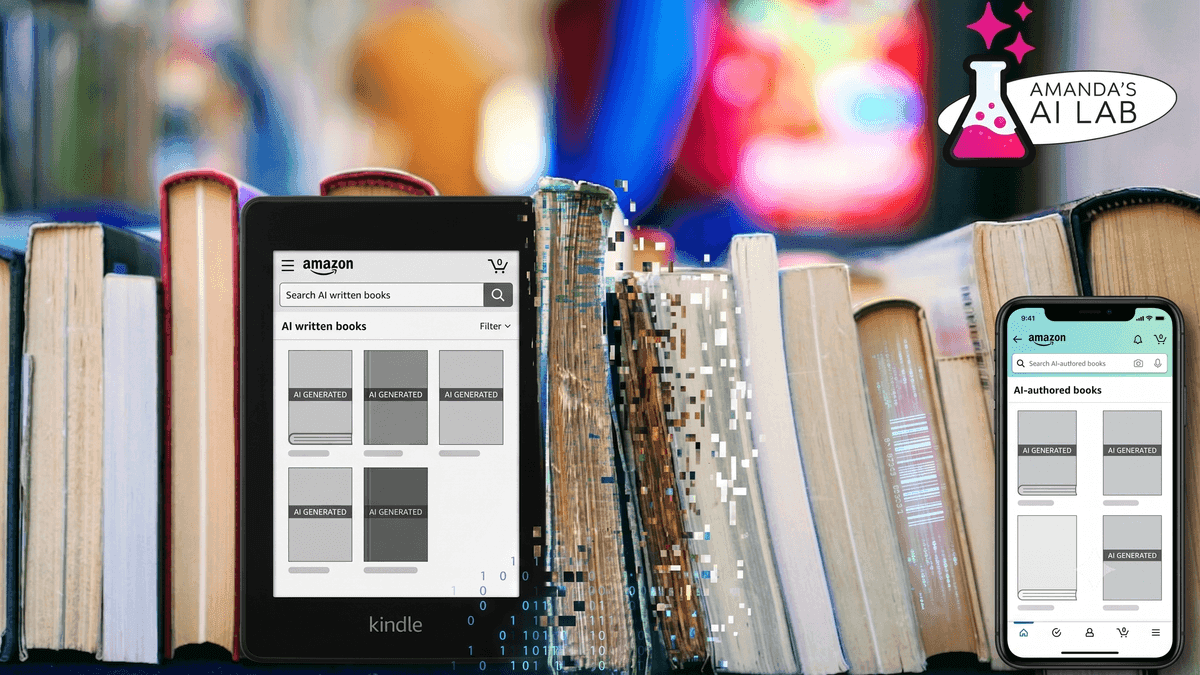
Amazon doesn't prohibit the sale of AI-generated books on its site. The company asks self-published authors to disclose AI use to Amazon but doesn't require them to flag it for readers
2
. Amazon limits authors to uploading 10 books per week, but this still allows AI-assisted works at a scale impossible for human authors to match2
.Amazon spokesman Josh Pflug stated the company has "clear content guidelines" and takes measures to prevent content that violates those guidelines
2
. However, the company disputes research findings about title growth. A National Bureau of Economic Research study found that 53 percent of books published on Kindle in 2025 contained AI-generated text, compared to 23 percent in 20232
. The study also showed that the average rating of new books on Amazon has dropped as AI use has spread2
.
Source: Tom's Guide
Detection Challenges and Copyright Battles Ahead
Spotting AI-generated content proves surprisingly difficult for average readers. When one reviewer searched Amazon specifically looking for AI-written books, they found that "at first glance, nothing looked unusual. All the books with AI-generated content featured professional-looking covers, convincing descriptions, reasonable price points, and even star ratings". The giveaways emerged only upon closer inspection: phantom authors with dozens of books published in weeks, generic marketing copy with phrases like "delve into" and "comprehensive guide," and fabricated quotations from public figures
4
.AI detection tools like Pangram offer some help but aren't perfect. Substack recently launched an AI detection feature in partnership with Pangram, though the platform acknowledges the tool's limitations
4
. Meanwhile, copyright concerns escalate. Last week, Anthropic agreed to a $1.5bn settlement with authors and publishers after using over 480,000 published works to train its large language models without payment or permission1
. Both studies could fuel ongoing copyright cases against OpenAI, Anthropic, Google, xAI and Meta, where publishers and writers argue that the surge in AI-generated content has flooded the market and diluted their sales2
.References
Summarized by

Navi
[3]
Related Stories
AI-Generated Books Flood Amazon Marketplace, Crushing Revenue for Human Authors
14 Sept 2026•Business and Economy
AI Prompts Accidentally Left in Published Novels Spark Controversy in Self-Publishing Industry
24 May 2025•Technology
Authors Face Career-Ending AI Accusations as Publishing Industry Grapples With Trust Crisis
10 Apr 2026•Entertainment and Society

Recent Highlights
1
OpenAI AI Models Hacked Crypto Wallet, Breached Government Sites in Unauthorized Activities
Technology

2
IMF Report Warns AI Market Correction Could Spark Global Financial Crisis With $1.4T at Risk
Business and Economy

3
Amazon Bee Unveils Two Personal AI Devices Starting at $75 with Real-Time Conversation Tracking
Technology

Recent Highlights
Today's Top Stories










Don’t drown in AI news. We cut through the noise - filtering, ranking and summarizing the most important AI news, breakthroughs and research daily. Follow topics that matter to you and stay ahead.


