5 Sources
[1]
PSA: Amazon's shopping AI can now tell you if that message is a scam
Amazon is turning to AI to help fight scammers, the company announced on Wednesday. The retailer said some 360,000 customers every year reach out to its customer service department, wondering whether a message they received from Amazon is real or a scam. Now, customers will be able to ask Amazon's consumer AI service, Alexa for Shopping, to help answer that question instead. The company said its AI can "definitively" confirm whether a communication originated from its own systems by checking it against the billions of messages Amazon has sent globally. The AI analyzes the sender information, content, timing, message metadata, and more, to determine authenticity. Amazon said the system will improve as customers report more suspicious messages, helping it to spot scams more effectively in the future. The new AI capabilities follow on Amazon's earlier attempts to address the growing scam problem, which includes fake order confirmations, Prime membership renewal alerts, account suspension warnings, package delivery notifications, and job scams. Earlier this year, Amazon launched an email address, [email protected], that allows anyone to forward suspicious messages to the company and receive a response that confirms whether the email was a real message or a scam. It also offers an online form on its customer service site that provides the same assistance. The feature's addition is aanother example of how Amazon has shifted its product strategy around Alexa to focus more on how it can assist with shopping-related questions and provide proactive help. Today, the assistant can source personalized deals, create shopping guides, help customers reorder their everyday items, offer AI product overviews, transcribe handwritten shopping lists, and more. On Tuesday, the retailer also added an Alexa feature that lets customers set alerts when something new or relevant happens, like a favorite brand launching a new product, the release of a new book from a favorite author, or an artist dropping a new record. Alexa for Shopping is available from both the Amazon website and mobile app.
[2]
Amazon's AI assistant can now spot fake emails from the company
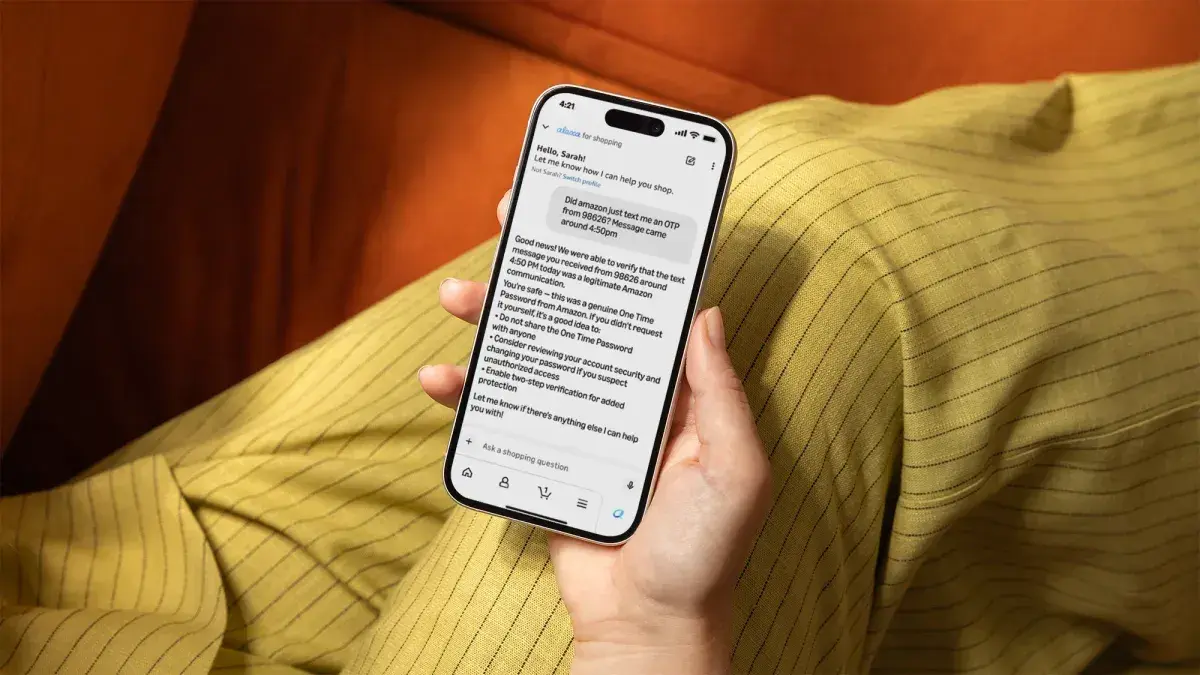
Amazon is trying to combat impersonation scams with a new feature that allows you to use its AI assistant to determine whether an email, text message, or phone call actually came from the company. With the update, you can ask Alexa for Shopping about a message you received, and it will use AI to compare it "against a record of every message Amazon has sent," while also analyzing its contents, formatting, and the sender. As noted by Amazon, the assistant will only confirm that a message is real if it's "completely certain." An example shared by Amazon shows a customer asking, "Did Amazon just text me an OTP from 98626? Message came around 4:50pm." Alexa for Shopping responds by confirming that Amazon actually did send the message, saying, "This was a genuine One Time Password from Amazon." If Alexa for Shopping determines a message isn't from Amazon, it will instruct customers to check their orders in the app and contact Amazon's support team directly. The company launched a similar feature earlier this year that lets you forward suspicious messages to "[email protected]" to check if they're real. This isn't the only recent update Amazon has launched for Alexa for Shopping, as it added an "Update Me When" feature that can now help you track new product releases as well.
[3]
Alexa for Shopping AI Now Flags When a Scammer Pretends to Be Amazon
(Credit: Mateusz Slodkowski/SOPA Images/LightRocket via Getty Images) Ever find yourself unsure whether an email from Amazon is real or not? You can now ask Alexa for Shopping to check whether it's a scam. The newly launched AI feature will use a database of billions of messages sent by Amazon's team to verify whether an email, phone call, message, or text is from an official source. The brand announced the new feature in a blog post on Sept. 2, saying it wanted to help the over 360,000 customers who contact Amazon customer service with similar queries each year. Amazon also likely wants to alleviate some of the strain on its support department, too. "Scammers thrive when customers can't easily verify whether a message is real," said Scott Knapp, vice president of worldwide buyer risk prevention at Amazon. "That's why we built a tool to put certainty directly in customers' hands, in real time, when they need it most. It's part of our broader commitment to educate and empower customers and protect them against scams." To use this feature, you can head to the chatbot within the Amazon Shopping app or on its website, and ask it directly about a message. An example in Amazon's marketing sees the user write, "Did amazon just text me an OTP from 986626? Message came around 4:50pm." Amazon's AI will then check details against its own records, using the sender's information, message content, metadata, formatting, and message timing to make a decision. If it's real, it will respond with "Yes, this message is an official Amazon communication." Amazon says, "The tool only confirms a message is real when it's completely certain." If it isn't, it will ask you to use an alternative verification path. If it's proven not to be from Amazon, it will walk you through how to report the message, including advice not to click any links and steps to ensure your account's safety. The AI may also suggest sending the communication to [email protected], which can also be used as an alternative way to report a message. Anyone can use that email address, even if they're not an Amazon customer, to see where a message came from.
[4]
'Alexa for Shopping' Can Now Help You Spot a Spam Email
If the bot cannot confirm it with this level of certainty, you may receive an alert the bot was unable to verify the message. While many internet scams are obvious enough to easily avoid, they are growing more sophisticated. Even seasoned users may find themselves duped by a clever fake email, text, or phone call. Case in point: If you receive a message from "Amazon," you might have trouble quickly identifying whether or not it's legitimate. That could lead you to either fall for a trap, or, if the message is real, miss an important announcement or alert from the company. There are plenty of tactics and best practices out there for verifying these messages on your own, of course: You can take a look at the email address or phone number that sent it, and do your own research to see whether it's official contact info for the company (depending on the email address, this might be apparent on its own); you can study the body of the message, looking for grammar and spelling mistakes that would give away a hasty phishing scheme; and you can note any financial requests, or time-sensitive demands, which would raise the stakes and increase the chances that someone would treat the message and its contents as legitimate. But none of these tactics allows you to confirm directly with the company -- in this case, Amazon -- whether that outreach is real. A new Alexa tool does just that. How Alexa for Shopping helps you confirm Amazon messages are legit On Wednesday, Amazon announced an interesting new initiative aimed at reducing -- if not eliminating -- the risk of users falling for scams. Starting today, "Alexa for Shopping," Amazon's shopping assistant, will help you verify whether an email, text, or phone call from "Amazon" is actually from the company. The company says you can ask Alexa for Shopping questions like "Did Amazon send me a text about a delivery problem yesterday?" "Is this email about my Prime membership from Amazon real?" or "I got a call about a refund from someone saying they're from Amazon. Was that real?" In addition, you ask Alexa for Shopping for more information about the message or call in question, providing any details that seem relevant (e.g., the email address or phone number the message came from, when you received it, and what it said). The AI will use these details to figure out whether the message is something Amazon sent itself. What's unique about this new feature is that the bot can actually check your details against the company's record of "every communication it has sent," including sender information, message content, when messages were sent, and exact formatting. Amazon says it completes this check "within seconds," and you'll receive one of the following answers: confirmed from Amazon, not from Amazon, or unable to verify. Amazon says Alexa for Shopping will only confirm a message is real if it has total certainty. If the message was from Amazon, the company will confirm that the message type, source, date, and time were all consistent with Amazon's message records. You'll also get tips for keeping your account secure -- whether you asked for them or not. If the message is not from Amazon, you might get a result like, "This message does not appear to match any official Amazon communication based on the information provided." Alexa for Shopping may then follow up with recommendations, like checking your orders in the app, contacting Amazon directly, and warnings against clicking links or replying to the message. If it can't confirm the message, Amazon may encourage you to try another verification method. This isn't the first verification method Amazon has rolled out. The company says it launched an email address, "[email protected]," earlier this year for users to forward messages to. There is also an existing Amazon customer service form that walks you through filing a similar request. Alexa for Shopping will likely point you in these directions if it can't verify your message for whatever reason. While companies continue to shove AI features into all of their products, this one from Amazon seems potentially quite useful. It's such a simple concept that I'm surprised more companies don't already offer a similar service. Why not automatically check user submissions against your message records to help separate real messages from spam? Perhaps Amazon will be a trailblazer here -- assuming the feature actually works, and doesn't hallucinate verifications.
[5]
Is this message really from Amazon? This is how we can use its AI to defend ourselves from scams
Alexa for Shopping checks sender, content, timing and metadata. We receive an email about an order, a reminder about a Prime renewal, or one about a pending delivery and, all too often, we ask ourselves: is this message really from Amazon? The company wants to be able to answer this question for us quickly and reliably and, for that reason, as TechCrunch reports, it has added to Alexa for Shopping a way to check whether a message really came from Amazon. A particularly interesting tool against digital scams that are becoming ever more convincing and that's as easy to use as asking a simple question. Alexa can check where a message came from Every year, some 360,000 customers contact Amazon to confirm the authenticity of different messages they've received. Now we'll be able to ask Alexa that same question directly. The system analyzes the sender, the content, the arrival time and, of course, all the metadata to verify whether any message is authentic. A simple question like "Did you send me an OTP from the number XXXXXX about 10 minutes ago?" is enough to make sure an apparently legitimate message is real. While fraud attempts take the form of order confirmations, notices about Prime, account alerts or delivery messages and are becoming increasingly convincing thanks to AI, having an integrated verification system makes it very easy to put any doubts to rest. Alexa for Shopping, available on the web and in the Amazon app, boils it down to a single question. A big improvement over forwarding suspicious messages to [email protected] and one that will allow us to interact with Amazon with greater confidence.
Share
Copy Link
Amazon launched an AI-driven security feature in Alexa for Shopping that helps users verify messages from Amazon by checking them against billions of company records. The tool analyzes sender information, content, timing, and metadata to confirm authenticity within seconds, addressing 360,000 annual customer service inquiries about potential scams.
Amazon has deployed an AI-powered feature within Alexa for Shopping that allows customers to verify whether emails, texts, or phone calls claiming to be from the company are legitimate
1
. The retailer reports that approximately 360,000 customers contact its customer service department annually to confirm authenticity of messages they receive, creating significant strain on support resources1
3
. This new scam verification system addresses the rising sophistication of phishing attempts targeting Amazon customers, from fake order confirmations to fraudulent Prime membership renewal alerts and account suspension warnings.
Source: TechCrunch
The Amazon AI system can "definitively" confirm whether communications originated from company systems by cross-referencing them against billions of messages Amazon has sent globally
1
. Users can ask Alexa for Shopping questions like "Did Amazon just text me an OTP from 98626? Message came around 4:50pm" and receive immediate verification2
. The AI analyzes sender information, message content, timing, message database records, and metadata to determine authenticity within seconds3
5
. Amazon emphasizes that the tool only confirms a message is real when it has complete certainty2
3
."Scammers thrive when customers can't easily verify whether a message is real," said Scott Knapp, vice president of worldwide buyer risk prevention at Amazon. "That's why we built a tool to put certainty directly in customers' hands, in real time, when they need it most"
3
. The feature helps users defend from scams that have grown more convincing, making it difficult even for experienced internet users to spot fake emails4
. When Alexa for Shopping cannot verify messages from Amazon, it directs customers to check orders in the Amazon Shopping app and contact support directly, while warning against clicking links or replying to suspicious communications2
3
.Related Stories
This launch follows Amazon's earlier anti-scam initiatives. The company introduced [email protected] earlier this year, allowing anyone to forward suspicious messages and receive confirmation about their legitimacy
1
4
. An online customer service form provides similar assistance for those who prefer that method1
. The new AI verification represents a significant upgrade over these manual processes, delivering instant results through simple conversational queries5
. Amazon states the system will improve as customers report more suspicious messages, enhancing its ability to identify and combat digital scams more effectively over time1
.
Source: PC Magazine
The scam verification tool exemplifies Amazon's evolving product strategy around Alexa, concentrating on shopping-related assistance and proactive customer support
1
. Alexa for Shopping now offers personalized deals, creates shopping guides, helps reorder everyday items, provides AI product overviews, and transcribes handwritten shopping lists. Amazon recently added the Update Me When feature, enabling customers to set alerts for new product releases from favorite brands, book launches from preferred authors, or new music from artists they follow1
2
. The verification feature is accessible through both the Amazon website and mobile app, ensuring broad availability for users seeking to confirm authenticity of communications1
. This integrated approach to combating digital scams may establish a new standard for how major retailers protect user confidence in an era of increasingly sophisticated phishing attempts.Summarized by
Navi
[4]