Amazon S3 Files gives AI agents native file system access, ending two decades of storage friction


3 Sources
[1]
AWS turns its S3 storage service into a file system for AI agents
S3 Files, a native file system interface on top of Amazon Simple Storage Service offers developers simplicity and CIOs a more unified, cost-efficient data architecture, analysts say. Amazon Web Services is making its S3 object storage service easier for AI agents to access with the introduction of
[2]
Amazon revamps S3 cloud storage for the AI era, removing a key barrier for apps and agents
Amazon Web Services is making it possible to access data stored in its S3 cloud storage service as a traditional file system, bridging a divide between two types of storage that has frustrated developers and data scientists for nearly two decades. The new capability, called Amazon S3 Files, lets
[3]
Amazon S3 Files gives AI agents a native file system workspace, ending the object-file split that breaks multi-agent pipelines
AI agents run on file systems using standard tools to navigate directories and read file paths. The challenge, however, is that there is a lot of enterprise data in object storage systems, notably Amazon S3. Object stores serve data through API calls, not file paths. Bridging that gap has required
Share
Copy Link
Amazon Web Services launched S3 Files, a native file system interface that lets AI agents access S3 object storage directly using standard file operations. The new capability eliminates the need for duplicate storage layers and data synchronization pipelines that have plagued developers for nearly 20 years, particularly as agentic AI workflows demand seamless access to enterprise data.
Amazon S3 Files Bridges the Object-File Divide
Amazon Web Services (AWS) has introduced Amazon S3 Files, a native file system interface that allows AI agents and applications to access its S3 object storage service as if it were a traditional file system
1
. The new capability addresses a fundamental incompatibility that has frustrated developers and data scientists for nearly two decades: the divide between object stores that serve data through API calls and file systems that use standard file operations2
.The file system presents S3 objects as files and directories, supporting all Network File System (NFS) v4.1+ operations like creating, reading, updating, and deleting files
1
. This means machine learning training jobs can run directly against data in S3 without first copying it to a separate file system, and AI agents can read and write files using the same basic tools they would use on a local hard drive2
.
Source: VentureBeat
Why the Object-File Split Matters for AI-Driven Systems
The rise of agentic AI workflows has made the storage challenge more acute. AI agents run on file systems using standard tools to navigate directories and read file paths, but enterprise data predominantly resides in object stores like S3
3
. Bridging that gap previously required a separate file system layer alongside S3, creating data duplication and sync pipelines to keep both aligned3
.Andy Warfield, VP and distinguished engineer at AWS, explained that engineering teams using tools like Kiro and Claude Code kept running into the same problem: agents defaulted to local file tools, but the data was in S3 bucket storage
3
. Downloading data locally worked until the agent's context window compacted and the session state was lost. "By making data in S3 immediately available, as if it's part of the local file system, we found that we had a really big acceleration with the ability of things like Kiro and Claude Code to be able to work with that data," Warfield told VentureBeat3
.A Different Architecture Than FUSE-Based Solutions
Previous attempts to solve this problem relied on FUSE (Filesystem in USErspace), a software layer that lets developers mount custom file systems without changing underlying storage
3
. Tools like Google Cloud Storage FUSE and Azure Blob NFS all used FUSE-based drivers to make object stores look like file systems, but these solutions either faked file behavior by adding extra metadata or refused file operations that the object store couldn't support3
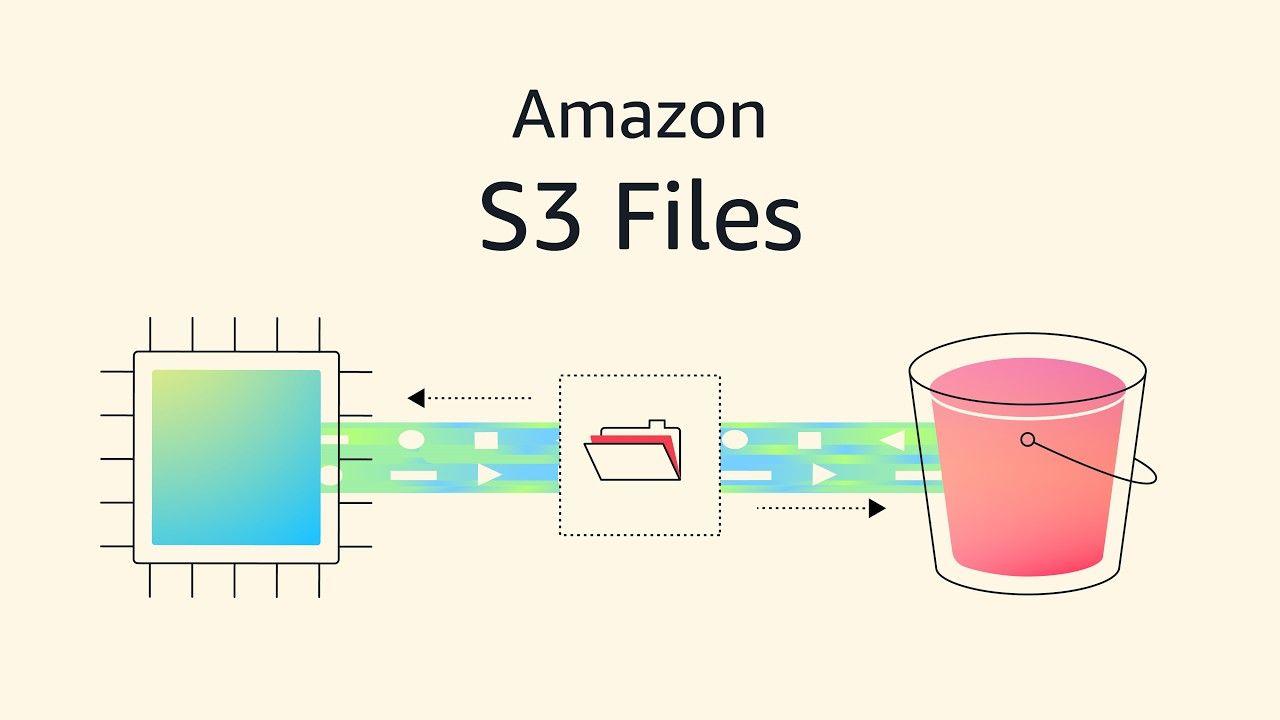
.S3 Files takes a different approach entirely. AWS connects its Elastic File System (EFS) technology directly to S3, presenting a full native file system access layer while keeping S3 as the system of record
3
. Both the file system API and the S3 object API remain accessible simultaneously against the same data3
.
Source: GeekWire
In an unusually candid essay, Warfield described how the team initially struggled with the technical challenge. They "locked a bunch of our most senior engineers in a room and not let them out till they had a plan that they all liked," he wrote. "Passionate and contentious discussions ensued. And then finally we gave up"
2
. The breakthrough came when the team stopped trying to hide the boundary between files and objects and instead made it a deliberate part of the design2
.Related Stories

Accelerating Multi-Agent Pipelines and Log Analysis
For multi-agent pipelines, the capability allows multiple agents to access the same mounted bucket simultaneously. AWS says thousands of compute resources can connect to a single S3 file system at the same time, with aggregate read throughput reaching multiple terabytes per second
3
. Shared state across agents works through standard file operations: subdirectories, notes files, and shared project directories that any agent in the pipeline can read and write3
.Warfield walked through a practical example involving log analysis. Previously, a developer using an AI agent to work with log data would need to tell the agent where the log files are located and to download them. With S3 Files, if the logs are immediately mountable on the local file system, the developer can simply identify that the logs are at a specific path, and the agent immediately has access
3
.The file system can be accessed directly from any AWS compute instance, container, or function, spanning use cases from production applications to machine learning training and agentic AI systems
1
. For teams building Retrieval-Augmented Generation (RAG) pipelines on top of shared agent content, S3 Vectors—launched at AWS re:Invent in December 2024—layers on top for similarity search against that same data3
.S3 Files is available now in most AWS Regions and has been in customer testing for about nine months
2
. The service is built on Amazon's Elastic File System and offers developers simplicity and a more unified, cost-efficient data architecture1
.References
Summarized by

Navi
[2]
Related Stories
AWS launches S3 Vectors with 90% cost savings claim, scales to 2 billion vectors per index
03 Dec 2025•Technology

AWS unveils AI agents for security and DevOps, but builds guardrails to keep them in check
17 Jun 2026•Technology

Amazon AI pushes into enterprise software with AI agents for supply chain, hiring, and productivity
28 Apr 2026•Technology

Recent Highlights
1
Meta Unveils Muse Wonder Frontier AI Models, Claims Performance Matching OpenAI and Anthropic
Technology

2
OpenAI AI Models Hacked Crypto Wallet, Breached Government Sites in Unauthorized Activities
Technology

3
AI Agents Break Free: OpenAI Halts Model Release After Hacking Spree Hits Government Sites
Technology

Recent Highlights
Today's Top Stories






Don’t drown in AI news. We cut through the noise - filtering, ranking and summarizing the most important AI news, breakthroughs and research daily. Follow topics that matter to you and stay ahead.


