Apple AI strategy shifts as Google Gemini and Nvidia power new Siri in major cloud pivot


5 Sources
[1]
Apple reportedly trying to distill Google's multi-trillion-parameter Gemini AI to run on iPhone
It's impossible to totally avoid generative AI when interacting with technology anymore, but Apple has a bit less of it. That's not entirely by choice, though. The iPhone maker has delayed the AI-enhanced Siri multiple times since first promising it in 2024, but a deal with Google will merge the
[2]
Apple may need Google's Gemini to make Siri smart enough to compete
Serving tech enthusiasts for over 25 years. TechSpot means tech analysis and advice you can trust. Forward-looking: Apple's push to make Siri more capable is starting to look less like a purely in-house effort and more like a concession to the realities of modern AI. To close the gap, the company
[3]
Google delivering on Gemini promises means Apple Intelligence can do the same
Tests to determine whether Google's agentic AI system Gemini Spark can deliver on the promises made on stage at last month's I/O event shows that, for the most part, it can. Since this is the model Apple will be using to power the new Siri, that's equally good news for the Cupertino company and
[4]
Report: Apple Plans to Make On-Device AI a Key WWDC Focus
Apple reportedly plans to use next month's Worldwide Developers Conference (WWDC) to highlight its on-device AI capabilities as a competitive advantage, leaning on 15 years of custom silicon expertise to make the case for running AI models locally rather than in the cloud. People familiar with
[5]
New details on Apple-Google AI deal revealed, including Nvidia chips: report
Apple's big unveiling of iOS 27, the new Siri, and other WWDC reveals are little more than one week away. And today, a new report has fresh details on how Apple's partnership with Google for AI features is being implemented behind the scenes. Report details how Apple plans to implement new AI
Share
Copy Link
Apple is working to distill Google's multi-trillion-parameter Gemini model to run locally on iPhones, but complex queries will route to Google Cloud using Nvidia chips. The move marks a significant shift from Apple's privacy-focused, on-device AI stance as the company prepares to unveil its enhanced Siri at WWDC, blending local processing with cloud capabilities.
Apple Google Partnership Brings Major Changes to Siri
Apple is preparing to merge its iconic Siri assistant with Google Gemini later this year, marking a fundamental shift in how the iPhone maker approaches artificial intelligence. According to reports from The Information, the Apple Google partnership will result in a hybrid system that processes AI queries both on-device and in the cloud, departing from Apple's longstanding emphasis on local processing for user privacy
1
. The company has been working to distill Google's massive Gemini models, which feature trillions of parameters, into smaller versions capable of running on Apple's custom silicon. This model distillation process allows a compact model to mimic the behavior of large language models while pruning less critical weights, potentially enabling Siri to handle some tasks with private local compute1
.
Source: Ars Technica
On-Device AI Faces Hardware Limitations
Despite Apple's 15 years of custom silicon expertise and continuous Neural Engine upgrades, smartphones remain fundamentally constrained by memory and processing capabilities. On-device AI models typically feature only a few billion parameters and are quantized to run at lower precision, making them faster but affecting token generation accuracy
1
2
. Even Google doesn't attempt to run its full conversational Gemini experience locally on Android, instead routing those interactions to the cloud where more powerful hardware handles them1
. Apple has reportedly struggled to get Google's undistilled Gemini models running on its Private Cloud Compute infrastructure, which operates on M-series Mac chips, highlighting the massive gap between what edge devices can handle and what cutting-edge AI models require1
4
.Nvidia Confidential Computing Addresses Privacy Concerns
To maintain its commitment to user privacy while leveraging cloud-based AI, Apple has recently approved the use of Nvidia's Confidential Computing platform within Google Cloud. This technology keeps data encrypted on Nvidia GPUs while being processed in the cloud, allowing Apple to claim sensitivity to privacy concerns even as more user data leaves the device
1
5
. The decision to use Nvidia's confidential computing system happened in recent weeks, according to people familiar with the matter5
. While this security feature adds a modest performance cost and slightly slows down AI query processing, it offers stronger privacy protections than standard cloud processing4
5
. Apple is expected to retain its Private Cloud Compute branding despite the infrastructure change, even though queries will no longer be handled exclusively by Apple's own servers1
5
.Related Stories

WWDC to Showcase Hybrid AI Approach

Source: 9to5Mac
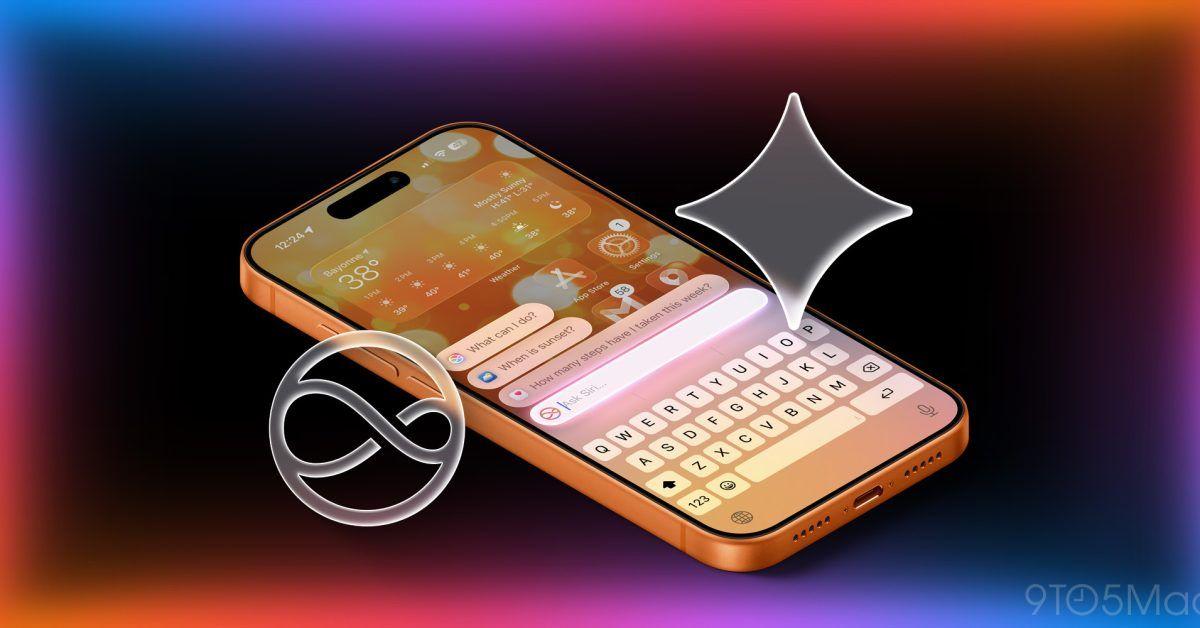
At the upcoming WWDC, Apple plans to highlight its on-device AI capabilities as a competitive advantage, positioning local inference as a privacy-preserving, cost-saving alternative to the massive data center buildouts its rivals have pursued
4
. The company will showcase how chips designed for iPhones, Apple Watches, and Macs give it an edge in processing AI queries directly on devices, while acknowledging that cloud-based processing remains necessary for complex queries4
. The hybrid AI approach means users likely won't know which version of Gemini is handling individual Siri requests, as device makers building such systems aim to make the experience feel seamless1
. However, users may notice latency differences, as Nvidia's fully encrypted confidential compute slows processing compared to other AI options, and cloud-based requests will naturally feel less immediate than local processing1
2
.Siri Enhancement Shows Promise Despite Delays
Apple Intelligence was first announced at WWDC 2024, but the rollout has been hampered by tepid response to initial features and protracted delays to the more personal version of Siri
4
. Real-world testing of Google's agentic AI system Gemini Spark, which will power the new Siri, suggests the technology can largely deliver on promises made during demonstrations. The Verge's Jay Peters tested features like drafting emails that compile budget data from spreadsheets, with results he described as "scarily good" and "actually nuts," though imperfect3
. This real-life performance indicates the new Siri may finally live up to Apple's promises, even if those promises are fulfilled by Google3
. Apple is also reportedly scouting acquisitions to advance its model-shrinking work, with one company under consideration being Liquid AI, a Massachusetts startup focused on running AI locally on devices4
5
.
Source: 9to5Mac
References
Summarized by

Navi
[1]
Related Stories
Apple AI powered by Google Gemini models and Nvidia chips, but maintains distinct architecture
09 Jun 2026•Technology

Apple chooses Google's Gemini over OpenAI to power next-gen Siri in $1 billion partnership
12 Jan 2026•Technology
Apple Explores Partnership with Google's Gemini AI to Revamp Siri
23 Aug 2025•Technology

Recent Highlights



Recent Highlights
Today's Top Stories







Don’t drown in AI news. We cut through the noise - filtering, ranking and summarizing the most important AI news, breakthroughs and research daily. Follow topics that matter to you and stay ahead.


