2 Sources
[1]
AMD Radeon RX 9070 GRE review: thoroughly midrange
Why you can trust Tom's Hardware Our expert reviewers spend hours testing and comparing products and services so you can choose the best for you. Find out more about how we test. It's a grim time to be a PC gamer and enthusiast, as anybody who has spent any time making a build list well knows. The AI gold rush has made practically everything that goes into a PC more expensive as LLMs and agentic workflows conspire to grab every available square millimeter of logic, memory, and storage wafers the world over. For all that, here we are at Computex 2026 with a fresh graphics card review. AMD is bringing its formerly China-only RX 9070 GRE (aka "Great Radeon Edition," neΓ© Golden Rabbit Edition) to global markets. This card has been available in the Chinese market for about a year, but AMD has decided that now is the time to bring the GRE to the wider world. And here it is, launching at the same $549 in the USA that the RX 9070 ostensibly listed for. That's sure to cause some double-takes, but times have obviously changed since the 9070 arrived a bit over a year ago. In today's wild graphics market, prices on what we might call "entry-level enthusiast" cards with large memory capacities have gotten out of whack with the performance levels they deliver. The $349 RX 9060 XT 16GB is now selling for closer to $450, and the $429 RTX 5060 Ti 16GB is now closer to $570. The RX 9060 XT might be situationally recommendable at that price, but the RTX 5060 Ti 16GB is clearly DOA. And higher-end cards that would formerly have served as true midrange products are more expensive, too. The $549 RX 9070 sells for closer to $650, as does the RTX 5070. So there's currently a wide gap in the graphics market for enthusiasts who want strong enough performance for high-refresh-rate gaming at both 1080p and 1440p without spending a dollar more than they need to, and AMD sees an opportunity for the RX 9070 GRE to fill it. For a quick refresher, the RX 9000 series uses the RDNA 4 graphics architecture, AMD's first to include dedicated matrix math accelerators for AI tasks like upscaling and frame gen. RDNA 4 also boasts improved RT units that claim up to a 2x improvement over the RDNA 3 CU. RDNA 4 also includes a much-improved media engine that can encode and transcode video quickly with much higher image quality than past Radeon products. The RX 9070 GRE uses the same large Navi 48 GPU as the RX 9070 and RX 9070 XT, but it's the most cut-down version of that chip thus far, with only 48 RDNA 4 compute units of a possible 64. That downsizing has the expected downstream consequences for texture sampling throughput, pixel fill rate, and raw FLOPS compared to higher-end RDNA 4 cards. AMD has also decked out the GRE with slower GDDR6 memory and less of it compared to its higher-end stablemates. This card offers 12GB of GDDR6 running at 18 Gbps on a 192-bit bus, which is good for 432 GB/s of raw memory bandwidth. (The RX 9070 and 9070 XT use 20 Gbps GDDR6, as does the RX 9060 XT.) All of those cuts are clearly meant to thread the performance gap between the RX 9060 XT 16GB and the RX 9070. In terms of raw FLOPS, the GRE isn't that far behind the RX 9070, but its slower GDDR6 clocks and narrower bus both mean that vital memory bandwidth is down a whole 33% compared to the 9070 and 9070 XT. And just 12GB of GDDR6 means this card will be less well suited to RT and 4K gaming versus its two higher-end stablemates. All that suggests it might have been good for AMD to be bolder with the RX 9070 GRE's price. With just 12GB of VRAM and relatively low memory bandwidth, this card is less appealing for local AI trailblazers than the higher-end 9070 and 9070 XT might be, and as we'll see, its gaming performance isn't so close to the 9070 that it would threaten to cannibalize sales of that product. But a $479 9070 GRE (or even a $499 one) would probably kill every current RX 9060 XT 16GB card dead -- or at least force prices back down, both of which are outcomes that AMD's board partners would likely be unhappy with in today's wild market and constrained upstream supply conditions. But another angle here is that hardware is just the beginning of evaluating a given graphics card in 2026. You don't just plug one into a PC and install occasional driver updates for it any longer. Modern gaming requires a GPU vendor to conduct ongoing investment in a multi-part software stack encompassing upscaling, frame generation, and RT denoising, and to effectively evangelize that stack to developers and get it into games. Thanks to Nvidia's sustained investment in the DLSS ecosystem, owning a GeForce card means that you can generally trust that you'll enjoy either day-one support for the latest DLSS versions in games or an easy override using the Nvidia App. And Multi Frame Generation on Blackwell has matured to the point that early tradeoffs with input latency are basically ironed out in the latest titles. That all means that you have a wide range of freedom to tune performance, smoothness, and image quality to taste on GeForces. AMD certainly has competitive AI-powered upscaling options in FSR 4 and 4.1, both of which are major improvements over FSR 3 and earlier. And you can enable them in many games with driver overrides, just as with the Nvidia App. But community surveys have still shown a strong preference for the output of DLSS, so AMD still has work to do on its upscaling models. And for those who want to embrace the smoothness boost of framegen, AMD is clearly behind. FSR 4 ML Frame Generation is still limited to a 2X multiplier, and it's only supported in a handful of games compared to DLSS MFG. Even Intel has enabled higher 3x and 4x framegen multipliers for its Arc products. And AMD's Ray Regeneration RT denoiser is only available in a couple of titles, while you can usually find DLSS Ray Reconstruction alongside titles that are pushing the state of path-traced effects forward. Ray Reconstruction is a key feature in titles like Resident Evil Requiem, Pragmata, Indiana Jones and the Great Circle, Doom: The Dark Ages, and more. In fact, AMD cards are locked out of path-traced effects entirely in Resident Evil Requiem and Pragmata. Whatever the cause of these divergent experiences on GeForces and Radeons, the fact of the matter is that Nvidia has the money and developer relations muscle to make sure its DLSS features make their way into practically every new game, whereas AMD apparently does not, and that gap seems to grow wider with every AAA release. All that is to say that if you choose a Radeon today, you are likely going to encounter more inconsistent feature support, fewer cutting-edge options for eye candy, and a less flexible performance tuning experience compared to GeForces. And that all means that AMD likely needs to be more aggressive on pricing to get gamers back into its camp (and perhaps funnel some of its AI cash back into developer relations to stoke broader adoption of its tech). It's tough to admit that you're behind on these features and their adoption, to be sure, but pricing is a powerful way to make up some of the difference.
[2]
SAPPHIRE Radeon RX 9070 GRE PULSE OC Review - A New 1440p Challenger Has Arrived
Although a lot of the attention is placed on more powerful PC gaming graphics cards when it comes to showcasing 4K visuals and performance in modern releases, even though over 80% of PC gamers are still gaming at 1440p or lower. According to the latest data from Steam, the PC gaming community is not only gaming at these lower resolutions but also using mainstream hardware or cards that aren't exactly built for 4K. This makes new mainstream and mid-range GPU releases more notable in many ways and more competitive, as it's a market that serves a much larger audience. And this is where the 'new' Radeon RX 9070 GRE from AMD fits into the picture, a GPU built for 1440p gaming, releasing at a price point that makes it the most affordable option in the company's Radeon RX 9070 line-up. That said, the Radeon RX 9070 GRE is releasing at a time when we weren't expecting any new GPUs to hit the market. And that's because the current memory, storage, and supply crisis has caused chaos throughout the enthusiast PC hardware market, with increased prices and scarcity. With that context, the Radeon RX 9070 GRE's arrival also presents a mid-range reshuffle of sorts as the third release in the Radeon RX 9070 Series. Utilizing the same Navi 48 die, albeit cut down, that powers the baseline Radeon RX 9070 and the flagship Radeon RX 9070 XT, this new GRE variant effectively replaces the Radeon RX 9070 at the $549 price point, which has, in turn, officially increased to $619 USD. And to highlight just how volatile the current market is, this puts the Radeon RX 9070 GRE's price on par with the current retail price of the GeForce RTX 5060 Ti 16GB GPU, even though, MSRP-wise, its direct competitor is the GeForce RTX 5070. Setting aside pricing, what separates the Radeon RX 9070 GRE from the rest of the 9070 Series is that its cut-down hardware is paired with 12GB of GDDR6 memory on a slower 192-bit bus, which definitely positions it as a 1440p gaming GPU first and foremost. And when it comes to 1440p gaming, in SAPPHIRE Radeon RX 9070 GRE PULSE OC form, AMD's latest RDNA 4 offering is, on average, around 19% faster than the GeForce RTX 5060 Ti 16GB, while falling short of the GeForce RTX 5070 by around 6%. Naturally, these are just numbers, as all three cards are great for gaming at 1440p in 2026, so the overall value proposition comes down to additional features, exclusive technologies, pricing, and other factors. On that note, as it's been over a year since the first RDNA 4 GPU hit the scene, AMD's AI-powered FSR 4 has now reached a point in terms of game adoption where we'd consider it a key feature and reason for picking up a Radeon RX 9070 GRE. At 1440p, you get image quality and additional performance that is competitive with NVIDIA's DLSS Super Resolution. And with RDNA 4's massive improvement to ray-tracing performance, the SAPPHIRE Radeon RX 9070 GRE PULSE OC is the sort of card, with FSR 4, that can deliver a stunning 1440p ray-tracing gaming in titles like Cyberpunk 2077. RDNA 4 - AMD Levels the Playing Field Below is a summary of AMD's new RDNA 4 architecture, applicable to all models. AMD's new RDNA 4 architecture presents a massive improvement over the chiplet design that we saw with RDNA 3. Returning to the monolithic design of RDNA and RDNA 2 might sound like a regression, especially when AMD CPUs have gone in the other direction, but this isn't the case. In a nutshell, RDNA 4 is built for the modern era of PC gaming. This GPU architecture embraces ray-tracing performance as a key pillar, lays the groundwork for neural rendering, and supercharges AI performance with the new FSR Upscaling (ML) and native support for complex AI workloads. Throw in a revamped media engine for creators and streamers, and support for next-gen DisplayPort 2.1a displays, and RDNA 4 presents a new and revitalized direction for Radeon graphics. RDNA 4's overhauled Compute Unit, which houses all raster, ray-tracing, and AI hardware, has seen several enhancements over RDNA 3 and is one of the reasons the Radeon RX 9000 Series GPUs deliver impressive performance gains. The RDNA 4 Compute Unit, or CU, features an enhanced memory subsystem, improved scalar units (for raw raster), dynamic register allocation to reduce latency and bottlenecks, and increased efficiency. The improvements also mean that Radeon RX 9000 Series GPUs can ship with much higher clock speeds than their RDNA 3 counterparts, hitting close to 3 GHz in several 9070 XT models, with 9060 XT models pushing up to 3.3 GHz. The show's star, at least in terms of the massive improvement over what came before, has to be the arrival of RDNA 4's 3rd-Generation Ray-Tracing Accelerators. AMD is aware that game developers across PC and console platforms are embracing ray tracing, which provides a realistic depiction of lighting and related effects such as shadows and reflections. The only problem is that real-time ray-tracing is complex, requiring the right blend of raw performance and innovative technologies to enhance efficiency and deliver a playable experience. One area RDNA 4's RT Accelerator delivers where RDNA 3's don't is the arrival of "Oriented Bounding Boxes," an innovative method of handling ray-tracing Bounding Volume Hierarchy (BVH) data. Think of it as efficiently tracing rays through an environment and geometry with a lower memory cost and less hardware. RDNA 4's RT Accelerator also adds a second intersection engine to double the performance of specific raytracing workloads and calculations. The results can be seen in titles with heavy ray-tracing like Cyberpunk 2077, where the Radeon RX 9070 XT delivers a significant 30+% performance improvement over the previous gen flagship - the Radeon RX 7900 XTX. A card with 50% more RT Accelerators than the Radeon RX 9070 XT. The mainstream Radeon RX 9060 XT also delivers substantially faster ray-tracing performance than the Radeon RX 7600, to the point where mainstream RDNA 4 is now what you'd call RT-ready. RDNA 4 also fully embraces AI, with new AI accelerators that support FP8 while delivering double the FP16 and four times the INT8 performance compared to RDNA 3's AI accelerators. For gamers, this means the new AI-powered FSR Upscaling (ML) delivers a massive improvement in image quality over FSR 3, now called FSR Upscaling (Analytical). However, in 2026, the good news is that, even though AMD's custom FP8-based AI model, trained on powerful AMD Instinct hardware, is currently exclusive to RDNA 4 hardware, the company is bringing an INT8 version to RDNA 3 and RDNA 2 GPUs. With RDNA 4, AMD has also introduced its answer to NVIDIA's DLSS Ray Reconstruction and AI Frame Generation for Path Tracing with FSR Redstone's new AI-based Ray Regeneration and Frame Generation, alongside support for Neural Radiance Caching. FSR Redstone officially launched in December 2025, with support in over 200 games; however, this is mainly limited to FSR Upscaling (ML). With improved raw performance and a massive boost to ray tracing and AI performance, RDNA 4 represents an enormous leap forward over RDNA 3. However, catching up to GeForce RTX in these areas and offering a viable DLSS alternative still means early adopters will need to wait for AMD to deliver its full Path Tracing solution, which might not arrive until RDNA 5. This brings us to RDNA 4's enhanced Media Engine, which offers creators and streamers significant improvements in H.264, HEVC, and AV1 encoding and decoding. NVIDIA's lead in this area has meant that few creators use Radeon hardware. With RDNA 4, AMD aims to close the gap and offer a viable alternative, especially in image quality when using popular settings in apps like OBS. Specs and Test System Specifications Here's a comparison of the Radeon RX 9070 GRE specs with the Radeon RX 9000 Series. Three GPUs using the same underlying hardware are not unheard of, but it's worth highlighting that the new Radeon RX 9070 GRE, Radeon RX 9070, and Radeon RX 9070 XT are all built on the same Navi 48 GPU. What this means is that the new GRE variant still sports a relatively large 357 mm-squared die with 53.9 billion transistors, albeit in a cut-down form. Compared to the flagship Radeon RX 9070 XT, the GRE sees a 25% reduction in Stream Processors, Compute Units, Ray Accelerators, AI Accelerators, and even VRAM capacity. Compared to the baseline Radeon RX 9070, you're looking at 14% fewer Compute Units and Ray Accelerators. And if you were to skip ahead to the 4K gaming performance breakdown, you'll probably notice how this correlates with an almost 1-to-1 difference in performance across all three cards. And when comparing overall performance to the GeForce RTX 5060 Ti and RTX 5070, it's worth noting that the 9070 GRE's cutdown Navi 48 GPU is roughly double the physical size and draws up to 50% more power than the GeForce RTX 5060 Ti 16GB when gaming. In fact, with the same baseline 220W power draw as the Radeon RX 9070, due to its higher Boost Clock speeds, you're looking at a less efficient GPU even in the context of it being a lower-tier Radeon RX 9070. And with that, the biggest difference is its lower VRAM capacity and slower overall memory bandwidth: 12GB of GDDR6 memory at 18 Gbps over a 192-bit interface, as opposed to 256-bit. This is an understandable change as it better positions the Radeon RX 9070 GRE as a 1440p gaming GPU, leaving the 4K action to the flagship Radeon RX 9070 XT, much like how the GeForce RTX 5070 compares to the RTX 5070 Ti. One area where the Radeon RX 9070 GRE sees a boost compared to the Radeon RX 9070 non-XT is its Boost Clock speed, and in the SAPPHIRE Radeon RX 9070 GRE PULSE OC form, that's pushed even higher to 2920 MHz. Alongside an increase in power draw to 240W, the increased Boost Clock speed translates to faster performance. Looking at the broader RDNA 4 picture, which sees a massive overhaul to the underlying architecture and a move to a smaller TSMC 4nm process, the Radeon RX 9070 GRE represents a new era for Radeon graphics where ray-tracing performance is competitive, and AI-powered Super Resolution and Frame Generation are key parts of the overall picture. The result is that the Radeon RX 9070 GRE maintains its performance advantage over the GeForce RTX 5060 Ti while keeping up with the GeForce RTX 5070. Path tracing is a different story, as NVIDIA's RTX Blackwell hardware seems better suited for the next-gen lighting solution, but it's still impressive to see RDNA 4 close the gap in a meaningful way. Kosta's Test System Physical Design and Cooling SAPPHIRE's dual-fan PULSE design is found in its more affordable models, ditching features like RGB lighting in favor of a simpler, more streamlined design focused on cooling and reliable performance. The two-tone black with red accents will be familiar to anyone who has played around with a SAPPHIRE PULSE GPU in recent years, and the company has kept refining and improving the design as new Radeon generations hit the scene. Here, in Radeon RX 9070 GRE form, you've got a full metal backplate, new AeroCurve fan blades designed to improve airflow and static pressure, optimized composite heatpipes, and a cooling module that covers the GPU, memory, and VRMs. One thing to note about SAPPHIRE's new AeroCurve fans is that the improved design also paves the way for an increased RPM range for more efficient cooling; however, in our testing, we rarely saw fan speeds exceed 30% or GPU temperatures rise above 60 degrees Celsius. With a direct-contact design, custom heatpipes, and free-flow cooling thanks to dual-fan positioning, airflow paths, and venting, SAPPHIRE's revamped PULSE GPU design is certainly impressive for a value-focused GPU lineup. This extends to the eight-layer PCB with its 14-phase digital power design and fuse protection. The SAPPHIRE Radeon RX 9070 GRE PULSE OC also arrives with the company's latest version of its TriXX Software, which offers a clean and intuitive interface for monitoring performance, switching between efficiency and performance-focused profiles, and fine-tuning settings. All in all, SAPPHIRE's PULSE GPUs continue to deliver performance, robust build quality, extended features, and exceptional thermal design as an 'entry-level' Radeon series. If we had one complaint, which is more of an opinion, that would be for SAPPHIRE to update the black-and-red design with the sleeker and more modern aesthetics found in its PURE and NITRO+ series. The Games and Tests PC gaming spans a wide range of genres and styles, from indie games with simple 2D graphics to massive 3D worlds lit by cutting-edge real-time ray tracing. With that, each gamer's needs and requirements vary. High refresh rates and reduced latency are more important than flashy visuals or playing at the highest resolution possible for those who live and breathe fast-paced competitive games. For those who want to live in a cinematic world and become a key player in an expansive narrative, ray tracing and high-fidelity visuals are a stepping stone toward greater immersion. Our chosen benchmarks cover various games, engines, APIs, and technologies. For the SAPPHIRE Radeon RX 9070 GRE PULSE OC, all tests are run at 1080p, 1440p, and 4K, and include results for performance-boosting Super Resolution technologies such as FSR Upscaling (ML) (or FSR 4), as well as the new AI-powered FSR Frame Generation. In many ways, FSR 4 numbers are more important than native rendering; however, our benchmark results are still sorted using 'raw performance' or native rendering. Here's the breakdown of games, settings, and what's being tested. Games and Settings Benchmarked Path Tracing Games and Settings Benchmarked GPUs Included in Our Testing Offering a wide range of GPUs for comparison adds much-needed context when evaluating overall performance, efficiency, and value. Here's the full list of GPU models included in the results: INNO3D GeForce RTX 5060 8GB TWIN X2 OC, SAPPHIRE Radeon RX 9060 XT 16GB PULSE OC, MSI GeForce RTX 5060 Ti Ventus 2X 16GB, NVIDIA GeForce RTX 4070 Founders Edition, MSI GeForce RTX 4070 Ti GAMING X TRIO, NVIDIA GeForce RTX 5070 Founders Edition, GIGABYTE Radeon RX 9070 GAMING OC, ASRock Radeon RX 9070 XT Steel Legend, MSI GeForce RTX 5070 Ti Ventus 3X, NVIDIA GeForce RTX 5080 Founders Edition. Gaming Performance Analysis Average Gaming Performance - 1080p Results Although the overclocked SAPPHIRE Radeon RX 9070 GRE PULSE OC is built for 1440p gaming, it's still a powerhouse for 1080p (FHD) gaming. Here, the 151 FPS average across all games in our benchmark suite, which includes titles with ray-tracing and playing with Ultra-like settings, is 26.9% faster than AMD's mainstream Radeon RX 9060 XT 16GB, and 15.3% faster than the GeForce RTX 5060 Ti 16GB. At this resolution, performance is within 4.4% of the GeForce RTX 5070 and 8.5% of the baseline Radeon RX 9070. As seen with other RDNA 4 GPUs, AMD's next-gen ray tracing delivers excellent performance at this resolution in RT-heavy titles such as Cyberpunk 2077, DOOM: The Dark Ages, and F1 25. The other big thing to note when looking at the averages is that performance varies from title to title, with a few exceptions. First, the Radeon RX 9070 GRE continues to dominate its GeForce counterparts in Call of Duty performance, with the SAPPHIRE model slightly edging out the GeForce RTX 5070 Ti at 1080p. However, this is the exception rather than the rule, and when it comes to competitive gaming performance, playing Counter-Strike 2 is the one title where performance falls behind the GeForce RTX 5060 Ti 16GB. Still, at 1080p, performance across most cards is much closer, so increasing the resolution to 1440p provides a clearer picture of how the SAPPHIRE Radeon RX 9070 GRE PULSE OC fits into the current-gen line-up of gaming GPUs. Average Gaming Performance - 1440p Results Increasing the resolution to 1440p, and the SAPPHIRE Radeon RX 9070 GRE PULSE OC's average performance of 108 FPS solidifies it as a mid-range gaming GPU built for this resolution. It's enough to make it a whopping 30.1% faster than the Radeon RX 9060 XT 16GB GPU, a card you could definitely pair with a 1440p display, with its lead over the GeForce RTX 5060 Ti 16GB also increasing to 18.7%. That said, it's a similar expansion in the opposite direction, with the GeForce RTX 5070 being 6% faster at this resolution, on average, and the baseline Radeon RX 9070 being 12.2% faster. At this resolution, the flagship Radeon RX 9070 XT is 19.4% faster, a notable lead, but that GPU is better suited for 4K gaming. 1440p is also the resolution at which the SAPPHIRE Radeon RX 9070 GRE PULSE OC gains the most benefit from enabling FSR 4 and FSR 4.1 AI-powered Super Resolution. Using the Quality preset, which delivers impressive image fidelity, Cyberpunk 2077's Ultra ray-tracing performance increases from 41 FPS to a much smoother 70 FPS, while DOOM: The Dark Ages pushes performance into triple-digit territory by going from 84 FPS to 116 FPS. Likewise, another title with ray-tracing, F1 25, sees its performance climb from 65 FPS to 99 FPS. All of these increases can be viewed as free performance, and with AMD's new FSR 4 and FSR 4.1 supported in hundreds of games, it's a key factor in delivering excellent performance at this resolution. Average Gaming Performance - 4K Results Bumping up the resolution to the demanding 4K, and the SAPPHIRE Radeon RX 9070 GRE PULSE OC begins to fall behind its beefier Radeon RX 9070 siblings. Here, on average, it's 16.7% slower than the baseline Radeon RX 9070 and 25% slower than the flagship Radeon RX 9070 XT. Part of this is due to the cut-down hardware, but also the shift to a more efficient and affordable 12GB of VRAM on a slower 192-bit interface. That said, there are many titles where the SAPPHIRE Radeon RX 9070 GRE PULSE OC is more than capable at this resolution, with Call of Duty: Black Ops 7 running at 94 FPS natively and DOOM: The Dark Ages pushing 68 FPS with the help of FSR 4's Quality preset. At this resolution, FSR is a game-changer for the Radeon RX 9070 GRE, as lower-quality presets like Balanced and Performance modes deliver notable gains while maintaining decent image fidelity. Finally, at this resolution, the SAPPHIRE Radeon RX 9070 GRE PULSE OC delivers 22% faster 4K gaming performance than the GeForce RTX 5060 Ti 16GB. At the same time, the GeForce RTX 5070 increases its lead to 9.1%. Benchmarks - 3DMark Synthetic Tests 3DMark offers a suite of synthetic benchmarks built to test GPUs in various scenarios. 3DMark Steel Nomad is a cutting-edge DirectX 12 benchmark that uses modern rendering techniques to push GPUs to their limits. The 'Light' version tests at 1440p, while the main Steel Nomad benchmark tests pure native 4K rendering. Port Royal is a benchmark focused exclusively on real-time ray tracing for lighting effects, including reflections, shadows, and more. With three Radeon RX 9070 models all built on the same underlying hardware, the synthetic Steel Nomad and Steel Nomad Light benchmark scores do reflect what we see in real-world gaming workloads, with the baseline Radeon RX 9070 scores coming in around 15% higher, and the flagship Radeon RX 9070 XT scores coming in around 23% higher. But, when you look at how the SAPPHIRE Radeon RX 9070 GRE PULSE OC's scores stack up against the GeForce RTX 5060 Ti and GeForce RTX 5070, the results don't quite line up as well. For example, in the 4K-based Steel Nomad benchmark, you're looking at basically the same performance on the Radeon RX 9070 GRE and the GeForce RTX 5070, but the RTX 5070 scores around 18% higher in the 1440p-based Steel Nomad Light. Likewise, this means that the SAPPHIRE Radeon RX 9070 GRE PULSE OC's 4K Steel Nomad score is 43.6% higher than the GeForce RTX 5060 Ti 16GB, with that lead significantly dropping when looking at the Steel Nomad Light results. Port Royal is a synthetic ray-tracing benchmark that has been around for several GPU generations. As it tests raw ray-tracing performance, it's still a good indicator of what to expect when playing games with RT enabled. And with RDNA 4's big gains in this department, the SAPPHIRE Radeon RX 9070 GRE PULSE OC's score is within 10% of the GeForce RTX 5070, while coming in 27.3% higher than the GeForce RTX 5060 Ti 16GB. This highlights how competitive the Radeon RX 9070 Series is in ray tracing; however, these results do not carry over to the more demanding cinematic path-tracing modes. Benchmarks - 1080p Gaming Benchmarks - 1440p Gaming Benchmarks - 4K Gaming FSR Redstone - Upscaling, Frame Generation, Ray Regeneration Currently exclusive to RDNA 4 (this is set to change very soon) and the Radeon RX 9000 Series of desktop graphics cards, AMD's latest version of FSR - dubbed FSR Redstone - now encompasses a full suite of AI-powered rendering technologies that finally closes the gap between FSR and NVIDIA DLSS. AMD FSR Upscaling (ML), also called FSR 4, is powered by a new ML-based algorithm that delivers a dramatic improvement in image quality when upscaling from lower resolutions to 1080p, 1440p, or 4K. FSR Frame Generation (ML) upgrades AMD's Frame Generation technology with a new AI approach powered by a neural network that improves image fidelity and reduces image artifacts, such as ghosting. FSR Ray Regeneration (ML) is an AI-powered denoiser, similar to DLSS Ray Reconstruction, built for ray tracing. FSR Radiance Caching is best described as FSR Upscaling for ray tracing calculations. It accelerates ray tracing by leveraging AI and a Neural Radiance Cache to infer complex lighting calculations in real time, reducing GPU load. With FSR's new AI-powered upscaling available in hundreds of games, with FSR Frame Generation support also improving, looking at what it brings to the table in games with ray-tracing is a great way to showcase the overall benefits. For example, Cyberpunk 2077's 41 FPS becomes 70 FPS using the FSR 4 Quality preset, which then increases to 133 FPS with Frame Generation. The latter is a motion-smoothing technology designed to enhance motion clarity on high-refresh-rate displays, so that 133 FPS still feels like 70 FPS from a gameplay perspective. Although it's improved greatly, AMD's Frame Generation solution still has some catching up to do as it lacks a Multi Frame Generation option, and image quality and overall stability aren't quite at that DLSS level. Path Tracing Performance Path Tracing builds on real-time ray tracing by applying the concept of ray-traced effects to everything - global illumination, shadows, reflections, indirect lighting, and more. With multiple bounces, it's a hardware-intensive, cutting-edge look at the future of PC gaming, made possible only by AI tools and technologies. With RDNA 4 dramatically improving ray-tracing performance over RDNA 3, GPUs like the Radeon RX 9070 GRE are capable of rendering stunning Path Traced visuals; however, it's more proof of concept than practical. Path tracing, a full ray tracing mode that's increasingly appearing in major game releases, is incredibly demanding on hardware. It relies on AI technologies to deliver performance, image fidelity, and responsiveness, so right now, it still feels like a mode better suited for GeForce RTX 50 Series hardware. On that note, the SAPPHIRE Radeon RX 9070 GRE PULSE OC's path tracing performance falls behind the GeForce RTX 5060 Ti 16GB GPU, which is a card we'd consider as 'entry-level' when it comes to path tracing. That is, playing at 1080p and leveraging DLSS technologies to hit a smooth 100+ FPS. As the Radeon RX 9070 GRE falls short, and AMD's FSR Redstone technologies aren't fully supported in several path-tracing-ready games, this is an area where there's still plenty of room for improvement. As of now, path tracing on the SAPPHIRE Radeon RX 9070 GRE PULSE OC is more proof of concept than an actual feature. Temperature and Power Efficiency Although it's the company's entry-level or affordable design, the SAPPHIRE Radeon RX 9070 GRE PULSE OC is still an impressive performer in terms of overall cooling and build quality. In cut-down form, the Radeon RX 9070 GRE runs cooler than the more powerful variants in general, and SAPPHIRE's cooling keeps GPU temperatures below 60 degrees Celsius under load, with fan speeds also kept in a range that doesn't make much noise. That said, when it comes to 1440p gaming, the Radeon RX 9070 GRE draws as much power as the more powerful baseline Radeon RX 9070 and considerably more power than the GeForce RTX 5060 Ti 16GB and the GeForce RTX 5070. So in this sense, the overall power efficiency falls short of matching its performance. Final Thoughts The Radeon RX 9070 GRE, or Golden Radeon Edition, debuted last year as a China-exclusive release. Cut to mid-2026 and a very different PC gaming hardware climate, thanks to the memory and storage crisis, AMD is now unleashing this mid-range gaming option on the global market. And with that context, the $549 price makes sense after you take a glance at current retail listings for 1440p gaming cards and at its performance relative to GeForce options like the RTX 5060 Ti 16GB and RTX 5070. With 12GB of VRAM, it replaces the baseline Radeon RX 9070 at the $549 price point, which is a shame, because in a perfect world, launching this closer to the RTX 5060 Ti 16GB's MSRP would have been a big move. Pricing discussion aside, as it stands, the SAPPHIRE Radeon RX 9070 GRE PULSE OC delivers impressive 1440p gaming performance with or without ray tracing, bolstered by AMD's new FSR 4. NVIDIA's DLSS might still have the advantage in terms of technology and game adoption, but AMD has made massive strides in closing the gap with RDNA 4, making the Radeon RX 9000 Series one of the most competitive in years. And when it comes to SAPPHIRE's revamped PULSE design, you've got overclocked performance and fantastic cooling in a relatively compact and affordable dual-fan design. It'll be interesting to see how the Radeon RX 9070 GRE slots into the current GPU market in the coming months, and whether it will lead more gamers to choose Radeon over GeForce. Especially now, with AMD's FSR finally delivering on that promise of being a viable DLSS alternative.
Share
Copy Link
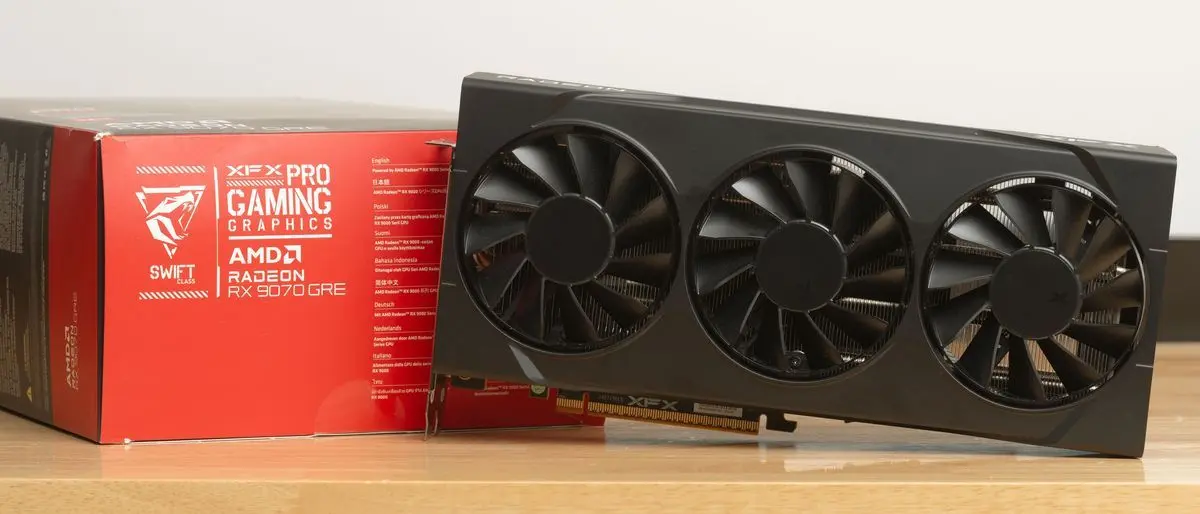
AMD is bringing its formerly China-exclusive Radeon RX 9070 GRE to global markets at $549, positioning it as a mainstream option for 1440p gaming. The card features RDNA 4 architecture with 48 compute units and 12GB GDDR6 memory, arriving as the GPU market faces supply constraints and inflated pricing from the AI gold rush.
AMD has decided to bring its Radeon RX 9070 GRE (Great Radeon Edition, originally Golden Rabbit Edition) to global markets after approximately a year of availability exclusively in China. Launching at $549 USD, the card enters a GPU market experiencing significant turbulence due to supply constraints and pricing pressures from the AI gold rush, which has driven up costs across memory, storage, and logic wafers
1
. The timing of this release coincides with widespread price inflation affecting mainstream GPU market options, where the $349 RX 9060 XT 16GB now sells closer to $450, and the $429 RTX 5060 Ti 16GB approaches $5701
.
Source: Tom's Hardware
The AMD Radeon RX 9070 GRE utilizes RDNA 4 architecture, AMD's first to include dedicated matrix math accelerators for AI tasks like upscaling and frame generation. This represents a return to monolithic design after the chiplet approach of RDNA 3, with AMD claiming the architecture delivers up to 2x improvement in ray-tracing performance over RDNA 3 compute units
1
2
. The graphics card features the same Navi 48 GPU found in the RX 9070 and RX 9070 XT, but in its most cut-down configuration with just 48 RDNA 4 compute units out of a possible 64, directly impacting texture sampling throughput, pixel fill rate, and raw FLOPS compared to higher-end models1
.AMD equipped the RX 9070 GRE with 12GB of GDDR6 memory running at 18 Gbps on a 192-bit bus, delivering 432 GB/s of raw memory bandwidthβ33% less than the RX 9070 and 9070 XT which use 20 Gbps GDDR6
1
. This slower memory configuration and reduced capacity position the card squarely for 1440p gaming, where over 80% of PC gamers currently operate according to Steam data2
. The SAPPHIRE Radeon RX 9070 GRE PULSE OC variant demonstrates approximately 19% faster gaming performance than the GeForce RTX 5060 Ti 16GB on average, while falling about 6% short of the GeForce RTX 50702
.Related Stories
More than a year after RDNA 4's initial launch, AI-powered FSR 4 has reached a level of game adoption that positions it as a compelling reason to consider the Radeon RX 9070 GRE. At 1440p resolution, FSR 4 delivers image quality and additional performance competitive with NVIDIA's DLSS Super Resolution
2
. Combined with RDNA 4's improved ray-tracing performance, the card can deliver what reviewers describe as stunning 1440p ray-tracing in demanding titles like Cyberpunk 2077 when FSR 4 is enabled2
. However, the importance of software ecosystems in 2026 cannot be understated, as modern gaming requires ongoing investment in upscaling and frame generation technologies1
.The $549 launch price effectively replaces the baseline RX 9070 at that price point, with the standard RX 9070 officially increasing to $619 USD
2
. This pricing strategy reflects current market volatility, where the RX 9070 GRE's price matches the retail price of the GeForce RTX 5060 Ti 16GB despite the latter's lower MSRP positioning2
. Some observers suggest AMD could have been bolder with pricingβa $479 or $499 price point might have disrupted the RX 9060 XT 16GB market more aggressively, but such moves would likely displease board partners facing constrained supply conditions1
. The 12GB VRAM configuration also makes the card less appealing for local AI applications compared to higher-capacity alternatives, though its gaming performance remains competitive for mainstream users1
.Summarized by
Navi
[1]
1
Technology

2
Policy and Regulation

3
Technology