AMD Helion Rack-Scale Design Delivers 32,768 Zen 6 Cores for Agentic AI Workloads


14 Sources
[1]
AMD debuts Helion reference design for agentic AI servers with up to 32,768 Zen 6 'Venice' cores -- rack design ships next year in CPU-only and all-in-one configurations
AMD is bringing a new reference rack-scale design to the data center ecosystem with Helion. It's a standardized, 21-inch rack reference design that will complement the Helios rack AMD revealed at OCP Global Summit last year. This year, we have Helion, which AMD says can house up to 32,768 Zen 6
[2]
AMD unveils Helion racks for AI agents at OCP summit
AMD is expanding its rack-scale AI lineup with a design to run AI agents, offering CPU-only configurations or integrated CPU/GPU deployments, and liquid-cooled or air-cooled versions. Revealed at the Open Compute Project (OCP) Summit 2026 in San Jose, California, the chipmaker's new rack reference
[3]
Meta Muse gives AMD a boost as AI momentum shifts to personal agents
* The personal agent boom is lifting the fortunes of AMD and Intel, which have outperformed their megacap tech peers this year and over the past month. * As leading developers of central processing units, the longtime rivals are finding a major role in the AI market, which had been dominated by
[4]
AMD puts 32,768 CPU cores in a rack built for AI agents
Helion is aimed partly at sovereign AI operators, arriving as European grids ration new connections AMD has published Helion, an open rack blueprint for running AI agents rather than training models, with a CPU-only version holding up to 32,768 cores. Partner systems are due in November, and the
[5]

AMD Helion agentic AI rack design targets hyperscale and enterprise
The Helion platform, based on an Open Compute Project spec, pairs EPYC processors with optional Instinct GPUs and is expected to be available in November AMD $AMD introduced the AMD Helion agentic AI rack on Monday, an open blueprint for agentic AI infrastructure built on an Open Compute Project
[6]

AMD Stock Hit a Fresh High. Meta's Muse Is a Win for the Chipmaker, Says Citi
Get personalized, AI-powered answers built on 27+ years of trusted expertise. Advanced Micro Devices shares are rallying to fresh records amid growing optimism about demand driven by AI agents. Citi analysts on Tuesday hiked their price target for Advanced Micro Devices (AMD) to a Street-high
[7]

AMD Helion Rack Crams 32,768 EPYC Zen 6 Cores Into One CPU-Only Agentic AI Blueprint
AMD has introduced its latest Agentic AI rack-scale solution called Helion, which comes in a CPU-only configuration with up to 32K "Zen 6" cores. AMD's Helion Rack Scale Solution Gives Customers The Choice Between All-CPU and a CPU+GPU Configuration At OCP 2026, AMD is announcing a brand new rack
[8]

AMD Makes Big Agentic AI Push With Helion - Advanced Micro Devices (NASDAQ:AMD)
Advanced Micro Devices Inc. (NASDAQ:AMD) on Monday introduced AMD Helion, an open, rack-scale computing platform designed to support agentic artificial intelligence workloads across hyperscale data centers and enterprises. AMD Expands Agentic AI Infrastructure Built on the company's Helios
[9]
AMD Balances Near-Term Yield Pressures with Long-Term AI Growth - Advanced Micro Devices (NASDAQ:AMD)
Advanced Micro Devices Inc. (NASDAQ:AMD) is facing near-term pressure from higher Treasury yields and energy costs, but its long-term AI growth story remains intact as demand for chips, server CPUs and data center infrastructure expands. AMD stock closed nearly 3% higher Tuesday after Marvell
[10]

Meta Muse gives AMD and Intel investors a reason to cheer
For most of the AI boom, one kind of chip got all the attention. Graphics processors trained the big models, Nvidia sold them, and the older hardware makers took a back seat for years. That script began to wobble by early June. Agentic AI started pulling those older names higher, while GPU-focused
[11]

AMD Helion AI Rack Targets Autonomous AI Workloads With Up to 32,768 CPU Cores
AMD has introduced Helion, a new rack-scale computing design aimed at meeting the growing infrastructure demands of agentic AI. Announced on Monday (October 12, 2026), the platform gives data center operators and enterprises greater flexibility to run AI agents that can reason, use tools, and
[12]

AMD unveils Helion agentic AI rack with flexible configurations By Investing.com
SANTA CLARA, Calif. - AMD (NASDAQ:AMD) introduced the AMD Helion agentic AI rack on Monday, an open blueprint for agentic AI infrastructure based on an Open Compute Project specification and powered by AMD compute. The rack design allows customers to configure CPU core density, performance and
[13]
Citigroup raises AMD price target on agentic AI demand outlook By Investing.com
Investing.com -- Citigroup raised its price target for Advanced Micro Devices (NASDAQ:AMD) to $800 from $575 on Tuesday, representing a potential 26.6% gain from the stock's last close. The brokerage increased its 2030 CPU total addressable market forecast to $300 billion from $237 billion. The
[14]

Advanced Micro Devices, Inc. Introduces AMD Helion Agentic AI Rack
Advanced Micro Devices, Inc. introduced the AMD Helion agentic AI rack, an open blueprint for agentic AI infrastructure based on an Open Compute Project spec-design and powered by AMD compute. Building on the open-platform approach of the AMD Helios? rackscale solution, AMD Helion is designed to
Share
Copy Link
AMD introduced Helion, an open rack blueprint for agentic AI infrastructure at the OCP Summit 2026. The design supports up to 32,768 Zen 6 cores in CPU-only configurations or hybrid deployments with Instinct MI350P GPUs, targeting both hyperscale and enterprise customers running personal AI agents.
AMD Helion Targets Growing Demand for Agentic AI Infrastructure
AMD unveiled its Helion rack-scale design at the Open Compute Project Summit 2026 in San Jose, introducing a flexible blueprint specifically engineered for agentic AI workloads
1
2
. The timing aligns with surging interest in personal AI agents following Meta Muse's rapid climb to the top of the Apple App Store in under two weeks and OpenAI's recent launch of Dots3
. Unlike AMD's existing Helios rack designed for frontier-scale AI training and large-scale inference, Helion addresses the distinct computational requirements of AI agents that execute tasks autonomously over extended periods1
2
.Dual Configurations Address Hyperscale and Enterprise Needs
Source: Tom's Hardware
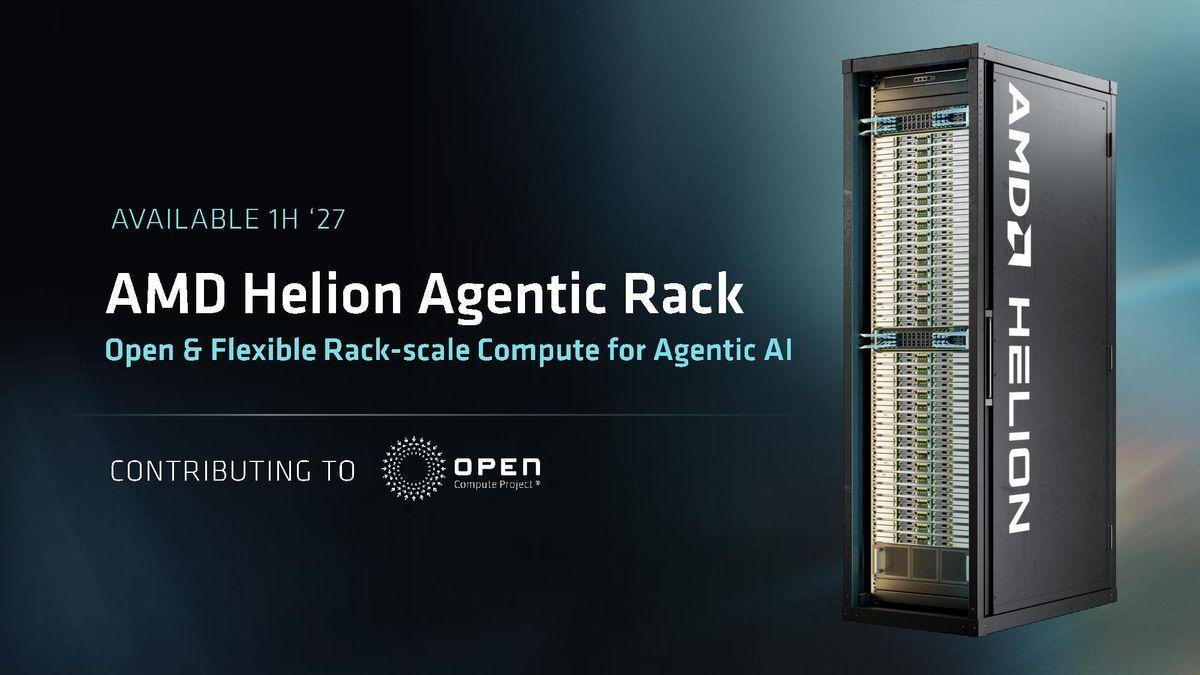
The AMD Helion platform offers two primary deployment models tailored to different operational scales. The CPU-only configuration targets hyperscale operators and can house up to 128 EPYC 9996 processors, delivering a combined 32,768 Zen 6 cores per rack using the dense 256-core Venice chips
1
4
. This configuration provides dedicated capacity for agent execution while connecting to separate model inference infrastructure, mirroring the architecture currently deployed in Meta Muse and OpenAI Dots1
. The enterprise configuration combines EPYC CPUs with up to 16 Instinct MI350P GPUs and 102 Tbps of networking bandwidth, creating an all-in-one rack for data management, networking, and AI usage1
5
. Both configurations support air-cooled and direct liquid-cooled deployments1
2
.Open Compute Project Compliance Drives Industry Adoption

Source: The Register
AMD built Helion as a standardized 21-inch rack reference design based on the Open Compute Project's ORv4 specification, which is slightly wider and taller than standard IT racks
1
. The design supports 44 OpenU trays and complies with OCP's DC-MHS standard, which aims to bring interoperability between key elements of data center, edge, and enterprise infrastructure1
. AMD plans to contribute the Helion specifications to the Open Compute Project, making them available to the broader community for further development and adoption2
5
. Rather than selling racks directly, AMD is providing this open rack blueprint for OEMs and ODMs to bring to market1
. Eight companies have announced support for the platform, including Cisco, Dell, HPE, Foxconn, Lenovo, Supermicro, QCT, and Wiwynn2
5
.Related Stories

CPUs Reclaim Central Role as AI Agents Shift Workload Patterns
The emergence of personal AI agents is fundamentally changing the balance between CPUs and GPUs in data centers. Ryan Shrout, president of Signal65, explained that as more agents are created and people use them for more tasks, workloads will shift away from GPUs and onto CPUs
3
. This shift has already benefited AMD and Intel significantly, with AMD's stock jumping 32% in the past month and the company entering the trillion-dollar market cap club3
. While GPUs remain essential for inference and processing AI models, CPUs perform the actual workflows as agents execute tasks autonomously3
. Meta Muse tells users it runs on an AMD-powered computer, while OpenAI Dots reports running on a virtual computer powered by AMD EPYC CPUs3
. AMD's data center revenue more than doubled to $6.7 billion in the quarter ended June, accounting for almost 60% of total sales3
.Power Efficiency and Sovereign AI Considerations Drive Design Philosophy
Source: The Next Web
The core design philosophy behind AMD Helion centers on maximizing the number of AI agents that can run per watt of power consumed
4
. Dan McNamara, AMD's senior vice president and general manager of compute and enterprise AI, emphasized that agentic AI is not a single workload but spans personal agents, enterprise applications, code execution, and complex workflows, each with different compute requirements2
5
. The platform is aimed partly at sovereign AI operators, arriving as European grids ration new connections4
. Denmark's grid operator paused new connections in March, with about 60GW of projects queued against peak demand near 7GW4
. The enterprise rack includes a token router that sends agents' model calls either to frontier models in the cloud or to open-source models running in the rack, enabling efficient use of available power4
. Partner-built Helion configurations are scheduled for November 2026, with AMD expecting the design to ride the wave of Zen 6 deployments ramping up later this year1
2
.References
Summarized by

Navi
[2]
[4]
Related Stories
AMD Helios AI rack system takes direct aim at Nvidia with Microsoft, OpenAI backing
20 Jul 2026•Technology

HPE adopts AMD's Helios rack architecture with custom Ethernet switch for 2026 AI systems
02 Dec 2025•Technology

AMD Unveils Helios: Next-Gen Rack-Scale AI Platform Challenges NVIDIA's Dominance
14 Oct 2025•Technology

Recent Highlights



Recent Highlights
Today's Top Stories



Don’t drown in AI news. We cut through the noise - filtering, ranking and summarizing the most important AI news, breakthroughs and research daily. Follow topics that matter to you and stay ahead.


