11 Sources
[1]
Microsoft will deploy AMD's Helios rack-scale AI accelerator 'at scale' on Azure - Radeon Instinct MI455X and Epyc Venice power will be available through Redmond's cloud infrastructure
But it's not clear just how much AMD AI compute Microsoft is buying The demand for AI compute is already insatiable, and it seems only poised to grow in the wake of the introduction of frontier-class open models like Kimi K3 that anybody can potentially fine-tune and serve. Against this backdrop, Microsoft and AMD are teaming up to get Redmond more AI FLOPS for both internal and external use. The two companies announced this morning that Microsoft will commit to adding AMD's Helios rack-scale AI accelerator in volume to run frontier-model workloads in its own data centers, as well as for Azure AI infrastructure customers and services. The partnership makes next-gen AMD AI compute available to Azure customers like AI labs for AI training and inference serving workloads, and it'll also underpin managed compute for enterprise customers looking to deploy AI workloads through Microsoft Foundry. The two companies didn't indicate the exact size of Microsoft's Helios deployment in either watts or dollars, but the commitment would seem to be another major win for AMD as it seeks to grab data center GPU share from Nvidia. AMD has struck massive partnerships with OpenAI and Meta in the past year with gigawatts of compute installations and hundreds of billions of dollars potentially hanging in the balance. For a quick refresher, the Helios rack-scale accelerator will take the fight to Nvidia's Vera Rubin NVL72 system when it arrives later this year. Helios joins together 72 next-generation Instinct MI455X GPUs with an aggregate of 31.1TB of HBM4 memory capacity across the system. Those GPUs offer as much as 1.4 exaFLOPS of FP8 compute and 2.9 exaFLOPS of FP4 for AI models using those OCP AI data types. AMD is targeting 260 TB/s of scale-up bandwidth within the rack, on par with Nvidia's Vera Rubin NVL72 rack-scale system, and 43 TB/s of scale-out bandwidth using UALink over Ethernet, or about twice that of Vera Rubin, although the performance of UALink over Ethernet in practice remains to be seen. Microsoft and AMD also announced that Azure will add two new VM series built on AMD's upcoming sixth-gen Epyc Venice CPUs: the HDv2 series for "agentic AI and data pipelines," and the HXv2 for semiconductor design workflows. Microsoft will also leverage its existing deployment of AMD Pensando DPUs to integrate that hardware into its Azure Boost offerings to accelerate networking and storage processing operations. Tom's Hardware will be on the ground at AMD's Advancing AI event this week, where we expect to learn more about AMD's AI ambitions for the second half of this year and beyond. Stay tuned for our coverage from that event. Follow Tom's Hardware on Google News, or add us as a preferred source, to get our latest news, analysis, & reviews in your feeds.
[2]
AMD launches Helios, its first rack AI system to rival Nvidia, adding Microsoft as newest buyer
AMD rivals Nvidia with first AI system, signing Microsoft and Meta After a decade-long comeback, chip giant Advanced Micro Devices is preparing to ship its first rack-scale system for artificial intelligence, called Helios, to a growing list of customers that now includes Microsoft. It's the first rival to Nvidia's wildly popular Grace Blackwell and Vera Rubin systems, and is aiming to give the world's most valuable chipmaker its first real competition in years. Microsoft announced Monday it will use the Helios system in its data centers, joining Meta, OpenAI, Oracle and others in a race to grab as much compute as possible. AMD will begin shipping to customers, including Microsoft, later this year. Details about financial terms or the amount of compute capacity weren't disclosed. "We are expanding the Azure infrastructure portfolio with AMD Helios to give customers the performance, scale and choice they need to build and run the next generation of AI applications," Microsoft CEO Satya Nadella wrote in a press release. The new Helios system will power frontier model inference for Microsoft, its AI customers and support Azure AI services. Microsoft will also add two new computing instances run on AMD's latest "Venice" central processing units, or CPUs, one for agentic AI and data pipelines, and another for semiconductor design. It's the continuation of a longtime partnership, with AMD chips powering Microsoft's Surface PCs and Xbox gaming consoles for many years. In 2023, Microsoft was also the first to adopt AMD's MI300X graphics processing unit, or GPU, that rivaled Nvidia's AI chips. Microsoft also deploys its own Maia chips in its data centers. Like its peers, Microsoft needs as much compute as possible, especially as it ramps up its own model development and allocates more computing capacity to research and development. In June, it announced seven models built in-house. Microsoft's AI efforts thus far have seen mixed results, from its 365 Copilot AI assistant to its GitHub Copilot coding agent. It's the worst-performing "Magnificent Seven" stock so far this year. Microsoft is part of a growing number of big companies turning to AMD for AI acceleration. AMD says eight of the top 10 AI companies run workloads on its Instinct GPUs, including OpenAI, Cohere and Elon Musk's SpaceXAI, which is part of SpaceX.
[3]
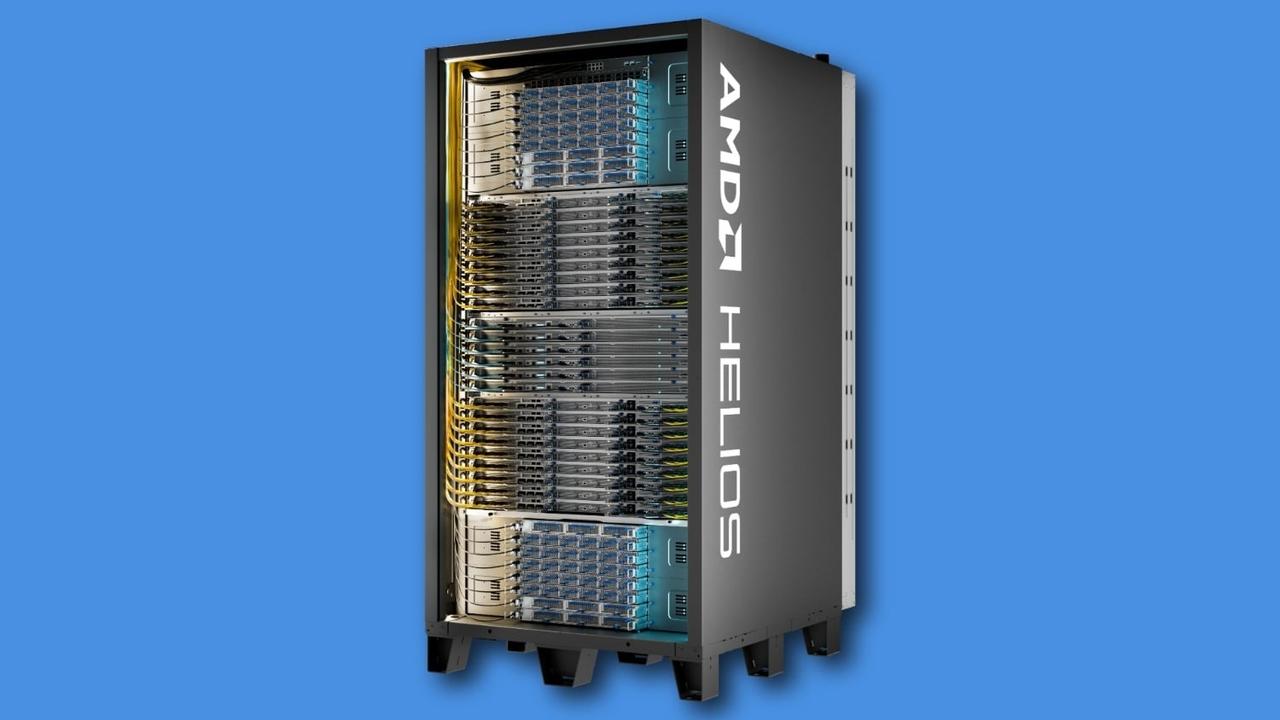
AMD's Helios puts 72 GPUs and 31 terabytes of HBM4 in one rack. It is AMD's answer to Nvidia's NVL72.
AMD Helios packs 72 MI455X GPUs, 31TB HBM4, and 2.9 exaflops of inference into one rack. Built on open standards. Engineering samples H2 2026, mass production Q2 2027. AMD's Helios is a single rack containing 72 Instinct MI455X GPUs, 31 terabytes of HBM4 memory, and 2.9 exaflops of FP4 inference compute. It is AMD's first rack-scale AI system and its direct answer to Nvidia's Vera Rubin NVL72. The system uses 18 compute trays, each holding four MI455X accelerators on the new CDNA 5 architecture and one sixth-generation EPYC "Venice" CPU. Engineering samples ship in the second half of 2026. Mass production begins Q2 2027. The architecture bet is open standards. Helios uses UALink for scale-up interconnect between GPUs within the rack, Ultra Ethernet Consortium specifications for scale-out networking between racks, and the OCP Open Rack Wide form factor. Nvidia's competing NVL72 uses proprietary NVLink. AMD is betting that data centre operators who do not want to be locked into a single vendor's interconnect will pay for the flexibility. AMD Pensando AI NICs handle the networking with programmable hardware and UEC-ready RDMA. The numbers are designed to compete on memory, not just compute. Each MI455X GPU carries HBM4 with 19.6 TB/s of bandwidth. The full rack delivers 260 TB/s of scale-up bandwidth and 43 TB/s of scale-out bandwidth. That memory capacity matters for frontier model training and long-context inference, where the bottleneck has shifted from raw compute to how much data the system can hold and move. The AI-driven memory crisis has pushed HBM prices up sharply, and 31TB of HBM4 in a single rack represents an enormous materials cost that only hyperscaler and sovereign compute budgets can absorb. Supermicro showed Helios hardware at Computex in June. AMD committed billions to UK AI infrastructure at London Tech Week, and Helios is the hardware those commitments will run on. The ROCm software stack supports PyTorch, TensorFlow, and JAX, which means developers do not need to rewrite code to move from Nvidia's CUDA ecosystem, at least in theory. Whether AMD can close the software gap that has kept it behind Nvidia in AI compute is the question Helios is designed to force. The hardware specs are competitive. The ecosystem is the test.
[4]
Microsoft to deploy AMD Helios AI system on Azure
"We are expanding the Azure infrastructure portfolio with AMD Helios to give customers the performance, scale and choice they need to build and run the next generation of AI applications," Microsoft Chairman and CEO Satya Nadella said in a statement. Beyond Helios, the expanded partnership covers additional AMD products across Azure. Two new VM series -- Azure HDv2, aimed at agentic AI and data pipelines, and Azure HXv2, designed for semiconductor work -- will run on 6th Gen AMD EPYC "Venice" processors, the company said. AMD's Pensando data processing units will also see broader deployment in Azure networking infrastructure.
[5]
Microsoft will use AMD's AI-optimized Helios racks in Azure
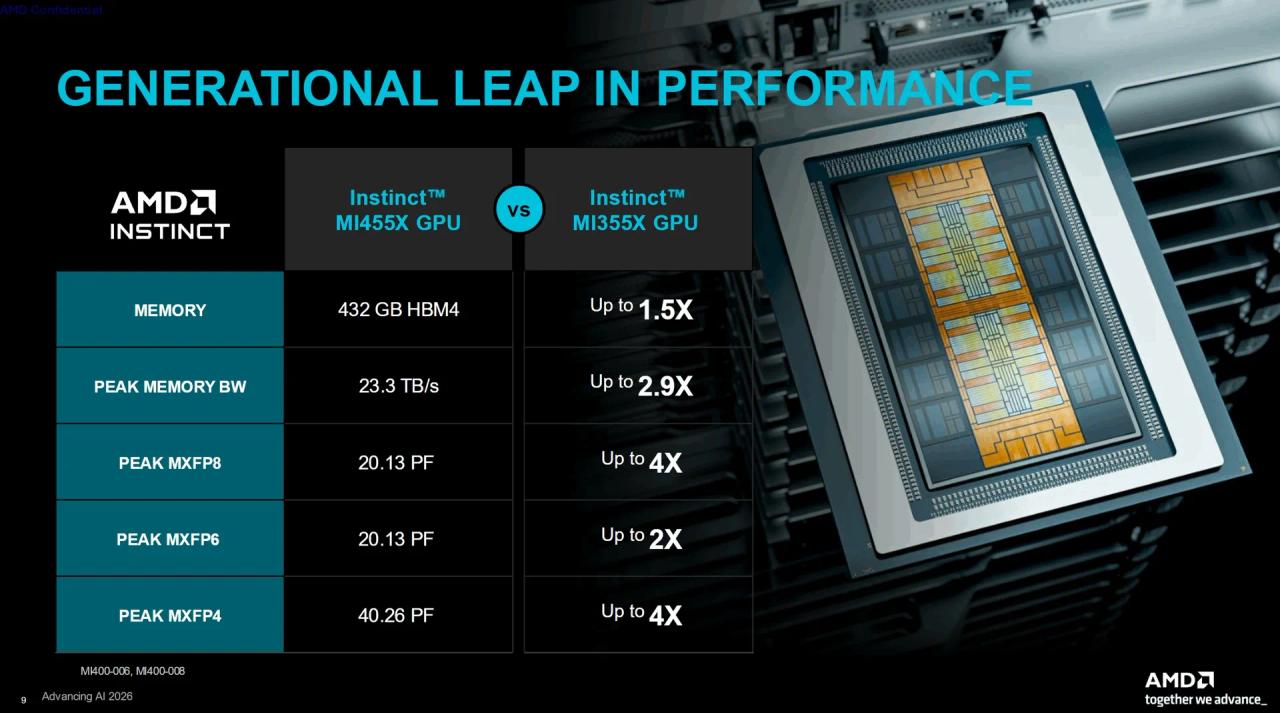
Microsoft Corp. will use Advanced Micro Devices Inc.'s upcoming Helios rack design to power some Azure services. The cloud and operating system giant announced the partnership today alongside three new instance families. Helios is a reference design, a blueprint that AMD's manufacturing partners can use to make data center racks. Each system contains 72 of the chipmaker's upcoming Instinct MI455 graphics processing units. AMD has to date shared only a few details about the GPU. It will feature 432 gigabytes of HBM4 memory, 19.6 terabits per second of bandwidth and a new core architecture called CDNA 5. Helios' GPUs are supported by Pensando data processing units and Epyc central processing units. Pensando chips are optimized for infrastructure management tasks such as coordinating storage equipment and encrypting network traffic. According to AMD, they can run such workloads more efficiently than CPUs. That lowers costs while making more CPU capacity available for customer applications. The CPUs in Helios are from AMD's upcoming Venice data center processor series. In May, the company started ramping up production of the chips using Taiwan Semiconductor Manufacturing Co.'s two-nanometer process. The Venice series also uses a second TSMC technology called SoIC that makes it possible to stack chiplets atop one another. Helios organizes its CPUs, GPUs and DPUs in modules called trays. The trays are wider than a standard rack server to accommodate more hardware. They use liquid cooling to dissipate heat from their chips and exchange data using an open-source network protocol called UALoE. "AMD and Microsoft have spent years building high-performance infrastructure together, and today we're extending that partnership across the full stack of AMD AI solutions on Azure," said AMD Chief Executive Officer Lisa Su. AMD will start shipping Helios racks to Microsoft and other customers later this year. The tech giant will use the systems to power a new family of Azure instances called the ND MI455X v7 series. According to Microsoft, the virtual machines are optimized for inference workloads such as artificial intelligence agents and search tools. The company debuted the ND MI455X v7 series alongside two other instance families that will also run on AMD silicon. The HDv2 series is optimized for tasks that AI applications carry out using CPUs rather than CPUs. That includes the process of preparing datasets for analysis by AI agents. Each instance includes up to 500 Epyc Vulcan cores, four terabytes of memory and 32 terabytes of flash storage. The third addition to Azure's virtual machine portfolio is an instance series called HXv2. It's an improved version of an existing Azure instance series optimized for EDA, or electronic design automation, applications. Those are programs that engineers use to design chip. Microsoft says that HXv2 supports a broader range of workloads including scientific simulations. Each HXv2 virtual machine features 176 Epyc Vulcan cores with a clock speed exceeding 5GHz. According to Microsoft, each core will feature 50% more cache than previous-generation hardware. Customers can configure their virtual machines with up to four gigabytes of memory. "The significantly increased per VM and per core performance, and the inclusion of 800 Gb InfiniBand, enable large-scale MPI-based simulations and make HXv2 an ideal fit for a wide variety of HPC customers," Scott Guthrie, Microsoft's executive vice president of cloud and AI, wrote in a blog post. The company's new collaboration with AMD also extends to a technology called Azure Boost. It offloads the computations involved in running virtualization software from CPUs to more efficient, specialized chips. Microsoft will work with AMD to optimize Azure Boost for the latter company's products.
[6]
Microsoft to Deploy Next-Gen AMD Instinct and AMD EPYC Processors
AMD today announced an expanded strategic partnership spanning AMD GPUs, CPUs, networking and software on Microsoft Azure. At the center of this expansion, Microsoft will deploy the AMD Helios Rackscale Solution, to power frontier model AI inference for Microsoft, its AI customers and support Azure AI services. Azure will also add two new AMD EPYC CPU-powered VM series and broaden its deployment of Pensando DPUs to support Azure networking services. AMD will begin shipping Helios to customers, including Microsoft, in the second half of 2026. AMD Helios combines AMD Instinct MI455X GPUs, AMD EPYC "Venice" CPUs, Pensando networking and ROCm software in an open, integrated rackscale platform built for large-scale AI training and inference. The Azure deployment will use Helios for inference workloads spanning frontier models, Azure AI services and customer applications. "AMD and Microsoft have spent years building high-performance infrastructure together, and today we're extending that partnership across the full stack of AMD AI solutions on Azure," said Dr. Lisa Su, Chair and CEO, AMD. "Microsoft's new AMD deployments mark an important milestone as we deliver leadership compute solutions to Azure customers and scale the next generation of AI infrastructure together." "Customers are looking for AI infrastructure that is optimized for a wide range of workloads, from training and inference to data preparation, search, and reinforcement learning," said Satya Nadella, Chairman and CEO, Microsoft. "Through our collaboration with AMD, we are expanding the Azure infrastructure portfolio with AMD Helios to give customers the performance, scale and choice they need to build and run the next generation of AI applications." The collaboration expands access to AMD AI infrastructure across Azure. Frontier model builders can now leverage AMD-powered infrastructure to train and serve large-scale AI models, while enterprise customers can deploy and scale production AI workloads through Azure Foundry Managed Compute. Azure's new VM series, Azure HDv2 for agentic AI and data pipelines, and Azure HXv2 for semiconductor design, will be powered by 6th Gen AMD EPYC "Venice" processors. Together, the new VM series broaden Azure's AMD EPYC portfolio across AI, data and engineering workloads. The collaboration also extends into the networking layer that connects and scales Azure infrastructure. Building on Microsoft's broad deployment of AMD Pensando DPUs, the companies are integrating Azure Boost with AMD technologies to improve networking performance, efficiency and connection processing at cloud scale. As AI demand accelerates, AMD and Microsoft will continue to deliver open, high-performance infrastructure that gives customers flexibility, efficiency and scale to build what's next.
[7]
AMD Unveils Helios, Its Next-Gen AI Powerhouse With MI455X & 6th Gen EPYC, Challenging NVIDIA's Rack-Scale Dominance
AMD has unveiled its next-generation Helios AI Rack, which aims to become the leading solution for frontier AI and sovereign computing, powered by its MI455X GPUs and 6th Gen EPYC CPUs. AMD's Helios AI Racks Are A Sight To Behold: Combining Next-Generation Instinct GPUs, EPYC CPUs, & Pensando Networking Chips For Large-Scale Inferencing It was last year at Advancing AI 2025 when AMD gave us the first glimpse at its Helios AI rack, a solution designed to meet the growing demands of AI workloads in the Agentic era. After giving us the official unveiling, we got to see the first Helios platforms in the flesh at OCP 2025. And this year, we got to see Helios Rack on full display at the Computex show floor. The plan is simple: to roll out the platform that is the best at AI and disrupts the current market hierarchy dominated by NVIDIA's existing Oberon and upcoming Kyber racks. This will be AMD's first full-stack rack-level solution for AI and brings AMD's open standards to the industry. But the Helios AI rack isn't just a standard rack with some hardware components; full stack means full stack, and AMD has deployed its latest and greatest to ensure that firms using Helios get the full taste of its capabilities. Although AMD's Helios AI Rack will officially launch at the Advancing AI 2026 event, the company has officially disclosed the full platform details, so we decided to give you all a detailed rundown. There are three key components of the Helios AI rack: * AMD Instinct MI455X GPUs * 6th Gen AMD EPYC CPUs * AMD Pensando AI NICs CNBC got a real nice close-up of these chips, which you can see below: There are several other technologies that power Helios, which include: * AMD Pensando DPU * AMD Infinity Fabric * AMD ROCm Software Stack So let us start by looking at the key components that power the AMD Helios AI platform. AMD Instinct MI455X - The Inference GPU Powerhouse For Helios The AMD Instinct MI400 series are the GPUs that will power the Helios AI rack. These GPUs are based on the latest CDNA 5 architecture, which brings: * Increased HBM4 Capacity & Bandwidth * Expanded AI Formats with Higher Throughput * Standard-Based Rack-Scale Networking (UALoE, UAL, UEC) For the Instinct MI400 series, AMD will have three products; the first two are the Instinct MI455X & the MI450X, which are aimed at scale AI Training & Inference workloads. The MI455X is powering the Helios rack. The third chip is the MI430X, which is aimed at HPC & Sovereign AI workloads, featuring the "highest performance" FP64 capabilities, hybrid compute (CPU+GPU), and the same HBM4 memory as the MI455X. The AMD Instinct MI455X is a 40 PFLOPs of FP4 & 20 PFLOPs FP8 compute, which is double the compute capability of the MI350 series, making it a disruptive offering for AI. For comparison, an NVIDIA Rubin GPU offers 50 PFLOPs of FP4 and 17.5 PFLOPs of FP8 compute. In addition to the compute capability, AMD is also going to leverage HBM4 memory for its Instinct MI400 series. The new chip will offer a 50% memory capacity uplift from 288GB HBM3e to 432GB HBM4. The HBM4 standard will offer a massive 19.6 TB/s bandwidth, more than double that of the 8 TB/s for the MI350 series. For comparison, the Rubin GPU comes with 288 GB of HBM4 at 22 TB/s. AMD Instinct AI Accelerators: AMD 6th Gen EPYC Venice - The Host CPU For Helios & The First Zen 6 On Market The other key component, and the one that is really shaping up as the king of the Agentic AI era, is the CPU. For Helios, AMD is leveraging its brand new Zen 6 core architecture that will be used on its 6th Gen EPYC CPUs, codenamed Venice. AMD's EPYC Venice chips are the first HPC product to enter volume production on TSMC's 2nm process technology, and their readiness for Helios AI racks proves that AMD will always deliver the best of the best for its high-performance customers. The TSMC 2nm process technology transitions from FinFET to Nanosheet transistors (GAA), and offers 10-15% higher performance at the same power, 25-30% lower power consumption at the same performance, and up to 15% higher transistor density. AMD's 6th Gen EPYC Venice CPUs were teased earlier this year at CES, offering up to 256 cores and 512 threads with eight massive compute dies and two even larger I/O dies. For this chip, AMD has promised over 70% performance & efficiency improvement with its EPYC Venice CPUs, with a >30% increase in thread density. Once again, the requirement for high-performance CPUs has risen tenfold with Agentic AI workloads. And competitors are firing across all cylinders with CPUs that are optimized around agents. Just like GPUs, NVIDIA is AMD's primary competitor in this space, which is leveraging Vera CPUs based on its custom Arm IP to power the Vera Rubin NVL72 racks. AMD's Helios AI racks powered by Zen 6 EPYC chips not only offer more cores, but faster performance and improved single-core capabilities, which is important for sustained throughput. In early benchmarks, AMD has shown that not only do its 5th Gen Turin "Zen 5" CPUs lead against Vera, but the 6th Gen Venice "Zen 6" chips lead massively, driving more performance & offering better TCOs at a similar power scale. AMD EPYC CPU Families: AMD Pensando "Vulcano" AI NICs & Pensando "Salina" DPU - Enabling Heightened Scale-Up & Scale-Out Networking/Fabric Solutions Networking and Fabric play a core role in shaping data center and enterprise solutions. AMD's Pensando stack delivers these technologies, and Helios is fitted with the latest Vulcano 800 AI NIC & Salina DPU, which rival NVIDIA's ConnectX-8 and Bluefield 3/4 DPUs. Starting with the AMD Pensando "Vulcano" 800 AI NIC, this is an 800 Gbps high-performance switch with 800 Gbps Ethernet network throughput. It is currently the only NIC to offer up to 2.4 Tbps of scale-out bandwidth per GPU, backed by full hardware and software programmability. Each GPU gets access to up to 8x the scale-out bandwidth, and with a UAL / PCIe Gen6 host interface, Helios drives super-low-latency communication between the GPUs. Vulcano is also UEC-ready with an RDMA Ethernet that is optimized for large-scale AI clusters. The scale-up fabric is built on an open networking approach, leveraging UALink over Ethernet (UALoE) to deliver high-bandwidth, low-latency GPU connectivity at rack scale. The fabric provides seamless interconnect for up to 72 GPUs, which is the full GPU count that each Helios AI rack supports. The AMD Pensando DPU bridges the AI servers to enterprise networks, accelerating network, security, and storage offloads to boost AI server efficiency. The Salina DPU features 16 Arm N1 cores that are used for offloading networking, security, and storage for front-end server-to-client connectivity. Each Salina DPU offers a 40% speed-up versus CPU-only processing and is twice as capable as AMD's prior generation DPUs while offering 40% performance uplifts versus NVIDIA's BlueField-3 DPUs. Helios - The Ultimate AI Rack From The High-Performance Leaders With all three core components outlined, we now want to shed some light on how Helios AI racks bring them together. The AMD Helios AI Rack makes use of Meta's Open Rack Wide standard submitted to the OCP (Open Compute Project). The Helios rack is a fully liquid-cooled design with 18 compute trays with six switches, and each tray features four Instinct MI455X GPUs and a single EPYC Venice "Zen 6" CPU. The system leverages AMD's Pensando "Salina" 400 DPU & the Pensando "Vulcano" 800 AI NIC for networking and interconnection. Each AMD EPYC Venice "Zen 6" CPU comes with up to 256 cores based on the Zen 6C architecture, and each Instinct MI455X GPU packs several thousand compute units. There are a total of 72 GPUs onboard the Helios AI Rack. Each GPU is placed under a liquid cold plate made out of copper. All put together, the Helios AI rack weighs roughly 5000 pounds and costs around $5-$5.5 million, as per CNBC. Each rack will consume around 225-245kW of power. The Helios rack scales up to 2.9 Exaflops of FP4 compute, 1.4 Exaflops of FP8 compute, 31 TB of HBM4 memory, 1.4 PB/s of aggregate bandwidth, 43 TB/s of scale-out bandwidth, 260 TB/s of scale-up interconnect bandwidth, and up to 4600 CPU + 18,000 GPU cores. All of these enable Helios to deliver a generational leap for trillion-parameter model training and large-scale AI inference. Comparison Table Software Stack & An Impressive Line of First Customers ROCm is AMD's industry standard for AI and HPC. Being the direct competitor to NVIDIA's CUDA, AMD has come a long way with its ROCm stack, now in v7.14. ROCm brings open hardware and software standards that reduce integration complexity and accelerate AI deployment across all AMD platforms. For Helios, AMD is bringing native support for leading frameworks such as PyTorch, TensorFlow, JAX, Hugging Face, vLLM, SGL, Deepspeed, ONNX, llm-d, OpenXLA, MLID, Llama Stack, and many more with Day-0 support. And now, coming to why this all matters. The explosive demand for Agentic AI has led to increased demand for more compute, and Helios brings with it some massive capabilities. Today, AMD and Microsoft announced that Helios Rackscale solutions will be deployed for its customers and also to support Azure AI services. The following are some of the Azure instances that will be offered by Microsoft: * Azure HDv2 (CPU-Focused) - Nearly 500 6th Gen EPYC CPU Cores, 4 TB RAM, 32 TB NVMe Storage, 400 Gb Azure Boost Networking * Azure HXv2 (Agentic AI Driver) - 176 6th Gen EPYC CPU Cores per VM (3D V-Cache, 5 GHz+ Clocks, 50% More Cache), 2-4 TB RAM, 800 Gb Infiniband * ND MI455X v7 (Helios Rack) - 72 MI455X GPUs, 6th Gen AMD EPYC CPUs Besides Microsoft, AMD has also announced various customers for its Helios AI Rackscale solutions, 6th Gen EPYC CPUs, and MI455X GPUs, which include OpenAI, META, Oracle, HPE, TCS, Celestica, Nutanix, US DOE. AMD's Helios AI Rack represents a bold and comprehensive leap forward in the Agentic AI era, delivering a fully integrated, open-standards rack-scale platform that combines cutting-edge Instinct MI455X GPUs, powerful 6th-Gen EPYC Venice CPUs, and advanced Pensando networking technologies into a liquid-cooled powerhouse. With superior HBM4 memory capacity, exceptional scale-up and scale-out bandwidth, and a mature ROCm software ecosystem offering broad framework support, Helios is positioned to challenge the established order by providing higher memory density, greater flexibility, and compelling performance-per-dollar advantages over competing solutions. Backed by an impressive roster of early adopters including Microsoft, OpenAI, Meta, and Oracle, this innovative system promises to accelerate trillion-parameter model training and large-scale inference while fostering a more open and interoperable AI infrastructure. As it prepares for official launch at Advancing AI 2026 in just a few days, Helios underscores AMD's commitment to high-performance leadership and stands as a compelling testament to the rapid evolution of AI hardware. Follow Wccftech on Google to get more of our news coverage in your feeds.
[8]
AMD Expands Microsoft Foothold With New Azure AI Deal
Dominic Daninger, vice president of engineering at Burnsville, Minn.-based systems integrator Nor-Tech, tells CRN that it's good to see AMD attacking the data center opportunity with its latest collaboration with Microsoft. AMD said Monday that it expanded its collaboration with Microsoft in a deal that would see the chipmaker deploy its latest Helios AI rack-scale architecture and next-generation EPYC data center processors to Azure. As part of the deal, Redmond, Wash.-based Microsoft will deploy Helios to power "frontier model AI inference for Microsoft, its AI customers and support Azure AI services," the companies said. AMD and Microsoft both said that Azure will also add two new AMD EPYC CPU-powered VM series and broaden its deployment of Pensando data processing units (DPUs) to support Azure networking services. Santa Clara, Calif.-based AMD will begin shipping Helios to customers, including Microsoft, in the second half of 2026. Dominic Daninger, vice president of engineering at Burnsville, Minn.-based systems integrator Nor-Tech, told CRN that with more deployments of chips, "sometimes parts might be a little harder to get" given the current global chip shortage. But it's good to see AMD attacking the data center opportunity, said Daninger, who praised AMD CEO Lisa Su's leadership. "Competition always breeds innovation." Helios rack-scale architecture integrates AMD Instinct GPUs with EPYC Venice CPUs to deliver high-performance AI infrastructure. In AMD's quarterly earnings call in May, Su said that the company is "seeing significant customer interest" around Helios and AMD's Instinct MI450 data center AI accelerator chip. Su cited AMD's partnerships with OpenAI and Meta, saying those collaborations are "going really well," according to a transcript of the call. "We appreciate the deep co-engineering that has gone on there," said Su at the time. "Based on our current visibility, how those forecasts are coming in with all of our customers, we're actually seeing it above our initial plans that we had planned for 2027. I think the encouraging thing is we're seeing a breadth of customers who are now very interested in deploying at significant scale, MI450 series." The Microsoft deal would significantly expand the availability of the Helios product to another technology powerhouse. "Our approach to AI infrastructure is designed to support the breadth of how AI systems are built and run," said Scott Guthrie, Microsoft's executive vice president of cloud and AI, in a blog post. "We closely work with industry innovators like AMD as well as our own purpose-built silicon and systems to provide customers with a comprehensive, open and heterogenous platform to achieve the best performance, cost and energy efficiency outcomes." An AMD spokesman declined to disclose additional details on the scale and the financial terms of the collaboration. A Microsoft spokesperson pointed CRN to Microsoft's blog post and AMD press release. Shares of AMD stock rose nearly 2 percent on Monday to $503.57. In the last quarter, AMD grew its data center revenue to a record $5.8 billion -- once again higher than what its larger rival, Intel, made for the segment. Even with the growth in sales, AMD is still behind leader Nvidia in sales, which reported record data center revenue of $75.2 billion in its last quarter, up 92 percent from a year ago.
[9]
Microsoft to Deploy AMD's Next-Generation AI Chips on Azure Under Expanded Partnership
Advanced Micro Devices is expanding its strategic partnership with Microsoft, under which the software company is set to deploy AMD's next-generation artificial-intelligence chips and processors across its Azure cloud platform. Microsoft will deploy AMD's Helios rack-scale AI platform to power frontier-model inference workloads for its own AI services and Azure customers, the companies said on Monday. AMD said it expects to begin shipping the Helios platform to customers, including Microsoft, in the second half of 2026. Helios combines AMD's Instinct MI455X graphics processors, sixth-generation EPYC Venice central processing units, Pensando networking technology and ROCm software in an integrated AI computing platform, the companies said. Microsoft said it will also introduce two new Azure virtual-machine series powered by AMD's sixth-generation EPYC processors. The Azure HDv2 series is designed for agentic AI and data pipeline workloads, while the Azure HXv2 series targets semiconductor-design applications. The companies also said they are expanding deployment of AMD Pensando data-processing units across Azure's networking infrastructure and integrating AMD silicon with Microsoft's Azure Boost technology to improve cloud-networking performance. "Microsoft's new AMD deployments mark an important milestone as we deliver leadership compute solutions to Azure customers and scale the next generation of AI infrastructure together," AMD Chief Executive Lisa Su said in a statement. Microsoft Chief Executive Satya Nadella said the expanded partnership will provide customers with additional infrastructure options for AI training, inference and other workloads. Financial terms of the partnership weren't disclosed. Shares of AMD were up 3.5% Monday morning at $513.29. Shares of Microsoft were down around 0.7% at $391.24.
[10]
AMD launches Helios and steps up its offensive against Nvidia with Microsoft's backing
Helios is AMD's most ambitious offering yet for data centers dedicated to artificial intelligence. Microsoft will deploy the infrastructure in Azure to run inference for its AI models and will also incorporate AMD's new "Venice" processors into its services. The platform, which brings together graphics processors, central processors, networking gear and internally developed software, already has Meta, OpenAI, Oracle, Tata Consultancy Services and several other major industry players as clients. AMD says Helios lowers the total cost of ownership while improving performance for artificial intelligence workloads. The company says that 8 out of the 10 leading AI-focused firms already use its Instinct accelerators, even as Nvidia retains more than 95% of the data-center graphics processor market thanks to the strength of its CUDA software ecosystem. Several analysts say Helios could nonetheless allow AMD to gain market share quickly if early deployments deliver on its promises. The new platform fits into AMD's turnaround under CEO Lisa Su, following years of investment and strategic acquisitions, including Xilinx, Pensando and ZT Systems. Data centers are now the company's primary growth engine, and as from 2027, AMD expects to generate tens of billions of dollars in annual AI revenue, largely driven by Helios. However, analysts warn that commercial success will depend both on the quality of the technology and AMD's ability to close the software gap with Nvidia.
[11]
AMD launches Helios and steps up its offensive against Nvidia with Microsoft backing
Helios is AMD's most ambitious offering yet for data centers dedicated to artificial intelligence. Microsoft will deploy this infrastructure in Azure to run the inference phases of its AI models and will also integrate AMD's new 'Venice' processors into its services. The platform, which brings together graphics processors, central processors, networking equipment and in-house developed software, already counts Meta, OpenAI, Oracle, Tata Consultancy Services and several other major industry players among its customers. AMD says Helios reduces total cost of ownership while improving performance for artificial intelligence workloads. The group says eight of the 10 leading AI-focused companies already use its Instinct accelerators, even as Nvidia retains more than 95% of the data center graphics processor market thanks to the strength of its CUDA software ecosystem. Several analysts say Helios could nonetheless allow AMD to win market share quickly if early deployments deliver on its promises. This new platform is part of the turnaround led by Lisa Su at AMD, following several years of investment and strategic acquisitions, including Xilinx, Pensando and ZT Systems. Data centers are now the group's main growth engine, and it expects to generate, starting in 2027, tens of billions of dollars in annual AI revenue, largely thanks to Helios. Analysts nonetheless believe commercial success will depend as much on the quality of the technology as on AMD's ability to compete with Nvidia's software lead.
Share
Copy Link
Microsoft announced it will integrate AMD Helios, a rack-scale AI accelerator featuring 72 Instinct MI455X GPUs and 31TB of HBM4 memory, into Azure infrastructure. The system ships later this year, joining Meta, OpenAI, and Oracle as major customers. AMD's first rack-scale system directly challenges Nvidia's Vera Rubin NVL72, offering 2.9 exaFLOPS of FP4 inference compute and built on open standards to avoid vendor lock-in.
Microsoft will deploy AMD's Helios rack-scale AI system across its Azure cloud infrastructure, marking a significant expansion of the partnership between the two tech giants. The announcement positions AMD Helios as a direct competitor to Nvidia's dominant position in AI compute, with Microsoft CEO Satya Nadella stating the move will "give customers the performance, scale and choice they need to build and run the next generation of AI applications"
1
4
. While Microsoft and AMD didn't disclose exact financial terms or the precise scale of the deployment, the commitment represents another major win for AMD as it seeks to capture data center GPU market share from Nvidia1
.The new Helios system will power frontier model inference for Microsoft Azure, support Azure AI services, and provide managed compute for enterprise customers deploying AI workloads through Microsoft Foundry
1
. Microsoft joins Meta, OpenAI, Oracle, and others in adopting AMD's rack-scale AI system, with AMD reporting that eight of the top 10 AI companies now run workloads on its Instinct GPUs2
.
Source: Wccftech
AMD Helios represents the company's first rack-scale AI accelerator, designed to compete directly with Nvidia's Vera Rubin NVL72 system when it ships later this year. The system integrates 72 next-generation Instinct MI455X GPUs with an aggregate of 31.1TB of HBM4 memory capacity across the entire rack
1
3
. These GPUs deliver up to 1.4 exaFLOPS of FP8 compute and 2.9 exaFLOPS of FP4 for AI models, providing substantial processing power for both training and inference workloads1
.The architecture uses 18 compute trays, each holding four MI455X accelerators built on the new CDNA 5 architecture and one sixth-generation Epyc Venice CPU
3
. Each MI455X GPU carries 432 gigabytes of HBM4 memory with 19.6 TB/s of bandwidth3
5
. AMD targets 260 TB/s of scale-up bandwidth within the rack, matching Nvidia's Vera Rubin NVL72, and 43 TB/s of scale-out bandwidth using UALink over Ethernet—approximately twice that of Vera Rubin, though real-world performance of UALink over Ethernet remains to be demonstrated1
.AMD's architecture bet centers on open standards rather than proprietary technologies. AMD's AI-optimized Helios racks use UALink for scale-up interconnect between GPUs within the rack, Ultra Ethernet Consortium specifications for scale-out networking between racks, and the OCP Open Rack Wide form factor
3
. This contrasts sharply with Nvidia's competing NVL72, which relies on proprietary NVLink technology. AMD is betting that data centers seeking to avoid vendor lock-in will value the flexibility of open standards3
.AMD Pensando DPUs handle networking with programmable hardware and UEC-ready RDMA capabilities
3
5
. These Pensando data processing units are optimized for infrastructure management tasks such as coordinating storage equipment and encrypting network traffic, running such workloads more efficiently than CPUs and lowering costs while freeing up CPU capacity for customer applications5
. Microsoft will leverage its existing deployment of AMD Pensando DPUs to integrate this hardware into Azure Boost offerings to accelerate networking and storage processing operations1
.The ROCm software stack supports PyTorch, TensorFlow, and JAX, meaning developers don't need to rewrite code to migrate from Nvidia's CUDA ecosystem, at least in theory
3
. Whether AMD can close the software gap that has kept it behind Nvidia in AI compute remains the critical question that AMD Helios is designed to answer3
.Related Stories

Source: Guru3D
Beyond deploying AMD Helios, Microsoft Azure will introduce three new virtual machine series powered by AMD silicon. The ND MI455X v7 series will run on Helios systems and is optimized for inference workloads such as artificial intelligence agents and search tools
5
. Microsoft also announced two new VM series built on AMD's upcoming sixth-generation Epyc Venice CPUs: the Azure HDv2 series aimed at agentic AI and data pipelines, and the Azure HXv2 series designed for semiconductor design workflows1
4
.The HDv2 series is optimized for tasks that AI applications carry out using CPUs rather than GPUs, including the process of preparing datasets for analysis by AI agents. Each instance includes up to 500 Epyc Vulcan cores, four terabytes of memory, and 32 terabytes of flash storage
5
. The HXv2 series represents an improved version of an existing Azure instance series optimized for electronic design automation applications that engineers use to design chips. Each HXv2 virtual machine features 176 Epyc Vulcan cores with clock speeds exceeding 5GHz, with each core featuring 50% more cache than previous-generation hardware5
.
Source: Tom's Hardware
Engineering samples of AMD Helios ship in the second half of 2026, with mass production beginning in Q2 2027
3
. AMD will start shipping to customers, including Microsoft, later this year2
. This timeline positions AMD to compete more aggressively with Nvidia as demand for AI compute continues to grow, particularly in the wake of frontier-class open models that require massive computational resources for fine-tuning and serving1
.The 31TB of HBM4 memory in a single rack represents enormous materials cost that only hyperscaler and sovereign compute budgets can absorb, reflecting how the bottleneck in AI workloads has shifted from raw compute to memory capacity and bandwidth for frontier model training and long-context inference
3
. For Microsoft, which needs as much compute as possible as it ramps up its own model development and allocates more computing capacity to research and development, the partnership addresses critical infrastructure needs. The company announced seven models built in-house in June and continues to expand its AI efforts across products like 365 Copilot and GitHub Copilot2
.Summarized by
Navi
[2]
[3]
[5]
02 Dec 2025•Technology

20 Nov 2024•Technology

16 Feb 2026•Technology

1
Policy and Regulation

2
Policy and Regulation

3
Technology