8 Sources
[1]
Claude Cowork expands to mobile and web
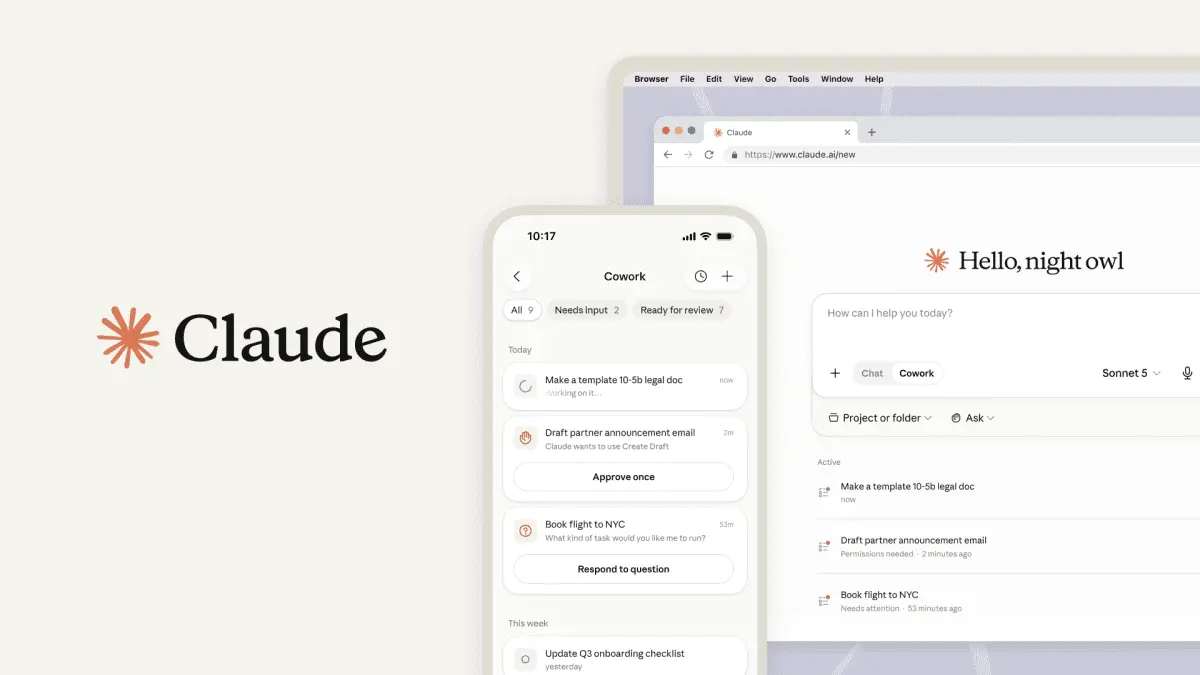
Claude Cowork -- Anthropic's Claude Code-style agent for general knowledge work -- is coming to your phone. Claude Cowork launched as a desktop app in January, but starting Tuesday it is available on web and mobile for Max subscribers. With the update, users can start a task from their desk, get status updates on their phone, and pick up the finished output later -- even if their laptop is closed. The product expansion is a signal that Anthropic wants Cowork to feel less like a coding tool for dummies and more like an agentic administrative coworker: something that can work in the background, tag along across devices, and request human input when a decision pops up only the user can make. In other words: the coding agent wars are spilling into the rest of the office. The move comes as AI firms try to push their products beyond chatbots into the everyday surfaces where work actually happens. OpenAI has made a similar move with Codex, which began as a software development tool but is increasingly being used by non-developers for reports, spreadsheets, presentations, research, data analysis and more. For both labs, the bet is that success will depend less on who has the best chatbot and more on who owns the space where work gets done. That push also extends to other apps. Anthropic recently launched Claude Tag, an always-on Claude that lives in Slack and acts as an AI teammate. Beyond the benefits of one specific interface, launching Cowork as a multi-platform app means that the agent can continue running tasks in the background without a device online, the company says. One example from Anthropic reads: "Set Monday's client prep for 6 am: Claude works through the email threads, transcripts, and recent news, builds the briefing doc, and leaves the follow-up email drafted but unsent. Review it over coffee." The desktop app will remain the place for deep work, where Claude can access local files and the browser. But bringing Cowork to web and mobile means people who didn't install the app can also use it. Anthropic says chat and Cowork will be unified in web and desktop to start, with projects and artifacts living together across both. Anthropic also released early Cowork data, which suggests the clearest use case for the tool is the "work around the work" that keeps companies functioning, handling what Anthropic calls the "tasks that are part of a broad swath of jobs, but are rarely a person's core responsibility." The study sampled 1.2 million anonymized and aggregated Cowork sessions from more than 600,000 organizations over the last two weeks of May. The largest category at 33.4% was business process operating: pulling scattered updates into a single report, building onboarding checklists, and reconciling spreadsheets. Anthropic said the tasks are common among roles in finance, HR, and administration. The next largest category at 16.4% was content creation and copywriting: tasks like drafts, slide decks, social posts, proposals, and other communications work that is usually performed by marketing and management positions. Software development, by comparison, only accounted for 8.7% of Cowork usage. "While coding is still -- understandably -- one of the uses of AI that gets the most attention, the use of AI for everyday business work is on the rise, and the kinds of tasks people are finding it most helpful for are coming into focus," Anthropic said in a blog post. "Our goal is to make this a reference point for people who are figuring out how to integrate AI products into their daily work, and to show where value is most concentrated."
[2]
Shut Those Laptops! Anthropic Puts Its Claude Cowork Agent on Your Phone
Claude Cowork now keeps working on tasks even after you close your laptop. It's part of a larger push toward smartphone-controlled agents. The era of half-cracking a laptop to keep AI agents running comes to a close. On Tuesday, Anthropic announced that Claude Cowork, its AI agent designed to perform digital tasks for you, is expanding beyond the desktop app. You don't need to leave your device active, aka laptop cracked open, to keep the agent going and run scheduled tasks overnight. Anthropic also announced limited versions of Cowork for users to interact with via its existing Claude smartphone app or the web browser, sans the formerly required desktop connection. In the launch video for this feature, Anthropic shows someone asking for help with a business deal renewal scheduled for the following day. In a single prompt, the user asks Cowork to pull together data from email threads, Slack channels, meeting transcripts, and recent online chatter. Then the user asks Cowork to use that info to generate a reference document for the meeting and a prewritten email. Cowork could previously do all of that while your desktop session was active, at least. Now, the agent can run even after you clock out, catching those late-night incoming messages. I first tried Claude Cowork when it dropped in January, and I was immediately stunned that this agent could actually follow through and complete the tasks I asked it to run on my laptop, like organizing a mess of screenshot files into respectable, labeled folders. It also did a solid job of helping me schedule events on my calendar. The agent wasn't perfect, and it still exposed me to the risk of prompt injections or other security breaches, yet Cowork felt like a step change in how everyday users could interact with their devices. This isn't the first time Claude users have been able to interact with Anthropic's agents on their mobile devices. Previously, users could pair their smartphone app with their desktop through the "Dispatch" feature. This enabled users to send task requests from their phone, no matter where they were. But this approach had one major limitation. "Your computer must be awake, and the app must be open for Claude to work on tasks," reads Anthropic's description. That's why some users left their laptops cracked open to keep sessions running. Now, Cowork can run tasks without an active desktop session. This announcement is part of a larger, recent shift in Silicon Valley towards always-running, semi-autonomous AI agents that you can control via texting. The trend was sparked by OpenClaw, a homebrew agent with a lobster mascot that went viral at the beginning of 2026, as early adopters ran it 24/7 and handed over control of their online lives. Other tech companies were jealous of all this crustacean-focused praise. So, in the first half of the year, OpenAI hired OpenClaw's creator and launched Codex, its adaptive agent; Google launched Spark, its take on the always-on agent; and Anthropic leaned further into making its agents more user-friendly. Anthropic's breakout hit was Claude Code, which helped developers automate tasks. Cowork takes a similar approach, translates it out of the context of the computer terminal, and puts that power into chatbot form for average users. Anthropic plans to roll out this revamped version of Cowork as a beta to subscribers of its Max plan, which starts at $100 a month. Then, the features are expected to trickle down to members of Anthropic's cheaper tier, Pro, which costs $20 a month. It's unclear whether this will roll out to free users, who don't currently have access to Claude Cowork in their subscriber tier. Alongside this release, Anthropic dropped a report detailing usage patterns for Claude Cowork. The company claims white-collar laborers are increasingly using its tools as part of their workflows. "Business process and operations," such as data reports and checklists, and "content creation and copywriting," like slide decks and partnership proposals, are the two largest categories of recent usage. Both OpenAI and Anthropic are exploring ways to weave their popular chatbots and agents together into a unified, smartphone-centric user experience. OpenAI rolled out Codex Remote last month, a feature similar to Claude Dispatch, letting users control their desktop agents from their smartphones. OpenAI also launched more Codex-focused updates for its iOS app in July, including "support for creating, searching, opening, forking, and managing Codex tasks directly from a conversation." Anthropic is taking it one step further with today's release, merging the Claude chatbot interface and the Cowork agent for the browser and desktop versions. These moves are part of a Silicon Valley vision that agentic automation could become central to how users interact with their devices, not just for nerdy developers. Rather than launching new apps or standalone tools, the strategy is to build these capabilities right into the chatbots millions of people already have on their phones.
[3]
Anthropic's Claude Cowork heads to the cloud as data shows 90% of sessions aren't for coding
Follow ZDNET: Add us as a preferred source on Google. ZDNET's key takeaways * Claude Cowork is becoming a cloud-based AI helper. * Desktop still offers the fullest Cowork experience. * Anthropic said 90% of Cowork use is not coding. Anthropic announced today it's bringing the agentic helper for Claude users, Claude Cowork, to the web and mobile devices. After analyzing 1.2 million Cowork sessions, Anthropic is also sharing some unexpected usage details. Let's start with the Cowork upgrade. The work around the work Anthropic also introduced a new phrase to describe Cowork: the work around the work. The premise is that professionals have a ton of domain expertise, but a lot of their time is consumed doing administrivia tasks, like digging through emails, consolidating spreadsheets, organizing files, and whatnot. Those tasks aren't technically "the work." They're the work you do to get the work done, hence, "the work around the work." Also: Claude Fable 5 is back, but I'm sticking with Opus 4.8 for daily work: 5 reasons why According to the company, "It's the work around the work: rarely in anyone's job description, but a large share of everyone's week." While some of this administrative support work does need to be done on the desktop, most of it doesn't. Last weekend, I set Cowork loose on my site to find vulnerabilities. None of that required it to run on my desktop. It could have easily run in the cloud. Now, it can. Untether your tasks According to the company, a user can start a task at a desk, check progress from a phone, and pick up finished output from any browser. It says you no longer need your laptop open to run Cowork. I normally run Cowork on my massive Mac Studio with 128GB of RAM and a 38-inch monitor, but it's the same idea. The machine could be off, and the task would still run. "Close the laptop and head to your meeting; Claude keeps going," said Anthropic. For some reason, I keep flashing on pictures in my head of the Energizer bunny. In fact, scheduled tasks can work entirely online as long as the task itself is online. So Cowork can sift through email threads, check transcripts, and examine news, all while you sleep. The limitation is that you have to use connected apps. Cloud Claude doesn't have access to your browser experience. Also: I had Gemini and Claude write my email replies - but only one sounds like me There's a mobile version of the app for Android and iOS. This serves two purposes. First, you can check status and get notifications on your phone. If Claude Cowork reaches a point where it needs permission or clarification, it'll push a notification to your phone. Drafts of messages won't be sent until you review and approve them. That way, you're always in control of the flow, even if you're not in front of your main machine. "When Claude reaches a call only you can make, it asks, and the question reaches your phone," the company's blog post said. I'm not sure I'm comfortable with the idea of clarifying something to an AI or granting it permission from atop the porcelain throne, but the flexibility does show promise in other non-scatological situations. Don't tell me you didn't have that thought, too. "Desktop remains the place for deep work, and it's the full Cowork experience, where Claude can also use your local files and browser. Users who couldn't install a desktop app can now use Cowork too," Anthropic said. The web and mobile versions of Cowork are in beta and available to Max plan subscribers. The company said access will expand to more plans (the cheap seats) in the coming weeks. Doubled Cowork usage limits are extended through Aug. 5 to mark the launch. Not just for coders anymore Along with the new feature announcement, Anthropic offered up some very interesting statistics derived from its session logs. Anthropic said it "sampled 1.2 million anonymized and aggregated Claude Cowork sessions" from May 11 to May 31, 2026, across more than 600,000 organizations. Also: Claude Code made an astonishing $1B in 6 months - and my own AI-coded iPhone app shows why With all the hullabaloo about Claude Code, you might have expected that Cowork use would be dominated by coding-related tasks. But Anthropic said that more than 90% of the sampled sessions were unrelated to software development. A full 50% of Cowork usage can be attributed to business process and content creation. Business process and operations was the largest category at 33.4%, followed by content creation and copywriting at 16.4%. "Our data suggests that people are using Claude Cowork to assemble and structure the information they can use to act on their expertise," Anthropic said. Also: I tested ChatGPT vs. Claude to see which is better - and if it's worth switching So here's the thought that's been banging around in my head ever since I learned about this announcement and started writing this piece. If I have Cowork and it runs autonomously in the cloud and on schedule, do I even need a dedicated server with OpenClaw anymore? Can't most of what I want done with OpenClaw be done with Claude and be safer and more reliable at the same time? OpenClaw doesn't incur usage limits with on-device AI. It doesn't have a fee. But if I'm already paying for Claude Max, how far can I take it? Stay tuned. I'm sure I'll be back with some hands-on tests. What do you think? Let us know in the comments below. You can follow my day-to-day project updates on social media. Be sure to subscribe to my weekly update newsletter, and follow me on Twitter/X at @DavidGewirtz, on Facebook at Facebook.com/DavidGewirtz, on Instagram at Instagram.com/DavidGewirtz, on Bluesky at @DavidGewirtz.com, and on YouTube at YouTube.com/DavidGewirtzTV.
[4]
Now you can direct Anthropic's Claude Cowork AI from your phone - Engadget
At the start of the year, Anthropic debuted Claude Cowork, an offshoot of its coding agent that gives people a way to ask Claude for help with tasks on their computer. After expanding the capabilities of the software in March, Anthropic is giving users a way to manage Cowork from their phones. Once you update to the latest version of the Claude app on Android and iOS, look for the new Cowork tab in the sidebar. To be clear, today's update doesn't mean you can use Anthropic's agent to automate tasks on your phone. Instead, it's a way to keep tabs on what Claude is doing on your computer back home. Anthropic has also updated Cowork to make it capable of running tasks in the background, where previously your device needed a stable internet connection for Claude to do its thing. If Claude needs permission to complete a task, you'll get a notification on your phone, from which you can tell it to move forward. "Nothing ships until you've reviewed and approved it," says Anthropic. Looking forward, Anthropic plans to unify Cowork with its chatbot, so that you can converse with Claude and give it computer-related tasks from a single interface. Users will see this change occur first on Claude's web client and desktop app. The company also plans to bring projects and artifacts together as well. Projects allows you to group your chats and files around a single topic so that you can make the most of Claude's context window. As for artifacts, they're small apps and games Claude can program for you. I suspect Anthropic might be doing this to give more visibility to artifacts since they're an interesting offering from the company, but I don't see many people engaging with them online, despite the fact Anthropic recently made it easier to do just that . If you're a Max subscriber, you'll get access to today's update first. Anthropic plans to bring the mobile integration to other plans in the coming weeks.
[5]
Anthropic brings Claude Cowork to mobile and web as usage data shows most users aren't coding
Anthropic on Tuesday launched Claude Cowork on mobile and web, expanding a tool that has quietly become the company's bridge between the developer-centric world of AI coding agents and the far larger market of knowledge workers who never open a terminal. The rollout, which begins in beta with Max subscribers before expanding to additional plans, marks a strategic inflection for Anthropic. It transforms Cowork from a desktop-only agent into a cross-device platform where tasks can start on a laptop, continue autonomously in the background, and be reviewed from a phone -- even after the user closes the app entirely. "Your work goes everywhere with you, and keeps going without you," Anthropic writes in its announcement. The timing is deliberate. Alongside the mobile launch, Anthropic published usage data from 1.2 million anonymized Claude Cowork sessions sampled between May 11 and May 31, drawn from more than 600,000 organizations. The data paints a striking picture: the overwhelming majority of what people do with Cowork has nothing to do with writing software. The biggest AI story nobody's talking about The numbers tell a story that cuts against the dominant narrative in enterprise AI, which has fixated on coding assistants and developer productivity as the primary use case for large language models. Business process and operations -- tasks like pulling scattered updates into a single report, building onboarding checklists, and reconciling spreadsheets -- accounted for 33.4% of all sampled Cowork sessions, making it the single largest category by a wide margin. Content creation and copywriting -- producing drafts, slide decks, posts, and proposals -- came in second at 16.4%. Together, those two categories make up roughly half of all Claude Cowork usage. Software development, by contrast, accounted for just 8.7%. DevOps and infrastructure followed at 7%, with research and intelligence at 6.4%, data analysis and business intelligence at 5.8%, document processing and extraction at 4.1%, and sales and revenue operations at 4%. The remaining 12 categories each represented less than 4% of usage, including personal assistance at 3.8%, education at 2.4%, and meeting intelligence at 1.8%. Anthropic describes these dominant use cases as "the work around the work" -- tasks that span nearly every role in an organization but rarely appear in anyone's core job description. "People are using it for a variety of tasks that aren't necessarily the hallmark of a specific role, but instead represent the connective work around a role that moves projects forward and keeps businesses running," the company writes. "That means tasks like drafting a status update, building a slide deck, or condensing reams of research into a single report." That phrase -- "the work around the work" -- is Anthropic's attempt to define and claim an entirely new category of AI productivity. It's a calculated reframing: rather than positioning AI as a tool that replaces what professionals do, Anthropic is arguing that the most valuable current application is handling everything professionals do around their actual expertise. What mobile access changes -- and what it doesn't The expansion to mobile and web introduces three concrete capabilities that reflect how Anthropic envisions Cowork fitting into daily workflows. First, sessions now sync across devices. A user can start a task at their desk, check on its progress from a phone, and retrieve the finished output from any device. Second -- and arguably more significant -- Cowork can now run tasks in the background with no device online at all. Users can schedule work for a specific time, and Claude will execute it autonomously. Anthropic offers the example of setting Monday morning client prep for 6 a.m.: "Claude works through the email threads, transcripts, and recent news, builds the briefing doc, and leaves the follow-up email drafted but unsent. Review it over coffee." Third, when Claude encounters a decision that requires human judgment, it surfaces the question to the user's phone. "Nothing ships until you've reviewed and approved it," Anthropic states. Desktop remains the most fully featured surface, with access to local files and the browser. But the web version also opens Cowork to users who cannot install a desktop application -- a meaningful expansion in enterprise environments where IT departments control software installation. The company also unified its interface: on web and desktop, chat and Cowork now share a single home screen, and projects and artifacts persist across both modes. To encourage adoption, Anthropic is extending doubled Cowork usage limits through August 5. The strategic logic: why Anthropic is chasing the non-developer The usage data and the mobile launch together reveal a company executing a two-track strategy. Claude Code, its terminal-based coding agent, dominates among software developers. But Cowork is designed to capture the vastly larger population of professionals whose work involves creating, organizing, and communicating information rather than writing code. The contrast between the two products is instructive. As Anthropic notes, Claude Code "is most often used by software developers for the key parts of their role: building, debugging, and shipping code." When developers do use Cowork, they tend to use it not for programming but for the communications-focused work that surrounds every role -- status updates, documentation, and coordination. This pattern -- where AI handles the connective tissue of work rather than its core substance -- aligns with what Anthropic describes as people using "Claude Cowork to assemble and structure the information they can use to act on their expertise." The company illustrates this with three examples: a lawyer using Cowork for document formatting and filing while reserving legal judgment for themselves, a hiring manager synthesizing interview feedback while spending more time on candidate conversations, and a team lead producing a slide deck that explains a decision while focusing on actually making that decision. The implications for Anthropic's business model are significant. Developer-focused tools, while high-profile, serve a relatively narrow market. The Ramp AI Index published in May showed Anthropic pulling ahead of OpenAI in business adoption for the first time -- with 34.4% of firms paying for Anthropic's services compared to OpenAI's 32.3% -- and suggests the company's enterprise push is gaining traction. Claude Code was identified as the primary driver of that shift. But Cowork targets an addressable market that is orders of magnitude larger: every knowledge worker with a laptop, a pile of spreadsheets, and a slide deck due by Friday. A crowded field gets more competitive The mobile launch arrives during one of Anthropic's busiest -- and most turbulent -- stretches in its history. Just last week, Anthropic launched Claude Sonnet 5, a new model that narrows the performance gap with its more expensive Opus-class models while maintaining lower pricing. The model is available at introductory pricing of $2 per million input tokens through August 31 before rising to $3 per million input tokens. Sonnet 5 serves as the engine underneath Cowork, and its improved agentic capabilities -- better reasoning, tool use, and sustained task completion -- directly enhance Cowork's ability to handle complex, multi-step workflows. Two weeks before that, Anthropic released Claude Tag, a Slack-native AI agent designed for team collaboration. Where Cowork focuses on individual task delegation, Claude Tag operates as a multiplayer tool -- a single Claude identity that everyone in a Slack channel can interact with, building context from conversations over time. According to Anthropic's announcement, 65% of the company's own product team's code is created by its internal version of Claude Tag. Fortune reported that Anthropic's head of product for Claude Code and Cowork, Cat Wu, described the distinction: "Claude Code, Cowork, and chat are very single-player, whereas Claude Tag is built to be interactive and multiplayer." Together, Cowork and Claude Tag represent a pincer strategy: Cowork captures individual productivity workflows across devices, while Claude Tag embeds AI into team communication channels. Both are designed to push Anthropic deeper into enterprise operations, beyond the developer seat. The security question looms The expansion also arrives against a backdrop of unresolved security concerns. On July 1, security firm Armadin -- led by Mandiant founder Kevin Mandia -- published research detailing what it described as a full sandbox escape in Claude Cowork on Windows, as reported by SiliconANGLE. The attack chain involved DLL sideloading against the Claude desktop executable to gain trusted access to Cowork's virtual machine service, then exploiting undocumented parameters to achieve root access and bypass network restrictions. Anthropic responded that the vulnerability did not qualify as a security issue because exploiting it requires an attacker to already have local code execution on the host machine. Armadin, however, raised a broader concern: that deploying local virtual machines on nontechnical users' systems creates visibility gaps that endpoint security products struggle to monitor. This tension takes on new dimensions as Cowork moves to mobile and web. The web and mobile versions run tasks server-side rather than in a local virtual machine, which eliminates the specific attack surface Armadin identified but introduces different questions about data handling, especially for scheduled background tasks that process email threads, calendar data, and documents without real-time user oversight. Anthropic's announcement states that "the decisions still come to you" and that nothing ships without review and approval. But as Cowork takes on increasingly complex autonomous workflows -- processing contract folders, building client briefings from multiple data sources, drafting emails -- the surface area for prompt injection and data exposure grows correspondingly. When Cowork first launched in January, TechCrunch reported that Anthropic explicitly warned about prompt injection risks, noting in its blog post: "These risks aren't new with Cowork, but it might be the first time you're using a more advanced tool that moves beyond a simple conversation." As Anthropic courts enterprises, geopolitics complicates the pitch Anthropic's enterprise push is also colliding with geopolitical reality. CNBC reported Monday that Alibaba will ban employees from using Anthropic's AI tools starting July 10, placing Claude Code on a high-risk software list. The move followed Anthropic's June letter to the U.S. Senate accusing Alibaba of carrying out what it called "the largest known distillation attack" against its models. The Alibaba ban, combined with reports that Anthropic is closing loopholes that allowed Chinese companies to access Claude through third-country entities, underscores the increasingly fraught environment for AI companies attempting to serve global enterprise customers while navigating U.S. export and security restrictions. At the same time, Anthropic is investing massively in infrastructure. Reuters reported Monday that Anthropic signed a $19 billion, 20-year lease with TeraWulf for a data center being built in Hawesville, Kentucky, with 401 megawatts of computing power expected to become fully operational in 2028. That kind of capital commitment only makes sense if the company expects enterprise demand -- not just from developers, but from the millions of knowledge workers that Cowork targets -- to grow dramatically. Anthropic's own usage report comes with notable blind spots Anthropic is transparent about the limitations of its usage analysis. The taxonomy classifies sessions by the type of work being performed, not by the job title of the person doing it. There are no standalone categories for marketing, finance, or HR -- functions that are likely absorbed into the dominant "business process and operations" bucket, which may partly explain why that category commands a third of all usage. The sample is also rate-capped rather than proportional to traffic, meaning the numbers are shares of sampled sessions, not absolute volumes. Usage during peak hours is somewhat underrepresented. And roughly 5% of sampled sessions involved personal, non-work use -- hobbies, personal assistance, and companionship-style conversations -- meaning the data doesn't purely reflect workplace activity. The company also acknowledged that its labeling pipeline changed around May 11, which is why the analysis window begins on that date rather than covering a longer period. What Cowork's rise says about the future of enterprise AI Anthropic's mobile launch and usage data arrive at a moment when the enterprise AI market is shifting from proof of concept to proof of value. The question facing every company deploying AI tools is no longer whether the technology works -- but whether it delivers measurable productivity gains across an organization, not just within engineering teams. The usage data suggests that the answer, at least for Cowork, is emerging in an unexpected place. It's not in the glamorous work of building software or conducting research. It's in the unglamorous, universal labor of turning messy information into structured outputs that move organizations forward -- the status reports, the onboarding checklists, the variance memos, the client decks. By untethering that capability from the desktop and making it available on every device, Anthropic is betting that the most valuable AI agent isn't the one that writes code. It's the one that handles everything else.
[6]
Claude Cowork can now keep working even after you close your laptop
Anthropic just untethered Claude Cowork from your laptop, letting it work in the background across web and mobile. Anthropic's Claude Cowork feature has been tied to your desktop since launch. That changes starting today, as the company is expanding Cowork to web and mobile. Max plan subscribers get beta access first over the coming days, and Anthropic says other plans will follow in the coming weeks. If you haven't used Cowork before, the idea is simple. You give Claude a task, and it works through your files, inbox, calendar, and other connected tools until it's done. The problem was that shutting your laptop lid also shut down the task. Not anymore. Your laptop is no longer the bottleneck Since Claude Cowork was previously dependent on your desktop running in the background, some long tasks were harder to execute. As soon as you closed your laptop, the task stopped. The new update fixes that, as Claude can now work with the cloud and your phone. Now, you can kick off a task from your desk and check on it later from your phone, wherever you happen to be. Scheduled tasks run in the cloud now, so you can close your laptop and take that nap, and Claude will keep doing its work. Claude still won't go rogue on you, though. Whenever it hits a decision that needs your input, it pings you, and nothing gets sent out without your say-so. What are people actually using Cowork for? With the announcement of its latest Claude Cowork feature, Anthropic also revealed its usage number, and color me surprised. Recommended Videos If, like me, you also thought that Claude Cowork was mainly used by software developers and programmers, you would be wrong. Anthropic says over 90% of usage is everyday work, like business operations and content creation. That's a pretty telling number. It shows that AI agents aren't just for people who can code. They are quickly becoming a tool for anyone drowning in spreadsheets, emails, and decks. If you have ever wished you could hand off the boring parts of your job to someone else, this update makes that even more possible. I'll be curious to see how this expansion to web and mobile changes the numbers even further. Once people realize they don't need to be tied to a laptop to use Cowork, I expect even more of that everyday work to shift over to Claude.
[7]
Anthropic will make Claude Cowork available to users via the cloud
Attendees at Anthropic's Code with Claude developer conference in San Francisco on May 6. Don Feria / AP Content Services for Anthropic AI company Anthropic announced Tuesday that it is moving its popular Claude Cowork agent to the cloud, making it accessible to users from multiple devices, and able to perform tasks even when the devices are not online. Cowork is a feature that was built primarily for nontechnical users. Launched in January, it automates multistep workflows for personal organization and scheduling by pulling from users' files, folders and applications without the need for constant prompting or direction. Up to now, Cowork had only been available for users operating on specific devices, which needed to remain open and active for work to be completed, and users could not operate Cowork via multiple devices using one account. The update announced Tuesday will change that. The changes announced will allow scheduled tasks, like drafting an email, to run without a device online, but Claude will still ask a user for a final review and approval before shipping, the company said in its blog. Anthropic will give beta access to users with Max subscriptions, the company's most premium plan for consumers, and will expand access to more plans in the coming weeks. To mark the launch, Anthropic is extending Cowork's doubled usage limits through Aug. 5. In addition to moving Cowork to the cloud, Anthropic says it will unify Claude chat and Cowork, putting them in the same space and giving them access to the same files. Cowork competes in a crowded push toward "agentic" AI -- systems that complete multistep tasks rather than answer questions -- where Google, OpenAI and Microsoft have all launched rival agent products. Claude has become a favorite among technical and nontechnical users, though, even as OpenAI's ChatGPT remains one of the most well known and most used AI products. As agents have become increasingly popular, users have expressed concerns about the broad permissions that often need to be granted to them in order to be effective. Anthropic has attempted to address this via its permissions structure, which frequently and repeatedly asks for consent to perform specific tasks as Cowork operates.
[8]
Anthropic brings Cowork out of the desktop and onto web and mobile
Anthropic brings Cowork out of the desktop and onto web and mobile Anthropic PBC today announced it's bringing its Claude Cowork agentic artificial intelligence assistant to mobile and the web, breaking it free from the desktop. Cowork allows users to harness the company's most powerful AI models to do work across files, calendar, email, messaging apps, the web and other tools on their personal computer. It was originally released to provide the technical power of Claude Code, the company's AI agent aimed at software engineers for development work, but packaged for everyday users. Before today, users needed to have Cowork open on their desktop with the app window churning away. If they walked away from their computer or laptop screen, they would lose access to it and wouldn't be able to keep track of its progress. With this update, users can start on their desktop and continue on mobile or the web, so they can keep going even when they're not at their keyboard. Starting with Max users in beta mode, the $100- to $200-a-month subscription plan for Anthropic's AI tools, users can now start a task on their laptop, let Claude begin its work, and walk away. If it runs into an ambiguity, can't access a tool without permission or needs to make a decision that requires human input, users can now control it via the web or mobile. Scheduled tasks will now run without the need for a computer to be online to activate them. This means that users can set up a 6 a.m. client prep for Monday morning to start before they get to the office. By the time they sit down and boot up the computer in their office, Cowork has already crunched a meeting briefing doc, prepared follow-up emails and scanned research that might come in handy for the week. How are people using Cowork? Alongside the beta launch of Cowork on mobile and web, Anthropic also released a report outlining how people use the tool. Anthropic released Cowork in January 2026 and in May, the company surveyed 1.2 million anonymized sessions, categorizing them across a number of types of work. The company said almost half of all Cowork usage came from professionals simplifying operations and creating content. The largest category turned out to be "business process and operations" - that is, anything that might be considered a type of knowledge work that requires looking through scattered documents and compiling them into a single report or handling tedious data comparison tasks. This category represented 33.4% of all usage. The second-largest category was content creation and copywriting -- anything that required synthesizing communications, producing drafts, slide decks or other document work. This category measured in at 16.4% of all usage. According to the company, users from numerous enterprise roles used the tool in their everyday work, including marketing, communications, business development and project management. The remaining top categories included software development at 8.7%, DevOps and cloud infrastructure codification and configuration at 7%, research and intelligence at 6.4%, document processing and extraction at 4.1%, and sales revenue operations at 4%. Unlike ordinary chatbots, which can also work over massive sets of documents to provide answers to questions, Cowork is similar to having an electronic intern sit down and work out an entire project. Chatbots operate on the idea that quick answers to questions now are helpful; Cowork takes questions and turns them into short- or long-term tasks that can run in parallel to everyday work. According to Anthropic, people appear to be using Cowork to assemble and structure information in ways that help them digest it more effectively. They're asking the tool to process larger volumes of data and documents, extract insights and organize them so they can more easily find what they need to understand the breadth of available knowledge and act on it. For example, a lawyer might use Cowork to handle document formatting and preparation, giving them more time to strategize based on the information contained in the case. A team lead might use the tool to produce a slide deck that breaks down timelines, cost ratios and other metrics they need to look at, presenting it alongside feedback from employees and clients to better understand the health of a project before making a decision or presenting an update to management. The company added that Cowork usage showed a contrast to Claude Code, which is most often used by software developers as part of the process of producing, debugging and shipping code. Coding work has dominated the headlines regarding the use of AI agents. In fact, it's common for the development community to jump immediately to new models and aim them at codebases to test how they'll work. How well an agent codes is an easy way to review its capability, but how well an agent builds a report, catches up on meeting notes or drafts emails doesn't catch as much attention. Documentation, content creation and knowledge work are also everything that isn't code, or as the industry would call it, "the connective tissue" that surrounds work, including the work done by software engineers.
Share
Copy Link
Anthropic expanded Claude Cowork beyond desktop, launching mobile and web versions that run tasks autonomously in the background. The company analyzed 1.2 million sessions from over 600,000 organizations and found that 33.4% of usage involves business process operations while software development accounts for just 8.7%, signaling a shift from coding tools to workplace productivity agents.
Anthropic announced Tuesday that Claude Cowork, its AI agent designed for general knowledge work, is expanding beyond its desktop-only origins to mobile and web platforms. Starting with Max subscribers who pay $100 per month, the update enables users to start tasks from their desk, receive status updates on their phone, and retrieve finished outputs later—even with their laptop closed
1
. The expansion represents a strategic move by Anthropic to position its AI agent as an agentic administrative coworker rather than just another coding tool, capable of working across devices and requesting human input only when necessary1
.
Source: VentureBeat
The mobile versions for Android and iOS don't allow users to automate tasks directly on their phones but instead provide a way to monitor what Claude Cowork is doing on their computer
4
. When the AI agent reaches a decision point requiring permission, users receive mobile notifications and can approve actions directly from their phone2
. Anthropic emphasizes that "nothing ships until you've reviewed and approved it," maintaining human-in-the-loop oversight4
.The most significant technical advancement is background task execution, which allows Claude Cowork to continue running tasks without requiring an active desktop session
3
. Previously, users had to leave their laptops open to keep the agent running, but now tasks can execute autonomously in the cloud2
. Anthropic provides an example: "Set Monday's client prep for 6 am: Claude works through the email threads, transcripts, and recent news, builds the briefing doc, and leaves the follow-up email drafted but unsent. Review it over coffee"1
.
Source: TechCrunch
Cross-device syncing enables sessions to persist across platforms, allowing knowledge workers to start tasks on one device and pick them up on another seamlessly
5
. The desktop app remains the platform for deep work with access to local files and browser capabilities, but the web version opens access to users in enterprise environments where IT departments restrict software installation5
. Anthropic plans to unify chat and Cowork interfaces on web and desktop, bringing projects and artifacts together across both experiences1
.Alongside the launch, Anthropic released usage data from 1.2 million anonymized and aggregated Claude Cowork sessions sampled between May 11 and May 31, 2026, across more than 600,000 organizations
1
. The findings challenge assumptions about AI agent usage: business process operations accounted for 33.4% of all sessions, making it the largest category by far5
. These tasks include pulling scattered updates into single reports, building onboarding checklists, and reconciling spreadsheets—work common among roles in finance, HR, and administration1
.Content creation and copywriting came in second at 16.4%, encompassing drafts, slide decks, social posts, and proposals typically performed by marketing and management positions
1
. Software development represented only 8.7% of Cowork usage, with more than 90% of sampled sessions unrelated to coding3
. DevOps and infrastructure followed at 7%, research and intelligence at 6.4%, and data analysis at 5.8%5
.
Source: SiliconANGLE
Related Stories
Anthropic introduced the phrase "the work around the work" to describe what Claude Cowork handles best—tasks that span nearly every role but rarely appear in job descriptions
3
. "While coding is still—understandably—one of the uses of AI that gets the most attention, the use of AI for everyday business work is on the rise, and the kinds of tasks people are finding it most helpful for are coming into focus," Anthropic stated1
. The company positions this data as a reference point for organizations figuring out how to integrate AI products into daily workflows and identify where value concentrates1
.This reframing represents a calculated strategy: rather than replacing what professionals do, Anthropic argues the most valuable current application involves handling everything professionals do around their actual expertise
5
. The approach targets the vastly larger population of knowledge workers compared to the developer-centric market that Claude Code serves5
.The expansion signals that coding agent wars are spilling into the rest of the office as AI firms push products beyond chatbots into everyday work surfaces
1
. OpenAI made a similar move with Codex, which began as a software development tool but increasingly serves non-developers for reports, spreadsheets, presentations, and data analysis1
. OpenAI also rolled out Codex Remote last month, a feature similar to Claude Dispatch that lets users control desktop agents from smartphones2
.For both labs, success depends less on who has the best chatbot and more on who owns the space where work gets done
1
. Anthropic recently launched Claude Tag, an always-on presence in Slack that acts as an AI teammate, further extending its workplace productivity push1
. The mobile and web versions of Claude Cowork are rolling out as a beta feature to Max subscribers first, with access expanding to other plans in coming weeks4
. To encourage adoption, Anthropic extended doubled Cowork usage limits through August 53
.Summarized by
Navi
[1]
[3]
12 Jan 2026•Technology

23 Mar 2026•Technology

25 Feb 2026•Technology

1
Policy and Regulation

2
Policy and Regulation

3
Policy and Regulation