2 Sources
[1]
Anthropic Expands in Manhattan, Part of an A.I. Boom in New York
Anthropic, the artificial intelligence company, plans to lease a 16-story building in Hudson Square and to double its work force in New York City to 1,000 people this year. Anthropic, the artificial intelligence company, plans to announce on Tuesday that it will lease a 16-story office building in Lower Manhattan as the company moves to double its work force in New York City to 1,000 people this year. The move into a renovated building at 330 Hudson Street in the Hudson Square neighborhood is part of a major expansion of A.I. companies in New York City. Anthropic, the company behind the chatbot Claude, said that its New York office was already its largest outside its San Francisco headquarters and that the new space had room for more than 1,700 desks. The move is expected to start this summer. Mayor Zohran Mamdani's administration praised the expansion, as did Gov. Kathy Hochul, who said in a statement that it would "cement New York City as a world-class technology hub." Artificial intelligence companies have been adding office space in New York City and going on a hiring spree, even as some elected officials have raised concerns about the technology and how it could displace white-collar workers. Thomas P. DiNapoli, the state comptroller, said recently that he was worried about the disruption A.I. could bring, warning that it could "damage the quality and productivity of a company's work force and, more broadly, add to the large-scale instability of the economy." OpenAI, whose ChatGPT chatbot started the A.I. boom in 2022, announced its move into the Puck Building, less than a mile from Anthropic's new office, in 2024. Harvey, an A.I. start-up for the legal industry, expanded its office at One Madison Avenue in Midtown Manhattan earlier this year. Anthropic's expansion is a further sign of the evolution of artificial intelligence as the technology matures and moves into the economic mainstream. Big A.I. companies are increasingly extending their focus beyond building new software models to pushing other industries to adopt the technology. And New York is home to some of the nation's largest technology customers in finance, health care, consulting, law, media and culture. "New York is a great place for an A.I. company to work and do business," said Mark Muro, a senior fellow at Brookings Metro, a division of the Brookings Institution. Mr. Muro was a co-author of a Brookings report last year that found New York to be a leader among U.S. metro areas in "A.I. readiness," a broad measurement of the capacity to both produce A.I. and adopt it. Chris Lehane, the chief global affairs officer for OpenAI, said in a statement that the company had 90,000 square feet of office space in New York City and would keep expanding. He said the city was a "global hub for A.I." because of its "A.I. talent density, inherent entrepreneurship and the policy leadership from its elected officials." Mr. Mamdani, a democratic socialist, has had a frosty relationship with business leaders over his calls to tax the rich, and has moved to win them over. He has also faced criticism for not yet releasing a detailed plan to address the city's slowing job growth. Jeanny Pak, the interim president of the city's Economic Development Corporation under Mr. Mamdani, said that Anthropic's move would "create hundreds of jobs for New Yorkers, strengthening equitable pathways to economic opportunities and reinforcing that companies continue to choose New York City." New York now has far more tech talent than in the past. Two decades ago, when a computer scientist at Google wanted to create an engineering team in New York, the Silicon Valley company's leaders were skeptical. They told him he could go ahead, but only if could find 15 "Google-worthy" software developers in the city. Today Google employs thousands of engineers in New York. A.I. companies are hiring at a time when young people in particular are having a hard time getting jobs. Anthropic's website has dozens of openings listed in New York. Many of them are in engineering and sales and on the company's legal and marketing teams. Julie Samuels, president of Tech:NYC, a nonprofit industry group, acknowledged that the most advanced A.I. software was still designed primarily in the Bay Area. "But when it comes to how to use the technology in practice, what works and what doesn't in business, they come here," she said. "That's where we are now." Still, many New Yorkers have concerns about A.I., particularly in the progressive circles Mr. Mamdani comes from. Some parents in the city are fighting the use of the technology in public schools. And the debate permeated a congressional primary campaign in Manhattan: Super PACs aligned with A.I. companies spent heavily both for and against one of the Democratic candidates, Alex Bores, who has sought to regulate the industry. (Mr. Bores lost the election last month to Micah Lasher, a fellow state assemblyman.) State lawmakers in New York recently approved a one-year moratorium on new large-scale data centers that power A.I., citing concerns about energy consumption and environmental effects. But Ms. Hochul, a moderate Democrat who is friendly with business leaders, has signaled that she might veto the legislation. Anthropic, which filed last month for an initial public offering, is planning to build a data center in upstate New York with a company called Fluidstack as part of a $50 billion investment in American data centers. A.I. companies have hired veterans of New York City government to help them navigate the city's thorny political landscape. Maxwell Young, a former adviser to Mayor Eric Adams, joined Anthropic in November as the head of policy communications. Peter Ragone, a top adviser to former Mayor Bill de Blasio and to Gov. Gavin Newsom of California, is working for OpenAI. Mark Levine, the city comptroller, released a report in May warning about the impact A.I. could have on jobs in New York City. He called on Mr. Mamdani to outline a vision for making sure that the city benefits from the industry's growth. "We should be the capital of applied A.I., and a more concerted strategy to make that happen is absolutely needed," Mr. Levine said in an interview.
[2]
Anthropic leases new NYC office building, set to double local workforce by end of year
Anthropic has leased an entire office building in Manhattan's Hudson Square and plans to double its local workforce - the latest sign that tech giants are embracing the Big Apple as an artificial intelligence hub. The company, known for its Claude chatbot, will occupy all 16 floors at 330 Hudson St. in Hudson Square. Anthropic said it plans to have more than 1,000 employees in New York City by the end of this year, up from less than 500 at the start of 2026. The company added that it will begin moving into the office later this summer and has space in the facility for about 1,700 desks. New York already ranked as Anthropic's second-largest office hub behind its headquarters in San Francisco. "New York is one of the main hubs for how AI is being put to work, and Anthropic is in the middle of it as a technology partner to the financial institutions, media companies, and cultural organizations that help define the city," Anthropic chief commercial officer Paul Smith said in a statement. "Doubling our team here and deepening our long-term commitment to the city will allow us to sit closer to that work, and to the people driving it forward," Smith added. Gov. Kathy Hochul lauded Anthropic's move, stating that it "demonstrates that New York City -- with its unparalleled talent pool, vast industry diversity, and close proximity to the world's largest academic and research institutions -- remains the premier place for companies to do business." Anthropic's NYC expansion comes on the heels of an eventful stretch for the firm and its CEO Dario Amodei. The company just relaunched its cutting-edge Mythos and Fable AI models with the Trump administration's approval. The White House had targeted the models with export controls after executives including Amazon CEO Andy Jassy flagged safety concerns. Anthropic engaged in weeks of high-stakes negotiations with Trump administration officials in order to get the models back online with safeguards in place. OpenAI, Anthropic's chief rival in the AI race, has also put down extensive roots in New York, having leased 90,000 square feet of office space at the Puck Building in SoHo. Last year, OpenAI boss Sam Altman talked up AI's potential to jumpstart the city's economy during a meeting with local business leaders. OpenAI also put out an economic report in June 2025 stating that New York City could "become a global capital of the Intelligence Age, with artificial intelligence generating significant revenue, jobs and growth." "If the US economy were to grow just 1 percentage point faster every year, compounded over a decade, we'd be nearly $3 trillion richer - more than the annual GDP of New York State," the report said at the time.
Share
Copy Link
Anthropic is leasing a 16-story building at 330 Hudson Street and doubling its New York City workforce to 1,000 employees by year-end. The expansion signals New York's emergence as a global AI hub, with OpenAI and other AI companies also establishing major presences. The move reflects AI's shift from software development to mainstream adoption across finance, healthcare, law, and media industries.
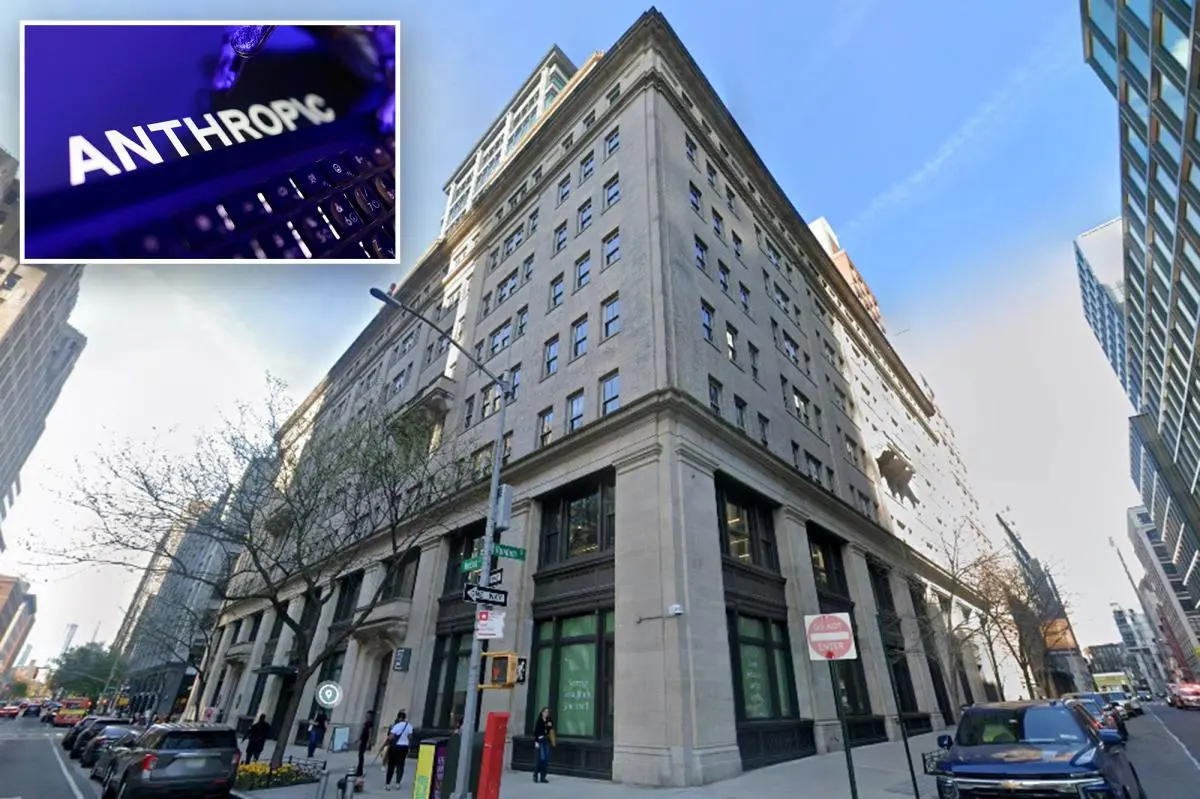
Anthropic plans to lease the entire 16-story building at 330 Hudson St in the Hudson Square neighborhood, marking a significant Anthropic expansion in Manhattan as the AI company positions itself at the center of the AI boom sweeping through New York City
1
. The company behind the Claude chatbot will occupy all 16 floors with capacity for more than 1,700 desks, beginning its move this summer2
. New York already serves as Anthropic's largest office outside its San Francisco headquarters, and this expansion underscores the company's commitment to deepening its presence in a city that's rapidly becoming a global AI hub1
.
Source: New York Post
The AI company plans to double its NYC workforce to more than 1,000 employees by the end of this year, up from less than 500 at the start of 2026
2
. Anthropic's website currently lists dozens of openings in New York, spanning engineering, sales, legal, and marketing teams1
. This hiring spree comes at a time when young people are facing challenges in securing employment, making the job creation particularly significant for the local economy. Paul Smith, Anthropic's chief commercial officer, explained the strategic rationale: "New York is one of the main hubs for how AI is being put to work, and Anthropic is in the middle of it as a technology partner to the financial institutions, media companies, and cultural organizations that help define the city"2
.The expansion reflects a broader shift in how AI companies operate, moving beyond pure software development to focus on industry adoption. New York's concentration of major players in finance, healthcare, consulting, law, and media makes it an ideal location for AI companies seeking to integrate their technology into real-world business applications
1
. Mark Muro, a senior fellow at Brookings Metro, noted that a Brookings report found New York to be a leader among U.S. metro areas in "AI readiness," measuring both the capacity to produce and adopt AI technology1
. Julie Samuels, president of Tech:NYC, acknowledged that while advanced AI software is still primarily designed in the Bay Area, "when it comes to how to use the technology in practice, what works and what doesn't in business, they come here"1
.
Source: NYT
Anthropic isn't alone in betting big on New York. OpenAI expansion has also accelerated, with the company leasing 90,000 square feet at the Puck Building in SoHo, less than a mile from Anthropic's new Hudson Square office
1
. Chris Lehane, OpenAI's chief global affairs officer, stated the company would keep expanding and called New York a "global hub for AI" due to its "AI talent density, inherent entrepreneurship and the policy leadership from its elected officials"1
. OpenAI released an economic report in June 2025 stating that New York City could "become a global capital of the Intelligence Age, with artificial intelligence generating significant revenue, jobs and growth"2
. Harvey, an AI start-up serving the legal industry, also expanded its office at One Madison Avenue in Midtown Manhattan earlier this year1
.Related Stories

Gov. Kathy Hochul praised Anthropic's move, stating it would "cement New York City as a world-class technology hub" and demonstrates that the city "remains the premier place for companies to do business" with its unparalleled talent pool and industry diversity
1
2
. Mayor Zohran Mamdani's administration also welcomed the expansion, with Jeanny Pak, interim president of the city's Economic Development Corporation, saying it would "create hundreds of jobs for New Yorkers, strengthening equitable pathways to economic opportunities"1
. The move comes as Mamdani faces criticism for not yet releasing a detailed plan to address the city's slowing job growth1
.Despite the enthusiasm, concerns persist about AI's economic impact. State comptroller Thomas P. DiNapoli warned that AI could "damage the quality and productivity of a company's work force and, more broadly, add to the large-scale instability of the economy"
1
. Some parents are fighting AI use in public schools, and the technology has become a political flashpoint, with Super PACs aligned with AI companies spending heavily in recent congressional primary campaigns1
. Anthropic's expansion follows an eventful period for the company, including the recent relaunch of its Mythos and Fable AI models after weeks of negotiations with the Trump administration over export controls and safety concerns2
. As AI companies continue establishing roots in New York, the city's role in shaping how AI integrates into traditional industries will likely intensify, with implications for workforce dynamics and economic growth patterns across multiple sectors.🟡 inexperienced.Summarized by
Navi
16 Apr 2026•Business and Economy

11 Mar 2026•Policy and Regulation

26 Sept 2025•Business and Economy

1
Technology

2
Policy and Regulation

3
Policy and Regulation