Security researchers use Anthropic Mythos to expose macOS vulnerabilities on Apple M5 chips


11 Sources
[1]
Researchers used Mythos to crack macOS.
Researchers at the security firm Calif say they used Anthropic's cybersecurity AI to create a privilege escalation exploit, the Wall Street Journal reports: Last September, Apple said it leveraged its hardware and operating system expertise into a technology called Memory Integrity Enforcement
[2]
First Apple M5 memory exploit discovered using Anthropic AI, gives root access on MacOS -- Claude Mythos helps security researchers bypass Memory Integrity Enforcement
AI-assisted security research is producing exploits at a frightening rate. Thanks to AI-assisted security research, hackers with hats of various colors are finding exploits everywhere. Linux has had its worst week in years with the CopyFail and Dirty Frag root-gaining vulnerabilities, and things
[3]
Fears of unfettered hacking spurred by Anthropic's Mythos AI model overstated
May 20 (Reuters) - Early fears that Anthropic's new AI model, Mythos, could dramatically turbocharge hacking are looking overstated a month after its release. The company warned at launch in April that Mythos had uncovered thousands of software vulnerabilities -- including flaws across every major
[4]
Security researchers, aided by Anthropic's Mythos, claim to have breached macOS - Engadget
Apple's operating systems are known for their security, especially compared to their rivals in mobile and computing. Now, security researchers from a Palo Alto-based company called Calif claim they were able to breach macOS after designing a privilege escalation exploit with help from Anthropic's
[5]

New macOS vulnerabilities were exposed by Anthropic's Mythos: report - 9to5Mac
Anthropic's Mythos AI model has famously been kept fairly secret due to its apparent risk to software systems around the world. And today a new report says Mythos was used to expose macOS security vulnerabilities that Apple is investigating now. Robert McMillan, writing at The Wall Street
[6]

Apple Alerted to macOS Security Vulnerability Uncovered With AI Tool
Anthropic recently announced Project Glasswing, an initiative that enables tech companies like Apple to use its new frontier AI model Claude Mythos Preview to find security vulnerabilities across operating systems and web browsers. The Wall Street Journal today reported that researchers at
[7]

Anthropic's Mythos is already finding security flaws in Apple software
Anthropic's Claude Mythos is an AI that's so good at finding security flaws, the company opted not to release it publicly, instead giving access to a closed circle of security researchers and large organizations. Now, we're getting first glimpses of just how powerful Mythos (currently available
[8]

Apple Mac M5 System Exploited With Anthropic's Claude Mythos AI, Researchers Claim - Decrypt
The company says a preview version of Anthropic's Claude Mythos AI helped identify bugs and assist with exploit development. Apple devices have long been considered among the hardest consumer systems to hack because of the company's tightly integrated hardware and software security. Now, a
[9]

Web infrastructure company Cloudflare says Claude Mythos reasoning 'looks like the work of a senior researcher'
It's been difficult as a layman in cybersecurity to figure out how seriously we should take all the hype and fear over Anthropic's Claude Mythos AI. But now I have something a little more concrete to grasp onto, as Cloudflare has been busy figuring out exactly what Mythos seems good for. The AI
[10]

Myhtos reportedly helped researchers uncover macOS exploit
Anthropic's advanced artificial intelligence tools for finding software vulnerabilities have drawn significant media attention. In March, Mozilla researchers reported that Anthropic's Claude Opus 4.6 identified 14 high-severity bugs and 22 CVEs in two weeks, surpassing the performance of human
[11]

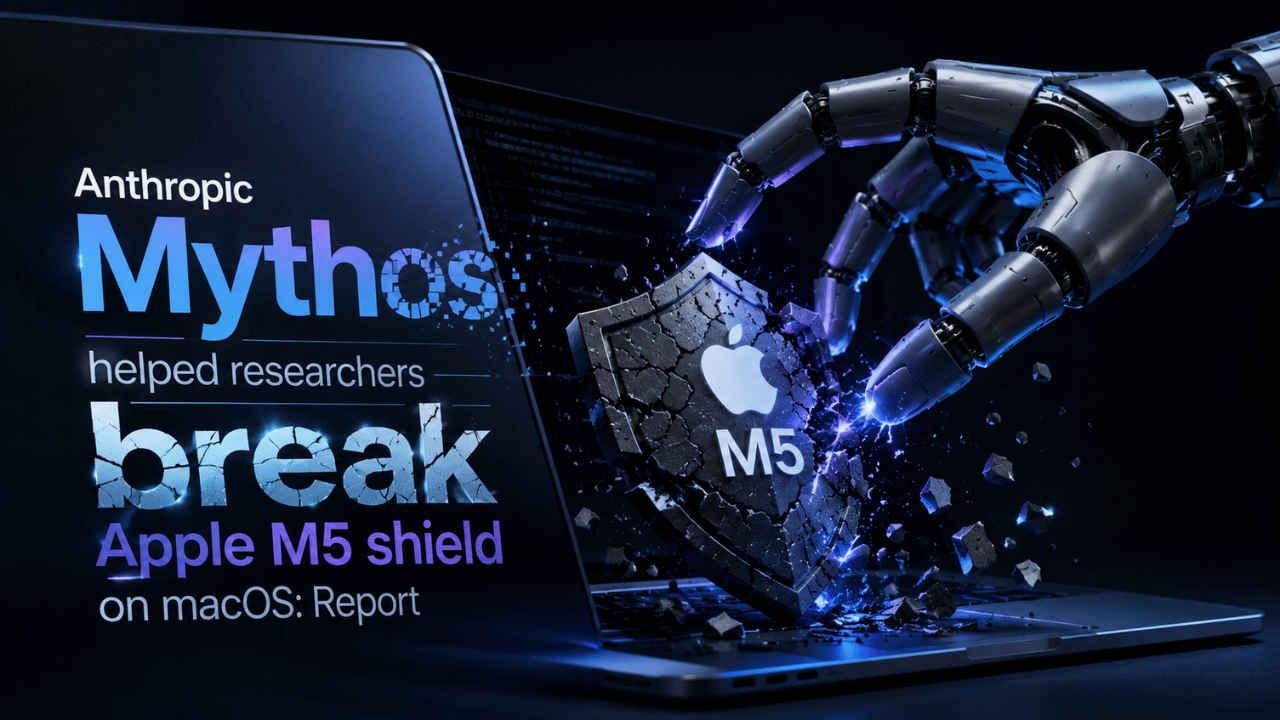
Anthropic Mythos helped researchers break Apple M5 shield on macOS: Report
Apple has been informed and is now reviewing the reported security issue. Apple has long been known for strong data and device security. However, the company's reputation has come under pressure after a cybersecurity startup claimed it uncovered major flaws in macOS protections using an advanced
Share
Copy Link
Security firm Calif used Anthropic Mythos to create a privilege escalation exploit for macOS, bypassing Apple's Memory Integrity Enforcement on M5 silicon in just five days. The discovery marks the first public macOS kernel memory corruption exploit on M5 chips and highlights AI's growing role in cybersecurity research, though experts say fears of AI-enabled hacking may be overstated.
Security Researchers Breach Apple's M5 Protection Using Anthropic Mythos
A Palo Alto-based security research company called Calif has successfully created a privilege escalation exploit for macOS using Anthropic Mythos, marking a significant development in AI cybersecurity. The researchers worked with Anthropic's Claude Mythos Preview to identify macOS vulnerabilities and develop an exploit that bypasses Memory Integrity Enforcement (MIE), a security feature Apple introduced on M5 and A19 chips
1
. What makes this discovery particularly notable is the speed: building the code that exploited two MacOS bugs took just five days, compared to the half-decade Apple spent developing MIE technology1
.
Source: Digit
The exploit represents the first public macOS kernel memory corruption exploit on M5 silicon, allowing attackers to run a command as a standard user and gain root access to the machine
2
. While Macs are rarely used as servers, limiting practical impact, the vulnerability remains concerning as it's relatively easy to trick users into running malicious code, and with full system control, the exploit becomes hard to detect and remove2
.How AI-Assisted Security Research Uncovered the Vulnerability
Calif disclosed the vulnerability to Apple in advance through an in-person meeting at Apple Park in Cupertino, delivering a 55-page report detailing their findings
5
. The researchers tested their code on an Apple M5 machine running macOS 26.4.1, successfully bypassing the hardware-level security enforced by MIE2
. Calif's chief executive, Thai Dong, emphasized that while the AI model for vulnerability discovery played a crucial role, the attack "couldn't have been pulled off by Mythos alone and leveraged the very human cybersecurity expertise of some of Calif's hackers"5
.
Source: MacRumors
The discovery was published as part of Calif's Month of AI-Discovered Bugs series, highlighting the expanding role of AI tools in uncovering software vulnerabilities
2
. Apple has responded seriously to the findings, stating that "Security is our top priority, and we take reports of potential vulnerabilities very seriously"4
. Calif plans to release full technical details only after Apple fixes the vulnerabilities and attack path4
.Mythos Preview and Project Glasswing's Broader Impact
Anthropic uses Claude Mythos Preview for Project Glasswing, an initiative launched in April to prevent AI cyberattacks with AI
4
. Participants include major technology companies such as Amazon Web Services, Apple, Cisco, CrowdStrike, Google, JPMorganChase, the Linux Foundation, Microsoft, NVIDIA, and Palo Alto Networks4
. Mozilla previously announced finding and patching 271 vulnerabilities in Firefox with help from Anthropic Mythos4
.The company warned at Mythos's launch in April that the AI model had uncovered thousands of software vulnerabilities across every major operating system and browser
3
. This prompted governments in multiple countries to huddle with banks assessing risks, and by early May the White House was weighing rules to control how new models are released after safety testing3
.Related Stories

Industry Experts Say Unfettered Hacking Fears May Be Overstated
Despite initial alarm, cybersecurity experts suggest concerns about unfettered hacking enabled by Anthropic Mythos may be overblown
3
. Isaac Evans, founder and CEO of software security firm Semgrep, noted "a really big communication gap between practitioners and policymakers," explaining that while the model represents "a real technical advance," the response "is not substantiated by what we actually know about how those capabilities will translate in the field"3
.One person with extensive vulnerability research experience using early access to Mythos told Reuters: "We've been able to use AI to find more bugs than we know what to do with for months if not years"
3
. The challenge isn't finding vulnerabilities but validating, prioritizing, and fixing them without breaking systems. Anthony Grieco, senior vice president and chief security officer at Cisco, highlighted that Mythos helps experienced practitioners scan vast amounts of code faster and lower false positive rates, allowing defenders to focus on pressing cyber risks3
.
Source: Reuters
The broader AI cybersecurity landscape is evolving rapidly, with OpenAI recently introducing its own initiative called Daybreak, using various AI models including specialized security agent Codex, in response to Project Glasswing
4
. This development shows how AI is fundamentally changing the race between attackers and defenders, though human cybersecurity experts remain essential to maximize these tools' effectiveness.References
Summarized by

Navi
[1]
[4]
Related Stories
Anthropic Mythos evolves faster than expected, now creates working exploits from vulnerabilities
13 May 2026•Technology

OpenAI launches GPT-5.4-Cyber model days after Anthropic's Mythos sparks global security concerns
14 Apr 2026•Technology

GPT-5.5 matches Mythos in cybersecurity tests, challenging Anthropic's restricted release
30 Apr 2026•Technology

Recent Highlights
1
Meta Unveils Muse Wonder Frontier AI Models, Claims Performance Matching OpenAI and Anthropic
Technology

2
IMF Report Warns AI Market Correction Could Spark Global Financial Crisis With $1.4T at Risk
Business and Economy

3
Eight States Sue OpenAI Over ChatGPT Safety Concerns and Unlawful Collection of Children's Data
Policy and Regulation

Recent Highlights
Today's Top Stories









Don’t drown in AI news. We cut through the noise - filtering, ranking and summarizing the most important AI news, breakthroughs and research daily. Follow topics that matter to you and stay ahead.


