Google launches Gemma 4 12B, bringing multimodal AI agents to consumer laptops with 16GB RAM


9 Sources
[1]
Google's new Gemma 4 open AI model is sized for your laptop
The generative AI boom has driven the cost of memory into the stratosphere, and Google is a key part of that trend. So it's only fitting that Google should offer some less RAM-hungry local AI models. The company has announced the release of a new Gemma 4 model that fills a gap in the lineup that
[2]
Google brings local AI agents to laptops with Gemma 4 12B
In a blog post, the company said the model, combined with the Google AI Edge stack, can be used to build and test applications on everyday machines. The model-runtime combination supports capabilities such as autonomous data processing, visual insight generation, webpage creation, and tool
[3]
Google's latest on-device AI model is custom-made for your laptop
It utilizes an encoder-free architecture to offer multimodal performance without the latency introduced by encoders. The new model performs close to the Gemma 4 26B MoE model in benchmarks. Back in April, Google released its mobile-friendly Gemma E2B and E4B models, bringing on-device multimodal
[4]
Google AI Edge Gallery launches to macOS
In addition to Google AI Edge Gallery, which lets users run Gemma models locally on their Macs, the company also released the Gemma 4 12B model and the Google AI Edge Eloquent dictation app for the Mac. Here are the details. A bit of background The majority of users who rely on LLMs for everyday
[5]

Google's new open source Gemma 4 12B analyzes audio, video -- and runs entirely locally on a typical 16GB enterprise laptop
While many AI open source model providers are pursuing larger and more powerful models, Google is still giving attention to the smaller, more local side of the market. Today, the tech giant released Gemma 4 12B, an 11.95-billion-parameter open-weights model with permissive Apache 2.0 license
[6]

See what 3 builders are making with Gemma 4
We recently released Gemma 4, our most capable open models to date. Since then, they have been downloaded more than 150 million times, and we've been expanding the family's capabilities. We introduced Multi-Token Prediction (MTP) to accelerate inference, and recently released the 12B Unified model
[7]
Introducing Gemma 4 12B: a unified, encoder-free multimodal model
Today, we are introducing Gemma 4 12B, our latest model designed to bring agentic multimodal intelligence directly to laptops. Bridging the gap between our edge-friendly E4B and our more advanced 26B Mixture of Experts (MoE), Gemma 4 12B packages powerful capabilities inside a reduced memory
[8]

Google unveils Gemma 4 12B for local AI agents, coding, and multimodal reasoning
Google DeepMind has introduced Gemma 4 12B, a new open-weight multimodal model designed to bring agentic intelligence directly to laptops with mobile-first efficiency and advanced reasoning. Gemma 4 12B sits between the edge-friendly E4B model and the larger 26B Mixture-of-Experts (MoE) model,
[9]

Google unveils Gemma 4 12B, a local AI model for everyday PCs: Here is what it can do
It is designed to bring agentic multimodal intelligence directly to laptops. Google has introduced a new artificial intelligence model called Gemma 4 12B. The tech giant describes Gemma 4 12B as a "unified transformer" which is designed to bring agentic multimodal intelligence directly to laptops.
Share
Copy Link
Google has released Gemma 4 12B, a new local AI model designed to run entirely on consumer laptops with just 16GB of RAM. The model features an encoder-free architecture that enables multimodal processing of text, audio, and images without the latency overhead of traditional systems. With performance comparable to larger 26B models, it supports agentic workflows and autonomous data processing while keeping all data on-device for enhanced privacy.
Google Fills Critical Gap in Gemma 4 Lineup with Laptop-Optimized Model
Google has launched Gemma 4 12B, a new local AI model specifically engineered to bridge the gap between mobile-optimized variants and high-end data center infrastructure
1
. When Google released four Gemma 4 models in April under the more open Apache 2.0 license, the lineup included two mobile-optimized options and two models requiring substantial computing power, leaving a significant unserved space in the middle1
. The new 11.95-billion-parameter model addresses this directly by enabling sophisticated on-device AI capabilities on consumer laptops with 16GB RAM, eliminating the need for expensive AI accelerators or cloud connectivity3
.
Source: VentureBeat
This release arrives as enterprises increasingly favor task-specific models over general-purpose systems. Gartner predicts that by 2027, organizations will use small, task-specific AI models at least three times more than general-purpose large language models, driven by demand for more contextualized and cost-effective AI systems
2
.Encoder-Free Architecture Delivers Multimodal AI Without Performance Penalties
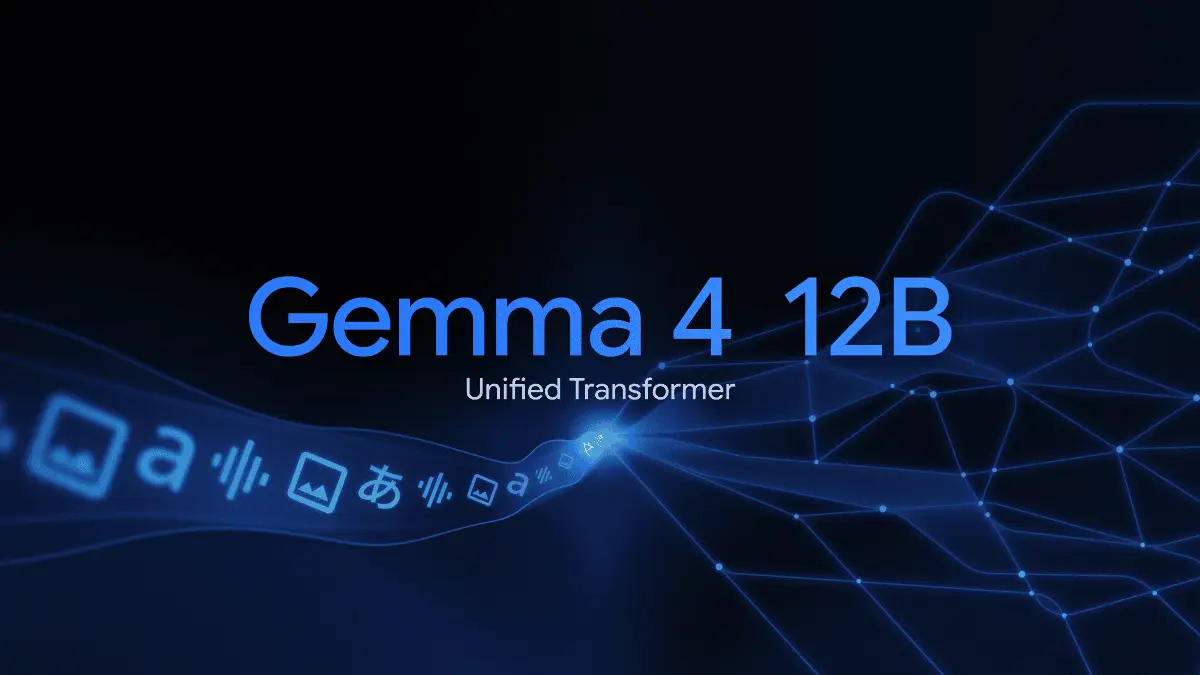
The defining innovation in Gemma 4 12B lies in its encoder-free architecture, which fundamentally reimagines how multimodal AI processes non-text inputs
5
. Traditional multimodal AI systems rely on dedicated encoders to convert audio waveforms and visual data into representations the core language model can process, inherently increasing both inference latency and memory consumption1
.
Source: Google
Google eliminated this bottleneck entirely. For vision processing, the company developed a streamlined embedding module featuring single-matrix multiplication and positional embedding, allowing image data to pass directly to the LLM with proper spatial awareness
1
. This lightweight module uses just 35 million parameters5
. For audio, there's no encoding at all—developers worked out a method of projecting raw audio signals directly into the same dimensional space as text tokens3
. This makes Gemma 4 12B the first mid-sized model from Google to support native audio input3
.Multi-Token Prediction and Agentic Workflows Drive Advanced Capabilities
Despite its compact size requiring about half the memory footprint of Gemma 4 26B MoE, the new model delivers comparable performance in benchmarks
1
. Google equipped Gemma 4 12B with newly devised Multi-Token Prediction (MTP) drafters out of the box, making it the first model in the family to ship with this feature as standard1
. MTP takes advantage of unused processing cycles to calculate possible future tokens, delivering greater speed and efficiency .The model supports complex multi-step reasoning and agentic workflows that previously required larger Gemma variants
1
. Combined with the Google AI Edge stack, developers can build and test applications supporting autonomous data processing, visual insight generation, webpage creation, and tool use directly on everyday machines2
. The model packs a 256K token context window, critical for processing lengthy financial reports, extensive code repositories, or hour-long meeting transcripts5
.Related Stories

Google AI Edge Ecosystem Expands Across Platforms
Google simultaneously expanded its AI Edge ecosystem with several complementary releases. The company launched Google AI Edge Gallery for macOS, where developers can use Gemma 4 12B to generate and run scripts for tasks suchs as data analysis
4
. The platform currently offers access to five of Google's own models, with Gemma 4 12B positioned as the flagship offering4
.
Source: 9to5Mac
Google's Eloquent voice dictation and editing app now runs fully on-device on macOS, supporting local transcription and voice-driven text editing
2
. The company also expanded LiteRT-LM, its lightweight command-line tool for running language models locally, with a new serve command that allows the CLI to act as a local LLM server2
. This lets developers connect Gemma 4 12B to standard tools, SDKs, and frameworks through a local endpoint while keeping data on-device2
.Data Privacy and Edge Deployments Define Strategic Value
The open source model addresses critical enterprise needs around data privacy and edge deployments. For organizations in highly regulated sectors like healthcare, finance, or defense, transmitting sensitive data to third-party APIs is unacceptable
5
. Because Gemma 4 12B runs entirely on machines with just 16GB of VRAM or unified memory, organizations can process sensitive multimodal data entirely on-premises or directly on employee laptops, eliminating data leakage risks5
.For applications operating at the edge—retail inventory monitoring, localized customer service kiosks, or offline field-service applications—maintaining persistent cloud connections is costly and sometimes impossible
5
. The model weighs just under 18GB and is available immediately for download on Kaggle and Hugging Face1
. Users can also access it without downloading through tools like LM Studio, Ollama, and Google AI Edge Gallery3
.References
Summarized by

Navi
[1]
[3]
[4]
Related Stories
Google releases Gemma 4 with Apache 2.0 license, enabling unrestricted local AI on devices
02 Apr 2026•Technology

Google's Gemma 3n: A Breakthrough in On-Device AI with Open-Source Multimodal Capabilities
27 Jun 2025•Technology

Google's Gemma 4 turns your phone into a local AI powerhouse with full offline capability
08 Apr 2026•Technology

Recent Highlights



Recent Highlights
Today's Top Stories







Don’t drown in AI news. We cut through the noise - filtering, ranking and summarizing the most important AI news, breakthroughs and research daily. Follow topics that matter to you and stay ahead.


