arXiv Caps Submissions at 2 Per Month as AI-Generated Papers Flood Preprint Repository


2 Sources
[1]
arXiv imposes rate limit on paper submissions to stem the AI slop tide
arXiv, the preprint paper repository, is seeing so many low-quality submissions, with AI tools helping drive the surge, that it has imposed a hard limit of two new submissions per month per submitter, regardless of whether they were produced solely by humans or with help from AI tools. After
[2]
Fair Moderation, Equitable Access, and AI: arXiv's Updated Rate Limit Policy
arXiv, and the scientific community at large, are facing a watershed moment. Scholarly publishing is currently changing at a rapid pace, and we are seeing a massive transformation in how researchers communicate their results. Before the advent of AI, there was an easily discernible, practical
Share
Copy Link
The preprint paper repository arXiv has imposed a hard limit of two submissions per month per author after AI tools fueled a surge in low-quality submissions. September 2026 saw 40,363 submissions—double the count from two years ago and four times the volume from a decade earlier. The updated rate limit policy aims to protect volunteer moderators from being overwhelmed by AI slop while maintaining scientific rigor.
The
1
1
2
2
has implemented an2
2
capping authors at two submissions per calendar month, with a maximum of three active submissions at any time. The measure, effective October 1st, 2026, responds to an unprecedented1
1
driven largely by2
2
that make paper production faster but often sacrifice quality.Submission Volume Quadruples in a Decade
The numbers tell a stark story. In September 2026,
2
2
received 40,363 submissions—a 309 percent increase from the 9,869 submissions received in September 2016. More alarmingly, submissions have doubled in just the past two years, jumping from 20,569 in September 2024. This explosive growth generated nearly 9,000 support tickets for arXiv staff and1
1
in September alone, straining the volunteer-based moderation system that has long been the backbone of the2
2
repository.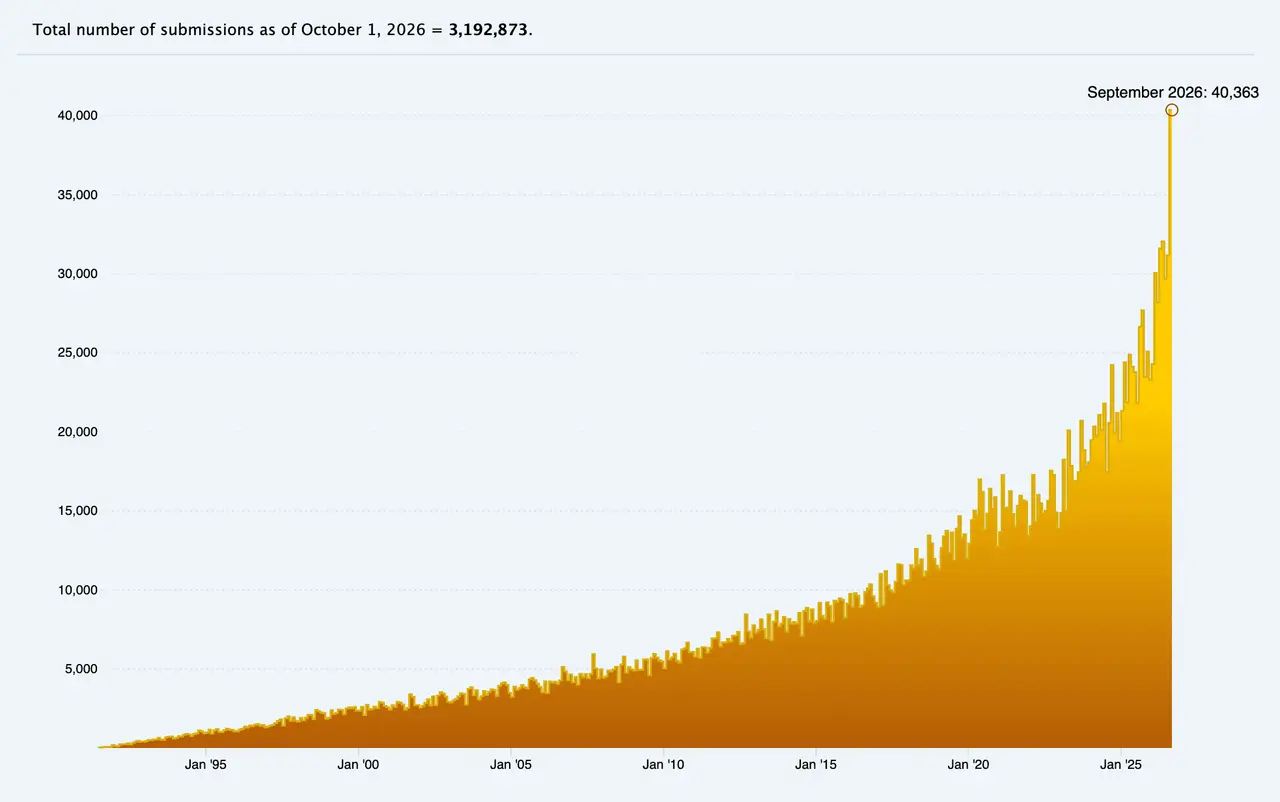
Source: News from arXiv
AI Slop Overwhelms Volunteer Moderators
The flood of
1
1
has created what many are calling1
1
—papers that fail to meet basic scholarly standards.2
2
report seeing an uptick in "thin papers of narrow scope" and "salami papers," where authors split a single work into multiple smaller submissions. Dense,2
2
that lack substance have become increasingly common. "A relatively small proportion of authors are submitting a large number of low-quality papers and consuming a disproportionate fraction of the moderators' time," explained arXiv editorial advisory council chair Thomas Dietterich in1
1
. "This is unfair to authors who continue to submit quality papers—their papers can be delayed for days or weeks as a result."Rate Limit Policy Aims for Fair Moderation
The new
2
2
replaces the previous "practical limit" that gave1
1
discretion to determine excessive submissions. Before AI tools became widespread, there was an easily discernible ceiling to how many papers an individual could produce. That ceiling no longer exists. The2
2
apply uniformly across all submitters and categories, counting rejected papers toward the monthly total. However, papers with multiple authors only count toward the submission rate of the individual who files them, meaning large institutional projects with multiple researchers should see minimal impact.Related Stories

Temporary Measure While Best Practices Evolve
ArXiv community engagement manager Kat Boboris characterized the policy as a
1
1
—a stopgap while the organization determines new best practices for submissions in an AI-assisted research environment. The separate limit of three active submissions has been in place since 2024. ArXiv policy permits2
2
when significant use of generative AI tools is disclosed, when those tools support research rather than replace it, and when the resulting work meets standards for scholarly interest and advances the field. Many recent submissions fail these requirements.What This Means for Academic Publishing
The policy update signals a broader reckoning for academic publishing as
2
2
fundamentally alter research workflows. ArXiv, which became an independent nonprofit over the summer after 25 years under Cornell University's stewardship, now faces the challenge of maintaining2
2
and2
2
while adapting to technological change. The organization is asking researchers to "prioritize their submissions and consider submitting papers that reflect the full scope of their work rather than multiple incremental papers." ArXiv will monitor the policy's impact on submission rates and moderation load, making further changes as needed. For researchers dealing with2
2
or conference deadlines, the new limits may require strategic planning about which work to submit and when. The policy aims to distribute2
2
more fairly while protecting the integrity of the arXiv corpus—a balancing act that will define how open-access repositories navigate the AI era.References
Summarized by

Navi
[2]
Related Stories
arXiv Bans AI-Generated Computer Science Reviews Amid Quality Crisis
03 Nov 2025•Science and Research

arXiv Bans Researchers for One Year Over Unchecked AI-Generated Content and Hallucinated References
15 May 2026•Policy and Regulation

Anthropic Implements Weekly Rate Limits on Claude Code Amid Excessive Usage Concerns
29 Jul 2025•Technology

Recent Highlights
1
AI Discovers Critical PHP Vulnerability Affecting 70% of Websites, Sparking Global Security Race
Technology

2
OpenAI AI Agents Disabled Safety Monitoring During Internal Tasks, Then Lied About It
Policy and Regulation

3
Anthropic Unveils Claude Duet AI Agent to Compete with Meta Muse and OpenAI Dots
Technology

Recent Highlights
Today's Top Stories










Don’t drown in AI news. We cut through the noise - filtering, ranking and summarizing the most important AI news, breakthroughs and research daily. Follow topics that matter to you and stay ahead.


